Pages

Wednesday, November 21, 2012

Obama pardons Cobbler the turkey, but runner-up Gobbler gets to live, too


OK... last post about turkey pardons this year, we swear...
President Barack Obama, with daughters Sasha, center, and Malia, right, pardons Cobbler the turkey, along with National Turkey Federation Chairman Steve Willardsen.
.
By Eun Kyung Kim, TODAY contributor

President Obama pardoned a turkey and a spare at a White House ceremony Wednesday.

Cobbler the turkey emerged victorious in nationwide poll against another turkey, Gobbler, in a twist to the annual tradition.

“They say that life is all about second chances, and this November, I could not agree more,” the president said during the Thanksgiving Eve Rose Garden ceremony, where he also spared runner-up Gobbler from someone’s dinner table. "If Cobbler cannot fulfill his duties as the official White House turkey, Gobbler will be waiting in the wings."

The 4-month-old, 40-pound birds will live out their lives at a nationally recognized livestock facility just outside the nation’s capital at George Washington’s Mount Vernon Estate and Gardens. 


“From here, these two lucky birds will be swept up in a whirlwind of fame and fortune that will ultimately lead them to Mount Vernon, where they will spend their twilight years in the historic home of George Washington,” said the president.

After the joking and gobbling, Obama wished American families a safe and healthy holiday. “Tomorrow, in the company of friends and loved ones, we will celebrate a uniquely American holiday. And think about just how lucky we are to live in the greatest nation on earth.”

The president went on to briefly address the devastation in the Northeast from Hurricane Sandy, and thank our armed forces. He reflected on his recent visits to tour the damage in New Jersey and New York: "While I’ve seen entire neighborhoods reduced to rubble, and heartbreaking loss and devastation, I have yet to find a broken spirit."

This year marked the first time the American public decided which of two birds would become the 2012 National Thanksgiving Turkey. The White House created a Facebook poll to determine the winner.

Voting was cut off Tuesday night, and Cobbler emerged as the victor. On Wednesday morning, Cobbler had 2,513 "likes" and 548 "shares" 
Gobbler had 2,230 "likes" and 484 "shares."

The names of the two birds were chosen from submissions sent by elementary school students in Rockingham County, Virginia, where the turkeys were raised. Two less fortunate birds will be donated to a local food bank, the president said. 
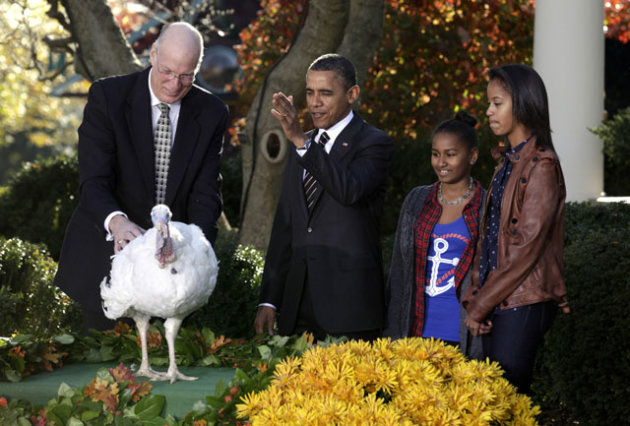

U.S. President Barack Obama pardons the 2012 Thanksgiving Turkey, Cobbler, next to next to his daughters Sasha and Malia (R) and National Turkey Federation chairman Steve Willardsen in The Rose Garden of the White House in Washington, November 21, 2012. REUTERS/Yuri Gripas

The pardon took place despite another annual custom — the written appeal by the People for Ethical Treatment of Animals to end the Turkey Day tradition. PETA asked Obama to skip the pardon, insisting the ceremony mocked “the mass slaughter of some 46 million gentle, intelligent birds.” The organization also said the tradition portrays the president in cahoots with “the turkey-killing industry.”

The turkey pardon is a presidential tradition that harkens back to Abraham Lincoln, who wrote out a Christmastime pardon at the insistence of his son.

It was John F. Kennedy who appears to be the first president to bestow a Thanksgiving pardon. A Nov. 20, 1963-dated article from the Los Angeles Times noted the president reprieved a monster of a bird, a “55-pound broad white tom.”

“We’ll just let this one grow,” Kennedy said at the time.
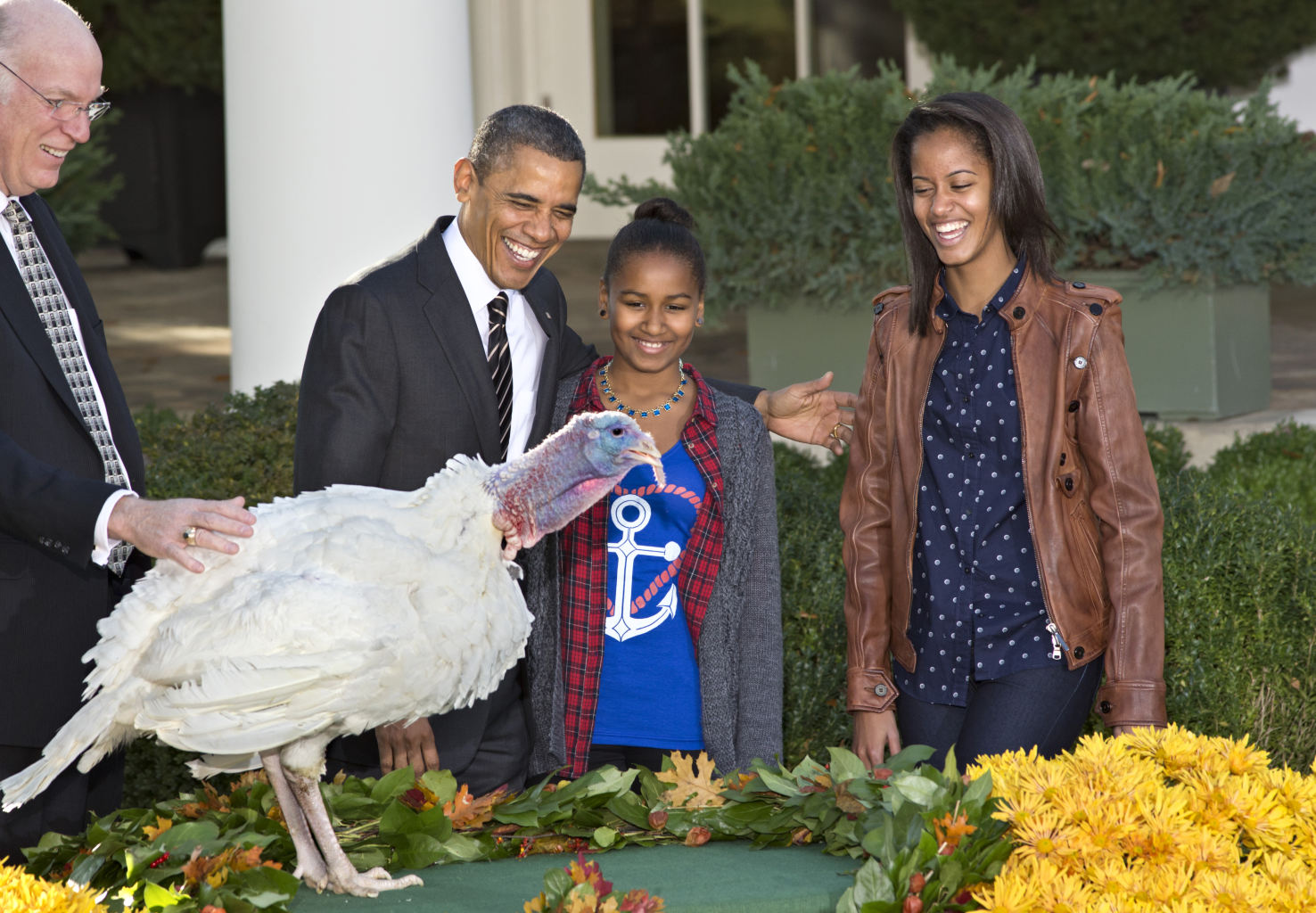
President Barack Obama, with daughters Sasha, center, and Malia, right, carries on the Thanksgiving tradition of saving a turkey from the dinner table with a "presidential pardon," at the White House in Washington, Wednesday, Nov. 21, 2012. After the ceremony, "Cobbler" will head to George Washington's historic home in Virginia to be part of the "Christmas at Mount Vernon" exhibition. National Turkey Federation Chairman Steve Willardsen is at left. (AP Photo/J. Scott Applewhite)


Clearing up some myths about the turkey pardon


Visit NBCNews.com for breaking newsworld news, and news about the economy


From the Archives: Thanksgiving with the Presidents

Presidential Libraries of the National Archives and Records Administration

November 21, 2012
10:00 AM EST

Apple, the National Thanksgiving Turkey, is photographed by guests attending a ceremony where President Barack Obama pardoned the turkey in the Rose Garden of the White House, Nov. 24, 2010. (Official White House Photo by Chuck Kennedy)


Highlights of Presidents celebrating Thanksgiving over the years. 
Photo credits: U.S. National Archives and Presidential Libraries
See the full-size gallery

Did you know that before the 1940s Thanksgiving was not on a fixed date but was whenever the President proclaimed it to be?

George Washington issued the first Presidential proclamation for the holiday in 1789. That year he designated Thursday, November 26 as a national day of “public thanksgiving.” The United States then celebrated its first Thanksgiving under its new Constitution. Seventy-four years later, in 1863, Abraham Lincoln declared Thanksgiving a national holiday on the last Thursday in November.

By the beginning of Franklin D. Roosevelt’s Presidency, Thanksgiving was not a fixed holiday; it was up to the President to issue a Thanksgiving Proclamation to announce what date the holiday would fall on. Tradition had dictated that the holiday be celebrated on the last Thursday of the month, however, this tradition became increasingly difficult to continue during the challenging times of the Great Depression.

Roosevelt’s first Thanksgiving in office fell on November 30, the last day of the month, because November had five Thursdays that year. This meant that there were only about 20 shopping days until Christmas and statistics showed that most people waited until after Thanksgiving to begin their holiday shopping. Business leaders feared they would lose the much-needed revenue an extra week of shopping would afford them. They asked President Roosevelt to move the holiday up from the 30th to the 23rd. He chose to keep the Thanksgiving holiday on the last Thursday of the month, however, as it had been for nearly three-quarters of a century.

In 1939, with the country still reeling from the effects of the Great Depression, Thanksgiving once again threatened to fall on the last day of November. This time President Roosevelt did move Thanksgiving up a week to the 23rd. Changing the date seemed harmless enough, but it proved to be quite controversial. Small business owners felt it put them at a disadvantage and they sent letters of protest to the President.

As opposition grew, some states took matters into their own hands and defied the Presidential proclamation. Some Governors declared November 30th as Thanksgiving. And so, depending upon where one lived, Thanksgiving was celebrated on the 23rd and the 30th. This was worse than changing the date in the first place. Families who lived in states such as New York did not have the same day off as family members in states such as Connecticut! Family and friends were unable to celebrate the holiday together.

In this telegram from November 13, 1940, Leota and Helen Care ask FDR what day they should serve their turkey.


(Photo credit: U.S. National Archives and Presidential Libraries )

President Roosevelt observed Thanksgiving on the second to last Thursday of November for two more years, but the amount of public outrage prompted Congress to pass a law on December 26, 1941, ensuring that all Americans would celebrate a unified Thanksgiving on the fourth Thursday of November every year.

Six years later, another tradition was formally established when Harry S. Truman presided over the first live turkey presentation by the Poultry and Egg National Board. The event inaugurated a lighthearted ceremony that now occurs annually at the White House. Initially, the presentation birds were intended for the Thanksgiving meal. In fact, among our holdings are photos from 1963 and 1967 in which the presentations birds given to John F. Kennedy and later, Lyndon B. Johnson, wear signs that read, “Good Eating Mr. President.”

Here is a photo of the 1967 presentation to Lyndon B. Johnson at the White House.


Annual presentation of the Thanksgiving turkey - Senator Everett Dirksen and representatives from the poultry industry and farm organizations present a turkey to Lyndon B. Johnson in the Fish Room of the White House. The turkey has a sign around its neck that says "Good Eating Mr. President,” November 16, 1967. (Photo credit: U.S. National Archives and Presidential Libraries )

It was not until November 14, 1989 that President George Bush officially “granted a Presidential pardon” to a turkey. Below is a photo of President Bush and the pardoned bird from that year’s presentation.


(Photo credit: U.S. National Archives and Presidential Libraries )

For highlights of Presidents celebrating Thanksgiving over the years, here’s a gallery from the holdings of the U.S. National Archives and the 13 Presidential Libraries across the country.


Tim Sloan / AFP - Getty Images
President George W. Bush meets Liberty, the turkey to receive the annual Thanksgiving Presidential Pardon in the Rose Garden of the White House 19 Nov. 2001.


Thanksgiving Decision 2012: Cobbler or Gobbler?

Erin Lindsay
November 20, 2012
10:20 AM EST


Turkeys have been carving out a special place in American history since 1963. That's when John F. Kennedy became the first U.S. President to "pardon" a turkey at the White House -- a tradition that's grown to be known as the National Thanksgiving Turkey Presentation.

On Wednesday, President Obama will pardon the 2012 National Thanksgiving Turkey and this year, for the first time ever, the American public will get its say. People all across the country are flocking to cast their vote.

Which of two turkeys will be named the 2012 National Thanksgiving Turkey?

Born on the same day on a farm in Rockingham Country, Virginia, Cobbler and Gobbler may look alike, but they're no birds of a feather. Cobbler craves cranberries, is known for his strut, and enjoys the musical stylings of Carly Simon. Gobbler, a patient but proud bird, loves to nibble on corn and enjoys any music with a fiddle.

Which turkey is your favorite? Go to the White House Facebook page and "Like" and "share" their post to cast your vote.

Polls close at 8:00 pm ET on Tuesday, November 20th 2012, so be sure to visit the White House Facebook page to cast your vote.

Choose the National Thanksgiving Turkey!

meet cobbler
Vote Cobbler
meet gobbler
Vote Gobbler
Don't forget to tune in to the 2012 ceremony on Wednesday, November 21st  at 2:00 pm ET to find out which turkey has been selected as the 2012 National Thanksgiving Turkey. And for more on how this Presidential tradition came to be check out the definitive history of the Presidential Turkey Pardon.
Note: It's all gravy -- no turkeys will be harmed during the selection of the National Thanksgiving Turkey.  After the pardoning, both turkeys travel to George Washington’s Mount Vernon Estate and Gardens to reside in a custom-made enclosure at Mount Vernon’s nationally recognized livestock facility.  Additionally, if for any reason one turkey is unable to perform the duties of the National Thanksgiving Turkey, his alternate will take his place during the National Thanksgiving Turkey Presentation.

Secretary Clinton announces Gaza cease-fire
By NBC's Domenico Montanaro

UPDATED 1:30 pm ET: U.S. Secretary of State Hillary Clinton announced from Cairo a cease-fire fire between Israel and Hamas in a deal brokered by Egypt.

Clinton described the crisis as "a critical moment for the region."

The agreement is effective at 2:00 pm ET Wednesday, according to the AP.

President Obama also played a key role. Israeli Prime Minister Benjamin Netanyahu agreed to the cease-fire after Obama urged it, Israeli ambassador the U.S. Michael Oren said on MSNBC's Andrea Mitchell Reports.

NBC’s Jim Maceda reports the agreement has two phases – (1) in the short term, a truce to stop the violence in Gaza, and (2) in the long term, to continue negotiations on the thorny issues that have been the underpinnings of tensions.

Israel wants something done about arms smuggling into Gaza and Sinai; Hamas wants a lifting of the six-year blockade. There was no agreement on those issues. The discussions will continue and be monitored by the Egyptians with Clinton also involved.

But NBC's Andy Eckardt reports that in the peace agreement, Israel will guarantee not to assassinate any leaders of Hamas or any other organization, according to Palestinian intelligence sources. Israel and Hamas will also commit to abide to restoring calm on both sides. And, after a few months, Israel will consider to ease the movement for Palestinians.

NBC’s Ali Weinberg reports from the White House that the president spoke to Netanyahu and Egyptian President Morsi.

To Netanyahu, Obama “reiterated his commitment to Israel's security,” according to a readout of their conversation. “The President made clear that no country can be expected to tolerate rocket attacks against civilians."

The readout adds that the president requested Netanyahu work with Egypt and to agree to this cease-fire.

Obama also noted, however, “that Israel maintains the right to defend itself.” And that the U.S. “would use the opportunity offered by a cease-fire to intensify efforts to help Israel address its security needs, especially the issue of the smuggling of weapons and explosives into Gaza.”

That was echoed by Oren on Andrea Mitchell Reports, when he said that Israel "reserves the right to defend itself if Hamas resumes to fire on our citizens."

Obama thanked Morsi for his work and leadership on the cease-fire. The readout also notes that Obama and Morsi "agreed on the importance of working toward a more durable solution."

There were questions as to how Morsi, a member of the Muslim Brotherhood, would handle the situation. Many saw this as a critical first test for the new leader. It appears that despite his sympathies with the Palestinian people, he may be willing to play something of the traditional Egyptian role of trying to maintain peace.

President Obama "welcomed President Morsi's commitment to regional security," according to the White House readout.

NBC’s Andrew Gross reports from the State Department that Secretary Clinton spent 30 minutes with Palestinian Authority President Mahmoud Abbas in Ramallah today, according to Deputy Spokesman Mark Toner. But Abbas has been largely sidelined in these negotiations with Hamas in control.

Toner said the U.S. still considers Abbas to be "relevant" and that "we will continue to work with him."

Toner added that the onus for the violence falls squarely on Hamas and their rocket attacks and that the firing must stop for there to be peace.

The White House was optimistic there would be at least a cease-fire with someone at the level of Clinton heading to the region.

The fighting has killed more than 140 Palestinians and five Israelis, according to an AP tally.

Obama calls Egyptian president third time in 24 hours

4
hours
ago
Nov 20, 2012

Visit NBCNews.com for breaking news, world news, and news about the economy

NBC's Domenico Montanaro reports on what the continued fighting in Gaza could mean politically for President Obama, U.S. foreign policy, and the balance of power in the Middle East.
By NBC's Shawna Thomas

YAKOTA AFB, Japan — President Barack Obama spoke with Egyptian President Mohammed Morsi for the third time in a 24-hour period while flying back from a trip to southeast Asia aboard Air Force One.

Deputy National Security Adviser Ben Rhodes said the call was to continue the discussions both presidents have had about Egypt's ability to help end the rocket-fire in Gaza.

"He also underscored that President Morsi's efforts reinforce the important role that President Morsi and Egypt play on behalf of regional security and the pursuit of broader peace between the Palestinians and Israelis," Rhodes said of the call, which occurred en route a refueling stop in Japan following Obama's three-day trip overseas.
This call comes as Secretary of State Hillary Clinton makes her way to the region to meet with Israeli Prime Minister Benjamin Netanyahu, along with Palestinian and Egyptian leaders. It is unclear about whether she will sit down with Morsi while in the Middle East.

Rhodes said the president has made clear that the primary objective at this moment is the deescalation of violence, and commended Morsi for sharing that goal.

"Without an end to rocket fire into Israel from Gaza, Israel can't be assured of the security of its people," Rhodes said.

The president believes the "preferred outcome" of all of the leaders involved is an end to the loss of life in the region.


Israel and Hamas agree to Gaza cease-fire


Visit NBCNews.com for breaking news, world news, and news about the economy
While Israel and Palestinian factions trade fire, Secretary of State Hillary Clinton arrives in the region to broker a truce. NBC's Ayman Mohyeldin reports.


By NBC News staff and wire reports
Updated at 1:11 p.m. ET: Israel and Hamas have agreed to a cease-fire, the Egyptian foreign minister said Wednesday, ending eight days of fighting that killed more than 140 Palestinians and five Israelis.
The cease-fire is set to start at 9 p.m. Cairo time (2 p.m. ET), Egyptian Foreign Minister Mohamed Kamel Amr announced in a news conference alongside visiting U.S. Secretary of State Hillary Clinton.
“The United States welcomes the agreement today for the cease-fire in Gaza," Clinton said, adding that Egypt's new government was exerting responsibility and leadership in the region.
Clinton also thanked Egypt's Islamist President Mohammed Morsi for his mediation efforts and pledged to work with partners in the region "to consolidate this progress, improve conditions for the people of Gaza, provide security for the people of Israel.""This is a critical moment for the region," she said.
According to the cease-fire agreement: 
  1. Israel will stop attacks on Gaza by land, sea and air and targeted assassinations; 
  2. Israel and Hamas will abide to restoring calm on both sides; 
  3. Israel will ease the movement of people and goods at border-crossing areas.
In Jerusalem, Israeli Prime Minister Benjamin Netanyahu confirmed the agreement.
Egypt is "the sponsor" of the cease-fire agreement.
Earlier, an explosion on a bus in Tel Aviv injured 19 people, three of them seriously, an official told NBC News.

Tel Aviv police spokesman Micky Rosenfeld told the U.K.'s Sky News that the bus blast took place in the heart of the city and that the surrounding area had been cordoned off as police searched for suspects.

"At the moment, we're looking to see exactly what was the cause of the explosion itself," Rosenfeld said, adding it might have been caused by a device left on the bus or taken on by a passenger.

"This was a terrorist attack," Ofir Gendelman, a spokesman for Netanyahu, told Reuters.

The White House condemned the attack as "outrageous." In a statement, it reaffirmed the United States' "unshakable commitment to Israel's security and our deep friendship and solidarity with the Israeli people."

Shot dead, dragged through the streets: The fate of an alleged spy in Gaza

Clinton arrived in Cairo on Wednesday, where she met with Morsi. Speaking earlier in Jerusalem, she assured Netanyahu of "rock-solid" U.S. support for Israel's security and spoke of seeking a "durable outcome" and of Egypt's "responsibility" for promoting peace.


Visit NBCNews.com for breaking news, world news, and news about the economy
A bomb ripped through a bus in Tel Aviv on Wednesday, wounding at least 16 people. NBC's Stephanie Gosk reports.
Hamas spokesman Sami Abu Zuhri praised the bombing, but stopped short of claiming responsibility.

"Hamas blesses the attack in Tel Aviv and sees it as a natural response to the Israeli massacres...in Gaza," he told Reuters. "Palestinian factions will resort to all means in order to protect our Palestinian civilians in the absence of a world effort to stop the Israeli aggression."

More photos: Explosion hits bus in Tel Aviv

Sweet cakes were handed out in celebration in Gaza's main hospital, which has been inundated with wounded from the round-the-clock Israeli bombing and shelling, Reuters reported. Celebratory gunfire also rang out in Gaza City when local radio stations reported the news.

The last time Israel's commercial capital was hit by a serious bomb blast was in April 2006, when a Palestinian suicide bomber killed 11 people at a sandwich stand near the city's old central bus station.

Related stories
Analysis: Why Hezbollah is sitting out the Gaza conflict'We are very scared': Egyptians fear being mired in Gaza-Israel crisis'Army must invade': In southern Israel, support grows for action in GazaAmericans caught in chaos of Gaza conflict

Like most Western powers, Washington shuns Hamas as an obstacle to peace and has blamed it for the Gaza conflagration.

A U.N. Security Council statement condemning the conflict was blocked on Tuesday by the United States, which complained that it "failed to address the root cause" -- the Palestinian rockets.

Meanwhile, the head of Iran's powerful Revolutionary Guard has disclosed his country has given fighters in Gaza the ability to produce longer-range missiles on their own, without direct shipments. The comments, by Gen. Mohammad Ali Jafari, quoted by the semi-official ISNA news agency, offer some of the clearest insights on Iran's weapons support for Hamas.

NBC's Lawahez Jabari, Ian Johnston and Andy Eckardt, Reuters and The Associated Press contributed to this report.Previously, Iran denied it directly supplied Hamas with the Fajr-5 rockets being fired at Israel in recent days.

The Real Reasons You Waited Hours in Line to Vote


An Obama campaign legal adviser explains the humiliating meltdown in voting we saw around the country during this year's presidential election.

miamivotinglineban.jpg
Voters in Miami on November 6 (Andrew Innerarity/Reuters)


In the coming months, proposals will abound for election reforms to address the embarrassment to American democracy -- and the indignity to citizens -- of 8-hour lines to vote. But what, precisely, accounts for these lines in places like Prince William County and the Norfolk and Hampton areas of Virginia, or Broward, Miami-Dade, and Palm Beach counties in Florida? As a Senior Legal Advisor to the Obama campaign with responsibility for these and other voting issues, I want to share the knowledge the campaign's thousands of observers on the ground generated about the underlying causes.
These causes can be grouped into three categories. I will focus specifically on Virginia, but the causes are largely similar, if not identical, elsewhere.

1. Excessive Local Control and Money Problems. Oddly enough, administration of national elections is largely run and financed not at the national level or the state level but at the local government level. Virginia has 134 local government units. Each has its own electoral board and essentially makes its own decisions about how many voting machines to buy and how much to invest in maintaining the machines. (A statewide board of elections exists, but it has almost no role on these machine issues.) Because local governments are primarily funded through local taxes -- particularly property taxes -- poorer counties and independent cities, with low tax bases, have fewer resources from the outset to devote to all public goods, including voting equipment. State law does impose minimal levels of machines per capita, but these requirements are so low as to be close to meaningless. In addition to resource-strapped local governments not being able to provide sufficient machines, lack of money leads to maintenance being put off and older machines staying in service too long. In Virginia, which holds an election every year (state and local elections alternate with ones for federal offices), this problem is exacerbated. The level of machine breakdown on Election Day is shockingly high, even if utterly predictable.
In addition, registrars typically allocate the machines they do have based on the number of "active voters" in various polling locations. "Active" means voting regularly every election, not just in presidential election years. Areas that have high turnout in presidential elections, but much lower turnout in non-presidential years, therefore have far too few machines in presidential-election years. As the difference between the make-up of the electorate in 2008 (or 2012) versus 2010 illustrates, younger voters and minority voters turn out at much higher rates in presidential elections. Thus, whether intended or not, the effect of this way of allocating scarce machines is to exacerbate their scarcity in poor areas with large minority or student populations.
These general, longstanding resource problems were dramatically enhanced in the wake of the 2008 financial meltdown. Local governments suffered enormous budget crunches. Not only did they lack the resources to maintain or update election equipment, they were cutting funding for the hiring of election officials.

2. Checking In to Vote and Voting. Voting has become increasingly complex, both technologically and legally. Yet the poll workers who run the process are temporary volunteers paid $100 a day. They serve episodically and cannot develop much expertise; they tend to be older and less technologically knowledgeable; they are mostly not lawyers, but must adapt, with minimal training, to constantly changing election laws. To give you a sense of contrast, the Obama campaign had lawyers available at key polling locations to make sure poll workers were applying the law properly; these lawyers had received 2.5 hours of training and had 3-inch thick binders with the relevant election laws.
On the legal side, poll workers now have to apply state election law for regular voters, the federal Help America Vote Act for those who are going to cast provisional ballots, and absentee-ballot laws for in-person absentee voting. Each category of voting has its own distinct set of rules to be mastered. Every additional layer of complexity creates more capacity to confuse poll workers and slow down the voting process, even if the law, such as the Help America Vote Act, is well intentioned. We have to assess the costs and benefits of these laws more fully. Virginia had also (like many other states) changed its own election laws in 2011; these changes both expanded and contracted the valid forms of voter identification. When a voter comes to check in, if his or her situation is anything other than the most routine, the process simply grinds to a halt. Poll workers are terrified of making a mistake, not sure of what the law requires, confused, and unclear about how to resolve the situation.
On the technology side, we are in the midst of moving from old-style printed poll books, where the names of registered voters are listed, to electronic poll books. In the long run, this change should speed the process up, but for now, there is resistance to this change and panic when it doesn't function properly, all of which further slows voting down. Sometimes the technology doesn't work properly; the electronic poll books won't open up, for example. Poll workers have little ability to deal with these technological problems on the spot.
Once a year volunteers have trouble making this system run smoothly, especially in the face of constantly changing laws and technology. Younger poll workers are more likely to be comfortable with new technologies, and we could improve things a bit by creating incentives to encourage college students, for example, to volunteer as poll workers.

3. Absence of Valves to Release Pressure. Whether or not these other problems are fixed, we also need at least two release valves to take pressure off of Election Day. First, when lines get long, election officials should be required to distribute paper ballots. This requirement would compensate for too few machines at high-demand sites and for machine breakdowns (though it would not solve problems associated with checking in). In Virginia, as the extraordinary length of the lines became clear during election day, the state Democratic Party sought to persuade local and state election officials to distribute paper ballots, then went to court, unsuccessfully, to pursue this option. Paper ballots can help with high-turnout surprises on election day.
Second, before Election Day, pressure can be taken off the system by generous early voting, mail-in voting, and no-excuse absentee voting. Some states, like Virginia, have none of these options. These options won't solve all problems, especially if not applied soundly; Florida had 8-hour lines for early voting due to too few days and too few sites. But they reduce pressure during the frenzy of Election Day.
As instant proposals start flying out to remedy the embarrassment of massive delays to vote, we need to start with the detailed knowledge now available about the causes of the problems. Only then can we enable sound policy choices about the effective pathways to fixing them.


oldprofessor  a day ago
All those folks who stood in line...and waited hours....Thank you!!!
This was an election where PEOPLE POWER won over MONEY POWER.

Spence Blakely  oldprofessor  16 hours ago
Yes, and make that very determined people power, especially to those people with not a lot of "free speech" in their wallets.

ibwilliamsi  Spence Blakely  14 hours ago
Honestly, a poor person's vote is like a poke in the eye to the uber-rich. I may have to stand in line for hours, but I get the same vote Donald Trump does.


The Most Badass Tumbleweed I've Ever Seen


Mischa Nachtigal
Nov 21 2012
Massoud Hassani was smuggled out of Afghanistan when he was 14-years-old. Watch his story about returning to Kabul and putting his product design skills to work to build a tool for cheaply surveying and raising awareness about the hundreds of thousands of land mines still hidden in Afghanistan.


There's No Amount Of Pot You Could Smoke That Would Lead To This Big Of A Policy Reversal


Max Slavkin
Nov 16 2012

Back in the 2008 presidential primary, then-Sen. Obama made an awful lotta sense talking about medical marijuana. In the last four years, however, despite statements like these, his Justice Department has escalated raids of dispensaries that were legal under state law. Now that both Colorado and Washington have voted to legalize marijuana, Obama is going to have to act, and we can only hope he listens to himself.


This DEA Agent Was Told Not To Enforce Drug Laws In White Areas. Yes, Really.
Mansur Gidfar
Nov 15 2012

Don't believe there's a racial element to the War on Drugs? As a former U.S. marshal and special agent for the Drug Enforcement Agency, Matthew Fog witnessed the astonishing inequity of the War on Drugs firsthand. This is his story.


Soledad Fact-Checks A Congressman Live On The Air, Accidentally Ends Up In A 'Who's On First' Sketch
Adam Mordecai
Nov 20 2012

The White House is floating Susan Rice as a potential secretary of state. In a interview about Benghazi, their opponents thought it would be good to start vilifying her now, using Rep. Joe Heck as their cudgel. Soledad O'Brien seemed to be of the belief that Susan Rice should get a fair hearing. So she decided to ask actual questions rather than let pundits be pundits. It's quite enjoyable. If all journalists reacted like her on TV, Washington might actually get some stuff done.


At 1:00, the congressman starts attacking. At 1:30, Soledad brings up a very reasonable point. At 2:12, Who is on first. At 2:47, What is on second. At 3:20, I Don't Know is on third. And Soledad asks for backup because she's so confused by his completely irrational arguments.

The Center for Public Integrity  


Gridlocked election commission awaits action by Obama

Five of six FEC members on expired terms

By 


 Updated: 

With five of six Federal Election Commission members working on expired terms (one since 2007), President Barack Obama had an opportunity to remake the agency with members more inclined to enforce campaign finance rules, say reformers.
But that hasn’t happened.
The situation hasn’t done much for the agency’s reputation.
“The Federal Election Commission is itself a campaign-finance scandal,” said longtime FEC critic and campaign finance reformer Fred Wertheimer, founder and president of Democracy 21.
“None of the players in the political arena had any reason to believe that the campaign finance laws would be enforced,” Wertheimer said. “The White House needs to address it or else must bear responsibility for this campaign-finance scandal continuing.”
As both Obama and GOP rival Mitt Romney raised hundreds of millions of dollars for their campaigns, long-time allies of each man launched supposedly independent super PACs that served as attack dogs during the long slog of the election.
Former White House aides Bill Burton and Sean Sweeney created the pro-Obama super PAC Priorities USA Action, while former Romney campaign advisers Carl Forti, Charles Spies and Larry McCarthy created the Restore Our Future super PAC to boost the former Massachusetts governor’s candidacy.
Both groups raised tens of millions of dollars, often from donors who also gave the legal maximum to the campaign committee of their preferred presidential candidate. Top campaign officials even appeared at fundraising events for the super PACs, including Romney himself.
Meanwhile groups that didn’t disclose their donors — such as Crossroads GPS, which was co-founded by GOP strategist Karl Rove — reported spending at least $425 million on political ads, according to the Center for Responsive Politics.
The activities of these new spending groups prompted numerous complaints by reform groups, alleging that FEC rules and existing laws banning coordination between campaigns and candidates — as well as those requiring disclosure of donors to outside spending groups — were being violated.
Many organizations have also sought “advisory opinions” from the FEC, seeking guidance on the contours of the new campaign finance landscape. The commission, which consists of three Republicans and three Democrats, has repeatedly deadlocked along partisan lines.
Despite a ban on outside spending groups coordinating with candidates, the commission tied 3-3 on whether the Republican super PAC American Crossroadscould feature political candidates in ads with messages that were “thematically similar” to candidates’ campaign materials.
Nor could it reach consensus on whether using the phrases “the White House” or “the administration” in negative ads ahead of Election Day referred to a “clearly identified candidate for federal office,” which would have required the American Future Fund, a conservative nonprofit, to disclose information about its donors.
The three Republican members supported the conservative groups’ positions in both cases.
“If you had an FEC that was at least half-way sentient, they would have promulgated regulations that made clear the kind of coordination and links that would not be permitted,” said Meredith McGehee, policy director at the Campaign Legal Center. ”You could have had an FEC that would have stopped this ‘my super PAC’ phenomenon.”
Likewise, Melanie Sloan, the executive director of Citizens for Responsibility and Ethics in Washington (CREW), agrees that a functioning FEC would have led to “more enforcement of the rules” and “more disclosure of some of the donors behind the negative ads” during the 2012 elections.
Only one commissioner, Republican Chairwoman Caroline Hunter, is working on an unexpired term — though it will end April 30.
The term of Democrat Ellen Weintraub, the commission’s vice chair, expired more than five years ago, in April of 2007.
“Every day I go in and check to see if my key still works,” said Weintraub. “They can replace me at any time. I used to get nervous about it, but now it’s become a fact of my life.”
The terms of Democrat Steven Walther and Republican Don McGahn both expired in April of 2009, while the terms of Democrat Cynthia Bauerly and Republican Matthew Petersen expired in April of 2011.
The law allows the commissioners to retain their seats until replacements are nominated by the president and confirmed by the Senate.
Since taking office in 2009, Obama has nominated just one individual for a seat on the FEC — labor lawyer John J. Sullivan, who, in 2010, told the Center for Public Integritythat the nomination process was “broken” after his lingered for more than 15 months, prompting him to withdraw from consideration.
Conservative lawyer Steve Hoersting doesn’t see the nomination of new commissioners as a top priority for the White House.
“With Benghazi to answer for, treaties to consider and spending cuts to champion, I don't think appointing new commissioners will be an early priority for the Obama administration, nor should it be,” he said.
Many campaign finance reformer advocates, though, are cautiously optimistic.
“Obviously, he has less to worry about from political opponents now that he’s been re-elected,” said Sloan of CREW. “I think there’s going to be [bipartisan] agreement that new FEC commissioners are warranted.”
For now, the White House isn’t saying.
The president “intends to nominate well-qualified candidates” to the FEC, according to spokesman Eric Schultz. But when pressed for specifics on timing, Schultz said he was “not going to publically speculate on future personnel decisions.”

Treasury Designates Hizballah Commander Responsible for American Deaths in Iraq

11/19/2012


WASHINGTON – The U.S. Department of the Treasury today designated Ali Mussa Daqduq al-Musawi (Daqduq) pursuant to Executive Order (E.O.) 13224 for acting on behalf of Hizballah. Daqduq is a senior Hizballah commander responsible for numerous attacks against Coalition Forces in Iraq, including planning an attack on the Karbala Joint Provincial Coordination Center (JPCC) on January 20, 2007, which resulted in the deaths of five U.S. soldiers.

On March 20, 2007, Coalition Forces in southern Iraq captured Daqduq, who falsely claimed to be a deaf mute at the time and produced a number of false identity cards using a variety of aliases. From January 2009 until December 2011, U.S. military forces held Daqduq in Iraq under the terms of the 2008 "Agreement Between the United States of America and the Republic of Iraq on the Withdrawal of United States Forces from Iraq and the Organization of Their Activities during Their Temporary Presence in Iraq" (the Security Agreement). In December 2011, the United States transferred Daqduq to Iraq's custody in accordance with our obligations under the Security Agreement. He was subsequently tried in Iraq on terrorism and other charges. On May 7, 2012, an Iraqi court dismissed terrorism and false documents charges against him. Daqduq remained in Iraqi custody until last week when the Iraqi government determined that it no longer had a legal basis to hold him, and he was released Friday.

"Ali Mussa Daqduq al-Musawi is a dangerous Hizballah operative responsible for planning and carrying out numerous acts of terrorism in Iraq," said Under Secretary for Terrorism and Financial Intelligence David S. Cohen. "The United States is extremely disappointed he was allowed to go free and we will continue our efforts to bring him to justice."

Today's action further highlights the fact that Hizballah's terrorist activities stretch beyond the borders of Lebanon. These terrorist acts are in some cases funded, coordinated, and carried out in concert with the Iranian Revolutionary Guard Corps-Qods Force (IRGC-QF). Hizballah, along with its Iranian allies, trained and advised Iraqi militants to carry out numerous terrorist attacks against Coalition and Iraqi forces.

Daqduq has been a member of Hizballah since 1983 and has served in multiple Hizballah leadership positions, including as commander of a Hizballah special forces unit and chief of a protective detail for Hizballah Secretary-General Hassan Nasrallah.

In approximately 2005, Iran asked Hizballah to form a group to train Iraqis to fight Coalition Forces in Iraq. In response, Hassan Nasrallah established a covert Hizballah unit to train and advise Iraqi militants in Jaysh al-Mahdi (JAM) and JAM Special Groups, now known as Asa'ib Ahl al-Haq.

As of 2006, Daqduq had been ordered by Hizballah to work with IRGC-QF to provide training and equipment to JAM Special Groups to augment their ability to inflict damage against U.S. troops.

Identifying Information

Individual: Ali Mussa Daqduq al-Musawi
AKA: Ali Musa Daqduq
AKA: Hamid Muhammad Jabur al-Lami
AKA: Hamid Muhammad al-Lami
AKA: Husayn Muhammad Jabur al-Musui
AKA: Hamid Muhammad Jabur al-Musui
AKA: Hamid Muhammad Daqduq al-Musawi
AKA: Hamid Muhammad Jabur al-Musawi
AKA: Hamid Majid 'Abd al-Yunis
Nationality: Lebanese
DOB No. 1: 1 September 1969
DOB No. 2: 31 December 1971
DOB No. 3: 9 August 1971
DOB No. 4: 9 September 1970
DOB No. 5: 9 August 1969
DOB No. 6: 5 March 1972
POB No. 1: Beirut, Lebanon
POB No. 2: Al-Karradah, Baghdad, Iraq