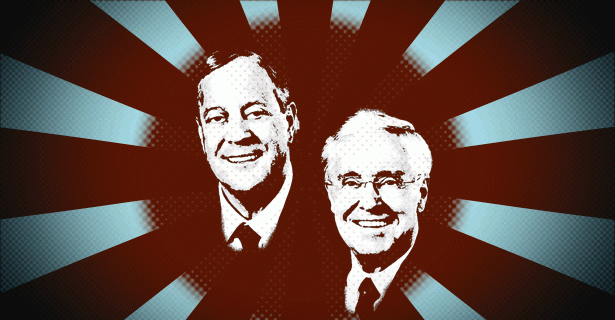
The billionaire Koch brothers have
become the poster children for corporate influence on politics in the
post-Citizens United era.
The billionaire Koch brothers have found a new way to influence the 2012 election: preaching to employees.
No longer is it
good enough for the Kochs to spend unlimited money influencing
elections. They are also touting candidates to employees while creating
policies that have a chilling effect on employees' freedom of speech.
Update: See Koch Industries' response to this story at bottom.
Much
has been written
about the owners of Koch Industries, brothers David H. Koch and Charles
G. Koch, trying to control the political process through hundreds of
millions of dollars in donations to right-wing causes and candidates.
Now, an
In These Times investigation reveals that the
billionaires have broken out another tactic to influence the 2012
elections: attempting to control their workers’ votes.
In a voter information packet obtained by In These Times, the Koch
Industries corporate leadership informed tens of thousands of employees
at its subsidiary, Georgia Pacific, that their livelihood could depend
on the 2012 election and that the company supports Mitt Romney for
president. The guide was similar to one the company distributed before
the 2010 midterm elections, which Mark Ames and I
reported on in
The Nation last year.
The packet arrived in the mailboxes of all 45,000 Georgia Pacific employees earlier this month. The cover letter [
PDF], by Koch Industries President and Chief Operating Officer Dave Robertson, read:
While we are typically told before each Presidential election that it
is important and historic, I believe the upcoming election will
determine what kind of America future generations will inherit.
If we elect candidates who want to spend hundreds of billions in
borrowed money on costly new subsidies for a few favored cronies, put
unprecedented regulatory burdens on businesses, prevent or delay
important new construction projects, and excessively hinder free trade,
then many of our more than 50,000 U.S. employees and contractors may
suffer the consequences, including higher gasoline prices, runaway
inflation, and other ills.
Enclosed with the letter was a flyer [
PDF] listing
Koch-endorsed candidates, beginning with Romney. Robertson’s letter
explained: “At the request of many employees, we have also provided a
list of candidates in your state that have been supported by Koch
companies or by KOCHPAC, our employee political action committee.”
The packet also included an anti-Obama editorial by Charles Koch [
PDF] and a pro-Romney editorial by David Koch [
PDF].
The letter went on to say, “We believe any decision about which
candidates to support is—as always—yours and yours alone, based on the
factors that are most important to you. Second, we do not support
candidates based on their political affiliation.”
In the flyer sent to Oregon employees, all 14 Koch-backed state candidates were Republicans.
The Koch’s in-house campaigning for the GOP is part of a larger trend
of corporations exercising new freedoms under Citizens United. The
Supreme Court decision overturned previous FEC laws prohibiting
employers from expressing electoral opinions directly to their
employees.
A culture of fear
Ironically, while the Kochs have been taking advantage of Citizens
United to expand political communications to employees, they have also
capitalized on weak labor laws to limit the political speech of those
employees.
In September, a number of unionized employees at Georgia Pacific’s
Toledo, Ore. plant posed for a photo in front of their union hall with
Democratic state Senate candidate Arnie Roblan. When the Koch Industries
voter information packet arrived in the workers’ mailboxes a few weeks
later, they saw that Roblan was not on the list of Koch-endorsed
candidates in Oregon.
It was then, says Association of Western Pulp and Paper Workers (AWPPW)
Vice President Greg Pallesen, that he started receiving some of the
strangest phone calls from workers he’s fielded in his 30-plus years of
union involvement. The unionized workers in the photo were worried that
they might be fired from their jobs if the image got out on the
Internet, because in the backdrop of the photo, the Georgia Pacific
plant could be seen.
Their fear comes not only from the mailing, but also from a new Georgia Pacific social media policy [
PDF]
implemented earlier this year that warns, “Even if your social media
conduct is outside of the workplace and/or non-work related, it must not
reflect negatively on GP’s reputation, its products, or its brands.”
Given the policy, the workers were scared to appear next to a candidate
the Kochs do not support with the plant in the background.
Georgia Pacific workers say that in general, they are not sure where
the boundaries of the social media policy lie. AWPPW Local 5 President
Jim Pierce, who works at Georgia Pacific paper mill, in Camas,
Washington, is wary of commenting online about the outspoken Koch
Brothers’ political beliefs.
“Even if I was at my own home, I can’t put something up [on Facebook]
against the Koch Brothers,” says Pierce. “I don’t post anything about
the Koch Brothers. I could lose my job.”
AWPPW has filed two unfair labor practices charges with the National
Labor Relations Board (NLRB) over the Georgia Pacific social media
policy. One alleges that the policy violates employees’ right to “
mutual aid and protection,”
which allows workers to join together to advocate better pay and
working conditions. The other contends that the social media policy is a
mandatory subject of bargaining that was not negotiated with the union,
but imposed unilaterally, in violation of federal labor law.
While some of their political speech might be protected by these laws,
few workers at Georgia Pacific’s Camas facility are willing to risk
losing their jobs. The plant was downsized from 1,200 workers in 2005,
when the Kochs took over Georgia Pacific, to a staff of 450 today. NLRB
hearings and appeals can take over a year.
“It’s just they can intimidate people this way and they can make life
miserable for you. The law would be strong enough to protect them
probably, but you could be looking at being without your job for nearly a
year,” says Pierce.
In August, Portland-based Georgia Pacific worker Travis McKinney, a member of the
Inlandboatmen’s Union of the Pacific
(an affiliate of the International Longshore and Warehouse Union),
learned about the social media policy the hard way during his yearly
evaluation.
When McKinney applied for a foreman job at the plant in May, he says,
his supervisor informed him that a higher-up said he wouldn’t get the
job because he was “too political.” “They said I should be aware of what
I am posting online,” says McKinney. A subsequent August evaluation of
McKinney [
PDF] noted that “supervisors feel Travis gets caught up in the politics of the day which can be distraction.”
McKinney says it wasn’t hard to deduce what they meant. He was quoted in the 2011
Nation
article I wrote with Mark Ames, talking about how the Kochs pushed
their libertarian “Market Based Management” principles on their workers
to such an extent that the dictums were even printed on employee time
cards. He had posted that article and other political articles about the
Koch brothers online.
While Charles Koch has often referred to the Market Based Management
system used to run Georgia Pacific as “the science of liberty,” many
employees, such as McKinney, feel that their own liberties have been
taken away by the company.
In addition to the social media policy, Georgia Pacific also demands
that workers seek approval from supervisors before running for local
elected office [
PDF] or
serving on the boards of nonprofits. Koch Industries claims such
approval is necessary to prevent conflicts of interest. These policies
could prohibit Georgia Pacific employees from running for local office
in communities that seek to more strictly regulate the company.
“I was kind of disturbed that they would infringe on my personal right
to run for office,” says Georgia Pacific employee Larry Wagoner of
Washougal, Wash. “ I was in the running for City Council this year. I
asked someone in the HR department, ‘What if I wanted to run for
Congress?’ She said you would just have to stop working here.” Wagoner
adds that he is pretty sure this was a misinterpretation of company
policy. But it serves as an example of the fuzzy boundaries of the
policies and their potential chilling effect.
Corporate free speech
In the new era ushered in by Citizens United, Koch Industries is not
the only company seeking to control its employees’ political activities,
including speech, lobbying efforts, donations and votes.
This week,
Gawker obtained
an email from the CEO of Westgate Resorts, Florida billionaire David
Siegel, informing his 7,000 employees that a vote for Obama would
endanger their jobs. Like Dave Robertson of Koch Industries, he couched
this as an economic analysis rather than a threat.
Meanwhile, a new
expose by Alec MacGillis of
The New Republic
reveals that the largest privately held coal company in the nation,
Murray Energy, has routinely coerced its employees in to giving to GOP
candidates. In the process, Murray Energy workers became the second
largest block of donors to Republican Speaker of the House John
Boehner’s 2009-2010 campaign. “We have been insulted by every salaried
employee who does not support our efforts,” wrote company CEO Robert
Murray in a March 2012 letter to employees obtained by
The New Republic; attached was a list of employees who had not yet attended fundraisers.
And last year,
Talking Points Memo reported
that Delta offered free rides, even bumping paying customers, for its
flight attendants to fly to Washington, D.C. to lobby for an FAA bill
that would make it more difficult for airline workers to organize a
union. “A lot of flight attendants told me that their supervisors would
encourage them to book a flight to Washington to go lobby,” says
Association of Flight Attendants (AFA-CWA) spokesperson Corey Caldwell.
The value of courage
The growing politicization of the workplace is yet another
manifestation of increasing corporate power over politics in the United
States. The Koch brothers are proudly leading this movement. As part of
the packet that went out to employees, Charles Koch wrote a letter
titled “
The Value of Courage”:
One of my greatest frustrations in recent years stems from the lack of
courage shown by many businesses. Rather than set a good example and
stand on principle, far too many successful companies have decided to
cave when faced with criticism from the media or the government. … For
example, last March, left-wing publications and a cable “news” channel
began spreading malicious lies about the American Legislative Exchange
Council [ALEC]. … The bogus charges against ALEC were quickly echoed by
various media outlets, bloggers, a labor leader, and other activists,
none of whom seemed fully aware of the fact. As result of this ginned up
outcry, a few high profile corporate members of ALEC either cancelled
their memberships or announced they would let them expire.
(Ironically, many corporations
abandoned ALEC, which crafts model legislation for right-wing state
legislatures, over the group’s support of anti-gun control “Stand Your
Ground” law. Yet many corporate policies, such as Georgia Pacific’s Code
of Conduct, strictly prohibit employees from bringing guns onto company
property).
“Several corporations couldn’t throw in the towel fast enough,” Koch continued. “Such lack of courage has become symptomatic”.
But Charles Koch reassures his audience that he is not of those weak-kneed corporate leaders.
“[Our opposition] figure that if
they apply enough pressure, we will cave in,“ writes Koch. “I realize,
as do my brother David, our board and other shareholders, that if we
slink away, ultimately we won’t have a business. And neither will anyone
else—at least one worth having”.
Georgia Pacific’s employees don’t find the Koch’s courage so inspiring.
“I don’t even put down on my
Facebook that I work at Georgia Pacific. I put that I work for the Camas
Paper mill. It’s embarrassing to let people know that you work for
Georgia Pacific because of what the Koch brothers are doing,” says one
employee who spoke on condition of anonymity out of fear of being fired.
“They are destroying the planet. They are trying to buy the votes. They
think they are so high and mighty. They have their principles. They
just think their way is the only way and they think everyone else is
wrong.”
“If you don't believe in their
philosophy, you can find a job somewhere else. I have worked there for
30-plus years. I have no training; I have worked in a factory. What am I
going to do?”
UPDATE 10/14/12: Koch Industries issued a statement in response to the story:
Regarding the recent mailing to employees,
The mailing contained various pieces of information we believe are
important for employees to know about, most importantly, our
companywide employee newsletter that contained important information
about our Guiding Principles.
Based on requests from many employees, the packet also contained
information employees commonly ask about, such as voter registration
deadlines and early voting options for their state of residence. And,
also based on frequent requests, it provided a list of candidates in
their state who are among those that have been supported by the Koch
companies and KOCHPAC, our employee political action committee.
As stated in the cover letter and in follow-up one-on-one
conversations for employees who ask, the information is purely intended
to be considered among all the other information employees may be
reading or receiving as an informed voter. We make it clear that any
decision about which candidates to support belongs solely to our
employees based on the factors that are most important to them, and this
is in no way an attempt to “intimidate” employees. Any such claim to
the contrary is completely untrue.
It is also important to note that many companies, as well as
organizations such as labor unions, also provide similar information to
their members and fellow employees. Indeed, unions and newspapers go
further than this and actually endorse candidates to their members and
readers.
As we regularly point out, Koch companies and KOCHPAC support
candidates based on their support for market-based policies and economic
freedom, which benefits society as a whole. Our support is not based on
party affiliation, and we support both Republicans and Democrats who
support market-based policies and solutions.
Regarding the social media policy,
The policy exists to inform employees about their responsibilities
for what they post on social media sites and the laws that govern any
claims or endorsements made by employees. The policy encourages
employees to make only truthful social media comments whether workplace
and/or non-work related, and to follow Federal Trade Commission (FTC)
rules on disclosing that they work for the company when making any
commentary about the company or its products.
Koch companies strive to create safe, respectful and
discrimination-free workplaces, and do not allow any unlawful
discrimination and discriminatory harassment (including verbal, visual
displays, physical harassment) in our workplaces. We do not retaliate
against any employee who voices their personal political opinions, and
any claims to the contrary are totally untrue.
Greg Guest
Senior Director, Corporate Communications
Georgia-Pacific
The company declined to comment on Travis McKinney's evaluation.
Late Sunday night (October 14), @kochfacts, the company's public-relations Twitter, posted the following: