Pages

Saturday, October 6, 2012


Romney's remarks at fundraiser shouldn't cause fuss

Joey Bluege
Mitt Romney has been under attack recently for a video that surfaced of him during a campaign fundraiser from earlier this year (“Romney: Nearly half ‘believe they are victims’,” Sept. 18).
During the private fundraiser he said that a huge part of Obama supporters were ones who don’t pay taxes, which make them feel like “victims” who will vote for the president “no matter what.” So where is the lie in that statement?
After almost four years in office, President Obama hasn’t been able to turn the economy around. Unemployment continues to sit around 8 percent with no relief in sight. So instead of focusing on creating jobs, Obama and his administration have focused on entitlement programs.
Now do I believe that Romney may have exaggerated a little bit when he used the number 47 percent? I do believe that number is a little high, but not by much.
According to a recent Gallup Poll, 39 percent of Americans think the government should be doing more to help them out. Since when did America go from being the country where you could work hard and live well to becoming a nanny state where it’s the government’s responsibility to take care of you from birth to death?
So here’s the problem. With the president focusing on entitlements and spending instead of jobs, the national debt continues to rise. There continues to be more Americans receiving money from the government through food stamps, disability payments and other government programs while there are no longer enough Americans to pick up the government’s tab.
If this trend continues, the United States will eventually become a nanny state.
Romney didn’t lie in his statement when he said that a large percentage of Americans feel like “victims” who need to vote for Obama in order to keep their benefits. So where’s all the controversy coming from?
Romney has the business knowledge to create jobs and put more people back to work so they don’t have to rely on the government. He will help turn America back into a nation where hard work pays off.
I believe that President John F. Kennedy said it best when he said, “Ask not what your country can do for you — ask what you can do for your country.” There’s still time for America to turn things around and once again be a land of opportunity.
Joey Bluege is a student at College of the Ozarks in Point Lookout.

President doesn't make law; Congress does

10:50 PM, Oct 3, 2012 
Written by Richard THOMPSON
All the president is, is a glorified public relations man who spends his time flattering, kissing, and kicking people to get them to do what they are supposed to do anyway.

— Harry S. Truman

 
In just over a month, we will know who is to be our president for the next four years, Mitt Romney or Barack Obama.
If we pick the right guy, surely he will solve all of our problems, single-handedly, in a year or two.
All we have to do is sit back and wait for him to lead us down Easy Street.
Poppycock. Even if there were easy overnight fixes, the president could not implement them without congressional action.
Granted, a president carries the ball in a few instances. As commander in chief, he can either promise to get Osama bin Laden and fail, or quietly lead
a successful assassination effort.
Also, the president is diplomat in chief. His words and actions abroad either enhance our international image or fuel anti-American sentiment.
However, closer to home, a president cannot keep the American dream alive without the cooperation of Congress. Harry Truman reminds us in his inimitable, cantankerous way that presidents do not have lawmaking authority.
All a president can do is suggest and promote a legislative agenda. Congress bears the responsibility for whether that agenda sees the light of day.
A president’s agenda might reflect belief in government of, by and for the people. That agenda will fail if the House of Representatives and Senate are controlled by people who believe in government from the top down, with no respect for their presumed inferiors.
The point is: We must pay as much attention to choosing representatives and senators as we do picking a president.
Judging from Congress’ recent approval ratings (as low as 10 percent in some
polls), we have not been doing a good job of that.
Our forefathers presumed that Congress and the president would always preserve their brilliant system of checks and balances.
How can either President Romney or President Obama be effective if we send to Congress a bunch of extremists, liberal or conservative, who dismiss checks and balances as lily-livered compromise?
The most effective campaign commercial this year is Claire McCaskill’s claim that she is a voice of reason.
Her ad points out that senators are rated on a scale from extreme liberal to extreme conservative. McCaskill proudly claims that she is No. 50, right in the middle.
That is a gutsy way to campaign in a political world seemingly controlled by extremists. It is a clear expression of understanding checks and balances.
I hope McCaskill’s campaign approach works.
The nation is watching the Missouri senate race, for several reasons. If McCaskill wins, future candidates nationwide might run on a platform of
reason and common sense.
Congress might include more problem solvers and fewer position takers. Checks and balances could finally once again become the law of the land.


US reluctant to give up Obama

8:39 PM, Oct 4, 2012 
Written by George WILL
WASHINGTON — In baseball, a game without a clock, each player on a team that is behind by a bunch of runs is advised to “stay within yourself.”
That baseball lingo means: Do not try to do too much. Instead, get ’em on, get ’em over, get ’em in. There are no five-run home runs. Small, incremental gains matter because the game goes on until someone makes the 27th out.
Unfortunately for Mitt Romney, presidential politics is, like football, a game with a clock.

Romney and his advisers must be bewildered by this fact: In October 2011 they would have been serenely confident of victory if they had been told that 12 months later the following would be true.

That President Obama would be waist deep in contradictory descriptions and explanations of the terrorist (he now concedes) attack on the U.S. diplomatic compound in Libya. That data just released for August 2012 show that real disposable income had again declined. That Obama would celebrate the fact that for the first month since he took office there were more U.S. jobs than when he took office. That the most recent figures show a 13.2 percent decline in durable goods orders. That nearly 25 percent of Americans between 25 and 55 are unemployed. That the second-quarter growth rate was adjusted down from 1.7 percent to 1.3 percent.

Obama’s administration is in shambles, yet he is prospering politically. This may not, however, entirely be evidence of the irrationality of the electorate. Something more benign may be at work.

A significant date in the nation’s civil rights progress involved an African-American baseball player named Robinson, but not Jackie.

The date was Oct. 3, 1974, when Frank Robinson was hired by the Cleveland Indians as the major leagues’ first black manager. But an even more important milestone of progress occurred June 19, 1977, when the Indians fired him. That was colorblind equality.

Managers get fired all the time. The fact that the Indians felt free to fire Robinson showed that another racial barrier had fallen: Henceforth, African-Americans, too, could enjoy the God-given right to be scapegoats for impatient team owners or incompetent team executives.

Perhaps a pleasant paradox defines this political season: That Obama is African-American may be important, but in a way quite unlike that darkly suggested by, for example, MSNBC’s excitable boys and girls who, with their (at most) one-track minds and exquisitely sensitive olfactory receptors, sniff racism in any criticism of their pinup.

Instead, the nation, which is generally reluctant to declare a president a failure — thereby admitting that it made a mistake choosing him — seems especially reluctant not to give up on the first African-American president. If so, the 2012 election speaks well of the nation’s heart, if not its head.

At Last Night’s Debate: Romney Told 27 Myths In 38 Minutes

Pundits from both sides of the aisle have lauded Mitt Romney’s strong debate performance, praising his preparedness and ability to challenge President Obama’s policies and accomplishments. But Romney only accomplished this goal by repeatedly misleading viewers. He spoke for 38 minutes of the 90 minute debate and told at least 27 myths:

1) “[G]et us energy independent, North American energy independent. That creates about 4 million jobs”. Romney’s plan for “energy independence” actually relies heavily on a study that assumes the U.S. continues with fuel efficiency standards set by the Obama administration. For instance, he uses Citigroup research based off the assumption that “‘the United States will continue with strict fuel economy standards that will lower its oil demand.” Since he promises to undo the Obama administration’s new fuel efficiency standards, he would cut oil consumption savings of 2 million barrels per day by 2025.

2) “I don’t have a $5 trillion tax cut. I don’t have a tax cut of a scale that you’re talking about.” A Tax Policy Center analysis of Romney’s proposal for a 20 percent across-the-board tax cut in all federal income tax rates, eliminating the Alternative Minimum Tax, eliminating the estate tax and other tax reductions, would reduce federal revenue $480 billion in 2015. This amounts to $5 trillion over the decade.

3) “My view is that we ought to provide tax relief to people in the middle class. But I’m not going to reduce the share of taxes paid by high-income people.” If Romney hopes to provide tax relief to the middle class, then his $5 trillion tax cut would add to the deficit. There are not enough deductions in the tax code that primarily benefit rich people to make his math work.

4) “My — my number-one principal is, there will be no tax cut that adds to the deficit. I want to underline that: no tax cut that adds to the deficit.” As the Tax Policy Center concluded, Romney’s plan can’t both exempt middle class families from tax cuts and remain revenue neutral. “He’s promised all these things and he can’t do them all. In order for him to cover the cost of his tax cut without adding to the deficit, he’d have to find a way to raise taxes on middle income people or people making less than $200,000 a year,” the Center found.

5) “I will not under any circumstances raise taxes on middle-income families. I will lower taxes on middle-income families. Now, you cite a study. There are six other studies that looked at the study you describe and say it’s completely wrong.” The studies Romney cites actually further prove that Romney would, in fact, have to raise taxes on the middle class if he were to keep his promise not to lose revenue with his tax rate reduction.

6) “I saw a study that came out today that said you’re going to raise taxes by $3,000 to $4,000 on middle-income families.” Romney is pointing to this study from the American Enterprise Institute. It actually found that rather than raise taxes to pay down the debt, the Obama administration’s policies — those contained directly in his budget — would reduce the share of taxes that go toward servicing the debt by $1,289.89 per taxpayer in the $100,000 to $200,000 range.

7) “And the reason is because small business pays that individual rate; 54 percent of America’s workers work in businesses that are taxed not at the corporate tax rate, but at the individual tax rate….97 percent of the businesses are not — not taxed at the 35 percent tax rate, they’re taxed at a lower rate. But those businesses that are in the last 3 percent of businesses happen to employ half — half of all the people who work in small business.” Far less than half of the people affected by the expiration of the upper income tax cuts get any of their income at all from a small businesses. And those people could very well be receiving speaking fees or book royalties, which qualify as “small business income” but don’t have a direct impact on job creation. It’s actually hard to find a small business who think that they will be hurt if the marginal tax rate on income earned above $250,000 per year is increased.

8) “Mr. President, all of the increase in natural gas and oil has happened on private land, not on government land. On government land, your administration has cut the number of permits and licenses in half.” Oil production from federal lands is higher, not lower: Production from federal lands is up slightly in 2011 when compared to 2007. And the oil and gas industry is sitting on 7,000 approved permits to drill, that it hasn’t begun exploring or developing.

9) “The president’s put it in place as much public debt — almost as much debt held by the public as all prior presidents combined.” This is not even close to being true. When Obama took office, the national debt stood at $10.626 trillion. Now the national debt is over $16 trillion. That $5.374 trillion increase is nowhere near as much debt as all the other presidents combined.

10) “That’s why the National Federation of Independent Businesses said your plan will kill 700,000 jobs. I don’t want to kill jobs in this environment.” That study, produced by a right-wing advocacy organization, doesn’t analyze what Obama has actually proposed.

11) “What we do have right now is a setting where I’d like to bring money from overseas back to this country.” Romney’s plan to shift the country to a territorial tax system would allow corporations to do business and make profits overseas without ever being taxed on it in the United States. This encourages American companies to invest abroad and could cost the country up to 800,000 jobs.

12) “I would like to take the Medicaid dollars that go to states and say to a state, you’re going to get what you got last year, plus inflation, plus 1 percent, and then you’re going to manage your care for your poor in the way you think best.” Sending federal Medicaid funding to the states in the form of a block grant woud significantly reduce federal spending for Medicaid because the grant would not keep up with projected health care costs. A CBO estimate of a very similar proposal from Paul Ryan found that federal spending would be “35 percent lower in 2022 and 49 percent lower in 2030 than current projected federal spending” and as a result “states would face significant challenges in achieving sufficient cost savings through efficiencies to mitigate the loss of federal funding.” “To maintain current service levels in the Medicaid program, states would probably need to consider additional changes, such as reducing their spending on other programs or raising additional revenues,” the CBO found.

13) “I want to take that $716 billion you’ve cut and put it back into Medicare…. But the idea of cutting $716 billion from Medicare to be able to balance the additional cost of Obamacare is, in my opinion, a mistake. There’s that number again. Romney is claiming that Obamacare siphons off $716 billion from Medicare, to the detriment of beneficiaries. In actuality, that money is saved primarily through reducing over-payments to insurance companies under Medicare Advantage, not payments to beneficiaries. Paul Ryan’s budget plan keeps those same cuts, but directs them toward tax cuts for the rich and deficit reduction.

14) “What I support is no change for current retirees and near-retirees to Medicare.” Here is how Romney’s Medicare plan will affect current seniors: 1) by repealing Obamacare, the 16 million seniors receiving preventive benefits without deductibles or co-pays and are saving $3.9 billion on prescription drugs will see a cost increase, 2) “premium support” will increase premiums for existing beneficiaries as private insurers lure healthier seniors out of the traditional Medicare program, 3) Romney/Ryan would also lower Medicaid spending significantly beginning next year, shifting federal spending to states and beneficiaries, and increasing costs for the 9 million Medicare recipients who are dependent on Medicaid.

15) “Number two is for people coming along that are young, what I do to make sure that we can keep Medicare in place for them is to allow them either to choose the current Medicare program or a private plan. Their choice. They get to choose — and they’ll have at least two plans that will be entirely at no cost to them.” The Medicare program changes for everyone, even people who choose to remain in the traditional fee-for-service. Rather than relying on a guaranteed benefit, all beneficiaries will receive a premium support credit of $7,500 on average in 2023 to purchase coverage in traditional Medicare or private insurance. But that amount will only grow at a rate of GDP plus 1.5 percentage points and will not keep up with health care costs. So while the federal government will spend less on the program, seniors will pay more in premiums.

16) “And, by the way the idea came not even from Paul Ryan or — or Senator Wyden, who’s the co-author of the bill with — with Paul Ryan in the Senate, but also it came from Bill — Bill Clinton’s chief of staff.” Romney has rejected the Ryan/Wyden approach — which does not cap the growth of the “premium support” subsidy. Bill Clinton and his commission also voted down these changes to the Medicare program.

17) “Well, I would repeal and replace it. We’re not going to get rid of all regulation. You have to have regulation. And there are some parts of Dodd-Frank that make all the sense in the world.” Romney has previously called for full repeal of Dodd-Frank, a law whose specific purpose is to regulate banks. MF Global’s use of customer funds to pay for its own trading losses is just one bit of proof that the financial industry isn’t responsible enough to protect consumers without regulation.

18) “But I wouldn’t designate five banks as too big to fail and give them a blank check. That’s one of the unintended consequences of Dodd-Frank… We need to get rid of that provision because it’s killing regional and small banks. They’re getting hurt.” The law merely says that the biggest, systemically risky banks need to abide by more stringent regulations. If those banks fail, they will be unwound by a new process in the Dodd-Frank law that protects taxpayers from having to pony up for a bailout.

19) “And, unfortunately, when — when — when you look at Obamacare, the Congressional Budget Office has said it will cost $2,500 a year more than traditional insurance. So it’s adding to cost.” Obamacare will actually provide millions of families with tax credits to make health care more affordable.

20) “[I]t puts in place an unelected board that’s going to tell people ultimately what kind of treatments they can have. I don’t like that idea.” The Board, or IPAB is tasked with making binding recommendations to Congress for lowering health care spending, should Medicare costs exceed a target growth rate. Congress can accept the savings proposal or implement its own ideas through a super majority. The panel’s plan will modify payments to providers but it cannot “include any recommendation to ration health care, raise revenues or Medicare beneficiary premiums…increase Medicare beneficiary cost-sharing (including deductibles, coinsurance, and co- payments), or otherwise restrict benefits or modify eligibility criteria” (Section 3403 of the ACA). Relying on health care experts rather than politicians to control health care costs has previously attracted bipartisan support and even Ryan himself proposed two IPAB-like structures in a 2009 health plan.

21) “Right now, the CBO says up to 20 million people will lose their insurance as Obamacare goes into effect next year. And likewise, a study by McKinsey and Company of American businesses said 30 percent of them are anticipating dropping people from coverage.” The Affordable Care Act would actually expand health care coverage to 30 million Americans, despite Romney fear mongering. According to CBO director Douglas Elmendorf, 3 million or less people would leave employer-sponsored health insurance coverage as a result of the law.

22) “I like the way we did it [health care] in Massachusetts…What were some differences? We didn’t raise taxes.” Romney raised fees, but he can claim that he didn’t increase taxes because the federal government funded almost half of his reforms.

23) “It’s why Republicans said, do not do this, and the Republicans had — had the plan. They put a plan out. They put out a plan, a bipartisan plan. It was swept aside.” The Affordable Care Act incorporates many Republican ideas including the individual mandate, state-based health care exchanges, high-risk insurance pools, and modified provisions that allow insurers to sell policies in multiple states. Republicans never offered a united bipartisan alternative.

24) “Preexisting conditions are covered under my plan.” Only people who are continuously insured would not be discriminated against because they suffer from pre-existing conditions. This protection would not be extended to people who are currently uninsured.

25) “In one year, you provided $90 billion in breaks to the green energy world. Now, I like green energy as well, but that’s about 50 years’ worth of what oil and gas receives.” The $90 billion was given out over several years and included loans, loan guarantees and grants through the American Recovery Act. $23 billion of the $90 billion “went toward “clean coal,” energy-efficiency upgrades, updating the electricity grid and environmental clean-up, largely for old nuclear weapons sites.”

26) “I think about half of [the green firms Obama invested in], of the ones have been invested in have gone out of business. A number of them happened to be owned by people who were contributors to your campaigns.” As of late last year, only “three out of the 26 recipients of 1705 loan guarantees have filed for bankruptcy, with losses estimated at just over $600 million.”

27) “If the president’s reelected you’ll see dramatic cuts to our military.” Romney is referring to the sequester, which his running mate Paul Ryan supported. Obama opposes the military cuts and has asked Congress to formulate a balanced approach that would avoid the trigger.
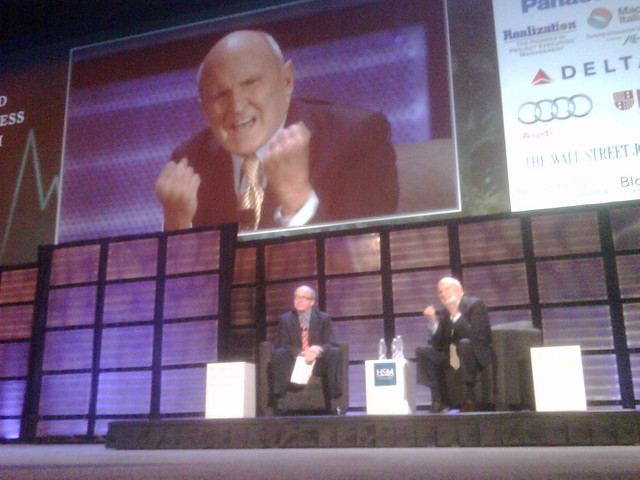
Jack welch (Photo credit: challengefuture)

Jack Welch was CEO and later chairman of GE from 1981 to 2001. His primary claim to fame is that he increased GE’s stock valuation by 4000%, making GE the world’s most valuable company at one point. For most of his career he was unknown by the general public, but he was toasted by Wall Street and GE stock owners as the world’s greatest businessman.  

He also was a pioneer in job outsourcing and offshoring, and his accomplishments in that area make Mitt Romney look like a piker.
 GE insisted that its suppliers also outsource and offshore jobs passing the savings along to GE. GE even offered to teach its suppliers how to outsource and offshore.

Early in his career, Jack Welch won the nickname “Neutron Jack” for his ability to empty GE factories of employees and leave the buildings standing empty.

When the jobs report was issued yesterday, Jack Welch questioned the numbers. Just a question he said, having no basis in fact to question the numbers.

I think that Jack Welch is not a reliable source when it comes to challenging the results of BLS jobs numbers. In the longer article above, you can read about how GE cooked the books in order to sustain its stock price and was caught and fined.

Although Welch is superficially a credible figure — indeed, still an idol in certain quarters of American business — he is also a particularly enthusiastic and volatile Romney surrogate,  he admires Romney deeply, perhaps because both have become symbols of “corporate greed, arrogance, and contempt for workers.”

His tweet about the BLS was a political expression, not an expert assessment, and invites skepticism. But Welch certainly is familiar with dubious numbers and political manipulation.
 
Welch, who made news Friday morning for accusing the Labor Department of cooking the books on the good September jobs report to make President Obama look good. Welch doubles down on his accusations, though he says he has no evidence.

The 76-year-old retiree riled up the Twitterverse this morning with a tweet that said, “Unbelievable jobs numbers..these Chicago guys will do anything..can’t debate so change numbers.”


Visit NBCNews.com for breaking news, world news, and news about the economy
Chris Matthews talks to former CEO of GE Jack Welch, who made news Friday morning for accusing the Labor Department of cooking the books on the good September jobs report to make President Obama look good. Welch doubles down on his accusations, though he says he has no evidence.

“I am doing nothing more than raising the question,” Mr. Welch said. “It’s fact-based.”

Here are Mr. Welch’s facts.
 To hold the unemployment rate even as the population grows, he said, the economy needs to add between 150,000 and 200,000 jobs a month.

“We haven’t reached those numbers at all,” Mr. Welch said. Employers added a seasonally adjusted 114,000 jobs in September, down from a revised 142,000 jobs in August. The economy, however, has added 143,000 jobs a month after revisions this year.

The former GE chief also raised questions about job growth shown in the household survey, which is the source of the unemployment rate. That survey showed a healthy jump of 873,000 jobs in the month, at odds with the 114,000-job gain in the survey of businesses.

“The economy doesn’t feel like it added 873,000 jobs in September,” Mr. Welch said. “There are a number of things here that are open to discussion.”

Still, several economists have pointed out exactly how the unemployment rate can diverge on a month-to-month basis from nonfarm payroll growth. Considering the household survey showed job losses throughout the last few months, September’s sharp gain could be a catch-up from those recent reports.


Filling in for Cavuto, Eric Bolling has a great conversation with former CEO of GE Jack Welch about his earlier tweet about jobs numbers shenanigans. Welch goes into details about why and how the numbers just don’t add up.


  • How President Obama and Mitt Romney compare on preserving Social Security for America’s seniors


    In the first debate, Mitt Romney sacrificed the facts in order to mislead and confuse voters about where he stands on important issues to the middle class. On one issue—Social Security—it’s worth clarifying where President Obama and Governor Romney agree and where they disagree. Both President Obama and Mitt Romney know that the program is solvent for more than two decades and that there’s a need for gradual reforms to the benefits that millions of seniors have worked for, paid for, and earned. But that’s where their agreement ends.
    While President Obama is committed to keeping the promise of guaranteed Social Security benefits for current and future generations, Mitt Romney and Paul Ryan have supported plans to privatize the program, and have put forward a plan that would slash benefits for current workers. Here are the key differences between the President’s and Romney-Ryan’s approach to Social Security:

    Obama-Biden
    The President knows that guaranteed Social Security benefits are not handouts, but a bedrock of the commitment to retirement security America makes to our seniors. He believes that no current beneficiaries should see their basic benefits reduced, and he will not accept any approach that slashes benefits for future generations. President Obama stands firmly opposed to privatizing Social Security—the future security of hard-working Americans should not be dependent on the fluctuations of the stock market. That is why the President has called on Congress to develop a bipartisan plan that follows these principles:
    • Any reform should strengthen Social Security for future generations and restore long-term solvency.
    • The administration will oppose any measures that privatize or weaken the Social Security system.
    • While all measures to strengthen solvency should be on the table, the administration will not accept an approach that slashes benefits for future generations.
    • No current beneficiaries should see their basic benefits reduced.
    • Reforms should strengthen retirement security for the most vulnerable, including low-income seniors.
    • Reform should maintain robust disability and survivors’ benefits.

    Romney-Ryan
    Mitt Romney is taking a starkly different approach to Social Security—he refuses to ask the wealthy to pay their fair share, and is proposing to close Social Security shortfalls through benefit cuts alone. As Nobel Prize-winning economist Peter Diamond and former OMB director Peter Orszag noted, his plan insists that any reform prohibit additional revenue, and thus relies on “excessive benefit cuts that would undermine financial security for future retirees.” Analysis of a similar plan showed that typical workers in their forties would lose $2,400 a year, and workers in their twenties would lose $4,700 a year in future benefits. Romney’s running mate Paul Ryan was even the architect of a privatization plan that would have left seniors’ benefits devastated by the 2008 financial crisis.

    The choice is clear: President Obama will never privatize Social Security or undermine retirement security for middle-class Americans. The same cannot be said for Romney.

Romney Starts to Fill in Blanks on His Tax Plan

For months, voters have been in the dark about key details of Mitt Romney's tax plans.

He specified $5 trillion in tax cuts, a 20% cut in income tax rates, a 40% cut in the corporate tax rate, repeal of the estate tax and alternative minimum tax and elimination of taxes on interest, dividends and capital gains for households with incomes below $200,000.

He did not want his changes to raise the deficit, but he was utterly mum on how to raise $5 trillion to offset the tax cuts.

During the summer, two colleagues and I showed that if Romney did not want to add new taxes on savings and investments -- and raising savings and investments is the second of four main planks in Romney's overall economic package -- he could not finance his tax cuts without generating a net tax cut for households with income above $200,000.

Even if all the available tax expenditures were closed in the most progressive manner possible, it would not raise enough revenue among high-income households to offset the tax cuts they would receive. This was true even when we adjusted the revenue estimates to allow for the impact of potential economic growth, and even when we gave the campaign a trillion-dollar mulligan by ignoring the cost of the corporate tax cuts.

As a result, we concluded that if Romney did not impose new taxes on savings and investments, the only way to finance his tax cut proposals and reach revenue neutrality was to raise taxes on households with income below $200,000.

This was not a forecast of what Romney would actually do; it was simply a matter of arithmetic.

But it highlighted the need for specifics; $5 trillion is not a trivial amount, even in Washington, and the prospect of middle-class tax increases sets off alarm bells.

Earlier this week, Romney finally started the process of proposing ways to pay for his tax cut proposals. He broached the idea of putting a cap on each taxpayer's total amount of itemized deductions -- including mortgage interest, state and local taxes, charitable contributions.

Although critical design features remain foggy, Romney has said the cap could range from $17,000 to $50,000, and it could vary with income.
Several things are already clear.

First, capping -- or even eliminating -- itemized deductions will not come close to paying for Romney's tax cuts. It would be a step toward financing, but much more will be needed.

Nevertheless, as a piece of the revenue puzzle, a cap is an interesting and important idea and a welcome step forward.

Members of Congress are quick to see the political advantages of a cap. Relative to curtailing specific deductions, a cap allows them to leave existing deductions in place but restrict the overall use of such deductions. In that sense, the cap is like the alternative minimum tax was intended to be -- a limit on the overall use of tax shelters, even if political leaders could not shut down each one.

A cap on itemized deductions goes after one of the three areas of the income tax where the money is. The other two are the exclusion of health insurance premiums from taxation and saving and investment incentives like 401(k) plans, and the lower tax rates on capital gains and dividends and carried interest. A cap on a taxpayer's use of all of these subsidies -- as opposed to just itemized deductions -- could get at all three areas.

Martin Feldstein of Harvard University and the Romney campaign and Maya MacGuineas of the Center for a Responsible Federal Budget have proposed a different style of cap that applies to more than just itemized deductions.

While Romney's cap appears to apply to all itemized deductions, it may have a disproportionately negative effect on charitable contributions. After all, people have to pay their state and local taxes, and many people are already in the middle of a long-term commitment to pay down their mortgage.

For those households, there may be little room left under the cap to take deductions for charitable contributions. And, for all households, the cap would eliminate tax deductions for contributions larger than the cap, so large gifts to charities would automatically lose their tax-preferred status.
So, a cap is not a panacea, but it could well be one part of a constructive solution. Likewise, his acknowledgment that his earlier, disparaging comments about the 47% of households that do not pay federal income taxes were misguided suggests a reconsideration of the role taxes play in those households.
If the journey of a thousand miles begins with a single step, Romney has finally taken the first step. But there is still much more work to be done.
How many of you will leave a comment and tell, how are you feeling today?

Friday, October 5, 2012


Photo of the day: Francis Southcott served in the U.S. Army as an Aviator with Alpha Company, 229th Assault Helicopter Battalion, 1st Cavalier Division. He went on to fly search and rescue missions with the U.S. Coast Guard and eventually became a pilot for American Airline. He is photographed in Tây Ninh, Vietnam in October, 1969. Thank you for your service, Francis!
FINAL INSPECTION


  by:  Sgt Joshua Helterbran


Part I
The soldier stood and faced God,
Which must always come to pass,
He hoped his shoes were shining,
Just as brightly as his brass.

"Step forward now, you soldier,
How shall I deal with you?
Have you always turned the other cheek?
To My Church have you been true?"

The soldier squared his shoulders and
said, "No, Lord, I guess I ain't,
Because those of us who carry guns,
Can't always be a saint.

I've had to work most Sundays,
And at times my talk was tough,
And sometimes I've been violent,
Because the world is awfully rough.

But, I never took a penny
That wasn't mine to keep...
Though I worked a lot of overtime
When the bills got just too steep,

And I never passed a cry for help,
Though at times I shook with fear,
And sometimes, God forgive me,
I've wept unmanly tears.

I know I don't deserve a place
Among the people here,
They never wanted me around,
Except to calm their fears.

If you've a place for me here, Lord,
It needn't be so grand,
I never expected or had too much,
But if you don't, I'll understand."

There was a silence all around the throne,
Where the saints had often trod,
As the soldier waited quietly,
For the judgment of his God.

"Step forward now, you soldier,
You've borne your burdens well,
Walk peacefully on Heaven's streets,
You've done your time in Hell." 


To all that serve. 


- Part II

I'm very saddened by America today, 

when they take credit for what others say.

I wrote a poem because of problems in my past, 
how was I to know that it was going to last.

It has been read by all and loved the same, 
but indeed at the end there is no name.

The name is simple for those who know, 
it's not Kilmer, Longfellow, Service, or Poe.

It's a soldier who has fought for his country so true,
He's proud of the ole Red, White and Blue.

You now know the poem the one and the same, 
The Final Inspection is the name.

I wrote it because of the trials so true, 
and of my buddies who died for country and you.

So take this poem, take it as you trod, 
because in Heaven I'll see my God.

He will look at me and say don't be sad, 
others read your poem and you made them glad.

Now step forward my son and look your best, 
and come inside with all the rest.

by:  Sgt Joshua Helterbran
This is the second part to the poem
Final Inspection


Notes:

A HUGE Thanks to Joshua Helterbran's Mother for sending me the missing verse and for letting me know who wrote it.  Thanks also for having a wonderful son that is so talented.
Here's a small bio Joshua kindly permitted me to publish and a note from his Mom about the wonderful poem:

I entered military service September 18, 1996 I graduated from Basic Training in Ft. Benning, Ga. I then attended Jump School there, and went on to attend R.I.P (ranger indoctrination program). I was then stationed with Aco 3rd Platoon, Weapons Squad, 3rd Ranger Battalion. I then was stationed with the 1/508th ABCT, 173rd Brigade in Vincenza, Italy. I am currently stationed with HHC 224th Engineer Battalion. We were on deployment in Iraq, when I was injured. I am currently stationed at Ft. Sill, OK where I am receiving medical treatment. Thank you again for all you have done for us troops. God speed and God Bless

From Joshua's Mother:
The poem has a lot of meaning to many of people, as I have found it at many points on the Internet.
Dear Joshua,
Stay STRONG!  Hurry Home!!
GOD Bless you always,
Beti Ryan-Mercer


Photo of the Day


Photo of the Day: The guided-missile destroyer USS Mustin fires a Standard Missile 2 missile from the ship's forward and aft missile decks during a missile exercise in the Pacific Ocean, Sept. 20, 2012. The Mustin is one of seven guided missile destroyers assigned to Destroyer Squadron 15 and is forward deployed to Yokosuka, Japan. U.S. Navy photo by Petty Officer 2nd Class Devon Dow
Can a Christian Vote for a Non-Christian Candidate?
I urge, then, first of all, that petitions, prayers, intercession and thanksgiving be made for all people – for kings and all those in authority, that we may live peaceful and quiet lives in all godliness and holiness.           
– 1 Timothy 2:1-2  

It is clear from the Apostle Paul’s writing that we are to pray for all leaders in government, including  those who may not be Christians. But can we vote for them?

Theologian Wayne Grudem writes in Politics According to the Bible
“Christians should support the candidates who best represent moral and political values consistent with biblical teaching, no matter what his or her religious background or convictions.”
There are many biblical examples of God bringing non-believers to work alongside His people to further His purpose:
 Genesis 41:37-57 - God used Pharaoh to establish Joseph in a position of authority in Egypt. 
 1 Kings 5:1-12 – Hiram, King of Tyre helped Solomon build the Temple. 
 Daniel 2:46-49 - Nebuchadnezzar placed Daniel and his Jewish friends in positions of high authority in Babylon. 
 Isaiah 45:16 – Cyrus, King of Persia, restored the Jewish exiles to Israel. 
This working together with non-believers is called co-belligerence. Christian apologist Francis Schaeffer writes, “A co-belligerent is a person with whom I do not agree on all sorts of vital issues, but who, for whatever reasons of their own, is on the same side in a fight for some specific issue of public justice.” 
There are many other examples of co-belligerence. William Wilberforce joined with non-believers to abolish the slave trade in England. Our country’s Christian Founding Fathers joined with their nonChristian counterparts, men like Jefferson and Franklin, to establish the foundations of a new nation. 
There will be times that God calls us to engage in co-belligerence for the furtherance of His Kingdom.  We may be required to vote for a non-Christian to help us accomplish God’s design for our time. 
Al Mohler, President of The Southern Baptist Theological Seminary writes: “We must be honest and  acknowledge that there are non-Christians or non-evangelicals who share far more of our worldview and  policy concerns than some others who identify as Christians. The stewardship of our vote demands that  we support those candidates who most clearly and consistently share our worldview and combine these commitments with the competence to serve both faithfully and well.” 
Theologian Dr. John Frame writes in Doctrine of the Christine Life: “…in some cultures (like the ancient Roman, in which the New Testament was written) there is not much that Christians can do, other than pray, to influence political structures and policies. But when they can influence them, they should. In modern democracies, all citizens are ‘lesser magistrates’ by virtue of the ballot box. Christians have an obligation to vote according to God’s standards. And, as they are gifted and called, they should influence others to vote in the same way.” 
Christians need to vote responsibly. We have an obligation to be informed about issues and candidates, and then vote for those whose stances most closely align with biblical principles. As voters, we share the responsibility of government and thus share accountability to God for what takes place in our nation.
And yes, this may mean that at times we need to vote for a non-Christian