Pages

Thursday, June 21, 2012

If the House of Representatives find our US Attorney General in Contempt of Congress


next week, what repercussions will that have?

This is a question people should be asking themselves and each other.  There is a reason behind this utter madness that no one is talking about.

Why are Republicans trying so desperately to discredit Eric Holder?  Especially at this point in time.  I remember in 2011 when Eric Holder denounced the 'Fast and Furious' operation as dangerous to Americans and Mexicans alike.

Now the NRA is shown to be involved and influential in the Republicans 'contempt of congress' vote against America's Attorney General.

What repercussions will this vote for contempt have on previous decisions by the US Justice Department and what affect will it have on future decisions by the US Justice Department?
Actions such as these can't be forgiven or retracted.  These allegations are putting the entire Administration's reputation at stake.

I have to say, this goes beyond reprehensible.

Reviewing comment and blog threads from conservative web sites, the amount of vile being spewed about and the amount of unsubstantiated accusations being raised is nearly overwhelming in their viciousness.

Nothing to date has given me such trepidation for our country as this unwarranted and vicious attack.

This is really, really bad for America.

Thu Jun 21, 2012 at 05:53 AM PDT

Eric Holder, our AG of a certain ilk...In Contempt?


This diary will be short and sour.

Never before have people of a certain ilk risen to such heights, as our President and our Attorney General: our top law enforcer.  (Notice I am not in any way accusing anyone of racism, or saying that someone's race plays any part in this...perish the thought that I would ever play a "race card" and impune good, hard-working lawmakers and media folks practicing their First Amendment rights).
But some folks of other ilks and other mindsets just can't stand it.

I remember recently a GOP lawmaker said that the "economic noose is tightening around Obama's neck."

Not that it has anything to do with this discussion of people of a certain ilk, but these matters are very close to me, and I remember stories from long ago, of black men in certain regions of our country called "uppity".  That was their only and final warning to close their businesses, take from their own homes whatever little they could carry, and abandon everything else they earned and worked for over their lifetimes...and just flee north after sundown, happy to still be alive.
Times have changed, thank god!!!

Soon we may see our AG of a certain ilk led out of the House chamber in handcuffs, like a street perp...over what again???
****************
Where do they find these special dog whistles that blow in such a low-frequency range?
Move along if all you have is a race card to play.  Nothing to see here.

Just STFD and STFU and close your damn eyes, and let the GOP folks of a certain ilk run our country again, and everything will be just fine.  They are entitled to it, after all.

Thu Jun 21, 2012 at 07:42 AM PDT

Holder's defense to charges of contempt of Congress.


It's a crime to be in contempt of Congress.  Looks like we're gonna need to open up those FEMA concentration camps to handle all the contemnors!  And Goddess knows what would happen to you if you should actually fart in their general direction!.  Let's give Eric Holder some practical device about getting these lunatic Republicans (but I repeat myself!) clinging on to his back like those leeches on Charlie Allnut as he's trying to get the African Queen unstuck and go on to marry Rosie and torpedo the Luisa.

Seems to me there's one word that no Republican can stand, and if you utter that word, not only will the Republicans not want to hear any more from you, they will actually order you to shut up.

Yes, you know the word I'm talking about.  Holder should use this word the next time Darrell Issa orders him to cut down the General Sherman tree with a herring.

The word is -- I cannot say it -- OMG now I'm saying it.  I SAID IT AGAIN ...


SCOTUS makes me rethink Obama


When the healthcare fight was raging and the public option was  negotiated away, I just emotionally unplugged and said President was to blame.  Like a lot of people I couldn't just give him a pass for not fighting for it.

If you are anything like me (in between fits of rage) you probably thought the following during the healthcare debate:

"Why bring all these scum bag insurance companies to the table Mr. President, they are the problem?  Just create a universal government program and let the big insurance companies whither on the vine as their business model is finally bankrupted by the competition."

"And by the way Mr. President, why not just raise the Medicare tax by .25% on everybody, eliminate the cap, and lower the eligibility age by 15 years every 5 years? It just seemed so simple. Do it by Executive order. I obsessed about how the president didn't fight hard enough for what we believe in."

"Mr. President, how can you cut deals with Joe Lieberman and Max Baucus?"

How many prognosticators, and bloggers, and political thinkers that I respect deeply said this Healthcare Law was garbage and it was no better than what we already had? Some very, very smart people on the left voiced nothing but disdain for the legislation and not only said it should not be passed, but that they hoped it would be overturned.  How many of you were so disgusted with Obama that you (like me) disengaged and stayed away from the polls in 2010?

Even now liberals are wondering if they will support Obama in 2012.  Now don't misunderstand me, this is no campaign pitch.  I'm not saying support the president, or donate, or knock on doors.  That is not my intent.  I am saying that we should all take a collective look at the last 3 years, specifically the health care debate and reevaluate our condemnation of the process as well as the outcome.  What if the president hadn't  gotten this law passed through both houses and had just done it by executive order?  How do you think that would have played with this insane republican party and lazy media?  If this wasn't a significant accomplishment, why did the people on the right fight so hard against it?  Just like the 2000 election the Supreme Court has once again twisted itself in knots trying to get their hands on it. That should tell you something.

Obama is up against a media and political establishment that has absolutely no foundation in the real world.  When they casually talk about cutting medicaid it is because they don't associate with people who live at the poverty line with no health insurance. They don't understand living a life where a copay of $50 or a deductible of $5000 is life altering because they can write a check for it.  When they casually say "go to the emergency room if you don't have insurance", they have never sat in an ER waiting room for 12 hours with their 6 year old writhing in pain.  When they talk about cutting social security it is becuase they literally cannot imagine living off of $1200 a month so they have nothing but disbelief that their are people who do.

Their is not one member of the US Supreme Court, one member of Congress, or one member of the Mainstream Media that has gone without health insurance, or lived at the poverty line and needed food stamps, or been denied a medical procedure. Not one.  This is the world we live in.  Reality does not matter, facts don't matter, what is best for the  majority in this country doesn't matter to most of these people.  We have to always remember that.  More importantly so does the President.

Romney Will Deport Children

by TomP
Thu Jun 21, 2012 at 10:24 AM PDT 

Based on reports I have seen, that is the only conclusion I can draw.
Romney said he wants to open the country to more legal foreign workers. But he said he did not plan on keeping in place the new order by President Obama halting deportations of hundreds of thousands of young illegal immigrants brought to the country when they were children. “Last week, the president finally offered a temporary measure – he called it a stopgap measure -- that he seems to think will be just enough to get him through the election,” Romney told the annual conference of the National Association of Latino Elected and Appointed Officials.
snip
“Some people have asked if I will let stand the president’s executive order,” Romney added. “The answer is that I will put in place my own long-term solution that will replace and supersede the president’s temporary measure.”
WaPo
What's that plan?
While that plan is still vague, it does not involve a path to legalization for any of the country's estimated 11 million illegal immigrants except for people who enlist in the military, according to a release from the campaign.
yahoo
“Mitt Romney believes that young illegal immigrants who were brought to the United States as children should have the chance to become permanent residents, and eventually citizens, by serving honorably in the United States military,” a Romney campaign release states. Romney has endorsed legal status for military service membrs before. In declining to go beyond that position Thursday, he signaled that he was not backing down from his past opposition to the DREAM Act, the legislation that would put many more young illegal immigrants on a path to citizenship.
WaPo800,000 people cannot be in the military, including those under 18.
So Romney's message to Hispanics is really "pound sand."
He's the same bigot he always was.

Romney Outlines How He Would 'Replace Obamacare'

Romney Outlines How He Would 'Replace Obamacare'

Mitt Romney, who is expected to be the Republican nominee for president, doesn’t usually talk about health care in his campaign stump speeches. Tuesday, at Con-Air Industries in Orlando, Florida, he blasted the 2010 federal health law and outlined what he would do if elected president.
Here is a transcript of the health care portion of the speech:

MITT ROMNEY: Now just yesterday, the president said something else that shows just how much out of touch he is. He said he didn't understand that Obamacare was hurting small business. He doesn't understand that Obamacare impacts small business and you have to scratch your head about that because about a year ago, the Chamber of Commerce did a survey of some 1,500 small businesses, and of those small businesses, three-quarters—75 percent—said Obamacare made it less likely for them to hire people.

It is having an impact on middle-income families that want to have good jobs. We also found out that 30 percent of employers in this country plan on dropping people once Obamacare is put in place—dropping them from their health care plan.

And then there were some other revelations about Obamacare. Instead of costing a trillion dollars, it's going to cost $2 trillion. It's not only bad policy, and bad for middle-income families, and bad for small business, it's simply unaffordable and so the right course for us is to make sure that the next president of the United States repeals Obamacare and replaces Obamacare.

The president needs to get in touch with what's happening in the private sector; what's happening with middle-income families and the damage that's being done by the specter of Obamacare, and the taxes that it already charges to businesses in the health care sector.

Now I know the Supreme Court is about to make a decision with regards to Obamacare, and I have right here in my pocket what they're going to say. Actually, I don't know what they're going to do. But you know, regardless of what they do, it's going to be up to the next president to either repeal and replace Obamacare or to replace Obamacare.

And I intend to do both, if I'm the president at a time when the Supreme Court has left Obamacare in place, I will repeal it on day one by sending out a waiver to all 50 states to keep them from having to pursue Obamacare.

Now if I'm able to repeal it—or if the Supreme Court is able to get that job done for us—we want to replace it. And I want to mention to you a number of things I would put in place with which to replace Obamacare.

Number one: The uninsured. Right now the uninsured are cared for at the state level. Each state has its own program for dealing with those that are uninsured. Some send uninsured people to clinics for care, others send them to emergency rooms.

What I would do is keep—as we have today—state responsibility for those that are uninsured. You see I believe in the 10th Amendment. I believe the states have responsibility to care for their people in the way they feel best. But to help states care for their own uninsured, I would take the Medicaid dollars that comes with all sorts of strings attached today, send them back to the states along with something known as the DSH money, and let states care for their own people in the way they think best. That—in my view—is the best way to care for the uninsured.

And states will learn from each other, and some will have good experiences and others will not. That's happening even today and states are learning and trying new ways to care for the uninsured. It's important for us in my view to make sure that every American has access to good health care.
There are other things I'd do. I want to get health care to act more like a consumer market, meaning like the things we deal with every day in our lives: The purchases of tires, of automobiles, of air filters, of all sorts of products. Consumer markets tend to work very well—keep the costs down and the quality up.

So how would I do that on health care? Well right now, most people get their insurance through their employer and the reason they do that is because their employer gets a tax deduction when they buy insurance for you. But if you're a very small-business person—let’s say a one-person business—you don't get a tax deduction for buying insurance. And if you're an individual that's not employed, you don't get a tax deduction for buying your own insurance.

What I would do is level the playing field and say individuals can buy insurance on the same tax advantage basis that businesses can buy insurance.

I also want to make sure that people can't get dropped if they have a preexisting condition. What I mean by that—so let's say someone has been continuously insured and they develop a serious condition, and let's say they lose their job or they change jobs, they move and they go to a new place. I don't want them to be denied insurance because they've got some preexisting condition. So, we're going to have to make sure that the law we replace Obamacare with assures that people who have a preexisting condition—who've been insured in the past are able to get insurance in the future—don't have to worry about that condition keeping them from getting the kind of health care they deserve.
And I want these individuals and businesses to be able to buy insurance across state lines to get the best deal they can get anywhere in the country. And I wanted to be able to join associations of like types of organizations so they can get bargaining power, purchasing power, and get insurance at a reasonable rate.

We can get health care to act more like a consumer market, and if we do that and we stop making it like big government managed utility, we're going to see better prices, lower costs and better care. It's happened everywhere we've applied consumer market principles. Free enterprise is the way America works—we need to apply that to health care.

Let me mention something else about health care, and that's Medicare. Medicare is the health care program for our seniors, and the president did something—I think—that that surprised a lot of seniors. When they saw the president campaign four years ago, he didn't mention to them that he was planning on cutting Medicare by $500 billion to pay for his health care plan, but that's what he did.

And so if you have seniors that say I need someone to protect Medicare, you remind them this president was the one that cut $500 billion out of Medicare. My plan is to protect and save Medicare, to make sure it's there not just for current seniors, but for future seniors. And my plan is this: I want people to have more choice. I want them to be able to have traditional government sponsored Medicare or private-sector Medicare provided by various companies, and let them make their choices to which one they want.

And by the way, higher-income people—I think—should get less help getting Medicare than lower-income people. I think we should care for those that need the help most and let them choose the private or public system they prefer. I think choice is the right course in Medicare.

Matthew Fleming contributed.
Jun 13, 2012

Mitt Romney's Fatal Prescription for Health Care

Thu Jun 21, 2012 at 11:51 AM PDT

Whatever ruling the nation's highest court hands down on President Obama's Affordable Care Act, Republican challenger Mitt Romney's prescription for health care is unchanged.  "Now if I'm able to repeal it--or if the Supreme Court is able to get that job done for us," he announced last week, "We want to replace it."  But what Romney wants to replace the ACA with  - "states with responsibility" to "make sure that every American has access to good health care" - is simply impossible.  His plan to gut Medicaid spending and vague proposals for tax deductions to purchase coverage wouldn't merely leave millions of Americans without health insurance, including hundreds of thousands in his home state of Massachusetts.  And as the sad history shows, without help from Washington universal coverage at the state level has a proven track record of failure.
The Washington Post's Ezra Klein noted that the Romney campaign's 330 word description doesn't offer many details on his scheme to "replace Obamacare."  As Klein explained:
Those words are enough to lay out a basic vision. Romney would turn Medicaid over to the states and -- though this appears in a separate policy paper -- cap its growth at inflation plus 1 percent, which would mean deep cuts to the program. He would allow private insurance to be sold across state lines, meaning that if health-care insurers find the rules in California too onerous, they can locate in South Dakota instead. This is basically how credit cards work today. He would cap non-economic damages in medical malpractice lawsuits and encourage "Consumer Reports-type" ratings of health plans. The broad idea, his campaign says, is to make the market for health insurance look more like the market for things that aren't health insurance.But the key to his plan comes in these nine words: "End tax discrimination against the individual purchase of insurance." The problem is, there aren't any words after that.
But as Romney ally Ramesh Ponnuru fretted last month, the Republican's proposal to offer tax deductions for individuals to purchase health insurance in the private market is little different than George W. Bush's 2007 plan.  While the Affordable Care Act will enable coverage for 30 million people, previous estimates suggested the Bush framework would add 9 million at most. Sadly, that's just the beginning of President Romney's health care body count.
Like his new GOP twin in Congress Paul Ryan, Mitt Romney has proposed steep cuts to Medicaid spending and pledged to hand-over the shrunken pool of funds as block grants to the states. And it is precisely that formula that would smother his once-beloved Romneycare in its cradle. As the Boston Globe recently documented, President Romney "would probably cripple the Massachusetts health care law":
"It would have been impossible for Massachusetts to do what it did without increased federal Medicaid support,'' said John McDonough, a major architect of the state's health care overhaul law and now director of Harvard University's Center for Public Health Leadership. "What he's proposing is in direct opposition to what he did as governor,'' said Amy Whitcomb Slemmer, executive director of Health Care for All in Massachusetts, citing the Bay State's 98 percent coverage rate, the highest in the nation. "That kind of expansion would not have been possible under a block grant program,'' as Romney has proposed. Block grants give states more flexibility in spending federal money, but restrict funding increases.
As ThinkProgress explained, Romney in the past had been very up front about the crucial role federal funding - and flexibility - played in making his signature achievement possible:
"[F]rom the beginning the plan was a 50/50 deal between the federal government and the state government. The Feds fund half of it, they have from the very beginning." The Boston Globe notes that "approximately 56 percent of the gain in coverage was related to increased federal Medicaid support" in Massachusetts, and of the newly insured, "18 percent gained coverage through Medicaid, and another 38 percent gained coverage through Commonwealth Care, a program that federal Medicaid dollars pay half of."
But like the new insurance coverage for 30 million Americans nationwide under the Affordable Care Act, the gains in Massachusetts would be a thing of the past under a Romney administration in Washington. Projections from the Congressional Budget Office suggest that 48 million more people would be uninsured under Paul Ryan's House GOP budget, a scheme similar to Romney's. That figure would include hundreds of thousands in the state Romney once governed. Keep in mind that Massachusetts was a national leader in health care even before the 2006 passage of Governor Romney's reforms.  While the state's individual mandate and subsidies have lowered the uninsured rate to two percent, roughly 90 percent of Bay State residents already had coverage when the law took effect.  With 50 million people uninsured, the national rate is roughly 16%.  And in states like Mississippi and Texas, the ranks of the uninsured top 25 percent.
Ironically, as this chart from the Commonwealth Fund shows, health care performance is worst in those states where Republicans poll best.
Nevertheless, in keeping with GOP orthodoxy Mitt Romney declared last week that states can do it all:
What I would do is keep--as we have today--state responsibility for those that are uninsured...And states will learn from each other, and some will have good experiences and others will not. That's happening even today and states are learning and trying new ways to care for the uninsured. It's important for us in my view to make sure that every American has access to good health care.
Unfortunately, recent history shows that even relatively more affluent states have failed to deliver universal coverage when they try on their own.  As Ezra Klein's Washington Post colleague Sarah Kliff pointed out this week, Washington State's 1990's mandate-less reforms led to skyrocketing premiums and insurers fleeing the state.  Writing for the Washington Monthly back in 2007 ("Over Stated"), Klein looked at the grim fates of efforts in California, Hawaii, Washington, Oregon, Tennessee and Illinois.  Thanks to their small markets, limited resources, unique populations and unsustainability in the face of recession-induced budget cuts, susceptibility to recessions, he concluded "the laboratories of democracy' can't achieve universal health care":
Letting states continue to take the lead would be disastrous, for one very simple reason: providing health care for all citizens is one of those tasks, like national defense, that the states are simply unequipped to manage on their own. The history of state health reform initiatives (and there's quite a history) is a tale of false hopes and great disappointments. The deck is stacked from the start, and the house--in this case the insurers, the providers, and other agents of the status quo--always wins....Over the years, states have tried programs of many different ideological and economic persuasions. All of them failed, and not because the programs were insufficiently inventive, but because states are structurally incapable of sustaining them.
Yet, that is precisely what Mitt Romney wants to do:
You see I believe in the 10th Amendment. I believe the states have responsibility to care for their people in the way they feel best. But to help states care for their own uninsured, I would take the Medicaid dollars that comes with all sorts of strings attached today, send them back to the states along with something known as the DSH money, and let states care for their own people in the way they think best. That--in my view--is the best way to care for the uninsured.
But Romney's prescription - slashing federal Medicaid spending over the next decade and turning what remains over to the states - is a toxic one.
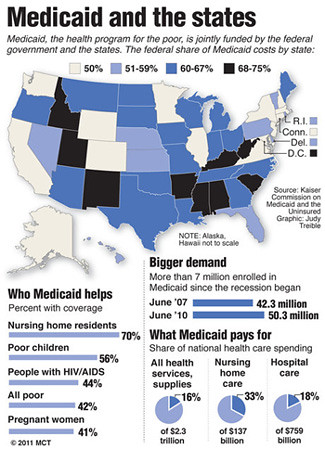
Currently, the $300 billion Medicaid program serves roughly 60 million Americans. On average, the federal government picks up 57% of the tab, with poorer states like Mississippi and Alabama getting 75% of the funding from Washington. Averaging 21.8% of states' spending, Medicaid is now the largest budget item for most. Medicaid not only pays for a third of nursing home care in the United States; it covers a third of all childbirths. (In Texas, the figure is one-half.) As with Medicare, Medicaid provides insurance for substantially less than private insurers (27% less for children, 20% for adults.) With the passage of the Ryan 2012 budget proposal, Republicans voted to slash Medicaid funding by $1 trillion over 10 years while sending the remaining dollars as block grants to the states.  As the Center on Budget Policy and Priorities documented, Romney's plan is even more draconian.  As it turns out, that gambit would not only gut the 2010 Affordable Care Act law, but guarantee than millions of low income Americans are deprived of health care. As Jonathan Cohn explained:
If the law changes and Medicaid becomes a block grant, then every year the federal government would simply give the states a lump sum, set by a fixed formula, and let the states make the most of it. Conservatives claim block grants would give states the flexibility they need to make their programs more efficient. But, as Harold Pollack has noted in these pages, states already have some flexibility. And because demand for Medicaid tends to peak during economic downturns, when state tax revenues fall, the likely impact of a block grant scheme would be to make Medicaid even less affordable at the time it is most necessary.That's not to say plenty of governors wouldn't take advantage of block grant status to change their Medicaid programs in ways they cannot now. They surely would--by capping enrollment, thinning benefits, increasing co-payments, and so on.
Which is exactly what they are already doing now. Ezra Klein summed up the findings from a recent study by Kaiser Family Foundation and the Bipartisan Policy Center:
Twenty states implemented benefit restrictions in the past year. In fiscal year 2010, 39 states implemented Medicaid provider rate cuts or freezes (up from 33 in fiscal year 2009), and 37 states have provider rate restrictions planned for the next fiscal year.
For Medicaid block grant supporters like Mitt Romney and Haley Barbour, America's future is Mississippi's present:
Mississippi provides some of the lowest Medicaid benefits to working adults in the nation. A parent who isn't working can qualify only if annual family income is less than 24 percent of the poverty line. Working parents qualify only if they make no more than 44 percent of the federal poverty level. Seniors and people with disabilities are eligible with income at 80 percent of the poverty line...Translated from the federal poverty guidelines, that means a working Mississippi couple with one child could earn no more than $8,150 a year and still qualify for Medicaid, seniors and people with disabilities could earn no more than $8,700, and a pregnant woman could earn no more than $20,000 a year.
That's a far cry from what's happening today in Mitt Romney's home state of Massachusetts.  By most measures, Romney's signature 2006 health care law has been a tremendous success. Enjoying the consistent support of Bay State residents by a 2 to 1 margin, the bill Governor Mitt Romney signed into law lowered the uninsured rate from about 10  percent to a national low of two percent. In March, a study by the National Bureau of Economic Research (NBER) showed that universal coverage in Massachusetts is indeed making people there healthier. Meanwhile, the rate of growth for business and individual insurance premiums has slowed dramatically, a trend state regulators recently announced will result in only a 1.2% increase. Unfortunately, what Governor Romney giveth, President Romney will taketh away.
* Crossposted at Perrspectives *

It's Not the Money, Mitt; It's Your Willful Ignorance


The rIch are different
So said F.Scott Fitzgerald.  In his famous novel The Great Gatsby which several generations of high school students have been forced to read. he depicts the tragic love for Jay Gatsby, a man with a shady past and low class origins, for Daisy Buchanan, who is beautiful, vivacious, charming and socially prominent. She and her husband made their money the old-fashioned way: they inherited it. She and her husband are vain, shallow, self-absorbed, and uncaring.  Someone has always cleaned up their messes for them. Someone will always be  on a flow of bathtub gin, pretty people without a care--and they hurt so many others  with their carelessness and lack of awareness. 
At first glance, Mitt doesn't seem to have much in common with the Buchanans. He's a straight-laced Mormon, who doesn't drink alcohol or even coffee or tea. He finds a Mormon church wherever he goes so he can worship on Sunday.  He married young, and it appears he's never even looked at another woman. He's the anti-John Edwards, faithful and supportive of her even during her breast cancer fight and her current battle with MS--many men would have sought comfort in the arms of a healthy woman, but Mitt didn't. He appears to be devoted to his children. And, while his time at Bain  can be criticized for lots of reason, there's not even a hint of his doing anything illegal.

In short, he sounds like the perfect presidential candidate: no sex scandals, no dirt in his background, pure as the driven snow.

Looks that way, doesn't he?

But it takes more to make a good president that being without bimbo eruptions or shady dealings--and that's where Mitt proves himself to be a handsome cardboard cutout.

He is so isolated from the reality of everyday Americans that he can't even recognize a donut when he sees one. He thinks his wife having  two Cadillacs is proof he believes in America, not getting that most of us struggle to make payments on old clunkers. His wife promises they won't take fancy overseas vacations because they value family above everything, and they have "places"they like to go--like the compound in New Hampshire or the huge mansion they're building on the California shoreline or the palace in Vail. ANd she doesn't seem to realize that the rest of us struggle to pay mortgages on the single home we own that has lsot far too much of its value.

He's the perfect president for the 1%. FOr the other 99%, not so much.

It isn't the money, Mitt. It isn't the private schools (though that hair-cutting incident at Cranbrook Academy should give people pause; bullying Putin won't go over well) or the Harvard education. It isn't owning all those houses or the two Cadillacs or the car elevator or the dressage horse   or the fact that you make 30 times (20 million) in dividends what the average American has said would be the best  amount of money to liou didn't learn from them because you didn't see the need--after all they're only workers, and they don't really count in your world..

We've had some damned good presidents  who came from privileged backgrounds. Teddy Roosevelt and FDR and Jack Kennedy,  had money. But they had thing you seriously lack: an awareness of reality.  They realized that when the 99% are suffering, the country suffers--and even in this day of diversification of assets and hedge funds and offshore accounts and global commerce, that suffering eventually affects the rich along with the poor. This recession, like the Great Depression (surely they told you about that in school?), is having a negative effect everywhere in the world, and its even beginning to hurt China.  Just making money for your pals won't cut it this time. Grover Norquist and his ass-kissing sycophants are wrong about not raising taxes. Even Reagan knew that there are times when you have to raise taxes and spend money putting the rest of us back to work. And that means, yes, the bulk of the tax hikes should be borne by the people who have suffered the least: the 1%.

That Ryan budget you cleave to so fervently?  It's a disaster for everyone but the rich. Ending Medicaid and Medicare?  Ditto.  You've never worried about taking a sick child to the ER, have you?  Your wife never had to worry about not getting treatment for her breast cancer, did she? She just picked the best doctor and the best hospital. When you get old and end up in the hospital with pneumonia as my Dad (50K for 10 days), you won't have to worry about how to pay for it.  You'll never worry that you can't pay for good insurance like a friend of mine: the two grand a month they pay for their insurance for a family of four is a third of his salary before taxes.

You're completely unqualified to be president of America. You don't have the vaguest understanding of the effects your philosophical decisions will  have on ordinary people.

It's all theoretical for you, happening to faceless, nameless strangers who don't count because they're not of your faith or your ethnic group or your income level.

You could have learned a lot from the Kennedy brothers.  Maybe it's because they were only one generation removed from Irish working class folks that they seemed to get what life was like for the rest of us. Because they were Irish and Catholic, it didn't matter that they had the mayor of Boston for  their grandfather or that their father had been Ambassador to the Court of Saint James (he'd also made his money from bootlegging which was just Not Done)--they were Irish and Catholic and could never, ever be considered acceptable in the best society, even if Jack was president.

For all their money, the Kennedys didn't forget their roots. You talk about  a family member selling paint from the back of his car, but you don't understand that this is how many of us live.  It seems to you like a quaint story of a long-gone past--because by the time you were in school, your father was a politician and you attended the fancy private school where you bullied others unmercifully because you knew there'd be no consequences (something else you have in common with the Buchanans in the novel). You can't recognize a donut when you see one and you complained because the cookies at one meet-n-greet were storebought, not homemade, as if most of us have cooks.

Teddy beat the crap out of you when you ran for his Senate seat, and there are reasons for your loss, the same problems you have today.  People knew him and liked him and understood that got their problems--and that when they called his office with problems, his staff would make sure the problems went away, if humanly possible. He could go into a working class bar and hoist a beer (yeah, we know you don't drink alcohol, but even Mormons drink Cokes) and gab with the men there.  If it was an Irish bar, he could sing rebel songs with the best of them.He was at home in a small church in a Black neighborhood as he was at high Mass at St. Peter's. He cared about potholes and late Social Security checks.He tried to get healthcare passed for decades; in my first job, I attended one of his briefings. He tried so hard because he knew that real people don't have a spare 100K tucked away to pay for cancer treatments--not without a second mortgage on their home. He knew that some people--single Moms making minimum wage, for example--couldn't afford a doctor's visit for a sick child so they brought them to the ER where the law said they had to be treated. He knew that when you shut down a company and sell off the pieces, it may make a ton of money for your investors, but it destroys the lives of the people who worked there. He understood that actions have consequences. You don't.

Obama gets it too. Obama had a mother who had to get food stamps to feed her family. Yes, he attended a good school, but it was on scholarship. He paid for his education at college and law school on scholarships and student loans which he only paid off a few years ago. As a community organizer, he helped people in Chicago get the help they needed, from getting potholes fixed to getting AFDC. He understands what life is like for the Other 99%.

Call it the common touch--Kennedy had it. So does Obama.

And you don't.

Worse, you don't seem to want to understand the problems of the people you'll be reigning--er, representing as president.  When someone complains about Citizens United  and buying political clout, you tell him  "Corporations are people, my friend" in the condescending tone of a professor correcting a particularly dense student.  You say it would have been a good thing for the car companies to go bust, ignoring the fact that many, many people would have lost their jobs, and probably never gotten another one. You don't have a clue and you have no interest in getting one.

You'd make a great president for the 1%.

For the rest of us, you'd be a disaster, Mr. Clueless.

Remarks by President Obama on college affordability, June 21, 2012


THE WHITE HOUSE
Office of the Press Secretary
______________________
For Immediate Release                         June 21, 2012
REMARKS BY THE PRESIDENT
ON COLLEGE AFFORDABILITY

East Room
1:36 P.M. EDT

THE PRESIDENT:  Thank you.  (Applause.)  Thank you, everybody.  Thank you.  Everybody have a seat.  (Applause.)  Well, it is good to see all of you.

AUDIENCE MEMBER:  We love you!

THE PRESIDENT:  I love you guys back.  (Laughter.)  I have to say, the -- I don’t know about the choice of music coming in here, though.  (Laughter.)  I love my Marine Band, but this is kind of a young demographic for the piano cocktail hour.  (Laughter.)

So some of the most fun I've had as President is when I get a chance to talk with you, college students, about the importance of earning a higher education in today's economy.  And I'll admit that the East Room isn't as rowdy as Carmichael Arena at UNC, or -- we got any UNC folks here in the house?  There we go.  Coors Center at CU Boulder -- any -- no?  Okay.  (Laughter.)  I have to say that most of you are much more dressed up than usually when I see you in your own natural habitats.  (Laughter.)

But our message today is serious.  Right now, the unemployment rate for Americans with a college degree or more is about half the national average.  They earn twice as much as those who don’t have a high school diploma.  So whether it's at a four-year college, or a community college, or a technical program, some form of higher education, something beyond high school has never been more important.  It's the surest path to finding a good job, earning a good salary, making it into the middle class.

And at the same time, over the last two decades, the cost of college has doubled -- it's actually more than doubled.  And that means -- and I don’t have to tell you, because you're probably tallying it up right now -- the cost for you to take out loans has increased, and you are more likely to rack up more debt.
The average student who borrows to pay for college now graduates with about $26,000 of debt from their student loans. 
 Americans as a whole now owe more on student loans than they do on their credit cards.  

And that is wrong, because we cannot afford to price the middle class and folks who aspire to go into the middle class, we can't price them out of the college education market.  We can't stand by when millions of young people are already saddled with debt just as you're starting off.

Your parents, your grandparents, oftentimes they were in a position where when they got that first job, the first thing they're thinking about is, how do I save to buy a home and start a family.  And if you're already dealing with a big bunch of debt before you even get started, that’s a problem.  And it's mind-boggling that we've had this stalemate in Washington that threatens to make the situation even worse.

So the reason you're all here, the reason all these fine-looking young people behind me are here is that in just over a week the interest rates on federal student loans are scheduled to double.  I’ve been talking about this now for what -- a month and a half, two months, three months, five months -- I’ve lost track. (Laughter.)  We’ve been talking about it for a long time.  If Congress does not get this done in a week, the average student with federal student loans will rack up an additional $1,000 in debt over the coming year.  If Congress fails to act, more than 7 million students will suddenly be hit with the equivalent of a $1,000 tax hike.  And that’s not something that you can afford right now.

Now, as I said, if this warning sounds familiar, we’ve been talking about this for months.  Congress has had the time to fix this for months.  It’s part of the reason why everybody here looks impatient.  (Laughter.)  This issue didn’t come out of nowhere; it’s been looming for months.  But we’ve been stuck watching Congress play chicken with another deadline.  
So we’re  nine days away from thousands of American workers having to walk off their job because Congress hasn’t passed a transportation bill.  
We’re 10 days away from nearly 7.5 million students seeing their loan rates double because Congress hasn’t acted.  
This should be a no-brainer.  It should not be difficult.  It should’ve gotten done weeks ago.

Now, the good news is there are folks in Congress trying to do the right thing.  Last month, Democrats in the Senate put forward a plan that would have kept these rates in place without adding a dime to the deficit.  Unfortunately, Senate Republicans got together and blocked it.  Over in the House, the Republicans said they’d keep these rates down only if we agreed to cut things like preventive health care for women, which obviously wouldn’t fix the problem, but would create a new problem.

This is -- even as they were voting in lockstep for an economic plan that would cut financial aid for nine million college students by an average of $1,000 and give a $150,000 tax cut to wealthy Americans.  So I recognize that there’s been some effort to change the subject from this rate hike.

One Congressman warned that this is all about giving college students “free college education” -- which doesn’t make much sense, because the definition of a loan is it’s not free -- (laughter) -- you have to pay it back.  Others have said we’re just talking about student loans to distract from the economy.  That doesn’t make much sense because this is the economy.

This is all about the economy.  This is all about whether or not we are going to have the best-trained, best-educated workforce in the world.  That improves our economy.  And higher education cannot be a luxury reserved just for a privileged few. It’s an economic necessity for every family, and every family should be able to afford it.

So you guys, during this period when you’ve been in college have been some of the toughest economic times since the 1930s,  and there are still a lot of challenges ahead globally.  And we can’t control every economic headwind that we face, but this is something we can control.  This is something we can do something about.  Stopping student rates from doubling at the end of the month is something we can do right now to make a difference in the lives of all the American people.

There’s still 10 days for Congress to do the right thing.  I understand that members of both parties say they want to get this done, and there are conversations taking place, but they haven’t done it yet.  And we’ve got to keep the pressure on.

That’s where all of you come in.  Over the past few months, there are so many students and parents who have been working hard to shine a light on this issue.  You’ve rallied on campuses, in your communities.  You’ve called, you’ve emailed, you’ve tweeted your representatives in Washington.  So you’ve played your part in making sure your voice is heard and your democracy is responsive.

My main message is, as you guys embark on this day of action, I want to make sure you keep this going.  Don’t stop until it’s actually done.  There is nothing more powerful than millions of voices that are calling for change, and all of your voices can make a difference.  So keep telling Congress to do what’s right, to get this done.  Tell them now is not the time to double interest rates on your student loans.  Tell them to double down on an investment in a strong and secure middle class -- and that means your education.  Tell them now is the time to double down on an America where everybody who works hard has a fair shot at success.

And for those who are not here and are watching, if you tweet, use the hashtag #dontdoublemyrate -- (laughter) -- #dontdoublemyrate.  But I tell you, when I look out at this group right here, you give me confidence in America.  You make me optimistic, not only because you’re getting a great education, but also because all of you are participating and making sure that this democracy works the way it’s supposed to.  We need outstanding engineers, and we need outstanding nonprofit leaders, and we need outstanding entrepreneurs, but we also need outstanding citizens.  And that’s what you guys are displaying by your presence and your activities.

So, keep it up.  Let’s get this done.  Thanks, everybody.  (Applause.)
                                           END                1:47 P.M. EDT

How Censorship of the Word "Vagina" by the Michigan House Is Related to Child Sexual Abuse


By censoring Rep. Lisa Brown's use of the word "vagina," lawmakers in Michigan are sending a powerful message to young people that certain things (and body parts) are so shameful adults can't even hear about them.  It is just this attitude that creates environments where years of abuse - like what is being alleged in the trial of Jerry Sandusky - can go on in silence.

Written by Claudia Trevor-Wright for RH Reality Check. This diary is cross-posted; commenters wishing to engage directly with the author should do so at the original post.

An Open Letter to the Michigan House of Representatives:

I write to you today wearing several hats — I am a health educator and an attorney. I am also the mother of a four-year-old son, and tremendously fortunate to be expecting another son in August.

Over the past few weeks, I have had the distinct displeasure of following the criminal trial of former Penn State Assistant Coach Jerry Sandusky. He stands accused of over 50 separate counts of sexually abusing ten children over a 15-year period. One witness testified that Sandusky anally raped him repeatedly, causing tearing and bleeding from his rectum. Another testified that Sandusky forced him to perform oral sex. A third witness testified he screamed for help while being raped in Sandusky’s basement.

You may ask — what does your silencing Representative Lisa Brown for her use of the word “vagina” have to do with these horrendous allegations?

According to the Rape Abuse & Incest National Network (RAINN), 44 percent of victims of sexual violence are under age 18, and for 93 percent of them, their attackers are trusted adults. Their attackers are family members or acquaintances. These children remain silent. In fact, most instances of sexual violence still go unreported. These children have every incentive to keep silent about their abuse. They may be deeply ashamed. They may blame themselves. They may be confused. Their safety or the safety of their loved ones may have been threatened. They may not have words to express the horrible things that are happening to them. In this silence, they remain vulnerable to continued abuse. And in this silence, they suffer. The World Health Organization reports these children are more likely to experience depression or post-traumatic stress disorder, and to consider suicide.

Yet here you stand — in your position of tremendous authority — raising the volume of that silence to a deafening roar.

My husband and I raise our son to be proud of his body, and to know and understand how it works. He has also watched my body grow and change as I progress through this pregnancy, and we use these teachable moments to help him understand the miraculous things our bodies can do. He knows to call his penis a "penis," and his testicles "testicles" (although at first it sounded more like "bicycles" to the great amusement of his grandparents).  Had we been blessed with a daughter, we would have taught her about her “vulva” and “vagina” so that she could know and appreciate her body.  Our son knows nobody should touch his body in a way that he doesn't like, and that he is the one person who gets to make that decision. I pray that he never experiences unwanted touching. But if he does, I pray that he would reach out to his father and me for help, using his voice and the words we have taught him to tell us what happened.

What does it say to him and the other sons and daughters of this world that grown men find the use of the word “vagina” — the medically accurate term for a part of the human body — to constitute a lack of decorum? “Vagina” is not a slur. “Vagina” is not slang.  It is, in fact, the only appropriate word to be used when referring to this body part, which I suspect is why it was repeatedly used in the legislation being debated at the time.

Your actions say that the human body is inherently shameful. Your actions say that talking about our bodies makes other people — grown adults — uncomfortable. Your actions tell us all to remain silent.
Your discomfort and your inability to engage in discourse regarding matters of biology using medically accurate terminology perpetuate an environment in which silence thrives, and predators serially offend for years uninterrupted.

That is truly shameful.

Sincerely,

Claudia Trevor-Wright, MA, JD

2008: Darrell Issa Voted "YES" to Fund Project Gunrunner & Merida Initiative

by cc
Thu Jun 21, 2012 at 07:30 AM PDT
    The Merida Initiative is the, and was the, basis for the 2008 HR-6028 Bill which specifically funded "Project Gunrunner."
     Darrell Issa pretends he has never heard of Project Gunrunner, yet in 2008 he specifically voted to fund Project Gunrunner.
     Apparently, there is more than just a huge connection between Merida Initiative and Project Gunrunner whereby Project Gunrunner funding, per HR-6028, is directly enveloped into the Merida Initiative.
     In October 2007, President Bush and President announced the Mérida Initiative, is a Billions of dollar aid package to support Mexico's President Calderón's war on drugs by, among other things, sending military grade weapons and helicopters to Mexico.  Project Gunrunner was Legislated into the Merida Initiative through HR-6028 in 2008.  After ample Congressional debate on conditionality and appropriations, the US Congress approved the initiative in HR-6028 without any strings attached.
IMPORTANT FACTS:
1)  Rep. Darrell Issa voted "yes" specifically to Fund: "Project Gunrunner" in June 2008. 2) In January 2008: ATF went to Congress and asked Congress to Fund Project Gunrunner for 3 years.
3)  In 2008, HR-6028 combined "Project Gunrunner" with the "Merida Initiative" also known as the "Merida Program."
4)  The Title of the Bill HR-6028 is:
Assistance for Mexico and Central America for Anti-Drug Programs (Merida Program)
5)   A SubSection of the Bill HR-6028 is Titled: PROJECT GUNRUNNER INITIATIVE
6)  Among other things, Project Gunrunner is directly funded through Merida Initiative
7)  In 2007 the Congress held hearings on Merida Initiative
8) Merida Initiative is complicated because it is an initiative that crosses through: Homeland Security, Secretary of State, ATF, FBI & DoJ.
    Merida is kind of like an octopus as Merida has many tentacles that go through many different areas of US security departments.      The notion that Darrell Issa had never heard of Project Gunrunner is bullsh!t since Issa voted "yes" to specifically fund Project Gunrunner in 2008.
    The 2007 Merida Initiative, along with Project Gunrunner, signed into law by President Bush in June 2008, not only allowed guns to walk into Mexico but also provided for America to send all kinds of military grade weapons, helicopters & training to and for Mexico.
JANUARY 2008:
ATF ASKS CONGRESS TO FUND PROJECT GUNRUNNER FOR 3 YEARS

      On January 16, 2008, William Hoover at the ATF briefed the House of Representatives Committee on Foreign Relations and stated Project Gunrunner a.k.a. "Merida initiative" was to be funded between 2008-2010
ATF Expands Efforts to Combat Illegal Flow of Firearms Into Mexico      The Bureau of Alcohol, Tobacco, Firearms and Explosives(ATF) plans to add additional staff members, including 35 special agents and 15 industry operations investigators, to the southwest border and deploy eTrace technology in nine U.S. consulates in Mexico in an effort to stem the illegal flow of firearms to Mexico as part of Project Gunrunner ATF Acting Director Michael J. Sullivan and Director ArthurDoty of the El Paso Intelligence Center (EPIC) today announced.
    ATF is also part of the Administration’s recently announced “Merida initiative.” This initiative is a comprehensive U.S. strategy to address drug smuggling, firearms trafficking, and increasing violence in Mexico and Central America.
     To address the overwhelming increase of violence and firearms trafficking along the Southwest border ATF has initiated “Project Gunrunner”, a comprehensive strategy that incorporates ATF’s expertise and resources to attack the problem both domestically and internationally.
     I would like to conclude by again stating that ATF has developed and is actively implementing our “Project Gunrunner” initiative which is modeled upon our border successes over the years, and that is designed to actively disrupt, deter and dismantle the criminal enterprises and infrastructures seeking to ensure a continued and viable supply of U.S. sourced firearms for criminal purposes to Mexico, but which is also designed to address and eliminate the actual sources of the firearms and ammunition that have become so readily available for criminal purposes in both Mexico and in the U.S.
~Assistant ATF Director William Hoover to Congress in January 2008
 
DECEMBER 2007:
CONGRESSIONAL ACTIONS ON MERIDA INITIATIVE & PROJECT GUNRUNNER

     In December 2007, Congress held meetings meetings to debate and discuss funding for the Merida Initiative:
The legislative process to pass the authorization of the Merida Initiative began after President Bush submitted his supplemental request of $45.9 billion to the U.S. Congress on October 22, 2007. ~Sen Dick Lugar; December 21, 2007
HR-6028 Bill Language JUNE 2008:
     On June 10 2008, Rep. Darrell Issa Voted "YES" to Fund Project Gunrunner via HR 6028.      
2008: HR 6028
Assistance for Mexico and Central America for AntiDrug Programs (Merida Program)
Bill Passed - House (311 - 106) Yea
     Title 1: SEC. 101. FINDINGS
         Congress finds the following:
          (9) On October 22, 2007, the United States and Mexico issued a joint statement announcing the Merida Initiative, a program to fight illicit narcotics trafficking and criminal organizations throughout the Western Hemisphere.      SEC. 402. REDUCTION OF SOUTHBOUND FLOW OF ILLEGAL WEAPONS.
     a) Sense of Congress- It is the sense of Congress that--
        (5) On January 16, 2008, ATF announced that it will add 25 special agents and 15 inspectors to their Project Gunrunner along the Southwest Border. And, the ATF Budget request for fiscal year 2009 includes funding for another 12 inspectors;
     (b) PROJECT GUNRUNNER INITIATIVE.—
         (1) IN GENERAL.—The Attorney General shall dedicate and expand the resources provided for the Project Gunrunner initiative (hereafter in this subsection referred to as the ‘‘initiative’’) of the Bureau of Alcohol, Tobacco, Firearms, and Explosives to identify, investigate, and prosecute individuals involved in the trafficking of firearms across the United States-Mexico border.
          (2) AUTHORIZATION OF APPROPRIATIONS.—
To carry out this subsection, there are authorized to be appropriated to the Attorney General $9,500,000 for each of the fiscal years 2008 through 2010.
    Notice in HR 6028 "Project Gunrunner" is dubbed "initiative" and then the Bill discusses "Mérida Initiative."  The Mérida Initiative and Project Gunrunner were President George Bush's brainchildren that Congress: debated, passed and was signed into law
     ... and yet Darrell Issa pretends he never heard a thing about Project Gunrunner. LACK OF OVERSIGHT ON MERIDA
     One of the biggest problems with Meridia Initiative is that Congress passed it without mandating oversight on the progress of Merida.  In June 2009, Rep. Ann Kirkpatrick wrote HR 3239 which would have mandated Homeland Security provide Congress with updates and progress of Merida --
HR 3239: Mandated Homeland Security report to Congress regarding the Merida Initiative's effects on: (1) border security; (2) border violence; (3) the illicit flow of arms, bulk cash, human trafficking and smuggling, and illegal narcotics across the U.S.-Mexico border; and (4) cooperation between DHS officials and agencies and their foreign counterparts participating in the Merida Initiative. Defines "Merida Initiative" as the program announced by the United States and Mexico on October 22, 2007, to fight illicit narcotics trafficking and criminal organizations throughout the Western Hemisphere.
JUNE 2011:
     In June 2011, Rep. Darrell Issa got pissed off when the Washington Post printed a story that Darrell Issa had been briefed on Project Gunrunner in 2010 and his staffer, Frederick Hill told the Daily Caller.
Hill said there was a briefing that Issa attended back in April 2010 on a similar subject.
    “There were questions at the time about the number of U.S. weapons that were ending up at Mexican crime scenes,” he said. “Basically, [it was about] the efforts of the ATF to stop cartels from doing this.”
     Did gun walking or Operation Fast and Furious come up at that briefing at all? Hill says “they certainly did not.”
    But wait Fred Hill!  Your boss, Darrell Issa, Voted to FUND "Project Gunrunner" in 2008 -- where was his concern then?      Was Darrell Issa in a coma in December 2007 when Congress was debating Merida?
     Was Darrell Issa in a coma in January 2008 when ATF met with Congress to ask for funding specifically for Project Gunrunner?
     Did Darrell Issa fail to read the Bill he signed that specifically talked about funding Project Gunrunner?
2006:
     In 2006 the DEA and ATF had already launched similar 'projects' in their effort to reduce organized crime domestically and in foreign countries:
(2005) Foreign-deployed Advisory and Support Team (FAST), Electronic Trace Submission System, and
Operation BlackJack
    Notice the term FAST was first used as an acronym in reducing gun smuggling and drug smuggling in 2005.  The DEA first piloted FAST in Afghanistan and Iraq and then the AFT picked up FAST to use in the Southwest border and in Mexico. RECENT FRIGHTWING UPROAR OVER 2nd AMENDMENT:
     In December 2007, the Mexican Armed Forced addressed the Second Amendment issue to Congress.  The Secretaria de la Defense Nacional, Mexican Armed Forces official told Congress:
``the [Mexican] military does not want to be involved in law enforcement any more than it has to, but it has no choice, regular police cannot compete with Ak-47s and grenade launchers. We understand your Second Amendment, but along the border states thousands of gun shows occur a year, and little is done to make sure that those guns stay in the U.S.''
    Yesterday, Rush Limpballs said:
You know the purpose of Fast and Furious, one of the purposes was, to get those guns across the border in the hands of Mexican drug cartels, have crimes committed, and then say we gotta do something about the Second Amendment.
    I guess old Limpballs thinks President Bush was in on the plot to get rid of the 2nd Amendment with his Operation Wide Receiver & other Gunrunner operations that went down under the Bush Administration.      I guess Darrell Issa is also part of the plot to get rid of the 2nd Amendment as Darrell Issa vote yes to specifically fund the Project Gunrunner operations (plural) in 2008.
     My questions: Why hasn't anyone in the media connected Project Gunrunner to Darrell Issa's yes vote to fund Project Gunrunner and why hasn't anyone in the media connected Project Gunrunner to Merida Initiative?

France and Germany Face Delicate Talks Over Economy


Christophe Ena/Associated Press
President François Hollande of France and Chancellor Angela Merkel of Germany in Chicago last month.
June 21, 2012 1:06 pm
PARIS -- Armed with a new mandate and a solid legislative majority, France's François Hollande is off to do battle with Germany in the name of growth, prosperity and human decency. Or that's the popular image, at least, of what is in fact a more delicate and nuanced relationship between the new French president and the German chancellor, Angela Merkel.

The partnership between Europe's two largest economies has been vital to the functioning of the European Union and the 17-nation euro zone. And it has thrived under leaders from similar parties or different ones; the euro itself is a French-German confection.

But the marriage is now under considerable strain, and France is very much on the defensive, not just because of the endless euro crisis, which is now undermining its southern European allies Spain and Italy, but because of the growing weakness of the French economy as well, which makes the French-German couple less than equal.

Pascal Malville, 49, selling pastries at a Paris market, said he thought the Germans had it essentially right. "Hollande will be obliged to yield to German power," Mr. Malville said, "because it's Germany that's on the good path."

On Friday, Mr. Hollande will go to Rome to meet with Ms. Merkel and the Italian and Spanish prime ministers, Mario Monti and Mariano Rajoy, to discuss the euro zone crisis before next week's European Union summit meeting. On the agenda are plans to develop cross-border banking supervision and a proposal from Mr. Monti to use the union's bailout funds to buy sovereign debt to help hold down interest rates for countries like Italy and Spain.

It is not a new idea -- there are not many of those -- and Ms. Merkel has been reluctant to accept the proposal because it could be another form of blank check signed by German taxpayers. Mr. Hollande is determined to show the French that he is willing to stand up to Berlin, to push Ms. Merkel to contribute even more than before toward a lasting solution of the euro mess, which is both financial and institutional. He believes that the German prescription -- heavy on fiscal discipline, light on new spending -- does not fit the euro disease in a recession. And he sees himself as the leader of what he hopes will be a new wave of left-leaning social democratic governments in Europe after a long period of right-wing leadership.

The problem for Mr. Hollande is that Ms. Merkel, while expressing support for some of his milder growth initiatives, is pushing back in a way that challenges France to the core.

Mr. Hollande brings to the table an argument for collectivized debt, or so-called euro bonds, and for the European Central Bank to be able to loan directly to banks and to the European bailout funds. In general, he wants the bank to operate more like the United States Federal Reserve, able to act as a lender of last resort to guarantee the debts of euro zone countries.

In response, Ms. Merkel contends that these steps must be a result of a closer political and economic union, not a precursor to it. Shared debt can work only if there is shared decision-making over budgets, taxes and pensions, she says.

That is why Ms. Merkel is pushing to move ahead with the long-stalled process of European integration. As Joschka Fischer, a former German foreign minister and Green party stalwart, said, "You can't mutualize the debt without mutualizing sovereignty; you can't have the financial benefits of a state without having one."

But "more Europe" would mean a considerable loss of French sovereignty over its national budget and the French financial system, an extraordinarily delicate issue for Mr. Hollande and his Socialist Party, which split badly on a similar issue in 2005.

"Merkel's call for fuller political, fiscal and budgetary union in the euro zone, though without details, creates problems for Hollande," said Thomas Klau of the European Council on Foreign Relations. "Hollande will have to accept or reject a course to euro zone integration sooner rather than later, and that will revive the French debate over how much sovereignty to transfer to Brussels."
In his tango with Ms. Merkel, Mr. Hollande is seeking support not just in Rome and Madrid, but even in Ms. Merkel's backyard: last week, he invited leaders of Germany's Social Democrats to Paris for talks.

By inviting her opposition, Mr. Hollande was judged to be sending a barbed message to Ms. Merkel, who openly supported his predecessor, President Nicolas Sarkozy, and refused to meet with Mr. Hollande while he was campaigning this year.

There are dangers, of course, in too much antagonism. "Without a partner in Paris ready to cooperate, overcoming the crisis is not conceivable," a front-page editorial in the Frankfurter Allgemeine Zeitung said this week.

So at the same time, Mr. Hollande has sent softer signals, wanting to modify the French-German equation, but not destroy it. His first visit, within hours of taking office, was to Berlin -- despite a lightning storm that threatened to stop his flight. He has named German speakers to major posts, including Jean-Marc Ayrault as prime minister, and he has spoken often of the need to work with Berlin. And his actual proposals for a "growth pact" to go alongside the German-inspired fiscal treaty are modest, making it easy for Ms. Merkel to accept most of them.

But any moves toward a deeper union within Europe will require constitutional change. Because Mr. Hollande does not have the necessary three-fifths majority in Parliament, he would face an almost irresistible demand for a public referendum. "That's the one scenario where the French president loses his power to French politics and the voters," Mr. Klau said. The Gaullist center-right would attack him, and it would reopen the political arena to more extreme anti-European voices on the far right and far left.

The issue of sovereignty is real for France, in part because it is so much weaker economically than Germany, which has emerged bigger and stronger than ever, having overcome many of its problems from creating a united Germany after the collapse of the Berlin Wall.

France has always wanted what Charles de Gaulle called "L'Europe des patries," or the Europe of homelands or nations, which keeps important decisions firmly in the hands of national leaders. But "more Europe means more centralized institutions with more power, and that means more Germany," said a senior diplomat, who spoke on the condition of anonymity because of the delicacy of the issue. "To agree to a more supranational Europe is also to agree to more German leadership in Europe."
Despite all the attention on the growth versus austerity debate, Ms. Merkel has already signaled she will accept the major elements of Mr. Hollande's modest proposal for a "growth pact" at next week's European summit meeting.

And it will not cost her much to do so. The total spending in the program is about 120 billion euros, or $152 billion, but it involves very little new money. The French package redirects 55 billion euros in existing European Union funds, or about $70 billion, for job creation, calls on the European Investment Bank to make an additional 60 billion euros or $76 billion in loans to private businesses and creates five billion euros or $7.3 billion in "project bonds" for infrastructure.
At best, the sum represents less than 1 percent of annual European Union economic activity, too little to make much of an impact.

More important will be proposals pushed by the European Central Bank and the European Commission for European-wide banking regulation and deposit insurance. But as with the Italian plan to allow Europe's bailout fund to buy sovereign debt directly, it is not clear whether Germany will accept either one.

At their first press conference in Berlin, Mr. Hollande and Ms. Merkel said that they would come forward with joint proposals before the June 28-29 summit meeting. So far, they haven't.
But there is still time. On Monday, Ms. Merkel's deputy, Georg Streiter, said that "she does not associate France with concern, but with hope." Ever since the end of World War II, Germany has enjoyed "very close, trusting and friendly relations" with France, Mr. Streiter said. "That is not going to change."

Melissa Eddy and Nicholas Kulish contributed reporting from Berlin, and Palko Karasz from Paris.
This article originally appeared in The New York Times.
First Published June 21, 2012 1:02 pm

Pentagon Gets Attention, but Planned Cuts Range Far and Wide


WASHINGTON — It is no secret here that come January, barring Congressional action, huge spending cuts will hit the Pentagon. Congressional Republicans, President Obama’s secretary of defense and military contractors have taken pains to denounce the planned reductions, which were scheduled as part of the resolution to the debt-ceiling crisis of last year.
But other government programs are facing equally large cuts, though they have received a scintilla of the attention and outrage that the planned Pentagon cuts have attracted.
From cancer research to farm inspectors to grants to cities and states and law enforcement agencies, nearly every sector of government would be affected by the planned $1.2 trillion in cuts, especially in the first year of the nine-year reductions.
While many mandatory programs, like Medicare, Social Security and others, are exempt or virtually untouched under the scheduled cuts, known as sequestration, roughly $321 billion would be cut from the “nondefense discretionary” category, which represents scores of government spending areas outside of the military.
“There has been a great deal of attention to the defense side,” said Senator Patty Murray, Democrat of Washington. “I think a lot of people simply aren’t aware” of the other cuts, she added. Ms. Murray has introduced a measure that would compel the Office of Management and Budget to deliver a report on the impact of all of the planned whacks.
The fact that Congress might have to force the Obama administration to detail where budgets would be sliced underscores one of the key reasons that so little attention has been turned to the impending cuts to nonmilitary programs.
The White House — along with some top Democrats — has concluded that Republicans care so deeply about the roughly $492 billion in planned Pentagon cuts that the military budget will become a bargaining chip that Democrats can use at the end of the year to pursue new revenues and leverage in the debate over extending the Bush tax cuts.
While Democrats are no more fond of the cuts than Republicans are — especially the roughly 8 percent cuts to various programs they cherish in the first year — many believe the reductions are less painful than any agreement they could reach with Republicans toward deficit reduction in the current political climate.
“Congress should do its job and pass a balanced plan for deficit reduction,” Kenneth Baer, a spokesman for the administration budget office, said in an e-mail. He added: “There is time for Congress to act, and we hope that it will. Should it get to a point where it appears that Congress will not do its job and the sequester may take effect, we will be prepared.”
Further, the Pentagon and those who service it — largely military contractors — have been a loud, unified voice, pressuring members of Congress about the cuts and their potential impact on local economies. This month, for example, a group of executives from the Northrop Grumman Corporation met with members of the Connecticut delegation to announce that they were closing a plant in Norwalk and laying off 315 workers in part because of the impending sequester, said a person who attended the meeting but could not be identified speaking publicly about it. (A spokeswoman for the company declined to comment on the meeting.)
Defense Secretary Leon E. Panetta has come to Capitol Hill more than once to complain about the cuts, and Republicans have offered several bills, including one that has passed the House, to undo sequestration. Members hammer the issue daily; the House Armed Services Committee has devoted its entire Web home page to the issue.
In contrast, the cuts to nonmilitary programs would be spread across scores of industries and groups, few of which have coalesced in a similar manner. While some administration officials have testified that the cuts would be harmful to government programs, few lawmakers have seized on their remarks and run with them.
There is an effort under way to write a letter to members of Congress from leaders of various groups, and the Coalition for Health Funding is trying to build awareness of the cuts through town hall meetings and other gatherings. “This is really a ‘Hey, what about us?’ effort,” said Emily J. Holubowich, the group’s executive director.
Further, because certain programs like Social Security and Veterans Affairs have been exempt from the cuts, there is a feeling among some Democrats that they have less at risk than Republicans defending Pentagon cuts. Republicans find that view baffling. “I guess they think it’s O.K.,” said Senator Lindsey Graham, Republican of South Carolina, who said he believed cuts to both types of spending would be devastating.
“There is political pain and substantive pain” in the cuts to nonmilitary spending, said Richard Kogan, a senior fellow at Center on Budget and Policy Priorities, a left-leaning research group, who noted that roughly a quarter of those cuts would affect Americans at or below the poverty line.
“When people start saying, ‘This means you’re going to cut the National Cancer Institute or air traffic control or the F.B.I. or Border Patrol by 8.4 percent, those little phrases can ring bells with the American public.”
According to the groups’ research, a portion of nonmilitary discretionary monies are in grants to states and local governments, including education programs, law enforcement and fire departments. “I voted against the deal for those reasons,” said Senator Kirsten E. Gillibrand, Democrat of New York. “I think those cuts would be devastating for New York.”
A recent report prepared by the Bipartisan Policy Center found that the sequester cuts in total could reduce the gross domestic product in the United States by roughly half a percentage point in 2013.
The end game for Democrats, according to half a dozen aides, is to wait for Republicans to become excessively nervous about large Pentagon cuts and start their bargaining to undo the entire package from there. For example, Democrats would like to end the Bush-era tax cuts for high earners, close tax loopholes for some companies and other revenue measures. “I imagine you will hear more about all of these things as we get closer,” Senator Bob Casey, Democrat of Pennsylvania.