Pages

Wednesday, July 13, 2011

McConnell’s Plan C(haos) on debt ceiling


Posted at 02:53 PM ET, 07/13/2011


Negotiations are in limbo as the clock is ticking toward an Aug. 2 deadline for raising the debt ceiling.


July 10, 2011
From left, House Minority Leader Nancy Pelosi, Speaker of the House John A. Boehner, President Obama and Senate Majority Leader Harry M. Reid sit before their meeting in the Cabinet Room of the White House. Talks between Obama and congressional leaders failed to break a partisan stalemate over how to raise the federal borrowing limit, leaving the politically charged negotiations in limbo with three weeks remaining before the administration says the country will begin to default.
Brendan Smialowski / Getty Images

There is something incredibly depressing, not to mention cynical, about the so-called Plan C 
outlined by Senate Minority Leader Mitch McConnell (R-Ky.). The nation is staring default in the face, and he’s more interested in playing political games to save his party from blame than safeguarding the full faith and credit of the United States. Sure, President Obama would be given the authority to raise the debt ceiling. But then Democrats on Capitol Hill would be hammered on the campaign trail next year for casting votes to allow the president to raise the national borrowing limit.
Jennifer Rubin thinks what McConnell has proposed is “genius.”Politically speaking, she is right. But because the consequences of the game he’s playing are so dire, McConnell’s plan qualifies as evil genius. The United States is galloping at full speed toward a cliff. And we could start slipping off that cliff, not on Aug. 2, when the Treasury loses its legal ability to borrow money, but most likely around July 22 or 24.
That’s when the White House says a deal needs to be done to allow for the bill to be drafted and voted on in time for Aug. 2. As a result, the first sign of calamity could come from the ratings agencies. Remember, S&P,Fitch  and Moody’s have already warned that the AAA bond rating of the United States is at risk of being downgraded. In fact, last month, Moody’s flat-out warned, “Since the risk of continuing stalemate has grown, if progress in negotiations is not evident by the middle of July,such a rating action is likely.” The minimum rating action any one of them could take is to downgrade the U.S. to double-A, which Moody’s announced two weeks ago “would be the most likely outcome” in a debt-ceiling rated default. And that’s when a world of hurt from inaction would be unleashed on the American economy and the American people.
Rob Nichols, president and CEO of Financial Services Forum, explained on Fox News yesterday and at an economic gathering last night what this would mean. 
Nichols says that if the U.S. bond rating drops to AA that “interest rates would climb maybe 100 basis points.” For the uninitiated, 100 basis points equal 1 percent. That seemingly small increase, Nichols said, “would create a huge drag on economic growth,” citing a Federal Reserve report suggesting that a 100 basis point increase would lead to a nearly 1 percent decrease in gross domestic product (GDP). This is also featured in a report from JP Morgan Chase on “The Domino Effect of a US Treasury Technical Default.” Nichols then brought it home: a 1 percent drop in GDP is equal to approximately 1 million jobs. A nation with 9.2 percent unemployment and a struggling economic recovery literally cannot afford to let this happen. And, remember, this is the minimum that could happen.
Groups, such as Financial Services Forum, the Chamber of Commerce, the Business Roundtable and the National Association of Manufacturers, have been making additional points in Capitol Hill meetings over the past several weeks. Not only would economic growth and job creation be stunted, but the global financial system itself would be under threat as Treasuries lose their value and banks face insolvency. The ensuing chaos would accelerate calls for a new non-dollar global reserve currency.
Closer to home, the implications for government operations would be immediate. In the month of August, the federal government will have $306 billion in expenses. But it is estimated that it will bring in only $172 billion. To come up with the remaining $134 billion, the government would basically have to rob Peter to pay Paul. This explains why Obama told CBS Evening News anchor Scott Pelley yesterday that Social Security checks and military pay might not go out on Aug. 3. Check out the chilling report from the Bipartisan Policy Center that shows why what the president said is no idle threat.
The situation is so alarming that a vast coalition of Wall Street and Main Street business leaders sent a letter to the president and every member of Congress yesterday demanding action. They want the debt ceiling raised and they want a plan that at least stabilizes the debt as a percentage of GDP. But most important, they want leadership. 
Now is the time for our political leaders to put aside partisan differences and act in the nation’s best interests. We believe that our nation’s economic future is reliant upon their actions and urge them to reach an agreement. It is time to pull together rather than pull apart.

McConnell’s plan doesn’t meet that definition of leadership. Doesn’t even come close.
July 12, 2011
McConnell offered a "last-choice" option for meeting the Aug. 2 deadline for raising the debt limit.
Melina Mara / The Washington Post

McConnell outlines new proposal on debt ceiling

By and , Published: July 12

Senate Minority Leader Mitch McConnell moved Tuesday to head off a potentially disastrous U.S. default by offering President Obama new authority to raise the federal debt limit without cutting government spending.
With debt-reduction talks between the White House and GOP leaders stalled, McConnell (R-Ky.) said his proposal offers a “last-choice option” for meeting an Aug. 2 deadline to raise the legal limit on the national debt. Senior Democrats privately embraced the idea, saying it could offer a detour around the looming crisis.
The proposal would transform the political dynamics of the debate, placing the entire burden for raising the $14.3 trillion debt limit on Obama. Republican lawmakers would be spared from voting to raise the limit and could shift their campaign for unprecedented spending cuts to the congressional appropriations process, where the risk of stalemate is shutting down the government instead of capsizing the U.S. economy. However, they would lose the approaching deadline as leverage to pursue their cost-cutting agenda.
The proposal is “not my first choice,” McConnell told reporters. But with a bipartisan agreement looking increasingly doubtful, he said, “we’re certainly not going to send a signal to the markets and to the American people that default is an option.”
McConnell’s proposal came as Obama warned that Social Security and disability checks could be delayed next month if the two sides fail to reach an agreement, piling fresh hardship on millions of families and putting new pressure on the sputtering recovery.
“I cannot guarantee that those checks go out on August 3rd if we haven’t resolved this issue, because there may simply not be the money in the coffers to do it,” Obama said in an interview with CBS News.
The White House reacted cautiously to the McConnell plan. Press secretary Jay Carney said in a statement that Obama is still committed to “seizing this unique opportunity to come to agreement on significant, balanced deficit reduction.”
Publicly, Senate Majority Leader Harry M. Reid (D-Nev.) left the door open to the idea. “I’m willing to look at this,” he told reporters. Privately, Reid has consulted with McConnell about making the proposal more palatable to reluctant Republicans by creating a joint committee to draft an enforceable debt-reduction plan, according to senior sources in both parties. Details are still being worked out, but the new committee would be stocked with Democratic and Republican lawmakers, and their budget-cutting plan could be fast-tracked to a vote in each chamber.
House Minority Leader Nancy Pelosi (D-Calif.) thanked McConnell for offering the plan as the leaders met at the White House on Tuesday afternoon for a third straight day of negotiations, according to a GOP source briefed on the meeting.
House Republicans were more openly skeptical. Aides said it would be extremely difficult to sell the plan to the rank and file, many of whom believe they were sent to Washington to radically reduce the size of government and have vowed for months to use the debt-limit debate to do it.
McConnell was quickly excoriated online by tea party bloggers, with Erick Erickson of the Web site RedState.com blasting the plan as “the Pontius Pilate Pass the Buck Act of 2011.”
Still, with less than three weeks left until the default deadline and no viable alternative in sight, House Speaker John A. Boehner (R-Ohio) declined to shoot it down. “I think everyone realizes there needs to be a backup plan if we can’t come to an agreement,” he told Fox News.
Little progress in meeting
By all accounts, negotiators made little headway during the two-hour session at the White House on Tuesday. Treasury Secretary Timothy F. Geithner opened with a sobering account of the consequences of default. With Ireland and Italy veering closer to their own debt crises, Geithner warned that this is the wrong time for the United States to be testing its luck with world markets, according to a Democratic official, speaking on the condition of anonymity to discuss the closed-door talks.
The two sides then sparred over the advantages of a mid-size deal that would reduce borrowing by roughly $2.4 trillion over the next decade vs. a grander, $4 trillion debt-reduction compromise Obama and Boehner had been trying to forge in private last week.
Since pulling the plug on the deal, Boehner has been largely silent in the meetings, leaving House Majority Leader Eric Cantor (R-Va.) to present details of the House’s position. On Tuesday, people in both parties said, Obama tried to reestablish Boehner’s primacy.
Cantor, who is advocating a smaller deal, at one point demanded that Obama offer the details of his vision for a “grand bargain.”
“Where’s your paper?” he asked angrily.
Obama snapped back: “Frankly, your speaker has it.  Am I dealing with him, or am I dealing with you?”
Boehner spokesman Michael Steel later said that the White House has not supplied Boehner with a detailed plan.
Details of ‘backup plan’
McConnell also gave details of what he called his “backup plan” if the two sides fail to reach an agreement. Under the proposal, Congress would change the rules surrounding the debt limit for the remainder of Obama’s first term.
That measure would create a new legal structure authorizing the president to raise the debt limit by as much as $2.5 trillion in three installments. The first, an increase of $700 billion, would come immediately. The next two, worth $900 billion each, would come this fall and sometime next summer.
On each occasion, Obama would be required to submit to Congress an explicit request for an increase, along with a menu of proposed spending cuts equal to the requested increase. The submission of the president’s first request would automatically raise the debt limit by $100 billion to give the Treasury Department breathing room while Congress considers the request.
Lawmakers would then have 15 days to pass a resolution of disapproval, giving them an opportunity to go on record against raising the debt ceiling. But Obama could veto the resolution, and the debt limit would then rise, providing that at least 34 Democratic senators stood firm in upholding his veto.
McConnell’s strategy makes no provision for spending cuts to be enacted. Aides said lawmakers could pick and choose from the president’s list when they put together appropriations bills in a separate process.
Obama’s responsibility
Sen. Lamar Alexander (R-Tenn.) said the proposal would defuse the extreme tension surrounding the current debt-limit debate and restore its traditional contours.
“Throughout the history of the country when the president has asked for a debt limit, he’s gotten it. I believe the number is about 89 times. His party has given it to him,” Alexander said. “It gives the president 100 percent of the responsibility.”
But the measure’s failure to enforce spending cuts presents a major hurdle in the House, where rank-and-file Republicans on Tuesday threatened to reject even a $4 trillion debt-reduction plan that failed to conform to their demands.
Arriving back at the Capitol after the White House meeting, Cantor declined to comment on the McConnell plan. But, he said, “we are still at a point where nothing can pass the House.”

The Fall of the House of Murdoch


by: Jonathan Schell, Project Syndicate | Op-Ed
 
Rupert Murdoch, News Corp. (Photo: World Economic Forum)
New York - During the four decades since the Watergate affair engulfed US President Richard Nixon, politicians have repeatedly ignored the scandal’s main lesson: the cover-up is worse than the crime. Like Nixon, they have paid a higher price for concealing their misdeeds than they would have for the misdeeds alone.
Now, for once, comes a scandal that breaks that rule: the United Kingdom’s phone-hacking affair, which has shaken British politics to its foundations. Over the past decade, the tabloid newspaper The News of the World, owned by Rupert Murdoch’s News Corporation, targeted 4,000 people’s voicemail. The list includes not only royalty, celebrities, and other VIPs, but also the families of servicemen killed in Afghanistan and Iraq, and those of victims of the July 2005 terrorist attack in London.
It all unraveled when The Guardian reported that the tabloid had hacked into the voicemail of missing 13-year-old Milly Dowler, apparently in the hope of obtaining some private expressions of family members’ grief or desperation that it could splash on its front page. When the girl’s murdered body was found six months later, the family and the police thought she might still be alive, because The News of the World’s operatives were deleting messages when her phone’s mailbox became full. (According to Scotland Yard, Murdoch hacks reportedly bribed mid-level police officers to supply information as well.)
In the extensive annals of eavesdropping, all of this is something new. Not even Stalin wiretapped the dead.
A cover-up ensued. James Murdoch, Rupert’s son and Chairman and Chief Executive of News Corporation’s European and Asian operations, authorized a secret payment of £1 million ($1.6 million) to buy the silence of hacking victims. Millions of in-house emails reportedly have been destroyed. Still, it seems safe to say that the peculiarly repellant inhumanity of the original deeds will remain more shocking than the details of this or any other cover-up.
Even so, the political consequences of the phone-hacking scandal will depend on far more than the outcome of the official investigations now underway in Britain. Above all, the scandal’s impact will depend on how governments and citizens assess what News Corporation really is.
The Murdochs call News Corporation a journalistic enterprise. In fact, it is, first, an entertainment company, with the bulk of its revenue coming from its film and television holdings. Second, and more importantly, it is a propaganda machine for right-wing causes and political figures.
This is News Corporation’s main face in the US, in the form of Fox News, whose hallmark has been relentless propagation of right-wing ideology. Whereas political propaganda had once been the domain of governments and political parties, Fox News is formally independent of both – though it overwhelmingly serves the interests of America’s Republican Party.
In Britain, News Corporation has been creating a sort of state unto itself by corrupting the police, assuming police powers of surveillance, and intimidating politicians into looking the other way. In the US, it has behaved similarly, using corporate media power to breathe life into a stand-alone political organization, the Tea Party.
All of this is far removed from what a journalistic organization is supposed to do. Journalism’s essential role in a democracy is to enable people to fulfill their roles as citizens by providing information about government, other powerful institutions, civil movements, international events, and so on. But News Corporation replaces such journalism with titillation and gossip, as it did when it took over the 168-year-old News of the World and turned it into a tabloid in 1984, and with partisan campaigns, as it did when it created Fox News in 1996.
Not surprisingly, at Fox News, as at many other News Corporation outlets, editorial independence is sacrificed to iron-fisted centralized control. News and commentary are mingled in an uninterrupted stream of political campaigning. Ideology trumps factuality. And major Republican figures, including possible contenders for the party’s presidential nomination, are hired as “commentators.” Indeed, its specific genius has been to turn propaganda into a popular and financial success.
Given The News of the World’s profitability, no one should be surprised if the Murdochs have been replicating their sunken British flagship’s reprehensible behavior elsewhere. But, whatever else is revealed, the UK phone-hacking scandal is of a piece with the Murdochs’ transformation of news into propaganda: both reflect an assault on democracy’s essential walls of separation between media, the state, and political parties. The Murdochs are fusing these entities into a single unaccountable power that, as we see in Britain today, lacks any restraint or scruple.
That effort should compel us to confront an uncomfortable reality underlying both the British phone-hacking scandal, with its penumbra of appalling cruelty and wanton corruption, and Fox News, America’s most popular news channel: too many people want what the News Corporation has been offering. And what too many people want can be dangerous to a civilized, law-based society.
To glimpse just how dangerous, consider Italy, where Prime Minister Silvio Berlusconi’s MediaSet conglomerate has seduced broad swathes of the electorate since the 1980’s with a Murdoch-like combination of insipid variety shows and partisan political theater. When Italy’s postwar party system collapsed in the early 1990’s, Berlusconi was able to establish his own political party, win power, and, over the course of three governments, bend laws and government institutions to serve his business and personal interests.
The News Corporation seems determined to take Britain and the US down a similar path. But now, at least in Britain, the political class is in revolt. Prime Minister David Cameron – who previously cultivated close ties with News Corporation leaders, even employing as his press secretary The News of the World’s former editor, who was recently arrested for his role in the scandal – called the phone hacking “disgusting.” Meanwhile, Labour leaders, who had also sought the Murdochs’ favor, have vowed to block News Corporation’s bid for full ownership of Britain’s largest pay-television broadcaster. Whether the rebellion will jump across the Atlantic remains to be seen.

Promise Kept


President Obama was wrapping up an interview with Mario Andres Moreno for Univision Miami’s Channel 23 at the White House in May when the conversation turned to the Eastern Conference Finals. The Bulls were one game away from facing the Miami Heat and a friendly wager was struck between the two loyal and competitive fans – if the Bulls won, Moreno would send the President some Cuban Fritas -- a treat the President had enjoyed on a recent visit to Miami -- and if the Heat won, the President would send Moreno some fully loaded Chicago Dogs. As fate would have it, the Bulls lost to the Heat and Moreno won the bet.
Last week, as promised, a large package of hot dogs with all the fixins arrived at Channel 23’s offices in Miami with everything needed to bring the Chicago Dog experience to the Sunshine State. Inside the insulated box were packages of all beef hot dogs, poppy seed buns, yellow mustard, bright green relish, onions, tomato wedges, pickle spears, sport peppers and celery salt – as well as a note from President Obama himself. The anchorman generously shared his victors prize with his Univision colleagues and everyone gathered together in the studio for an impromptu hot dog party, courtesy of the President himself. 
During the evening news broadcast, Mario Andres Moreno sat in his anchor’s chair with his Chicago Dog waiting in front of him as he recounted the story with his co-anchors.  A screen shot behind them featured a picture of the President, a hot dog, and the tag, “Palabra Cumplida”– “Kept His Word.”
The President is looking forward to a delivery of Cuban Fritas to the White House next season!
Channel 23 Univision Miami Eat Chicago Dogs
Photo by Daniel Lastra/Univision.com

Beware Ron Paul


AUTHOR

The longtime House member, whose fiscal discipline and passionate fans are nearly unmatched, is resigning to focus on 2012. Mark McKinnon on why the GOP would be foolish to count him out.


“I have decided not to seek re-election for my House seat in 2012 and will focus all of my energy winning the Presidency.” With that one proclamation Tuesday, Rep. Ron Paul of Texas may have changed the game plan for the GOP presidential-primary process.

He’s like a Texas fire ant—a tough little guy with a mighty big sting and an itch that just doesn’t go away. This is Paul’s third run for the White House. He ran as a Republican in 2008 and a Libertarian in 1988.

In his 12th term in Congress, Ron Paul said in his earlier presidential announcement: "Time has come around to the point where the people are agreeing with much of what I've been saying for 30 years, so I think the time is right."

Now chair of the House subcommittee with oversight for the Federal Reserve, his favorite target for criticism, Paul has been the most principled fiscal conservative and most consistent of any politician. He has never voted to raise taxes; he has never voted to approve an unbalanced budget. He does not participate in the congressional pension program; he returns a portion of his budget to the U.S. Treasury every year. And he is often the only representative to cast a "no" vote.

ron-paul-exit-mckinnon
Ron Paul during a campaign stop in Freedom, New Hampshire, on July 1, Brian Synder, Reuters / Landov

Though his hardline libertarian streak sometimes conflicts with core GOP values, Paul was reelected by his conservative district in 2010 with a whopping 76 percent of the vote. His decision to not seek reelection in the House may have been influenced by the redrawing of his district’s boundaries to accommodate the four House seats gained by Texas, but the opportunity to focus only on his presidential bid is a blessing (for him) and a challenge (for the GOP).

Dismiss them at your peril; his strong libertarian followers—call them Pauliacs or Roniacs—are masters at magnifying their might. In 2008, Paul captured a surprising 10 percent of the caucus vote in Iowa, a third-place finish but just 3 points behind the party’s eventual nominee, Sen. John McCain. And at the Conservative Political Action Conference in February of this year, he won the straw poll vote for the second consecutive year, capturing 30 percent of the vote, 7 points ahead of Mitt Romney.

His grassroots support is not big, but it is intensely loyal. Faded Ron Paul bumper stickers still appear on the highways across the country, along with hand-stenciled “Ron Paul Revolution” posters. Though their runaway enthusiasm borders on boorish, they are masters of the machinations behind the caucus and convention process.

At the Nevada state GOP convention in 2008, Ron Paul supporters drove through a rules change that halted the approval of a preapproved slate of convention delegates in an attempt to substitute their own supporters to travel to the national convention and boost Paul's delegate totals.

“A more focused Paul for President campaign could create real havoc at the 2012 convention, invited or not.”

Not offered a speaking slot at the Republican convention in 2008, Paul and his Campaign for Liberty hosted a parallel Rally for the Republic convention. Some 10,000 tickets were sold, and the event was broadcast on C-Span. A more focused Paul for President campaign could create real havoc at the 2012 convention, invited or not.

And his repeat wins at CPAC point more to his ability to organize supporters than his appeal to the broader GOP electorate as he lags behind Mitt Romney, Rep. Michele Bachmann, Gov. Rick Perry, Sarah Palin, and Herman Cain in the polls.

But with a more focused Paul, GOP beware. The more you scratch a fire-ant bite, the more the darn thing itches.

McKinnon Electability Index: Rep. Ron Paul

1. Rationale for running: He is the champion of a “limited, constitutional government, low taxes, free markets and a return to sound monetary policies.” * * * *

2. Emotional connection: His followers’ passion is matched only by his detractors’ derision. * *

3. Resonance/relevancy of message: The country is just catching up to his thinking on the economy, but his isolationism and absolute libertarian positions do not resonate with a conservative base. * *

4. Message discipline: When he latches on to a topic, he is unstoppable, but he sometimes wanders too far. * *

5. Candidate preparation: An encyclopedia on the economy. * * *

6. Life experience: U.S. Air Force flight surgeon, OB/GYN in private practice. * * * *

7. Political/government experience: More than 20 years in the U.S. House. * * *

8. Fundraising strength: $4.5 million in second quarter, ahead of Tim Pawlenty, Jon Huntsman, and Herman Cain. He raised $1 million in one day with an online “money bomb.” * * *

9. Base: Devoted and very vocal libertarian base belies its limited size. But a master of the caucus and convention process. *

10. General-election appeal: Limited. His bitter medicine does not attract crossover support. *

Total: 25 of 40 chads.

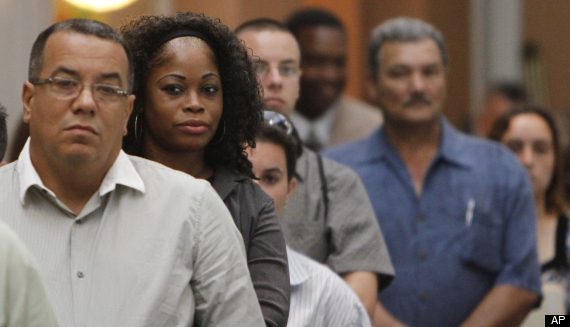
Employers Still Ruling Out Jobless Applicants: Report

Unemployed
Posted: 7/12/11 06:32 PM ET
Laura Bassett lbassett@huffingtonpost.com

Employers are still discriminating against unemployed people in their online job ads despite an increase of scrutiny on hiring practices, a new report by the National Employment Law Project has found.
HuffPost reported back in June 2010 that a number of job postings on sites such as Craigslist, Monster.com and Indeed.com explicitly ruled out jobless applicants using the language "must be currently employed," or "no unemployed candidates will be considered." According to the new NELP survey of a number of "heavily-trafficked job posting websites," employers have continued to screen out applicants solely because they are unemployed.
"This pernicious practice adds a tremendous burden for unemployed workers as they look for jobs," said Christine Owens, executive director of NELP. "For the millions of jobless Americans struggling to climb out of the deepest job hole in many decades, nothing can be more demoralizing than the double-whammy of losing a job and then learning they will not be considered for new positions because they are not currently working."
The jobs crisis is far from over: As of June, nearly 6.3 million U.S. workers had been out of work for six months or longer, according the Bureau of Labor Statistics. The average length of unemployment has steadily risen to almost 40 weeks, and there were nearly five job applicants for every job opening as of the most recent data in May.
In order to even out the playing field in the job market, Reps. Rosa DeLauro (D-Conn.) and Hank Johnson (D-Ga.) have introduced the Fair Employment Opportunity Act of 2011, which makes it illegal to discriminate against the jobless in a job advertisement or otherwise.
"I just thought about how unfair that was, to discriminate against people who had lost their jobs due to no fault of their own, who were just victims of corporate downsizing during a tough economy. And then to be penalized for having that status is just very unfair," Johnson told HuffPost. "It reminded me of the days when blacks were told to not apply for jobs, or job advertisements said 'no women allowed.'"
"I'm hopeful that this can be a bipartisan effort," he said, "because unemployment knows no demographic difference."

How News Corp. Received Billions In Tax Refunds


Source: Vermont Public Radio
July 13, 2011
As British investigators dig for details in the News Corp. scandal, a columnist for the Reuters news service looked at figures that were already public. News Corp. is a publicly-traded company in the U.S., meaning it must disclose its finances. So columnist David Cay Johnston ran those numbers and talks to Steve Inskeep about what he found.


Real Dems Beat Fake ‘Dems’ In Wisconsin Recall Primaries


TPMDC


A volunteer waits to gather signatures for a recall petition against Sen. Alberta Darling (R) outside of a polling station at Village Center in Shorewood, Wisconsin, Tuesday, April 5, 2011.
Wisconsin Democrats have easily fended off a Republican ploy in the state Senate recalls, with the official Dem candidates in each of six races easily defeating Republican activists who also filed in the Democratic primaries. But Republicans have not failed to reap some advantages from the situation.
With the vast majority of the precincts now in, all six official Democrats have been projected as the winners by the Associated Press. Only one primary, for the 10th District (GOP Sen. Sheila Harsdorf), has turned out to be tight or seriously contested, with official Dem candidate Shelly Moore winning by a margin of 54%-46%.
The other Dem primaries are nowhere near that close: Nancy Nusbaum is winning the primary for the 2nd District (Sen. Robert Cowles) by 65%-35%; Sandy Pasch is winning the 8th District (Sen. Alberta Darling) by 67%-33%; Fred Clark is winning the 14th District (Sen. Luther Olsen) by 67%-33%; Jessica King is winning the 18th District (Sen. Randy Hopper) by 68%-32%; and Jennifer Shilling is winning the 32nd District (Sen. Dan Kapanke) by 70%-30%.
Soon after the recall elections were triggered,Republicans declared a strategy to plant fake candidates in the Democratic primaries -- which they have called "protest candidates" -- in order to delay the general elections from July to August, while the GOP incumbents ran unopposed. The candidates included a GOP activist in his 20s, and an octogenarian former GOP state representative, among others. As it turned out, the scheme would cost local governments throughout the state over $400,000.
Predictably, this led to some low-level dirty tricks and mischief-making, with conservatives being urged to vote in the Democratic primaries for the fake Dems. Despite the possibility of countering this, Democrats specifically rejected entreaties by labor to respond in kind and run fake Republicans, in order to keep Republican voters in their own primaries.
However, Republicans gained an advantage from this maneuver that was about more than just the primaries themselves: By delaying the general elections to August, they bought themselves more time to quickly vote on various policies -- including a redistricting maneuver for 2012, which will involve a suspension of the state's usual redistricting procedures in order to move up the process. Of course, there is nothing too unusual about a gerrymander when a party has won full control of the legislature -- but the expediting of the normal rules, in order to beat the clock on a wave of recalls, does add to just how peculiar this whole year has been for Wisconsin.

In praise of McConnell’s plan

Posted at 06:10 PM ET, 07/12/2011


(SUSAN WALSH/ASSOCIATED PRESS)
Mitch McConnell’s debt-ceiling proposal isn’t getting very good reviews. In a conversation with me a few moments ago, Kent Conrad, a moderate Democrat who chairs the Senate Budget Committee, called it “totally and completely irresponsible.” Newt Gingrichtweets that it’s “an irresponsible surrender to big government, big deficits and continued overspending.” Kevin Drum writesthat “the whole thing is so patently, ridiculously political that it’s breathtaking.”
Me? I kinda like it.
I should say that I don’t know why House Republicans would go for it and it seems clear that this is going to be a big black eye for McConnell. But that doesn’t make it a bad plan. In essence, McConnell is proposing to permanently disarm the bomb that is the debt ceiling. He’d formalize the informal arrangement the parties have had in recent years, which is that the debt ceiling is used to embarrass the party in power, but it’s not allowed to threaten the American economy. If his plan passed, it’d become easier for the minority party to embarrass the majority party, but harder for them to threaten the economy. It’s win-win.
If you want to take a generous view of McConnell’s motivations here, you’d say that the canny Kentuckian, whose understanding of the way polarization and party discipline dominate today’s congress vastly exceeds that of any other politician, realized that it was no longer safe to assume that the two parties would always reach agreement in time to lift the debt ceiling, and in that world, the debt ceiling was too dangerous to the American economy.
The cynical interpretation of McConnell’s motivations is that McConnell sees that the White House is winning the politics of this issue, and he knows that Republicans will eventually be forced to agree to something. When they do, President Obama will be the great Compromiser-in-Chief. He’ll have shown himself willing to face down his party to make a deal and he’ll get credit for making it impossible for Republicans to continue to say no. After three years during which McConnell had slowly but surely destroyed Obama’s reputation as a postpartisan unifier, the White House will see its core political brand revived and invigorated. Obama will be a lock for reelection.
For someone who said “the single most important thing we want to achieve is for President Obama to be a one-term president,” that’s an unacceptable outcome. McConnell’s plan might not get the GOP a good deal, but it means Obama and the Democrats have to keep taking embarrassing votes, and that makes it, in theory, more likely that Obama and the Democrats lose the next election.
I’d imagine that some in the White House actually agree with this analysis. If I had to bet right now, I’d say that Obama is going to reject McConnell’s plan. “The American people sent us here to make the hard decisions,” he’ll say. That might serve his short-term political needs well. But it serves the country poorly.
Whether he’s responding to congressional dysfunction or demonstrating it, McConnell’s proposal is still a way of limiting the damage it can do to the economy. That the very forces that make it necessary make it impossible to pass seems obvious, but that doesn’t mean it shouldn’t pass. McConnell is giving us a way out of the hole we’ve dug for ourselves, and if the day ever comes that the two parties fail to raise the debt ceiling and the markets turn on us — something that may not be likely this year, but could well happen in time -- we’re going to wish we’d taken it.

Debt-Limit Harakiri


Mitch McConnell isn't selling out Republicans.


Republican Senate leader Mitch McConnell said yesterday he's concluded that no deal to raise the debt ceiling in return for serious spending restraint is possible with President Obama, and who can blame him? We've never thought the debt ceiling was the best leverage for a showdown over the entitlement state, and now it looks like Mr. Obama is trying to use it as a way to blame the GOP for the lousy economy.
This may have been the President's strategy all along: Take the debt-limit talks behind closed doors, make major spending cuts seem possible in the early days, but then hammer Republicans publicly as the deadline nears for refusing to raise taxes on business and "the rich."

Related Video

Opinion Journal columnist James Taranto on President Obama's news conference.
This would explain the President's newly discovered fondness for press conferences, which he has rarely held but now rolls out before negotiating sessions. It would also explain why Mr. Obama's tax demands have escalated as the August 2 deadline nears. Yesterday he played the Grandma Card, telling CBS that seniors may not get their August retirement checks. Next he'll send home the food inspectors and stop paying the troops.
The reality is that Mr. Obama is trying to present Republicans with a Hobson's choice: Either repudiate their campaign pledge by raising taxes, or take the blame for any economic turmoil and government shutdown as the U.S. nears a debt default. In the former case Mr. Obama takes the tax issue off the table and demoralizes the tea party for 2012, and in the latter he makes Republicans share the blame for 9.2% unemployment.
This is the political context in which to understand Mr. McConnell's proposal yesterday to force Mr. Obama to take ownership of any debt-limit increase. If the President still insists on a tax increase, then Republicans will walk away from the talks.
Mr. McConnell would then let the President propose three debt-limit increases adding up to $2.5 trillion over the coming months. Senate Republicans (with Majority Leader Harry Reid's cooperation) would use a convoluted procedure to vote for three resolutions of disapproval on the bills. Mr. Obama could veto the resolutions and 34 Democrats could vote to sustain. The President would get his debt-limit increase, but without Republicans serving as his political wingmen.
Getty Images
Senate Minority Leader Sen. Mitch McConnell
The hotter precincts of the blogosphere were calling this a sellout yesterday, though they might want to think before they shout. The debt ceiling is going to be increased one way or another, and the only question has been what if anything Republicans could get in return. If Mr. Obama insists on a tax increase, and Republicans won't vote for one, then what's the alternative to Mr. McConnell's maneuver?
Republicans who say they can use the debt limit to force Democrats to agree to a balanced budget amendment are dreaming. Such an amendment won't get the two-thirds vote to pass the Senate, but it would give every Democrat running for re-election next year a chance to vote for it and claim to be a fiscal conservative.
We agree with those who say that Treasury Secretary Tim Geithner can cut other federal spending before he allows a technical default on U.S. debt. No doubt that is what he will do. We'd even support a showdown over technical default if we thought it might yield some major government reforms. But Mr. Obama clearly has no such intention.
Instead he and Mr. Geithner will gradually shut down government services, the more painful the better. The polls that now find that voters oppose a debt-limit increase will turn on a dime when Americans start learning that they won't get Social Security checks. Republicans will then run like they're fleeing the Pamplona bulls, and chaotic retreats are the ugliest kind. By then they might end up having to vote for a debt-limit increase and a tax increase.
The tea party/talk-radio expectations for what Republicans can accomplish over the debt-limit showdown have always been unrealistic. As former Senator Phil Gramm once told us, never take a hostage you're not prepared to shoot. Republicans aren't prepared to stop a debt-limit increase because the political costs are unbearable. Republicans might have played this game better, but the truth is that Mr. Obama has more cards to play.
The entitlement state can't be reformed by one house of Congress in one year against a determined President and Senate held by the other party. It requires more than one election. The Obama Democrats have staged a spending blowout to 24% of GDP and rising, and now they want to find a way to finance it to make it permanent. Those are the real stakes of 2012.
Even if Mr. Obama gets his debt-limit increase without any spending cuts, he will pay a price for the privilege. He'll have reinforced his well-earned reputation as a spender with no modern peer. He'll own the record deficits and fast-rising debt. And he'll own the U.S. credit-rating downgrade to AA if Standard & Poor's so decides.
We'd far prefer a bipartisan deal to cut spending and reform entitlements without a tax increase. But if Mr. Obama won't go along, there's no reason Republicans should help him dodge the political consequences by committing debt-limit harakiri.