Monday, May 3, 2010
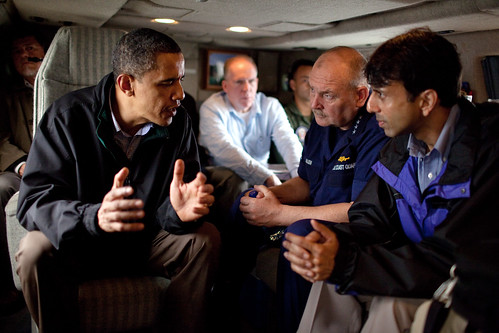
President Barack Obama talks with U.S. Coast Guard Commandant Admiral Thad Allen, who is serving as the National Incident Commander, and Louisiana Gov. Bobby Jindal, aboard Marine One as they fly along the coastline from Venice to New Orleans, La., May 2, 2010. John Brennan, Assistant to the President for Homeland Security and Counter terrorism, is in the background. (Official White House Photo by Pete Souza)
Comments
TheRedDragon Pro User says:
Nice capture
Posted 16 hours ago. ( permalink )
msrocky3 says:
Before the known trolls come on this picture, please realize what this picture is about and how those people in the gulf are suffering. It might take a bit of restraint, but please remember that the world is a big place and you are not its only inhabitant..so keep your gripes to yourself. This is not the venue for it.
Posted 16 hours ago. ( permalink )
stevej_1960 Pro User says:
Great shot. It shows a leader on the job and working with the people who are most directly going to have to deal with the mess in the GUlf.
Posted 16 hours ago. ( permalink )
vtpeacenik Pro User says:
PLEASE Mr. President, stop the off shore drilling. It is insane. How can you even consider it? I would rather see a thousand off shore wind farms than risk drilling. The definition of insanity is doing the same thing repeatedly and expecting a different result.
Stop the drilling!!!! If you continue that path I will not be able to vote for you again. I was so hopeful a year ago, but you seem to be too naive for the job, and you are too dispassionate. You should have waited 10 years.
Posted 16 hours ago. ( permalink )
stevej_1960 Pro User says:
I believe the President is serously rethinking the off-shore drilling business since it's clearly not as safe as it was sold to us as being. Our President is doing just fine if you think about it. As much as we liberals would like a leader to push through single payer health care, and other programs, the President has to be pragmatic and get what he can so change is here and it will continue, but it will have to be incremental. He's not naive, perhaps we were naive to think he'd act in a manner that isn't pragmatic? He seems to understand better than most of us that we cannot operate our nation by running roughshod over the opposition. He has to deal as a leader, not a bully.
C.Buttrill says:
I am so saddened to know our beaches will be hit today all because of this oil drilling...And who will pay for it? The economy is is such bad shape already...And now this will hurt more...Our beaches will be ruined...The wildlife and fishery will die...The tourism will stop...The money will not come in...All because of oil drilling!!! Another sad day in history. Sign of the times we are living in!
Posted 6 hours ago. ( permalink )
jAmisht says:
I don't know. If we can drill and refine our own oil, that would help balance the deficit. If more accidents (which I personally don't think anyone should be punished unless it was on purpose, which is technically sabotage) happen, then maybe there could be an X-Prize type of contest to find a better way of doing it. But before all that, we should explore without drilling anywhere and everywhere for oil.
Posted 4 hours ago. ( permalink )
Prayer Group for Obama says:
Let's keep thoughts and prayers to the people of this area, the animals and sea creatures that swim in their waters.
And please Lord, no more "drill baby, drill." Maybe Palin's millions can help save the creatures dying in the ocean waters.
Psalm 148
Praise Yah! Praise Yahweh from the heavens! Praise him in the heights!
Praise him, all his angels! Praise him, all his army!
Praise him, sun and moon! Praise him, all you shining stars!
Praise him, you heavens of heavens, Your waters that are above the heavens.
Let them praise the name of Yahweh, For he commanded, and they were created.
He has also established them forever and ever. He has made a decree which will not pass away.
Praise Yahweh from the earth, you great sea creatures, and all depths!
Lightning and hail, snow and clouds; stormy wind, fulfilling his word;
mountains and all hills; fruit trees and all cedars;
wild animals and all livestock; small creatures and flying birds;
kings of the earth and all peoples; princes and all judges of the earth;
both young men and maidens; old men and children:
Posted 3 hours ago. ( permalink )
ready aim click :-) Pro User says:
I didnt agree with Obama when he said he would allow drilling, I thought it was out of character for him. Drilling is a bad idea and they say god works in mysterious ways, this was one of those instances where it is better to heed the warning before destroying the environment. It makes me sick to see what is happeneing in the Gulf, I feel for the animals who call the Gulf home. It is our responsibility to prtotect the condition of the environment, it is clearer than ever that it is time for windmill power, its a wise and clean decision.
We should send people that support drilling to clean up the mess with their "Drill baby drill!" t-shirts. - Bill Maher
Posted 2 hours ago. ( permalink )
michaelb1 Pro User says:
That's my boss with the 4 stars on his collar.
Posted 89 minutes ago. ( permalink )
Weekly Address: Giving Government Back to the American People
Posted by Jesse Lee on May 1, 2010 at 6:00 AM EDT
As the President beats back lobbyists seeking to weaken Wall Street Reform, he talks about an even broader threat that would vastly expand the influence of massive industries and their lobbyists in Washington. A recent Supreme Court decision opened the floodgates for corporations, including foreign corporations, to spend endless money on political ads that would give them even more power at the expense of American families – the President pledges to fight for reforms to stem that influence.The Response to the Oil Spill: 5/1/10
Posted by Robert Gibbs on May 1, 2010 at 2:55 PM EDT
The response to the BP Oil Spill began as an emergency search and rescue mission by the U.S. Coast Guard and other partners on April 20.Concurrently, command center operations were stood up immediately in the Gulf Coast to begin also addressing the environmental impact of the incident.
The morning after the explosion, Secretary of the Interior Ken Salazar deployed Deputy Secretary David J. Hayes down to the gulf to assist with coordination and response to the incident.
The Administration immediately began holding regular calls with BP leadership and numerous senior-level meetings have been held between the administration and BP to discuss BP's response effort and federal oversight and support.
The National Response Team (NRT), an organization of 16 federal departments and agencies responsible for coordinating emergency preparedness and response to oil and hazardous substance pollution incidents was quickly activated and a coordinated group of federal partners-including the United States Coast Guard, Departments of Homeland Security, Commerce, Interior and the Environmental Protection Agency-immediately began directing and overseeing BP's response.
The President immediately began actively monitoring the incident and consulting on the response. The President has been in contact with all the governors of the states that may be affected and ordered that the administration use every single available resource at our disposal.
The Department of Defense is fully integrated into the DHS-led team and fully supportive of all response activities. Navy assets have been involved since day #1, and the Coast Guard and Department of Defense continue to work closely together, anticipating requirements, identifying response options, and rapidly providing response support.
The Secretary of Defense has approved a request for two C-130 aircraft with Modular Aerial Spray Systems (MASS), which are currently en route to the affected area. The Coast Guard has requested assistance from the Department of Defense for these aircraft.
These aircraft dispense the same dispersant chemical being used by BP and the federal responders. Each system is capable of covering up to 250 acres per flight with three flights per aircraft per day.
Additionally, in direct support of the Coast Guard under an existing pollution clean-up and salvage operations agreement, the Navy is providing a variety of oil pollution control equipment. The Navy has sent thousands of feet of inflatable oil boom with mooring equipment, several skimming systems, related support gear, and personnel to support oil spill response efforts. Naval Air Station Pensacola is serving as a staging facility for Coast Guard contractor-provided equipment.
To prepare for the possible spreading of the oil slick across the Gulf Coast and in support of the 2nd Unified command Center in Mobile, Ala., Department of Defense is airlifting additional boom materials to Mobile later today. The booms are currently located on four tractor trailers to expedite transportation on the receiving end.
Early on, the President directed responding agencies to not only devote every resource to respond to this incident but to also determine its cause. Earlier this week, Secretary of Homeland Security Janet Napolitano and Secretary of the Interior Ken Salazar laid out the next steps for the investigation.
The President has also dispatched Secretary Napolitano, Secretary Salazar, EPA Administrator Jackson, Assistant to the President for Energy and Climate Change Policy Carol Browner and NOAA Administrator Jane Lubchenco to the Gulf Coast to ensure all is being done to respond to this oil spill.
Secretary Napolitano announced that this incident is a spill of national significance, the Department of Interior has announced that they will be sending SWAT teams to the Gulf to inspect all platforms and rigs, and the EPA is conducting air monitoring activities to gather information on the impact of the controlled burn on air quality.
As part of the designation of the BP Oil Spill as a Spill of National Significance, Secretary Napolitano has announced that U.S. Coast Guard Commandant Admiral Thad Allen will serve as the National Incident Commander for the administration's continued, coordinated response—providing additional authority and oversight in leveraging every available resource to respond to the BP oil spill and minimize the associated environmental risks.
As National Incident Commander, Admiral Allen will continue to work closely with Coast Guard Rear Admiral Mary Landry, the federal on-scene coordinator, and the Departments of Homeland Security, Defense, Interior and Commerce, the Environmental Protection Agency and other federal departments and agencies as appropriate—as well as BP, the responsible party in the spill—to ensure the efficient continued deployment and coordination of vital response assets, personnel and equipment that were activated immediately after the spill began.
To keep the public informed about the latest, validated environmental air and water sampling results, EPA has launched a dedicated website at www.epa.gov/bpspill, which will also provide information on the broader federal response.
In response to the BP oil spill, the Secretary of Defense is authorizing under title 32 the mobilization of the Louisiana National Guard to help in the ongoing efforts to assist local communities in the cleanup and removal of oil and to protect critical habitats from contamination. As the responsible party in this incident, the government will hold BP accountable for the costs of the deployment.
The Minerals Management Service remains in contact with all oil and gas operators in the sheen area. Two platforms have stopped production and one has been evacuated as a safety measure. Approximately 6.2 million cubic feet of natural gas is shut-in—less than one-tenth of a percent of daily gas production in the Gulf of Mexico.
As the nation’s leading scientific resource for oil spills, NOAA has been on the scene of the BP spill from the start, providing coordinated scientific weather and biological response services to federal, state and local organizations. NOAA spill specialists are advising the U.S. Coast Guard on cleanup options as well as advising all affected federal, state and local partners on sensitive marine resources at risk in this area of the Gulf of Mexico.
Rapid response teams are staged to deploy to shorelines affected by oil to evaluate and determine an appropriate clean-up effort to minimize the impact to the environment.
A volunteer program has been established and a toll-free number—(866)-448-5816—set up for people to call to learn about volunteer opportunities in all areas and what training is required.
By the Numbers to Date:
- Personnel were quickly deployed and nearly 2,000 are currently responding to protect the shoreline and wildlife—hundreds more than yesterday.
- Approximately 75 response vessels have been responding on site, including skimmers, tugs, barges, and recovery vessels to assist in containment and cleanup efforts—in addition to dozens of aircraft, remotely operated vehicles, and multiple mobile offshore drilling units.
- More than 275,000 feet of boom (barrier) have been deployed to contain the spill—an increase of nearly 60,000 feet since yesterday. An additional 316,470 feet is available.
- More than 1 million gallons of an oil-water mix have been recovered—an increase of approximately 150,000 gallons since yesterday.
- Nearly 143,000 gallons of dispersant have been deployed—an increase of more than 3,500 gallons since yesterday. An additional 68,300 gallons are available.
- Six staging areas (Biloxi, Miss., Pensacola, Fla., Venice, La., Pascagoula, Miss. and Theodore, Ala., and Port Sulphur, La.) were set up to protect sensitive shorelines.
Remarks by the President at White House Correspondents Association Dinner
The White House
Office of the Press SecretaryFor Immediate Release
May 02, 2010
Washington Hilton Hotel, Washington, D.C.
10:04 P.M. EDTTHE PRESIDENT: Thank you so much, Ed. And to all the other board members; to honored guests; and to the lovely First Lady. (Applause.) Good evening.
Ed is right, I work a lot. And so I wasn’t sure that I should actually come tonight. Biden talked me into it. (Laughter.) He leaned over and he said, "Mr. President -- (laughter) -- this is no ordinary dinner. (Laughter.) This is a big (beep) meal." (Applause.)
It's been quite a year since I've spoken here last -- lots of ups, lots of downs -- except for my approval ratings, which have just gone down. (Laughter.) But that's politics. It doesn’t bother me. Beside I happen to know that my approval ratings are still very high in the country of my birth. (Laughter and applause.)
And then just the other day, my dear friend, Hillary Clinton, pulled me aside and she gave me a pep talk. She said, despite the numbers, she said, "Don't worry, Barack, you're likeable enough." (Laughter.) Which made me feel better.
Of course I may not have had the star power that I once had -- but in my defense, neither do all of you. (Laughter.)
People say to me, "Mr. President, you helped revive the banking industry, you saved GM and Chrysler. What about the news business?" I have to explain, hey, I'm just the President. (Laughter.) I'm not a miracle worker, here. (Laughter.)
Though I am glad that the only person whose ratings fell more than mine last year is here tonight -- great to see you, Jay. (Laughter and applause.) I'm also glad that I'm speaking first, because we've all seen what happens when somebody takes the time slot after Leno's. (Laughter.)
JAY LENO: Goodnight, everybody. (Laughter.)
THE PRESIDENT: By the way, all of the jokes here tonight are brought to you by our friends at Goldman Sachs. (Laughter.) So you don't have to worry -- they make money whether you laugh or not. (Laughter.)
We do have a number of notable guests in attendance here tonight. Obviously I'm most pleased that Michelle accompanied me. She doesn’t always go to these things. (Applause.) And there are few things in life that are harder to find and more important to keep than love -- well, love and a birth certificate. (Laughter.)
The Jonas Brothers are here. (Applause.) They're out there somewhere. Sasha and Malia are huge fans. But, boys, don't get any ideas. (Laughter.) I have two words for you -- predator drones. (Laughter.) You will never see it coming. (Laughter.) You think I'm joking. (Laughter.)
Speaking of 'tween heartthrobs, Scott Brown is here. (Applause.) I admire Scott -- a rare politician in Washington with nothing to hide. (Laughter.) Now, you should be aware that Scott Brown is not the only one with a salacious photo spread floating around. Recently David Axelrod was offered a centerfold opportunity of his own -- now, I did not know that Krispy-Kreme had a catalog. (Laughter.) But it's true.
I saw Michael Steele backstage when we were taking pictures -- AKA Notorious GOP. (Laughter.) Michael, who knows what truly plagues America today -- taxation without representin' --(Laughter.) My brother. (Laughter.) I did a similar routine last year, but it always works. (Laughter.)
Odds are that the Salahis are here. (Laughter.) There haven't been people that were more unwelcome at a party since Charlie Crist. (Laughter.)
Unfortunately, John McCain couldn't make it. Recently he claimed that he had never identified himself as a maverick. And we all know what happens in Arizona when you don't have ID. (Laughter.) Adios, amigos. (Laughter and applause.)
Look, I feel for John. You know, we were on the road together and obviously had a hard-fought battle, and you learn, certainly at the national level, politics isn’t easy. This year I've experienced my share of disappointments. For example, I had my heart set on the Nobel Prize -- for Physics. (Laughter.) But, hey, you can't win 'em all. (Laughter.)
Speaking of undeserved honors, a few weeks ago I was able to throw out the first pitch at the Nationals game. And I don't know if you saw it, but I threw it a little high and a little outside. This is how FOX News covered it: "President panders to extreme left-wing of batter box." (Laughter.) On the other hand, MSNBC had a different take -- "President pitches no-hitter." (Laughter.) And then CNN went a different way altogether -- (video is shown about volcano eruption in Iceland) -- I guess that's why they're the most trusted name in news. (Laughter.)
Now, look, I have a reputation for giving cable a hard time, so let's pick on Politico for a while. (Laughter.) You know, people attack Politico for putting a new focus on trivial issues, political fodder, gossip sheet. That's not fair. Politico has been doing this for centuries now. Just check out these headlines -- our researchers found these: "Japan surrenders -- where's the bounce?" Then there's this one: "Lincoln saves Union, but can he save House majority?" I don't know if you can see, there's a little portion there -- "He's lost the Southern white vote." (Laughter.) It's an astute analysis there.
And my favorite, July 3, 1776 -- "Senior Whig official: Talks break down, independence dead." (Laughter.)
So this is nothing new. But even though the mainstream press gives me a hard time, I hear that I'm still pretty big on Twitter, Facebook -- or as Sarah Palin calls it, "the socialized media." (Laughter.)
Of course, that's not the only thing that we've been accused of socializing this year. You might have heard we passed a health care bill and -- (applause.) Is that Roger Ailes applauding out there? (Laughter.) Some Republicans have suggested that the bill contains a few secret provisions. That's ridiculous. There aren’t a few secret provisions in the health care plan -- there are, like, hundreds. (Laughter.)
Tonight, in the interest of transparency, I'd like to share a couple. Let's see -- this provision is called the Bay State of Denial. It reads: "This bill shall cover short-term memory loss related to the passage of Massachusetts health care reform." So, good news, Mitt, your condition is covered. (Laughter.)
This next provision is called the Jersey Shore-Up. It reads: "The following individuals shall be excluded from the indoor tanning tax within this bill." Snooki, J-WOWW, the Situation, and House Minority Leader John Boehner. (Laughter.)
This provision ought to put a common misperception to rest. It says right here: "If you do not like the ruling of your death panel you can appeal." (Laughter.)
Now, look, obviously I've learned this year politics can be a tough business, but there are times where you just can't help but laugh. You know what really tickles me? Eric Massa. (Laughter.) Apparently Massa claimed that Rahm came up to him one day in the House locker room, stark naked, started screaming obscenities at him -- to which I say, welcome to my world. (Laughter.) I feel you. It's a tense moment.
You know, even as we enjoy each other's company tonight, we're also mindful of the incredible struggles of our fellow Americans in the Gulf Coast, both those leading the efforts to stem this crisis and those along the coast whose livelihoods are in jeopardy as a result of the spill.
Also in our thoughts and prayers tonight are the men and women in uniform who put their lives at risk each and every day for our safety and freedom. (Applause.) So in that spirit, I'd also like to pay a tribute to the journalists who play an extraordinary role in telling their stories.
Earlier today I gave the commencement address at Michigan, where I spoke to the graduates about what is required to keep out democracy thriving in the 21st century. And one of the points I made is that for all the changes and challenges facing your industry, this country absolutely needs a healthy, vibrant media. 'Probably needs it more than ever now.
Today's technology -- (applause) -- today's technology has made it possible for us to get our news and information from a growing range of sources. We can pick and choose not only our preferred type of media, but also our preferred perspective. And while that exposes us to an unprecedented array of opinions, analysis, and points of view, it also makes it that much more important that we're all operating on a common baseline of facts. It makes it that much more important that journalists out there seek only the truth.
And I don't have to tell you that. Some of you are seasoned veterans who have been on the political beat for decades; others here tonight began their careers as bloggers not long ago. But I think it's fair to say that every single reporter in this room believes deeply in the enterprise of journalism. Every one of you, even the most cynical among you, understands and cherishes the function of a free press and the preservation of our system of government and of our way of life.
And I want you to know that for all the jokes and the occasional gripes, I cherish that work, as well. In fact, tonight I wanted to present all of you with a bipartisan congressional resolution that honors all those wonderful contributions that journalists have made to our country and the world -- but, unfortunately, I couldn't break the filibuster. (Laughter.)
Thank you very much, everybody. God bless you and God bless the United States of America. (Applause.)
END
10:21 P.M. EDT
President Obama Trades Jokes with Jay Leno
President Obama made his second appearance at the annual White House Press and Scholarship Dinner last night in Washington, D.C. He took the dais before the headliner Jay Leno, remarking, "I’m also glad to be speaking first. We’ve all seen what happens to the person in the time slot after Leno."
But Leno was far from the only subject of the President's jokes. Senators, Members of Congress and his own Administration were all fair game. Of the recently passed health reform legistlation, he noted:
President Barack Obama and First Lady Michelle Obama attend the White House Correspondents Association Dinner at the Washington Hilton in Washington, D.C. May 1, 2010. (Official White House Photo by Lawrence Jackson)
Posted by Jason Djang on May 2, 2010 at 9:09 AM EDT
Read President Obama's full speech on the next entry
President Obama made his second appearance at the annual White House Press and Scholarship Dinner last night in Washington, D.C. He took the dais before the headliner Jay Leno, remarking, "I’m also glad to be speaking first. We’ve all seen what happens to the person in the time slot after Leno."
But Leno was far from the only subject of the President's jokes. Senators, Members of Congress and his own Administration were all fair game. Of the recently passed health reform legistlation, he noted:
You might have heard we passed a health care bill. And some Republicans have suggested that the bill contains a few “secret” provisions. That’s ridiculous. There aren’t a few secret provisions in the health care plan. There are like hundreds. And tonight, in the interest of transparency, I’d like to share a couple. Let’s see here. This provision is called the “Bay State of Denial.” It reads, “This bill shall cover short-term memory loss related to the passage of Massachusetts health care reform.” Good news, Mitt, your condition is covered! This next provision is called the “Jersey Shore-Up.” It reads, “The following individuals shall be excluded from the indoor tanning tax within this bill: Snooki, J-Woww, the Situation, and House Minority Leader John Boehner.” This provision ought to put a common misconception to rest. It says right here: “If you do not like the ruling of your death panel, you can appeal it.”
He concluded his remarks before Leno took the stage with a reminder of the necessary role of the fourth estate:Some of you are seasoned veterans who have been on the political beat for decades. Others here tonight began their careers as bloggers not long ago. But I think it’s fair to say that every single reporter in this room believes deeply in the enterprise of journalism. Every one of you, even the most cynical among you, understands and cherishes the function of a free press in the preservation of our system of government and our way of life. And I want you to know that for all the jokes and occasional gripes, I cherish that work as well. In fact, tonight, I wanted to present you all with a bipartisan, Congressional resolution that honors all those wonderful contributions that journalists have made to our country and our world. Unfortunately, I couldn’t break the filibuster.
The President also noted his ongoing concerns for the BP oil spill and the residents of the Gulf Coast. He will be traveling to the region later today.
President Barack Obama and First Lady Michelle Obama attend the White House Correspondents Association Dinner at the Washington Hilton in Washington, D.C. May 1, 2010. (Official White House Photo by Lawrence Jackson) "A Massive and Potentially Unprecedented Environmental Disaster"
Posted by Jesse Lee on May 02, 2010 at 07:09 PM EDT
Dead Sea turles washing up on shore at least 20 watch video
[UPDATE 5/2/10 9:30PM: Learn more from Press Secretary Robert Gibbs' briefing aboard Air Force One on the return trip from the Gulf Coast.]
The President spent the day touring the Gulf Coast area and getting a first-hand look at the ongoing response from the federal government to the BP oil spill (the EPA has also dedicated a site to keeping the public up to date on that response). After speaking to Admiral Thad Allen, who is serving as National Incident Commander, along with Coast Guard personnel, the President gave an update from Venice, Louisiana. After commending the police officers and citizens of New York who reacted so swiftly to the incident in Times Square, he spoke at length on the terrible situation surrounding the spill:
They gave me a sense of how this spill is moving. It is now about nine miles off the coast of southeastern Louisiana. And by the way, we had the Governor of Louisiana, Bobby Jindal, as well as parish presidents who were taking part in this meeting, because we want to emphasize the importance of coordinating between local, state, and federal officials throughout this process.
Now, I think the American people are now aware, certainly the folks down in the Gulf are aware, that we're dealing with a massive and potentially unprecedented environmental disaster. The oil that is still leaking from the well could seriously damage the economy and the environment of our Gulf states and it could extend for a long time. It could jeopardize the livelihoods of thousands of Americans who call this place home.
And that's why the federal government has launched and coordinated an all-hands-on-deck, relentless response to this crisis from day one. After the explosion on the drilling rig, it began with an aggressive search-and-rescue effort to evacuate 115 people, including three badly injured. And my thoughts and prayers go out to the family of the 11 workers who have not yet -- who have not been found.
When the drill unit sank on Thursday, we immediately and intensely investigated by remotely operated vehicles the entire 5,000 feet of pipe that's on the floor of the ocean. In that process, three leaks were identified, the most recent coming just last Wednesday evening. As Admiral Allen and Secretary Napolitano have made clear, we've made preparations from day one to stage equipment for a worse-case scenario. We immediately set up command center operations here in the Gulf and coordinated with all state and local governments. And the third breach was discovered on Wednesday.
We already had by that time in position more than 70 vessels and hundreds of thousands of feet of boom. And I dispatched the Secretaries of the Interior and Homeland Security; the Administrator of the EPA, Lisa Jackson, who is here; my Assistant for Energy and Climate Change Policy; and the Administrator of NOAA to the Gulf Coast to ensure that we are doing whatever is required to respond to this event.
So I want to emphasize, from day one we have prepared and planned for the worst, even as we hoped for the best. And while we have prepared and reacted aggressively, I'm not going to rest -- and none of the gentlemen and women who are here are going to rest -- or be satisfied until the leak is stopped at the source, the oil on the Gulf is contained and cleaned up, and the people of this region are able to go back to their lives and their livelihoods.
Currently, the most advanced technology available is being used to try and stop a leak that is more than 5,000 feet under the surface. Because this leak is unique and unprecedented, it could take many days to stop. That's why we're also using every resource available to stop the oil from coming ashore and mitigating the damage it could cause. And much of the discussion here at the center was focused on if we, and when we have to deal with these mitigation efforts.
Thus far, as you can tell, the weather has not been as cooperative as we'd like on this front. But we're going to continue to push forward.
I also want to stress that we are working closely with the Gulf states and local communities to help every American affected by this crisis. Let me be clear: BP is responsible for this leak; BP will be paying the bill. But as President of the United States, I'm going to spare no effort to respond to this crisis for as long as it continues. And we will spare no resource to clean up whatever damage is caused. And while there will be time to fully investigate what happened on that rig and hold responsible parties accountable, our focus now is on a fully coordinated, relentless response effort to stop the leak and prevent more damage to the Gulf.
I want to thank the thousands of Americans who've been working around the clock to stop this crisis -- whether it's the brave men and women of our military, or the local officials who call the Gulf home. They are doing everything in their power to mitigate this disaster, prevent damage to our environment, and help our fellow citizens.
During this visit, I am hoping to have the opportunity to speak with some of the individuals who are directly affected by the disaster. I've heard already that people are, understandably, frustrated and frightened, especially because the people of this region have been through worse disasters than anybody should have to bear.
But every American affected by this spill should know this: Your government will do whatever it takes, for as long as it takes, to stop this crisis.
This is one of the richest and most beautiful ecosystems on the planet, and for centuries its residents have enjoyed and made a living off the fish that swim in these waters and the wildlife that inhabit these shores. This is also the heartbeat of the region's economic life. And we're going to do everything in our power to protect our natural resources, compensate those who have been harmed, rebuild what has been damaged, and help this region persevere like it has done so many times before.
That's a commitment I'm making as President of the United States, and I know that everybody who works for the federal government feels the exact same way.

President Barack Obama tours the Louisiana Coastline between Venice and New Orleans in the Gulf Coast region to view recovery efforts firsthand following the BP oil well spill, Sunday, May 2, 2010.
"A Massive and Potentially Unprecedented Environmental Disaster" | The White House: http://bit.ly/dkh9AB via @addthis
Saturday, May 1, 2010
Gulf oil spill swiftly balloons, could move east
By ALLEN G. BREED and SETH BORENSTEIN, Associated Press Writers Allen G. Breed And Seth Borenstein, Associated Press Writers 1 hr 52 mins ago
video's I could not embed sorry
VENICE, La. – A sense of doom settled over the American coastline from Louisiana to Florida on Saturday as a massive oil slick spewing from a ruptured well kept growing, and experts warned that an uncontrolled gusher could create a nightmare scenario if the Gulf Stream carries it toward the Atlantic.
President Barack Obama planned to visit the region Sunday to assess the situation amid growing criticism that the government and oil company BP PLC should have done more to stave off the disaster. Meanwhile, efforts to stem the flow and remove oil from the surface by skimming it, burning it or spiking it with chemicals to disperse it continued with little success.
"These people, we've been beaten down, disaster after disaster," said Matt O'Brien of Venice, whose fledgling wholesale shrimp dock business is under threat from the spill.
"They've all got a long stare in their eye," he said. "They come asking me what I think's going to happen. I ain't got no answers for them. I ain't got no answers for my investors. I ain't got no answers."
He wasn't alone. As the spill surged toward disastrous proportions, critical questions lingered: Who created the conditions that caused the gusher? Did BP and the government react robustly enough in its early days? And, most important, how can it be stopped before the damage gets worse?
The Coast Guard conceded Saturday that it's nearly impossible to know how much oil has gushed since the April 20 rig explosion, after saying earlier it was at least 1.6 million gallons — equivalent to about 2 1/2 Olympic-sized swimming pools. The blast killed 11 workers and threatened beaches, fragile marshes and marine mammals, along with fishing grounds that are among the world's most productive.
Even at that rate, the spill should eclipse the 1989 Exxon Valdez incident as the worst U.S. oil disaster in history in a matter of weeks. But a growing number of experts warned that the situation may already be much worse.
The oil slick over the water's surface appeared to triple in size over the past two days, which could indicate an increase in the rate that oil is spewing from the well, according to one analysis of images collected from satellites and reviewed by the University of Miami. While it's hard to judge the volume of oil by satellite because of depth, it does show an indication of change in growth, experts said.
"The spill and the spreading is getting so much faster and expanding much quicker than they estimated," said Hans Graber, executive director of the university's Center for Southeastern Tropical Advanced Remote Sensing. "Clearly, in the last couple of days, there was a big change in the size."
Doug Suttles, BP's chief operating officer for exploration and production, said it was impossible to know just how much oil was gushing from the well, but said the company and federal officials were preparing for the worst-case scenario.
Oil industry experts and officials are reluctant to describe what, exactly, a worst-case scenario would look like — but if the oil gets into the Gulf Stream and carries it to the beaches of Florida, it stands to be an environmental and economic disaster of epic proportions.
The Deepwater Horizon well is at the end of one branch of the Gulf Stream, the famed warm-water current that flows from the Gulf of Mexico to the North Atlantic. Several experts said that if the oil enters the stream, it would flow around the southern tip of Florida and up the eastern seaboard.
"It will be on the East Coast of Florida in almost no time," Graber said. "I don't think we can prevent that. It's more of a question of when rather than if."
At the joint command center run by the government and BP near New Orleans, a Coast Guard spokesman maintained Saturday that the leakage remained around 5,000 barrels, or 200,000 gallons, per day.
But Coast Guard Adm. Thad Allen, appointed Saturday by Obama to lead the government's oil spill response, said no one could pinpoint how much oil is leaking from the ruptured well because it is about a mile underwater.
"And, in fact, any exact estimation of what's flowing out of those pipes down there is probably impossible at this time due to the depth of the water and our ability to try and assess that from remotely operated vehicles and video," Allen said during a conference call.
The Coast Guard's Allen said Saturday that a test of new technology used to reduce the amount of oil rising to the surface seemed to be successful.
During the test Friday, an underwater robot shot a chemical meant to break down the oil at the site of the leak rather than spraying it on the surface from boats or planes, where the compound can miss the oil slick.
From land, the scope of the crisis was difficult to see. As of Saturday afternoon, only a light sheen of oil had washed ashore in some places.
The real threat lurked offshore in a swelling, churning slick of dense, rust-colored oil the size of Puerto Rico. From the endless salt marshes of Louisiana to the white-sand beaches of Florida, there is uncertainty and frustration over how the crisis got to this point and what will unfold in the coming days, weeks and months.
The concerns are both environmental and economic. The fishing industry is worried that marine life will die — and that no one will want to buy products from contaminated water anyway. Tourism officials are worried that vacationers won't want to visit oil-tainted beaches. And environmentalists are worried about how the oil will affect the countless birds, coral and mammals in and near the Gulf.
"We are just waiting," said Meghan Calhoun, a spokeswoman from the Audubon Aquarium of the Americas in New Orleans. "We know they are out there. Unfortunately the weather has been too bad for the Coast Guard and NOAA to get out there and look for animals for us."
Fishermen and boaters want to help contain the oil. But on Saturday, they were again hampered by high winds and rough waves that splashed over the miles of orange and yellow inflatable booms strung along the coast, rendering them largely ineffective. Some coastal Louisiana residents complained that BP, which owns the rig, was hampering mitigation efforts.
"They're letting an oil company tell a state what to do," said 57-year-old Raymond Schmitt, in Venice preparing his boat to take a French television crew on a tour.
"I don't know what they are waiting on," Schmitt said. He didn't think conditions were dangerous. "No, I'm not happy with the protection, but I'm sure the oil company is saving money."
As bad as the oil spill looks on the surface, it may be only half the problem, said University of California Berkeley engineering professor Robert Bea, who serves on a National Academy of Engineering panel on oil pipeline safety.
"There's an equal amount that could be subsurface too," said Bea. And that oil below the surface "is damn near impossible to track."
Louisiana State University professor Ed Overton, who heads a federal chemical hazard assessment team for oil spills, worries about a total collapse of the pipe inserted into the well. If that happens, there would be no warning and the resulting gusher could be even more devastating because regulating flow would then be impossible.
"When these things go, they go KABOOM," he said. "If this thing does collapse, we've got a big, big blow."
BP has not said how much oil is beneath the Gulf seabed Deepwater Horizon was tapping, but a company official speaking on condition of anonymity because he was not authorized to discuss the volume of reserves, confirmed reports that it was tens of millions of barrels — a frightening prospect to many.
Louisiana Gov. Bobby Jindal said that he has asked both BP and the Coast Guard for detailed plans on how to protect the coast.
"We still haven't gotten those plans," said Jindal. "We're going to fully demand that BP pay for the cleanup activities. We're confident that at the end of the day BP will cover those costs."
Obama has halted any new offshore drilling projects unless rigs have new safeguards to prevent another disaster.
As if to cut off mounting criticism, on Saturday White House spokesman Robert Gibbs posted a blog entitled "The Response to the Oil Spill," laying out the administration's day-by-day response since the explosion, using words like "immediately" and "quickly," and emphasizing that Obama "early on" directed responding agencies to devote every resource to the incident and determining its cause.
In Pass Christian, Miss., 61-year-old Jimmy Rowell, a third-generation shrimp and oyster fisherman, worked on his boat at the harbor and stared out at the choppy waters.
"It's over for us. If this oil comes ashore, it's just over for us," Rowell said angrily, rubbing his forehead. "Nobody wants no oily shrimp."
Experts: Oil spill is the ‘bad one’ they feared
Environmental effect compared to Category 5 hurricane
In this August 1979 photo, Mexico's runaway Ixtoc 1 oil well dumps oil into the Gulf of Mexico in what was the worst peacetime oil spill on record. | |
By Seth Borenstein
The Associated Press
updated 6:21 p.m. ET, Fri., April 30, 2010
WASHINGTON - What makes an oil spill really bad? Most of the ingredients for it are now blending in the Gulf of Mexico.
Experts tick off the essentials: A relentless flow of oil from under the sea; a type of crude that mixes easily with water; a resultant gooey mixture that is hard to burn and even harder to clean; water that's home to vulnerable spawning grounds for new life; and a coastline with difficult-to-scrub marshlands.
Gulf Coast experts have always talked about "the potential for a bad one," said Wes Tunnell, coastal ecology and oil spill expert at Texas A&M University-Corpus Christi. "And this is the bad one. This is just a biggie that finally happened."
Recipe for devastation
It hasn't quite become a total disaster yet. But it's hard to imagine it not being devastating, said Ed Overton, who heads a federal chemical hazard assessment team for oil spills. The Louisiana State University professor has been testing samples of the spilled crude.
He compared what's brewing to another all-too-familiar Gulf Coast threat: "This has got all the characteristics of a Category 5 hurricane."
If conditions don't change quickly, devastation of the highest magnitude is headed for somewhere along the coast, said Overton, who works with the National Oceanic and Atmospheric Administration.
More than 200,000 gallons of oil a day are spewing from the blown-out well at the site of BP's Deepwater Horizon rig, which exploded April 20 and sank two days later. Crews are using at least six remotely operated vehicles to try to shut off an underwater valve, but so far they've been unsuccessful. Meanwhile, high winds and waves are pushing oily water over the booms meant to contain it. Besides BP, a slew of federal and state agencies are scrambling to minimize the onslaught of damage.
'This is relentless'Experts in oil spills have drills every few years to practice their response for spills of "national significance." One of those practice runs took place just last month in Maine. The Gulf of Mexico leak is a "combination of all the bad things happening" and makes it far worse than any disaster imagined in the drills, said Nancy Kinner, director of the Coastal Response Research Center at the University of New Hampshire.
"This is relentless," Kinner said.Most Americans think of Exxon Valdez when it comes to spills. But the potential and likelihood here "is well beyond that," said University of Rhode Island ocean engineering professor Malcolm Spaulding. Because the Deepwater Horizon well has not been capped and may flow for months more, it should be compared to a bigger more dangerous one from a well explosion in 1979, said Tunnell. That was Ixtoc 1, off the coast of Mexico. It was the worst peacetime oil spill on record.
The current spill "is kind of a worst-case scenario," Tunnell said.
What makes this spill relentless and most similar to Ixtoc 1 is that it's an active well that keeps flowing. The Exxon Valdez was a tanker with a limited supply of oil. The rig 40 miles from the Gulf Coast may leak for months before a relief well can be drilled to stop the flow, Kinner said.
And LSU's Overton said: "I'm not very optimistic that they'll be drilling a relief well in three months."
Type of oil also a problemThe type of oil involved is also a major problem. While most of the oil drilled off Louisiana is a lighter crude, this isn't. It's a heavier blend because it comes from deep under the ocean surface, Overton said.
"If I had to pick a bad oil, I'd put this right up there. The only thing that's not bad about this is that it doesn't have a lot of sulfur in it and the high sulfur really smells bad."
The first analysis of oil spill samples showed it contains asphalt-like substances that make a major sticky mess, he said. This is because the oil is older than most oil in the region and is very dense.
This oil also emulsifies well, Overton said. Emulsification is when oil and water mix thoroughly together, like a shampoo, which is mostly water, said Penn State engineering professor Anil Kulkarni.
It "makes a thick gooey chocolate mousse type of mix," Kulkarni said.
And once it becomes that kind of mix, it no longer evaporates as quickly as regular oil, doesn't rinse off as easily, can't be eaten by oil-munching microbes as easily, and doesn't burn as well, experts said.
That type of mixture essentially removes all the best oil clean-up weapons, Overton and others said.
Under better circumstances, with calmer winds and water, the oil might have a chance of rising without immediately emulsifying, but that's not happening here, Kulkarni said. It's pretty much mixed by the time it gets to the surface.
Winds and wavesThe wind and waves are also pushing the oil directly toward some of the most sensitive coastal areas: the marshlands of Louisiana and surrounding states.
And there are three types of beaches: sandy, rocky and marshy. Sandy beaches, like those in Florida, are the easiest to clean, Overton said. By far the hardest are marshlands and that's where the oil is heading first.
Marshes are so delicate that just trying to clean them causes damage, Kinner said. Once the oily mess penetrates, grasses must be cut. But it also penetrates the soil and that is extremely difficult to get out, she said.
The normal bacteria that eats oil needs oxygen to work, and in the soils of the marsh, there's not enough oxygen for that process, she said.
It's also the time of year in the Gulf of Mexico when fish spawn, plankton bloom and the delicate ecosystem is at a vulnerable stage.
Hurricane season is fast approaching in June and experts are sure the oil will still be flowing by then. Though it might seem counterintuitive, a big storm could help by dispersing and diluting the worst of the oil, Overton said.
"A hurricane is Mother Nature's vacuum cleaner," Overton said. Normally it cleans things up. But that's not a solution with a continuing spill.
© 2010 The Associated Press. All rights reserved. This material may not be published, broadcast, rewritten or redistributed.
Obama shelves new offshore drilling
'Must be done responsibly,' president says after rig disaster

Obama shelves new drilling as oil hits La.
'Must be done responsibly,' president says after rig disaster

MSNBC.com |
Obama shelves new drilling as oil hits La.
'Must be done responsibly,' president says after rig disaster
msnbc.com staff and news service reports
updated 12:11 p.m. ET, Fri., April 30, 2010
WASHINGTON - President Barack Obama on Friday directed that no new offshore oil drilling leases be issued unless rigs have new safeguards to prevent a repeat of the explosion that unleashed the massive spill threatening the Gulf Coast with major environmental damage.
Florida Gov. Charlie Crist, meanwhile, declared a state of emergency in the state's Panhandle coastal counties because of the threat.
"The oil slick is generally moving in a northerly direction and threatens Florida's coast," Crist said in the order declaring the emergency in Escambia, Santa Rosa, Okaloosa, Walton, Bay, and Gulf counties.
Obama ordered Interior Secretary Ken Salazar to report within 30 days on what new technologies are needed to tighten safeguards against oil spills from deepwater drilling rigs.
"We are making sure any leases going forward have those safeguards," said Obama at a White House Rose Garden event.
Obama's declaration is not expected to have any immediate impact. Under the expanded leasing plan Obama announced a month ago, the first offshore leases would be issued off the Virginia coast in 2012 at the earliest.
It is still unclear what caused the explosion on the BP rig more than 40 miles off the Louisiana coast. About 5,000 barrels of oil a day, 0r 210,000 gallons, are estimated to be spewing from three well leaks on the ocean floor.
Obama said supports domestic drilling for oil and natural gas but that it "must be done responsibly for the safety of our workers and our environment."Senior adviser David Axelrod earlier defended the administration's response to the April 20 accident, saying "we had the Coast Guard in almost immediately."
He deflected comparisons with the government's slow response to Hurricane Katrina in 2005, telling ABC's "Good Morning America" that such speculation "is always the case in Washington whenever something like this happens."
Axelrod said "no additional drilling has been authorized and none will until we find out what has happened here."
Coast Guard Rear Adm. Sally Brice-O'Hara also faced questions on all three network television morning shows Friday about whether the government has done enough to push oil company BP PLC to plug the underwater leak and protect the coast.
Brice-O'Hara said the federal response led by the Coast Guard has been rapid, sustained and has adapted as the threat grew since a drill rig exploded and sank last week, causing the spill.
She said crews would be unable to skim oil from the surface or burn it off for the next couple of days because of the weather.
Billions in damages possibleBP, for its part, said Friday it would compensate all those affected by the leak.
"We are taking full responsibility for the spill and we will clean it up and where people can present legitimate claims for damages we will honor them. We are going to be very, very aggressive in all of that," BP CEO Tony Hayward told Reuters.
The cost to the fishing industry in Louisiana could be $2.5 billion while the impact on tourism along Florida's Paradise coast could be $3 billion, Neil McMahon, analyst at investment firm Bernstein, said in a research note on Friday.
The spill could also hit Obama's plans to open some offshore areas of the U.S. where oil exploration is currently barred, to drilling, Hayward acknowledged.
"There may be an industry issue around what may or may not be opened," he said. The cost to the fishing industry in Louisiana could be $2.5 billion while the impact on tourism along Florida's Paradise coast could be $3 billion, Neil McMahon, analyst at investment firm Bernstein, said in a research note on Friday.
The spill could also hit Obama's plans to open some offshore areas of the U.S. where oil exploration is currently barred, to drilling, Hayward acknowledged.
However the CEO hopes an effective response to the spill, including a flotilla of around 80 vessels and several aircraft, would reassure people about the risks from drilling.
"It would be bizarre to say it shouldn't influence the debate. How the debate will come out, I think ultimately will be judged by the success we have in dealing with this incident."
Regulations on drilling safety will also come under scrutiny, Hayward predicted.
"It would be bizarre to say it shouldn't influence the debate. How the debate will come out, I think ultimately will be judged by the success we have in dealing with this incident."
Regulations on drilling safety will also come under scrutiny, Hayward predicted.
"Rightly, there will be a reaction. Whenever you have something of this significance, it's right that regulators should look very hard at what they can do to further ensure that something like this never happens again," he said.
He said possible changes could relate to testing of equipment like the blow-out preventer on the ocean floor which failed to operate correctly and shut off the flow of oil, although he added it would be impossible to say how testing could be improved until the cause of the accident was known.
Failures of blow-out preventers are extremely rare and the equipment is regularly tested.
The scale of the disaster could also lead to changes in the rules on who is allowed to operate licenses in the deeper waters of the Gulf of Mexico, analysts said.
The government could limit operating licenses to larger companies, like BP, which have the deep pockets and operational capability to mount large cleanup operations.
The oil slick could become the nation's worst environmental disaster in decades, threatening to eclipse even the Exxon Valdez in scope. It imperils hundreds of species of fish, birds and other wildlife along the Gulf Coast, one of the world's richest seafood grounds, teeming with shrimp, oysters and other marine life.
The leak from the ocean floor proved to be far bigger than initially reported, contributing to a growing sense among some in Louisiana that the government failed them again, just as it did during Hurricane Katrina in 2005. Obama dispatched Cabinet officials Thursday to deal with the crisis.
Members of Congress on Thursday had also issued new calls for Obama to reconsider his plan to open vast stretches of U.S. coastline to oil and gas drilling.
Worries over jobs
Cade Thomas, a fishing guide in Venice, worried that his livelihood will be destroyed. He said he did not know whether to blame the Coast Guard, the government or BP.
"They lied to us. They came out and said it was leaking 1,000 barrels when I think they knew it was more. And they weren't proactive," he said. "As soon as it blew up, they should have started wrapping it with booms."
An emergency shrimping season was opened to allow shrimpers to scoop up their catch before it is fouled by oil.
This murky water and the oysters in it have provided a livelihood for three generations of Frank and Mitch Jurisich's family in Empire, La.
Now, on the open water just beyond the marshes, they can smell the oil that threatens everything they know and love.
"Just smelling it, it puts more of a sense of urgency, a sense of fear," Frank Jurisich said.
The brothers hope to harvest all the oysters they can sell before the oil washes ashore. They filled more than 100 burlap sacks Thursday and stopped to eat some oysters. "This might be our last day," Mitch Jurisich said.
Without the fishing industry, Frank Jurisich said the family "would be lost. This is who we are and what we do."
In Buras, La., where Hurricane Katrina made landfall in 2005, the owner of the Black Velvet Oyster Bar & Grill couldn't keep his eyes off the television. News and weather shows were making projections that oil would soon inundate the coastal wetlands where his family has worked since the 1860s.
Pass-A-Loutre
The oil slick is likely to hit this reserve on Louisiana's southern-most tip near Venice first. The refuge is home to endangered species like the Brown pelican (the Louisiana state bird), the least tern, and piping plover.
Breton National Wildlife Refuge
This is the second oldest federal refuge, established by President Theodore Roosevelt in 1904 after the ardent conservationist learned about the plight of bird species due to human activity. These barrier islands in Louisiana are home to endangered species like the Brown pelican, least tern and piping plover, 23 species of seabirds and shorebirds light here, along with rabbits, raccoons and loggerhead sea turtles. It's home to 34,000 birds, including 2,000 pairs of pelicans, 5,000 pairs of royal terns, 5,000 pairs of caspian terns and 5,000 pairs of feeding, loafing and nesting gulls and other shore birds.
Sandhill Crane National Wildlife Refuge
The Mississippi refuge's namesake is the long-winged crane, which nest here in mating pairs and whose hatchlings are born in April. It was established in 1975 after about 75 percent of birds' natural habitat was destroyed by timbering and farming.
Gulf Islands National Seashore Antional Park
This park's snow-white beaches and coastal marshes in Florida and Mississippi are home to 12 federally listed threatened or endangered species including the Perdido Key Beach Mouse.
Grand Bay National Wildlife Refuge
Established in 1992 the refuge holds one of the nation's biggest expanses of pine savanna. The diverse habitat in Mississippi and Alabama also includes maritime forest, tidal and non-tidal wetlands, salt marshes, salt pannes, bays and bayous.
Bon Secour National Wildlife Refuge
French for "safe harbor," the 7,000 acres of wildlife habitat in Alabama are home to migratory birds, nesting sea turtles and the endangered Alabama beach mouse. Its dune-ridden beaches are nesting sites for loggerhead and Kemp's Ridley sea turtles. More than 370 species of birds migrate through the refuge, including ospreys and herons, also home to seven species of hummingbirds and animals like the red fox and coyote.
"A hurricane is like closing your bank account for a few days, but this here has the capacity to destroy our bank accounts," said Byron Marinovitch, 47.
"We're really disgusted," he added. "We don't believe anything coming out of BP's mouth."
Mike Brewer, 40, who lost his oil spill response company in the devastation of Hurricane Katrina nearly five years ago, said the area was accustomed to the occasional minor spill. But he feared the scale of the escaping oil was beyond the capacity of existing resources.
"You're pumping out a massive amount of oil. There is no way to stop it," he said.
The Associated Press, Reuters and msnbc.com staff contributed to this report.
This satellite image shows vessels at the source of the leaking oil, at the same location where just a week before the platform Deepwater Horizon sank after burning for two days.
MSNBC.com Gulf oil spill balloons, could move east
Rough seas hamper cleanup; Obama to visit Sunday
By ALLEN G. BREED, SETH BORENSTEIN
The Associated Press
updated 7:02 p.m. ET, Sat., May 1, 2010
VENICE, La. - Gloom settled over the American coastline from Louisiana to Florida on Saturday as a massive oil slick spewing from a ruptured underwater well kept growing, and experts warned that an uncontrolled gusher could create a nightmare scenario if the Gulf Stream carries it toward the Atlantic.
President Barack Obama planned to visit the region Sunday to assess the situation amid criticism that the government and oil company BP PLC should have done more to stave off the disaster. Meanwhile, efforts to stem the flow and remove oil from the surface by skimming it, burning it or spiking it with chemicals to disperse it continued with little success.
"These people, we've been beaten down, disaster after disaster," said Matt O'Brien of Venice, whose fledgling wholesale shrimp dock business is under threat from the spill.
"They've all got a long stare in their eye," he said. "They come asking me what I think's going to happen. I ain't got no answers for them. I ain't got no answers for my investors. I ain't got no answers."
He wasn't alone. As the spill surged toward disastrous proportions, critical questions lingered: Who created the conditions that caused the gusher? Did BP and the government react robustly enough in its early days? And, most important, how can it be stopped before the damage gets worse?
Size of spill unknown
The Coast Guard conceded Saturday that it's nearly impossible to know how much oil has gushed since the April 20 rig explosion, after saying earlier it was at least 1.6 million gallons — equivalent to about 2½ Olympic-sized swimming pools. The blast killed 11 workers and threatened beaches, fragile marshes and marine mammals, along with fishing grounds that are among the world's most productive.
Even at that rate, the spill should eclipse the 1989 Exxon Valdez incident as the worst U.S. oil disaster in history within about a week. But a growing number of experts warned that the situation may already be much worse. The Coast Guard conceded Saturday that it's nearly impossible to know how much oil has gushed since the April 20 rig explosion, after saying earlier it was at least 1.6 million gallons — equivalent to about 2½ Olympic-sized swimming pools. The blast killed 11 workers and threatened beaches, fragile marshes and marine mammals, along with fishing grounds that are among the world's most productive.
The oil slick over the water's surface appeared to triple in size over the past two days, which could indicate an increase in the rate that oil is spewing from the well, according to one analysis of images collected from satellites and reviewed by the University of Miami. While it's hard to judge the volume of oil by satellite because of depth, it does show an indication of change in growth, experts said.
"The spill and the spreading is getting so much faster and expanding much quicker than they estimated," said Hans Graber, executive director of the university's Center for Southeastern Tropical Advanced Remote Sensing. "Clearly, in the last couple of days, there was a big change in the size."
Florida State University oceanography professor Ian R. MacDonald said his examination of Coast Guard charts and satellite images indicated that 8 million to 9 million gallons had already spilled by April 28.
Doug Suttles, BP's chief operating officer for exploration and production, said it was impossible to know just how much oil was gushing from the well, but said the company and federal officials were preparing for the worst-case scenario.
Environmental disaster possible
Oil industry experts and officials are reluctant to describe what, exactly, a worst-case scenario would look like — but if the oil gets into the Gulf Stream and carries it to the beaches of Florida, it stands to be an environmental and economic disaster of epic proportions.
The Deepwater Horizon well is at the end of one branch of the Gulf Stream, the famed warm-water current that flows from the Gulf of Mexico to the North Atlantic. Several experts said that if the oil enters the stream, it would flow around the southern tip of Florida and up the eastern seaboard.
"It will be on the East Coast of Florida in almost no time," Graber said. "I don't think we can prevent that. It's more of a question of when rather than if."
At the joint command center run by the government and BP near New Orleans, a Coast Guard spokesman maintained Saturday that the leakage remained around 5,000 barrels, or 200,000 gallons, per day.
But Coast Guard Admiral Thad Allen, appointed Saturday by Obama to lead the government's oil spill response, said no one could pinpoint how much oil is leaking from the ruptured well because of its depth — about a mile underwater.
"Any exact estimation of what's flowing out of those pipes down there is impossible," he told reporters on a conference call.
From land, the scope of the crisis was difficult to see. As of Saturday afternoon, only a light sheen of oil had washed ashore in some places.
The real threat lurked offshore in a swelling, churning slick of dense, rust-colored oil the size of Puerto Rico. From the endless salt marshes of Louisiana to the white-sand beaches of Florida, there is uncertainty and frustration over how the crisis got to this point and what will unfold in the coming days, weeks and months.
The concerns are both environmental and economic. The fishing industry is worried that marine life will die — and that no one will want to buy products from contaminated water anyway. Tourism officials are worried that vacationers won't want to visit oil-tainted beaches. And environmentalists are worried about how the oil will affect the countless birds, coral and mammals in and near the Gulf.
"We are just waiting," said Meghan Calhoun, a spokeswoman from the Audubon Aquarium of the Americas in New Orleans. "We know they are out there. Unfortunately the weather has been too bad for the Coast Guard and NOAA to get out there and look for animals for us."
Fishermen and boaters want to help contain the oil. But on Saturday, they were again hampered by high winds and rough waves that splashed over the miles of orange and yellow inflatable booms strung along the coast, rendering them largely ineffective. Some coastal Louisiana residents complained that BP, which owns the rig, was hampering mitigation efforts.
"They're letting an oil company tell a state what to do," said 57-year-old Raymond Schmitt, in Venice preparing his boat to take a French television crew on a tour.
"I don't know what they are waiting on," Schmitt said. He didn't think conditions were dangerous. "No, I'm not happy with the protection, but I'm sure the oil company is saving money."
'They go KABOOM'As bad as the oil spill looks on the surface, it may be only half the problem, said University of California Berkeley engineering professor Robert Bea, who serves on a National Academy of Engineering panel on oil pipeline safety.
"There's an equal amount that could be subsurface too," said Bea, who worked for Shell Oil Co. in the 1960s when the last big northern Gulf of Mexico oil well blowout occurred. And that oil below the surface "is damn near impossible to track."
Louisiana State University professor Ed Overton, who heads a federal chemical hazard assessment team for oil spills, worries about a total collapse of the pipe inserted into the well. If that happens, there would be no warning and the resulting gusher could be even more devastating because regulating flow would then be impossible.
"When these things go, they go KABOOM," he said. "If this thing does collapse, we've got a big, big blow."
BP has not said how much oil is beneath the Gulf seabed Deepwater Horizon was tapping, but a company official speaking on condition of anonymity because he was not authorized to discuss the volume of reserves, confirmed reports that it was tens of millions of barrels.
At a church in the Lower 9th Ward of New Orleans, EPA Administrator Lisa Jackson told a gathering of community leaders that the spill has created an "environmental challenge of the highest order."
"Every oil spill is a challenge. But this is quite different because of where it is, because the marshes are so different than the beach and the coastline in Alaska when we had the Valdez," she said. "This one is complicated by the fact that the well head is 5,000 feet below the water."
The Coast Guard's Allen said Saturday that a test of new technology used to reduce the amount of oil rising to the surface seemed to be successful.
During the test Friday, an underwater robot shot a chemical meant to break down the oil at the site of the leak rather than spraying it on the surface from boats or planes, where the compound can miss the oil slick.
In Pass Christian, Miss., 61-year-old Jimmy Rowell, a third-generation shrimp and oyster fisherman, worked on his boat at the harbor and stared out at the choppy waters.
"It's over for us. If this oil comes ashore, it's just over for us," Rowell said angrily, rubbing his forehead. "Nobody wants no oily shrimp."
© 2010 The Associated Press. All rights reserved. This material may not be published, broadcast, rewritten or redistributed.
Subscribe to:
Posts (Atom)


