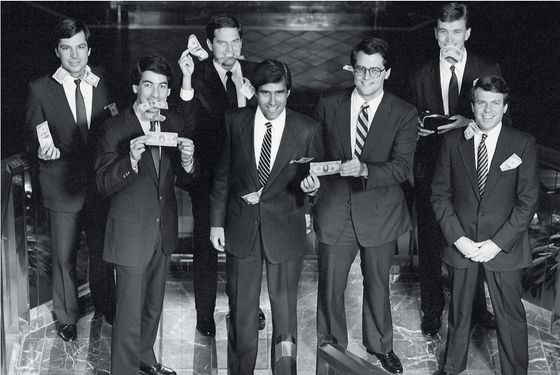
1984 Bain Capital money photo captured Romney on eve of major success
Boston — The seven Bain Capital founders believed they were so
destined to make millions that the young men posed for a photo on the
grand marble staircase of Boston’s Copley Place with $10 and $20 bills
popping out of their shirt collars, tucked behind their eyeglasses and
clutched in their teeth.
Their confidence was warranted. One went on to run an airline,
another to buy a basketball team, and another to oversee two health-care
companies and build custom roadsters.
Their leader, Mitt Romney, went on to become governor of Massachusetts and this year’s likely Republican presidential nominee.
At
the 1984 photo shoot, Romney and his partners were celebrating not only
their new company but also the ethos of their era. They had just given
up their jobs as consultants at Bain & Co. to start Bain Capital
with one overarching goal: to create wealth. They were, to use a
favorite Romneyism, “dreamers.”
Nearly three decades later, the
black-and-white snapshot captures a moment when Romney was about to
become wildly successful in business, giving him the resources and a
critical credential for entering national politics.
One of the fun highlights of the new issue of
Bloomberg Businessweek (The Interview Issue) is that
Romney finally speaks about this photograph—I believe for the first time.
Here’s the exchange:
BLOOMBERG
BUSINESSWEEK: When you look at it now, does that photo of you and your
Bain colleagues posing with money in your pinstripe suits make you laugh
or make you cringe?
ROMNEY: Oh, that was a moment of humor as we had just done what we
thought was impossible. We had raised $37 million from other people and
institutions who entrusted us with their funds, and we thought it was a
miracle that our group had been able to be so successful in fundraising.
And ultimately we were able to yield for them a very attractive return
by such investments as Staples, which was in our very first fund.
BLOOMBERG BUSINESSWEEK: So it’s a happy memory.
ROMNEY: We had a great group of people, each one of whom I think of fondly.
Yet the photo also embodies one of Romney’s challenges as a candidate: his wealth.
President
Obama has seized upon his challenger’s position at the apex of American
capitalism to portray him as elite and out of touch.
“We’re the
poster children for class warfare now,” said Geoffrey S. Rehnert, one of
the seven partners in the photograph. “That’s something I never
anticipated.” Rehnert and other partners said they are unhappy about the
politicization of the image. One of Romney’s mentors called the shot
“tacky” and “inappropriate.”
The cocky assurance that Romney and
his buddies displayed in the photo belied their youth and inexperience.
Romney, then 36, was a success by any measure. He had risen through the
Bain ranks quickly, and he was earning a good living and raising five
sons.
Running Bain Capital was the biggest challenge yet in his
career, and he approached it cautiously and gradually, with the same
careful evaluation and reliance on analytics that would characterize his
political campaigns and term as governor.
“We put Mitt in
charge,” said Patrick Graham, a mentor of Romney’s at Bain & Co.
“He’s an outstanding guy. He’s a leader. He didn’t have any financial
expertise, by the way. But we just wanted to give him a bigger
challenge.”
‘Driven for success’
When Bain Capital was started, the seven founding partners took
pay cuts and pooled much of their savings to invest in the firm. They
wouldn’t see a return for at least two years, and they say they feared
failure. As one of Romney’s partners said, only half-joking, the money
they were holding up in the 1984 photo was all they had.
“We were
excited about the prospects, but it was scary,” said Robert F. White,
one of the co-founders, who would become one of Romney’s closest
friends. “We were making a big bet, we still had student loans, and we
had very little money to invest.”
Scarier still, they were all
rookies. They had excelled as young consultants advising companies on
management decisions, but none had worked on Wall Street. “We came in
cold,” Rehnert said.
“They weren’t financial guys,” Graham said.
“They had their own language: ‘cash cows,’ ‘experience curves,’ ‘market
definition and market segmentation,’ ‘relative competitive
performance.’ ”
Consultant-speak.
Still, they were
ambitious. They were the stars of Bain & Co., a consulting machine
that guided companies on strategy and operations. They charged their
clients healthy fees but grew frustrated watching clients heed their
advice to generate profits that were many times what they paid Bain.
So,
they figured, why not become their own clients? The consulting partners
at Bain & Co. would pool their money, as well as money from wealthy
investors and institutions such as universities and pension funds, to
buy struggling companies or invest in new ones. They would apply their
management acumen to retool companies to maximize profits. Then they
would reap the rewards. It was a new field: private equity.
“Most
of the people in the venture-capital and private-equity world had
finance backgrounds, they had come from banks, and they did a good job
finding opportunities and doing financial restructuring,” White said,
“but very few people had operating backgrounds to help improve the
companies.”
Steven N. Kaplan, a professor at the University of
Chicago who studies the private-equity industry, said Bain Capital was a
pioneer because it was the first firm to apply “strategic insight that
the financial engineers didn’t have.”
“That turned out to be
absolutely correct, because everybody else today does what they started
doing 20 to 25 years ago,” Kaplan added.
Bill Bain tapped Romney,
one of his firm’s top consultants, to lead the new venture. Six years
earlier, Romney was a prize recruit; Graham flew to Florida to urge
Romney’s father, George, a former Michigan governor and presidential
candidate, to let Romney join Bain. Now, they were trying to persuade
Romney to leave his comfortable consulting perch to start something new.
“We
knew he was a high-profile guy,” Graham continued. “He could do
anything he wanted to, and we wanted to keep him, frankly. We offered
him this job, and I was half-surprised he took it.”
Romney did not
want to risk his position or reputation at Bain & Co. with what he
considered an experiment, so he privately negotiated a sort of golden
parachute with Bill Bain. If Bain Capital failed, Romney was guaranteed
to return to his former consulting job and receive his old salary — plus
any raises he had missed.
With his escape hatch in place, Romney
was in, and he began a year-long study of the business and assembled a
team of fellow Bain consultants to join him. His senior partner would be
T. Coleman Andrews III, whom Romney had hired as a young associate at
the consulting firm five years earlier. Like Romney, Andrews came from a
prominent political family; his grandfather, T. Coleman Andrews of
Virginia, ran for president in 1956 on the States’ Rights ticket.
Romney
chose Eric A. Kriss, a bookish Californian who had recently made
partner, to help run the venture-capital arm of the new company. And he
picked White, a charismatic son of a machinist who grew up in
working-class Woburn, Mass., and was the first in his family to graduate
from college, to handle the private-equity side. A trio of younger
consultants — Joshua Bekenstein, Fraser Bullock and Rehnert — rounded
out the team.
“My father went broke on a farm in southern Canada,” Bullock said.
“That’s the kind of heritage that many of us came from. But a common
heritage was that we were all driven for success. . . . You’re driven to make sure that you can return money, hopefully a very nice profit, to your investors.”
‘A moment of giddiness’
Soon after starting Bain Capital, the seven founding partners
gathered at Copley Place in downtown Boston to pose for a new brochure
promoting the firm’s first fund. At the end of a long, stiff shoot for a
formal portrait, the partners took a silly outtake holding up dollar
bills, several of the partners recalled in interviews. The photographer
gave copies to each of them as a memento, but the photograph was never
published or widely distributed.
But years later, as Romney
pursued the presidency, the photo surfaced on the front page of the
Boston Globe, part of the newspaper’s 2007 biographical series about
Romney. Most executives at Bain & Co., the parent consulting
company, did not know it existed until they saw it in the Globe, Graham
said.
“I was stunned when I saw it,” said Graham, who was not in
the picture. “I was upset. I thought it was tacky. I thought it was
inappropriate. They must’ve done it in a moment of giddiness.”
The
photograph depicts the Bain culture — which the partners described as
staid, strict and as purposefully un-Wall Street as the consultancy’s
Tennessee-born founder, Bill Bain — as the epitome of the ostentatious
world of high finance.
Robert Shrum, a longtime Democratic
strategist who advised the late senator Edward M. Kennedy (Mass.) in his
1994 race against Romney, said of the photo that “we certainly would
have used it had we had it.” Shrum called it “an iconic image of what
could be perceived of greed or a total focus only on the bottom line and
making a buck. That’s why it’s so powerful. It’s iconic.”
Over the past year, super PACs supporting Obama as well as Romney’s GOP primary rival Newt Gingrich used the image in
attack ads, and the photo has been featured prominently on cable news shows and magazine covers.
Romney, who declined to be interviewed for this article,
told Fox News last year
that he long expected that the Democrats would use it against him. “I
know that’ll be used — I know that. It’ll be fun,” he said, adding that
he and his partners were “just celebrating” their early successes.
In
the three decades since starting Bain Capital, the founders have
maintained their network. Four of Romney’s six partners have donated to
his campaigns, together giving at least $56,000 since he began plotting a
presidential run in 2006, according to federal records.
Bekenstein,
the only founding partner still at Bain Capital, remains a friend and
supporter of Romney’s, but records show that he also gave $2,500 to
Obama’s campaign in 2011 and has given tens of thousands of dollars to
other Democrats.
Others have worked for Romney in different
capacities. When he ran the 2002 Winter Olympics, he selected Bullock, a
fellow Mormon, to be his No. 2. And when he was governor, Romney
recruited Kriss to be his secretary of administration and finance.
None
is closer to Romney than White, a trusted corporate wingman who has
become Romney’s political alter ego. When he’s not keeping Romney
company on the campaign trail, White is in his second-floor office at
Romney’s headquarters strategizing with advisers or cheering up
exhausted staff members — a part-owner of the Boston Celtics, he is
known to dispense free tickets — or taking on sensitive tasks, such as
the January release of Romney’s tax returns.
‘Success stories’
The founders came to Bain from different backgrounds, yet they
were a homogenous group. Each was white and male, and by 1994, a decade
after the company started, there were still no black or Hispanic
employees among the 40 professionals and eight support staff members,
the Boston Globe reported at the time.
Romney tried to import the
culture of Bain & Co. — an insular firm where clean-cut “Bainies”
wore starched white shirts and red power ties, sang company songs and
were known for their secrecy — to the private-equity start-up.
“It
was completely different than Wall Street — I mean the opposite, not
just subtle differences,” Graham said of the consulting firm. “If you
were a self-aggrandizing, competitive person trying to take credit, we
just fired you.”
Romney and the other founders were so secretive
that they sometimes joked that they were in the CIA. At first, some
recalled, they didn’t carry business cards or give out their phone
numbers. They did not speak about their work on airplanes, lest another
passenger overhear too much.
“It’s a culture focused on
excellence, on winning and very high ethics. They wanted to make money,
they wanted to create success stories and make an impact,” said Tom
Stemberg, who came to Bain Capital seeking help starting an
office-supplies superstore. Staples would would become one of Bain’s
first success stories.
When Romney and his partners collected
money for the first fund, they raised millions from Bain & Co.
employees but were turned down by many of the nation’s richest families
and trusts. Harry Strachan, a Bain & Co. consultant based in Costa
Rica, suggested that Romney’s team look overseas — specifically to
oligarchic families he knew in Ecuador, El Salvador and Panama.
Romney
feared that some of the families were linked to the drug trade or to
guerrilla groups, according to the Boston Globe, but Strachan vouched
for the individual investors and, in 1984, Romney flew to Miami to meet
them and deliver them his pitch.
“We investigated the
individuals’ integrity and looked for any obvious signs of illegal
activity and problems in their background, and found none,” Romney told
the Globe in 1994. “We did not investigate in-laws and relatives.”
The
Latin Americans contributed about $6 million of the $38 million that
made up the first Bain Capital fund, according to the Globe.
With
the fund raised, Romney and his partners had to decide what to do with
the money. They spent more than a year sifting through hundreds of
pitches, from the goofy (an idea for packaged peanut-butter-and-jelly
sandwiches that could last on supermarket shelves for up to five years)
to the serious (an airline that chartered military flights).
Most
proposals were tossed aside after a cursory review, but those that
piqued a partner’s interest received intense scrutiny. After researching
the idea, the partner would present the proposal at a weekly Bain
Capital Business Review meeting.
BCBRs could be torturous, some
partners recalled, with Romney treating them like a prosecutor. They
grew so heated that Romney often would sweat through his shirts. He
would cross examine the presenting partner and ask another partner to
play devil’s advocate. Any of the seven could veto a proposal.
“What we prided ourselves on was doing deeper due diligence than anybody else,” Bullock said.
This
was a room full of strong-willed egos, but Graham said fights were
rare, at least in the founding years. “This is survival,” he said. “This
is like being in a military unit being shot at by the enemy. You’re
either all winners or you’re all losers. You pull together. These guys
liked each other. They’re not out there rearranging the deck chairs to
see who gets the better view, because it wasn’t guaranteed to succeed.
The fear of failure was a real motivator.”
Betting their careers
By the summer of 1986, Romney and his team had settled on
their first major purchase: Calumet Coach, a company that built custom
vehicles to transport large and fragile CAT scan and MRI units. But
before investing $1 million to buy the company, Romney and Rehnert
toured the factory in Calumet City, Ill., near the Indiana border.
Over dinner the night before, as Rehnert recalled, Romney asked him, “Are you ready to bet your career on this?”
Rehnert said he gulped and told his boss he didn’t have much to lose.
“Good,” Romney replied, “because we’re all betting ours on this. It’s our first buyout.”
The
next morning, during the tour, Calumet’s head of manufacturing gave
Romney and Rehnert a puzzled look and asked, “You guys really bought
this thing?”
“Mitt says, nervously, ‘Yeah, why?’ ” Rehnert recalled.
Then
the factory chief pointed to the trucks lined up on the floor and said
the previous owner made the workers paint the names of customers on
them, but nobody was really buying the vehicles. “There’s no customers
for these,” Rehnert recalled him saying. “I can’t believe you bought
this company.”
“I thought Mitt was going to have a heart attack,”
Rehnert recalled. “He looked over at me like he was going to kill me,
like I had been snookered. Then the guy burst out in a big grin and
said, ‘I’m just kidding!’ ”
There were more than enough customers.
Bain Capital’s $1 million investment paid off spectacularly. Two years
later, the company sold Calumet Coach for $34 million, giving the
founders a taste of the wealth their new venture would generate.





 A resident walks down a street covered in beach sand due to flooding from Hurricane Sandy in Long Beach, New York on Tuesday.
 Ted Wondsel, owner of Ted's Fishing Station in Long Beach, assesses the damage to his business Tuesday.