Pages

Friday, November 30, 2012

Red State, Blue City: How the Urban-Rural Divide is Splitting America

13 NOV 30 2012, 11:17 AM ET
Partisan lines that once fell along regional borders can increasingly be found at the county level. What does that mean for the future of the United States? 

Starting before the Civil War era, America's political dividing lines were drawn along state and regional borders. Cities and the then-extensive rural areas shared a worldview North and South of the Mason-Dixon line. While there was always tension within states, they were bound by a common politics. The city of Charleston, for example, was as rabidly anti-North as some inland plantation areas. Economic engines, ways of life, and moral philosophies changed at the 36th parallel, where the North began.

Today, that divide has vanished. The new political divide is a stark division between cities and what remains of the countryside. Not just some cities and some rural areas, either -- virtually every major city (100,000-plus population) in the United States of America has a different outlook from the less populous areas that are closest to it. The difference is no longer about where people live, it's about how people live: in spread-out, open, low-density privacy -- or amid rough-and-tumble, in-your-face population density and diverse communities that enforce a lower-common denominator of tolerance among inhabitants.

The voting data suggest that people don't make cities liberal -- cities make people liberal. Here, courtesy of Princeton's Robert Vanderbai, is an electoral map that captures the divisions:


The only major cities that voted Republican in the 2012 presidential election were Phoenix, Oklahoma City, Fort Worth, and Salt Lake City. With its dominant Mormon population, Mitt Romney was a lock in the Utah capital; Phoenix nearly voted for Obama. After that, the largest urban centers to tilt Republican included Wichita, Lincoln, Neb., and Boise.

The gap is so stark that some of America's bluest cities are located in its reddest states. Every one of Texas' major cities -- Austin, Dallas, Houston, and San Antonio -- voted Democratic in 2012, the second consecutive presidential election in which they've done so. Other red-state cities that tipped blue include Atlanta, Indianapolis, New Orleans, Birmingham, Tucson, Little Rock, and Charleston, S.C. -- ironically, the site of the first battle of the Civil War. In states like Nevada, the only blue districts are often also the only cities, like Reno and Las Vegas.

Because winning a state's electoral votes requires only a simple majority, a single city can change the entire game. Blue cities in swing states that ended up going for Obama last Tuesday include Las Vegas, Philadelphia, Pittsburgh, Denver, the cities of Florida, and the cities of Ohio.

Though not generally considered a swing state, Michigan (with 16 electoral votes) was virtually carried by the Detroit metropolitan area, spread across three counties, and a scrap of Flint. Almost the entire rest of the state went different shades of red.

This divide between blue city and red countryside has been growing for some time. Since 1984, more and more of America's major cities have voted blue each year, culminating in 2012, when 27 out of the nation's 30 most populous cities voted Democratic. According to Dave Leip's Atlas of U.S. Presidential Elections and The New York Times, the 2012 election marked the fourth time in the last five federal election cycles that voters shifted away from the party of the sitting president. Despite that constant churn, one part of the electoral map has become a crystal clear constant. Cities, year by year, have become drenched in more blue. Everywhere else is that much more red.

Comparing the state-by-state electoral maps between the election of George W. Bush in 2000 and Obama's reelection, there are considerable differences. But if you look instead at the county-by-county map, the picture changes. The same poles -- the coastal megalopolises, industrial Midwest, and Mississippi River and New South cities -- have fortified the base of Democratic support for 20 years. Republicans have consolidated themselves in the Mountain West, prairie heartland, and Bible Belt.

Between 2000 and 2004 the maps barely seem to change at all. Some counties, for instance, remain the only blue counties in the entire state, year after year. Even comparing 2004 and 2008, many of the most dramatic differences are simply in the margin of victory in various districts. Mushrooming Democratic popularity during the Clinton years and in 2008, while impressive, largely lights up along the periphery of the current Democratic spine.

For years, this continues: Urban and rural counties jostling with a small pool of counties which go back and forth every couple of elections. There's no real realignment, just a constant tug of war as the nation grows further divided.

Electoral cartograms by University of Michigan physics professor Mark Newman show the power of Democratic counties based on population density. Spreading each vote out, his illustrations portray the hidden truth of the conventional electoral map, and why but the much smaller number of dedicated blue counties is outmatching the more geographically numerous red counties.


But this also skirts the point. Cities are significant not just because of their physical locations, but their physical environment. This map of emerging "megaregions" in the U.S. matches up snugly with the blue spots on the electoral map:


In due course, these populous bastions of urban liberalism have helped spur state legislation and court rulings to create new laws, such as those permitting same sex marriage, that are often in direct conflict with federal laws and with the majority of fellow state counties. These measures are not always controversial -- such as Missouri's 2010 Prop B, regulating dog breeding shows -- but the divisions are often stark: cities vs. everywhere else. Meanwhile, the states with constitutional amendments banning gay marriage are often among the least densely populated in the country, such as South Dakota and Idaho.

On Election Day, voters in 37 states weighed in on 174 ballot measures, according to the National Conference of State Legislatures, on matters ranging from gambling to marijuana to the death penalty. It was the second-highest number ever, and this cycle also saw a definitive jump in votes on whether to overturn recently passed legislation, including Obamacare and gay marriage. These state laws are the foundation for potential future federal laws, but the sudden, radical divergence between laws from state to state is leading to a dizzying decentralization, with laws of varying importance in varying directions in varying states checkering the United States. This pre-election graphic demonstrates the complexity of the legal environment for same-sex unions alone across America:


After this year's election, roughly half of the 50 states allow the practice of one, more, or all of the following: same-sex marriage, marijuana use or assisted suicide. Voters in Alabama, Missouri, Montana, and Wyoming passed largely symbolic laws that would prohibit Obamacare, effectively another lifestyle law. Meanwhile, all of the states that voted against Obamacare also ban both same-sex marriage and marijuana use. In Montana, the government won't help insure your health, but it will assist you in killing yourself. Many Americans live in states where they are forced to buy health insurance but are not allowed to end their own lives or marry the person they love.

Federalism's dance is America's great helix, and in due course a new national consensus will tend to emerge. But things might get more divided before they get better. Immediately after the election, more than a 100,000 citizens in more than 20 states signed petitions on the White House websiterequesting to secede from the nation.

That has spurred some pundits to worry about a new splintering like the one 150 years ago and to bemoan, as they do each election year, how the country is growing more divided. But the new divisions don't break down neatly enough between states -- as opposed to within them -- to make the idea of any given state pulling out of the union anything more than minority grousing. Robert Forbes, an antebellum history professor at the University of Connecticut, says fears of a divided America are overblown.


"Compared to the United States of 1860," Forbes says, "the America of 2012 is more like the United Colors of Benetton."


Maps of the 2012 US presidential election results


Email: Thanks to everyone who wrote in about the maps. I've received so much email that I may not be able to reply to everyone, but I much appreciate all your comments and suggestions. Many of the things people have been asking about are answered in this list of frequently asked questions.

Election results by state

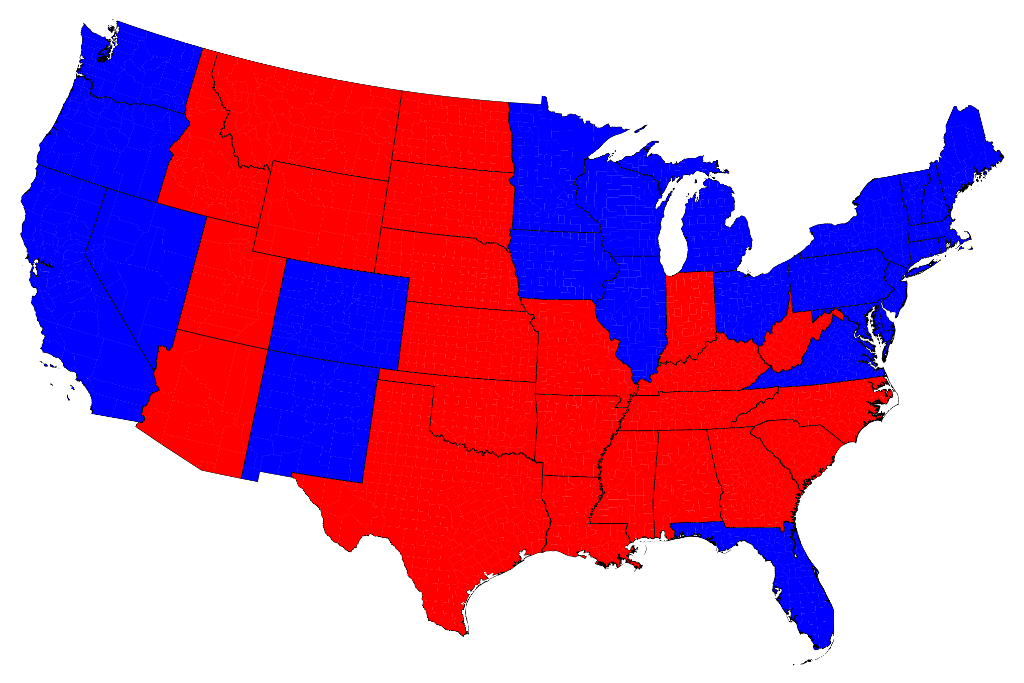
Most of us are, by now, familiar with the maps the TV channels and web sites use to show the results of presidential elections. Here is a typical map of the results of the 2012 election:

Click on any of the maps for a larger picture
The states are colored red or blue to indicate whether a majority of their voters voted for the Republican candidate, Mitt Romney, or the Democratic candidate, Barack Obama, respectively. Looking at this map it gives the impression that the Republican won the election handily, since there is rather more red on the map than there is blue. In fact, however, the reverse is true – it was the Democrats who won the election. The explanation for this apparent paradox, as pointed out by many people, is that the map fails to take account of the population distribution. It fails to allow for the fact that the population of the red states is on average significantly lower than that of the blue ones. The blue may be small in area, but they represent a large number of voters, which is what matters in an election.
We can correct for this by making use of a cartogram, a map in which the sizes of states are rescaled according to their population. That is, states are drawn with size proportional not to their acreage but to the number of their inhabitants, states with more people appearing larger than states with fewer, regardless of their actual area on the ground. On such a map, for example, the state of Rhode Island, with its 1.1 million inhabitants, would appear about twice the size of Wyoming, which has half a million, even though Wyoming has 60 times the acreage of Rhode Island.
Here are the 2012 presidential election results on a population cartogram of this type:
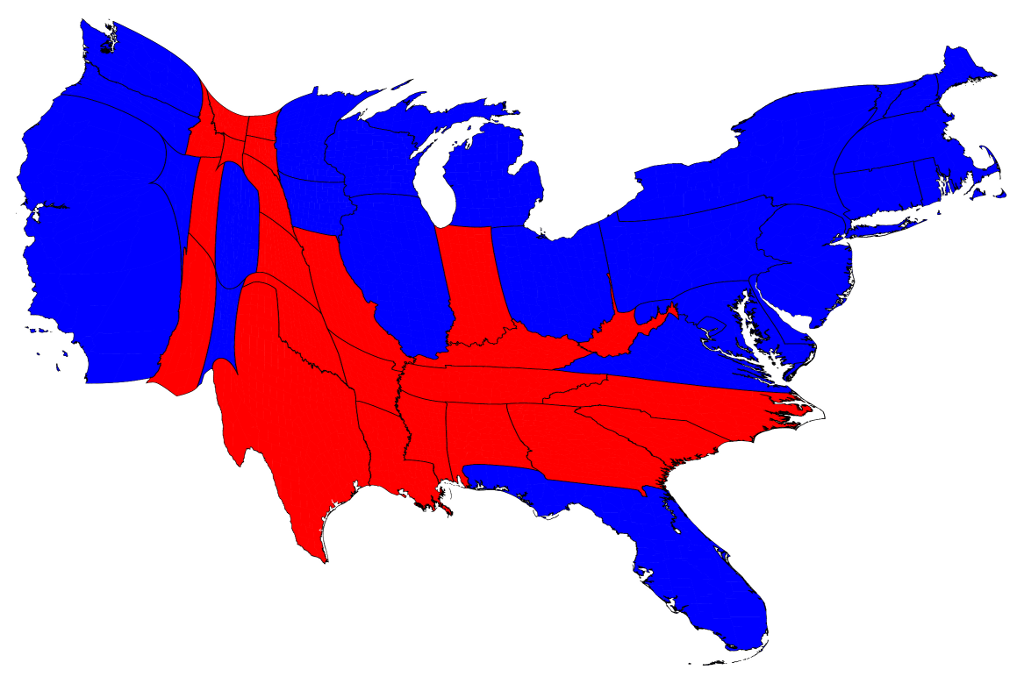
As you can see, the states have been stretched and squashed, some of them substantially, to give them the appropriate sizes, though it's done in such a way as to preserve the general appearance of the map, so far as that's possible. On this map there is now clearly more blue than red.
The presidential election, however, is not actually decided on the basis of the number of people who vote for each candidate but on the basis of the electoral college. Under the US electoral system, each state in the union contributes a certain number of electors to the electoral college, who vote according to the majority in their state. (Exceptions are the states of Maine and Nebraska, which use a different formula that allows them to split their electoral votes between candidates.) The candidate receiving a majority of the votes in the electoral college wins the election. The electors are apportioned among the states roughly according to population, as measured by the census, but with a small but deliberate bias in favor of less populous states.
We can represent the effects of the electoral college by scaling the sizes of states to be proportional to their number of electoral votes, which gives a map that looks like this:
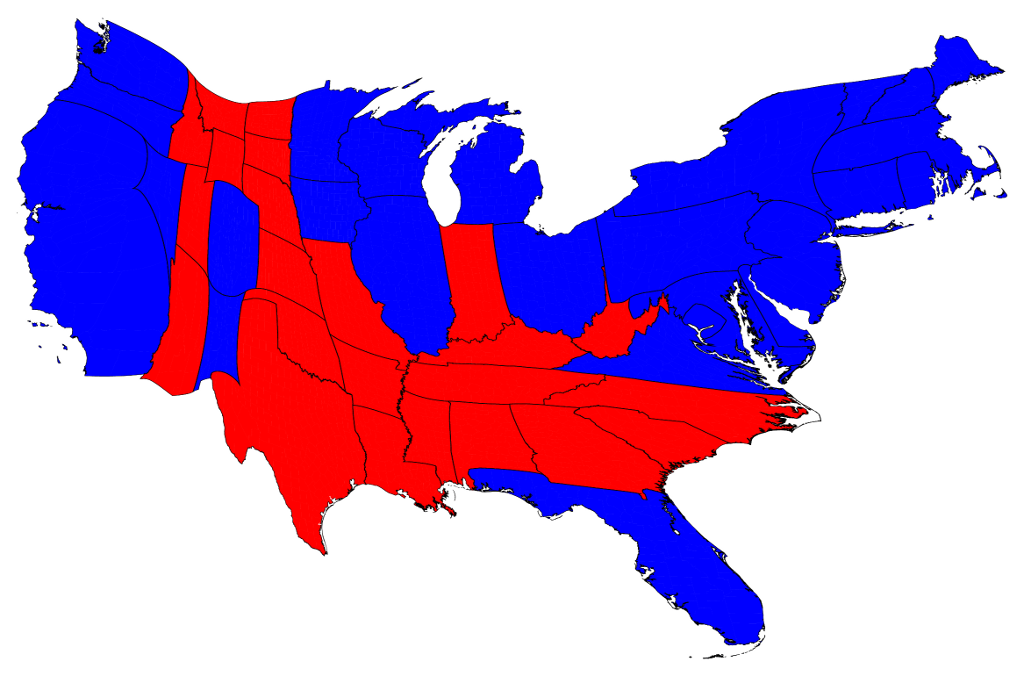
This cartogram looks similar to the one above it, but it's not identical. Wyoming, for instance, has approximately doubled in size, precisely because of the bias in favor of small states.
The areas of red and blue on the cartogram are now proportional to the actual numbers of electoral votes won by each candidate. Thus this map shows at a glance both which states went to which candidate and which candidate won more electoral college votes – something that you cannot tell easily from the normal election-night red and blue map.

Election results by county

But we can go further. We can do the same thing also with the county-level election results and the images are even more striking. Here is a map of US counties, again colored red and blue to indicate Republican and Democratic majorities respectively:
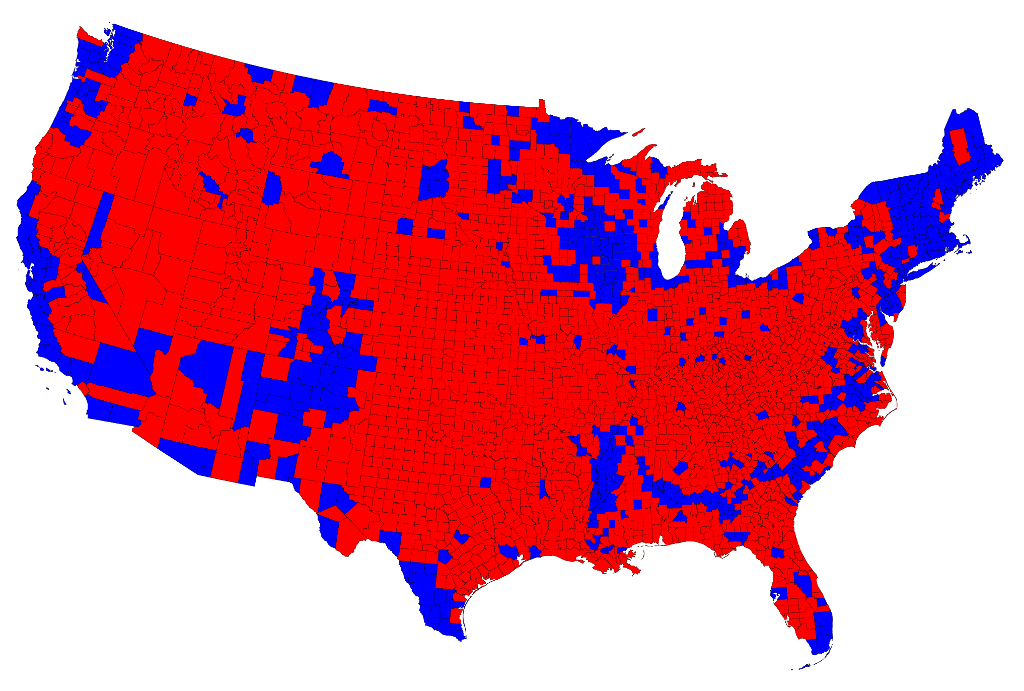
Now the effects we saw at the state level are even more pronounced: the red areas appear overwhelmingly in the majority, an appearance again at odds with the actual results of the election. Again, we can make a more helpful respresentation by using a cartogram. Here is what the cartogram looks like for the county-level election returns:
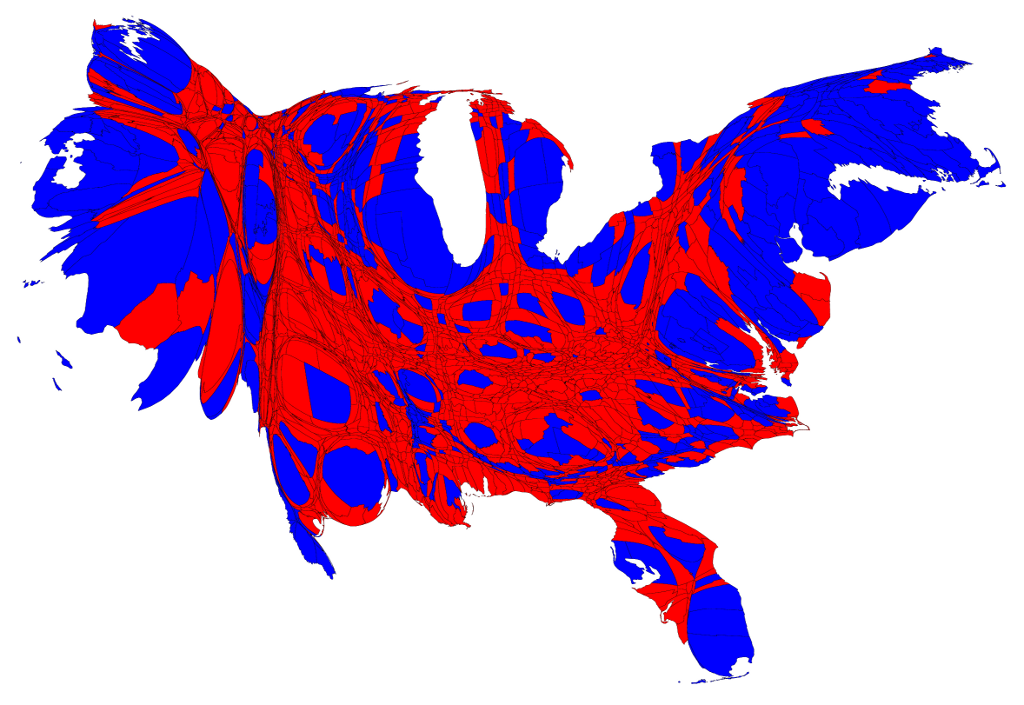
However, this map is still somewhat misleading because we have colored every county either red or blue, as if every voter voted the same way. This is of course not realistic: all counties contain both Republican and Democratic supporters and in using just the two colors on our map we lose any information about the balance between them. There is no way to tell whether a particular county went strongly for one candidate or the other or whether it was relatively evenly split.
One way to improve the map and reveal more nuance in the vote is to use not just two colors, red and blue, but to use red, blue, and shades of purple in between to indicate percentages of votes. Here is what the normal map looks like if you do this:

And here's what the cartogram looks like:

As this map makes clear, large portions of the country are quite evenly divided, appearing in various shades of purple, although a number of strongly Democratic (blue) areas are visible too, mostly in the larger cities. There are also some strongly Republican areas, but most of them have relatively small populations and hence appear quite small on this map.
A slight variation on the same idea is to use a nonlinear color scale like this:
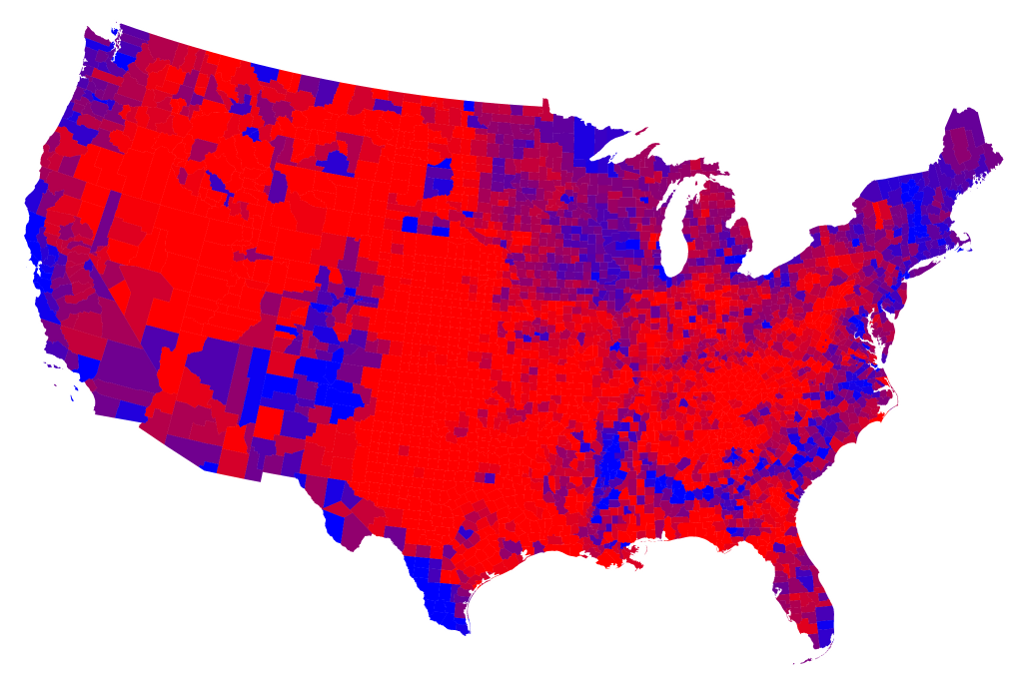
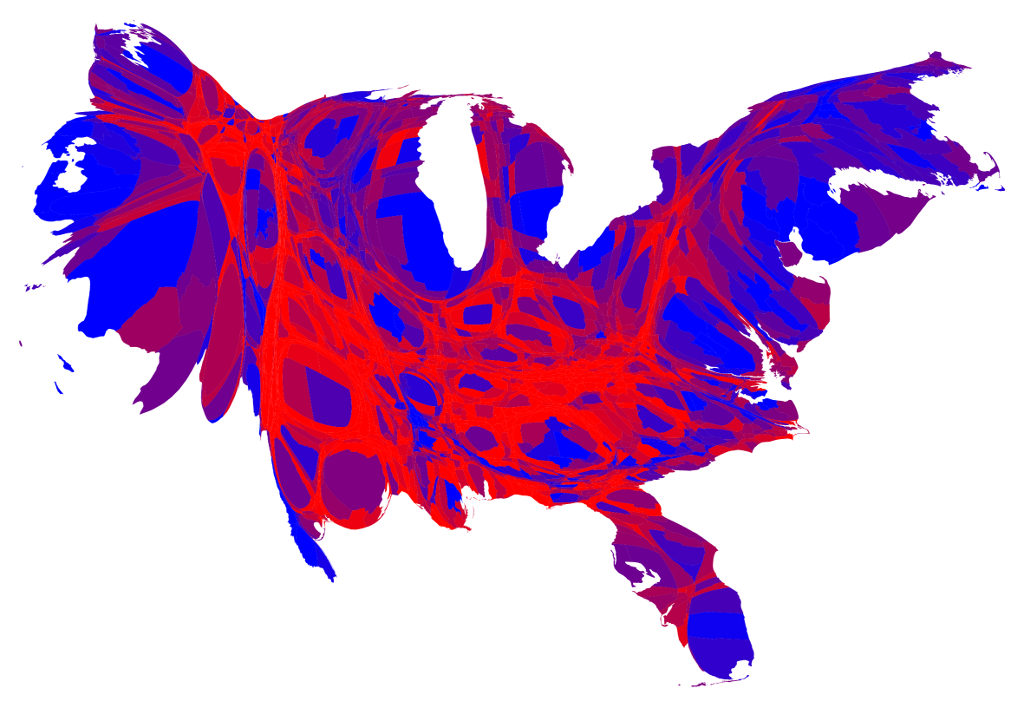
           
These maps use a color scale that ranges from red for 70% Republican or more, to blue for 70% Democrat or more. This is sort of practical, since there aren't many counties outside that range anyway, but to some extent it also obscures the true balance of red and blue.


Notes:

Frequently asked questions (FAQs): A list of frequently asked questions concerning these maps, along with answers, can be found here.
County results: The county-level data I used came from here. They are, as far as I know, up-to-date as of November 8, 2012, but a small number of precincts still had not reported by that date, so a few results are missing.
Thanks: Thanks to Robert Vanderbei for help with obtaining the county-level data. Professor Vanderbei also suggested the purple maps, and has made a terrific series of maps of his own, which you can find here.
Software: My computer software for producing cartograms is freely available here.

Christians, liberals left out as Islamists back Egypt's draft constitution


Visit NBCNews.com for breaking news, world news, and news about the economy
Tens of thousands of protesters gathered in Tahrir Square Friday to denounce Egypt's President Mohamed Morsi and the draft constitution his Islamic allies approved earlier in the day.

By NBC News wire services

CAIRO -- Islamists approved a draft constitution for Egypt early Friday without the participation of liberal and Christian members, seeking to pre-empt a court ruling that could dissolve their panel with a rushed, marathon vote that further inflames the conflict between the opposition and President Mohammed Morsi.

The vote by the constituent assembly advanced a charter with an Islamist bent that rights experts say could give Muslim clerics oversight over legislation and bring restrictions on freedom of speech, women's rights and other liberties.

The draft, which the assembly plans to deliver to the president Saturday, must be put to a nationwide referendum within 30 days. Morsi said Thursday it will be held "soon."

'No place for dictatorship'
Morsi added that the decree halting court challenges to his decisions, which provoked protests and violence from Egyptians fearing a new dictator was emerging less than two years after they ousted Hosni Mubarak, was "for an exceptional stage."

"It will end as soon as the people vote on a constitution," he told state television on Thursday night. "There is no place for dictatorship."

External link: English translation of Egypt's draft constitution

The Islamist-dominated assembly that has been working on the constitution for months raced to pass it, voting article by article on the draft's more than 230 articles for more than 16 hours. The lack of inclusion was on display in the nationally televised gathering: Of the 85 members in attendance, there was not a single Christian and only four women, all Islamists. Many of the men wore beards, the hallmark of Muslim conservatives.

Ahmed Youssef / EPA
Eighteen days of popular protest culminated in the downfall of Egyptian president Hosni Mubarak on Feb. 11, 2011.

For weeks, liberal, secular and Christian members, already a minority on the 100-member panel, have been withdrawing to protest what they call the Islamists' hijacking of the process.

"This constitution represents the diversity of the Egyptian people. All Egyptians, male and female, will find themselves in this constitution," Essam el-Erian, a representative of the Muslim Brotherhood, declared to the assembly after the last articles were passed just after sunrise Friday.

ANALYSIS: Crisis tests Egyptians' constitution

"We will implement the work of this constitution to hold in high esteem God's law, which was only ink on paper before, and to protect freedoms that were not previously respected," he said.

The sudden rush to finish came as the latest twist in a week-long crisis pitting Brotherhood veteran Morsi and his Islamist supporters against a mostly secular and liberal opposition and the powerful judiciary. Voting had not been expected for another two months. But the assembly abruptly moved it up in order to pass the draft before Egypt's Supreme Constitutional Court rules on Sunday on whether to dissolve the panel.

"I am saddened to see this come out while Egypt is so divided," Egypt's top reform leader, Nobel Peace laureate Mohamed ElBaradei said, speaking on private Al-Nahar TV. But he predicted the document would not last long. "It will be part of political folklore and will go to the garbage bin of history."

President Mohammed Morsi recently granted himself unprecedented power, leaving many Egyptians furious. NBC's Richard Engel reports.
NBC's Ayman Mohyeldin discusses Egypt unrest

A new opposition bloc led by ElBaradei and other liberals said the assembly had lost its legitimacy.

"It is trying to impose a constitution monopolized by one trend and is the furthest from national consensus, produced in a farcical way," the National Salvation Front said in a statement, read by Waheed Abdel-Meguid, one of the assembly members who withdrew.

Thursday's vote escalates the already bruising confrontation sparked last week when Morsi gave himself near absolute powers by neutralizing the judiciary, the last branch of the state not in his hands. Morsi banned the courts from dissolving the constitutional assembly or the upper house of parliament and from reviewing his own decisions.

In a sign of the divisions, protesters camped out in Cairo's Tahrir Square who were watching the interview chanted against Morsi and raised their shoes in the air in contempt.

The president's edicts sparked a powerful backlash in one of the worst bouts of turmoil since last year's ouster of autocrat Hosni Mubarak. At least 200,000 people protested in Cairo's Tahrir square earlier this week demanding he rescind the edicts.

Street clashes have already erupted between the two camps in the past week, leaving at least two people dead and hundreds injured. And more violence is possible.

The opposition plans another large protest for Friday, and the Brotherhood has called a similar massive rally for the following day, though they decided to move it from Tahrir to avoid frictions. Bands of youths have been daily battling police on a road leading off the square and close to the U.S. Embassy.


Visit NBCNews.com for breaking news, world news, and news about the economy

Several hundred Egyptian protesters and police faced off again today in central Cairo. NBCNews.com's Dara Brown reports.

Defiance
The Constitutional Court's announcement that it would rule on the legitimacy of the assembly was in direct defiance of Morsi's edicts. It will also rule Sunday on whether to dissolve the upper house of parliament, which is overwhelmingly held by Islamists. Most of the nation's judges are on indefinite strike to protest the edicts.

It is not clear what would happen to the approved draft if the court dissolves the assembly. The crisis could move out of the realm of legal questions and even more into the more volatile street, to be decided by which side can bring the most support.

The opposition is considering whether to call for a boycott of any referendum on the constitution or to try to rally a "no" vote, said Hamdeen Sabahi, a National Salvation Front leader who ran in this year's presidential race and came in a surprisingly strong third.

"The people should not be made to choose between a dictatorial declaration or a constitution that doesn't represent all the people," he told independent ONTV, referring to Morsi's decrees. "He is pushing Egypt to more division and confrontation."

During Thursday's session, assembly head Hossam al-Ghiryani doggedly pushed the members to finish. When one article received 16 objections, he pointed out that would require postponing the vote 48 hours under the body's rules. "Now I'm taking the vote again," he said, and all but four members dropped their objections. In the session's final hours, several new articles were hastily written up and added to resolve lingering issues.
"We will teach this constitution to our sons," al-Ghiryani told the gathering.
Islamist members of the panel defended the fast tracking. Hussein Ibrahim of the Brotherhood said the draft reflected six months of debate, including input from liberals before they withdrew.

"People want the constitution because they want stability. Go to villages, to poorer areas, people want stability," he said.

Over the past week, about 30 members have pulled out of the assembly, with mainly Islamists brought in to replace some. As a result, every article passed overwhelmingly.

Human Rights Watch Rights groups criticized the hurried manner in which the constituent assembly pushed the draft charter through, saying it not the right way to guarantee fundamental rights or the rule of law.

"Rushing through a draft while serious concerns about key rights protections remain unaddressed will create huge problems down the road that won't be easy to fix,"said Joe Stork, deputy Middle East and North Africa director for the New York-based group.

The draft largely reflects the conservative vision of the Islamists, with articles that rights activists, liberals and others fear will lead to restrictions on the rights of women and minorities and on civil liberties in general.


Visit NBCNews.com for breaking news, world news, and news about the economy
Egypt's president Mohamed Morsi, who had granted himself sweeping new powers that would have made all of his rulings immune to judicial review, is facing continued public outcry despite his decision to soften the decree by limiting those rulings to 'sovereign' matters. NBC's Ayman Mohyeldin reports.

'Morals and values'
One article that passed underlined that the state will protect "the true nature of the Egyptian family ... and promote its morals and values," phrasing that suggests the state could prevent anything deemed to undermine the family.

The draft says citizens are equal under the law but an article specifically establishing women's equality was dropped because of disputes over the phrasing.

As in past constitutions, the new draft said the "principles of Islamic law" will be the basis of law.

Previously, the term "principles" allowed wide leeway in interpreting Shariah. But in the draft, a separate new article is added that seeks to define "principles" by pointing to particular theological doctrines and their rules. That could give Islamists the tool for insisting on stricter implementation of rulings of Shariah.

Another new article states that Egypt's most respected Islamic institution, Al-Azhar, must be consulted on any matters related to Shariah, a measure critics fear will lead to oversight of legislation by clerics.

The draft also includes bans on "insulting or defaming all prophets and messengers" or even "insulting humans" — broad language that analysts warned could be used to crack down on many forms of speech.

It also preserves much of military's immunity from parliamentary scrutiny, putting its budget in the hands of the National Defense Council, which includes the president, the heads of the two houses of parliament and top generals.

The final draft contains historic changes to Egypt's system of government. It limits to eight years the amount of time a president can serve, for example. Mubarak was in power for three decades. It also introduces a degree of oversight over the military establishment - though not enough for critics.

The Associated Press and Reuters contributed to this report.


First Thoughts: A laughing matter?


Is the White House’s offer really a laughing matter?... It seems to be sending two messages to Republicans: 1) accepting the middle-class tax extension is less painful than the other proposals, and 2) you need to drag us to entitlement reform… Obama hits the road, delivering remarks on the fiscal negotiations in Hatfield, PA at 12:05 pm ET… Ted Cruz and 2016?... VA GOP blasts Bolling… And “Meet” to interview Geithner on Sunday.


By Chuck Todd, Mark Murray, Domenico Montanaro, and Brooke Brower

*** A laughing matter? After Treasury Secretary Tim Geithner’s individual meetings yesterday with congressional leaders in the so-called “fiscal cliff” negotiations, Republicans leaked to reporters what the Obama White House is offering: 1) $1.6 trillion in tax increases and revenues, 2) a permanent end to Congress’ control of the debt limit, 3) additional stimulus of at least $50 billion, and 4) $400 billion in savings in Medicare and other programs to be worked out next year. Republican aides dismissed the offer as “unbalanced” and “unreasonable,” NBC’s Luke Russert notes. A House GOP aide adds to First Read that the $1.6 trillion is TWICE the revenue that President Obama campaigned on (by not extending the Bush tax cuts for the wealthy); that the debt-limit demand is a “pipe dream”; and that the revenue in the offer ($1.6 trillion) is four times greater than the spending cuts ($400 billion). The Weekly Standard even reports that Senate Minority Leader Mitch McConnell “burst into laughter” after Geithner offered the plan.

J. Scott Applewhite / AP
Senate Minority Leader Mitch McConnell of Ky., center, accompanied by Sen. John Barrasso, R-Wyo., left, and Sen. John Thune, R-S.D., gestures while speaking to reporters on Capitol Hill in Washington, Tuesday, Nov, 27, 2012.


*** The White House’s two messages: But is the offer really a laughing matter? From what we understand, the White House is sending two messages from the offer it presented yesterday. 
One, it’s trying to force House Republicans to pass the middle-class extension of the Bush tax cuts -- with the idea of punting everything else until next year. The message: Extending the middle-class tax cuts is MUCH LESS painful than the other revenue, the debt-limit demand, and additional stimulus. (Think Team Obama has learned from its past negotiating offers, when it started out negotiating from the middle?) 
Two, the White House is sending the message that if Republicans want entitlement reform, they’re the ones who will have to propose it. After all, the administration’s offer is very specific when it comes to taxes, but not specific at all when it comes to entitlements. In other words, the White House is saying: We’re dragging you to agreeing to higher revenues, but you guys need to drag us to entitlement fixes. It is very possible that the White House’s sky-high offer could blow up in its face. But it’s also quite possible that it forces Republicans to think long and hard about the middle-class extension and what they exactly want on entitlements.

*** Road trip! Meanwhile, as we’ve already reported on this week, Obama hits the road today, taking his fiscal message on the road to Hatfield, PA (the Philadelphia suburbs), where he speaks at 12:05 pm ET. Per the White House, the president will make his case “by visiting a business that depends on middle class consumers during the holiday season, and could be impacted if taxes go up on 98% of Americans at the end of the year. The president will tour and deliver remarks at The Rodon Group manufacturing facility, the sole American manufacturer for K’NEX Brands, a construction toy company whose products include Tinkertoy, K’NEX Building Sets and Angry Bird Building Sets. The Rodon Group and K’NEX Brands, both third-generation family businesses, employ over 150 people at their Hatfield facilities.”

*** Ted Cruz and 2016? Wow, Sen.-elect Ted Cruz (R) hasn’t even been sworn in yet, and he’s already stoking 2016 speculation. Politico: “Texas Sen.-elect Ted Cruz advised the Republican Party to rebrand itself under a banner of ‘Opportunity Conservatism’ during a sweeping speech Thursday night that will only stoke speculation about a 2016 presidential run. Speaking before the conservative American Principles Project dinner at a downtown Washington hotel, Cruz said the GOP’s thumping in the 2012 elections was more the result of poor messaging and communication than the wrong ideology.” We’ve seen plenty of new senators come in with plenty of hype and attention (Hillary Clinton, Barack Obama, Marco Rubio), but those worked hard to keep expectations down. This is something else entirely…

*** VA GOP blasts Bolling: Yesterday, we wrote that Lt. Gov. Bill Bolling -- who had exited Virginia’s gubernatorial contest, meaning that Ken Cuccinelli would be the GOP’s nominee next year -- hadn’t closed the door to mounting an independent bid. And that in part explained this pretty stunning statement from the Virginia GOP chair: "I am disappointed by Lt. Governor Bolling's remarks over the past 48 hours... The proper venue for challenging a fellow Republican is during a nomination contest. Lt. Governor Bolling chose to suspend his campaign. I hope he will take his own words to heart and work to bring our Party together." Usually, that type of message is delivered through private channels, not via a press release. Bottom line: Bolling isn’t happy, and that’s a problem for the GOP.

*** On “Meet” this Sunday: Finally, NBC’s David Gregory interviews Treasury Secretary Geithner on “Meet the Press” this Sunday.


UN upgrades Palestinian status, bolstering statehood claim


Palestinians had a major symbolic victory when the United Nations General Assembly voted overwhelmingly to recognize them, but the U.S. argued the new status could set back Palestinians in the path to peace. NBC's Andrea Mitchell reports.


By NBC News staff and wire services

The U.N. General Assembly approved a resolution on Thursday giving implicit recognition to Palestinian statehood despite threats by the United States and Israel to punish the Palestinian Authority by withholding funds for the West Bank government.
The resolution, which lifts the Palestinian Authority's U.N. observer status from "entity" to "non-member state," like the Vatican possesses, easily passed the 193-nation General Assembly with 138 nations voting in favor, and nine opposed, including the United States. Forty-one countries abstained, including the United Kingdom.

Israel, the United States and the other members who opposed the resolution see it as a largely symbolic and counterproductive move by the Palestinians. The vote took place on the 65th anniversary of the assembly's adoption of resolution 181 on the partition of Palestine into Jewish and Arab states.

Palestinian President Mahmoud Abbas has led the campaign to win support for the resolution, which follows an eight-day conflict this month between Israel and Islamists in the Gaza Strip, who are pledged to Israel's destruction and oppose his efforts toward a negotiated peace.

The U.S. State Department made a last-ditch effort to get Abbas to reconsider, but the Palestinian Authority, which exercises limited self-rule in the Israeli-occupied West Bank, held firm.

Secretary of State Hillary Clinton, speaking at the Brookings Institution on Thursday, said the U.S. believes the resolution will "do nothing to advance the peace and the two-state solution we all want to see."

She noted that while the U.S. planned to vote "no," she played down differences with key diplomatic partners in Europe, including France, which were expected to vote in favor of the resolution.


Reuters
A Palestinian man shouts slogans during a rally in the West Bank city of Ramallah on Thursday. The U.N. General Assembly overwhelmingly approved a resolution on Thursday to upgrade the Palestinian Authority's observer status at the United Nations.

"We and our European partners agree on the most fundamental issues and share a common objective — two states living side-by-side living in peace and security," Clinton said.

Susan Rice, the U.S. ambassador to the U.N., said in a statement after the vote that "the only way to establish such a Palestinian state and resolve all permanent-status issues is through the crucial, if painful, work of direct negotiations between the parties."

"The United States therefore calls upon both the parties to resume direct talks without preconditions on all the issues that divide them," Rice said.

The U.K. had committed to voting for the resolution if Abbas had shown commitment to resuming peace negotiations without preconditions. Lacking that assurance, Britain abstained from the vote.

Following the vote at the UN General Assembly the Britain's Foreign Secretary William Hague said: "We continue to believe that the prospects for a swift return to negotiations on a two state solution — the only way to create a Palestinian state on the ground — would be greater today if President Abbas had been able to give the assurances we suggested, and without which we were unable to vote in favor of the resolution.

UN Palestinian statehood vote to be a personal political victory for Abbas


"In particular, we called on President Abbas to set out a willingness to return to negotiations without preconditions, and to signal that the Palestinians would not immediately seek action in the International Criminal Court, which would be likely to make a return to negotiations impossible.

"Nonetheless, we will redouble our efforts to restart the peace process, and will continue our strong support for President Abbas, the Palestinian Authority, and a two state solution," he said.

Despite its fierce opposition, Israel made efforts that appeared designed to prevent diplomatic isolation. In recent days, it toned down threats of retaliation in the face of wide international support for the initiative, notably among its European allies.

"The decision at the United Nations will change nothing on the ground," Israeli Prime Minister Benjamin Netanyahu said in Jerusalem. "It will not advance the establishment of a Palestinian state. It will delay it further."

But U.N. diplomats say that Israel's reaction might not be so measured if the Palestinians seek ICC action against Israel on charges of war crimes, crimes against humanity or other crimes the court would have jurisdiction over.


U.N. Ambassador Susan Rice addresses the assembly following a vote on whether to recognize a single Palestinian state.

Granting Palestinians the title of "non-member observer state" falls short of full U.N. membership — something the Palestinians failed to achieve last year. But it does allow them access to the International Criminal Court and other international bodies, should they choose to join them.

Speaking at an annual U.N. event in support of the Palestinians, Palestinian Foreign Minister Riyad al-Maliki appealed to U.N. member states to support Thursday's U.N. resolution. He also repeated his support for peace with Israel.

"Despite diminishing hopes and the decline of the situation on the ground due to Israel violations, we remain committed to the two-state solution and our hand remains extended in peace," he said at U.N. headquarters in New York.
State Department spokeswoman Victoria Nuland reiterated U.S. warnings that the move could cause a reduction of U.S. economic support for the Palestinians. The Israelis have also warned they might take significant deductions out of monthly transfers of duties that Israel collects on the Palestinians' behalf.

Russian Deputy Foreign Minister Mikhail Bogdanov was quoted by the Interfax news agency as calling on Washington and Israel to avoid "any hasty and destructive decisions."

"Supporting the Palestinian authorities is not only in the interest of the Palestinian side, but also of Israel and the whole international community that is longing for a peaceful political settlement," he said.

The European Union, a key donor for the Palestinians, has made clear it will not curtail aid after Thursday's vote.

U.N. Secretary-General Ban Ki-moon also called for a revival of the peace process: "Israelis and Palestinians must break out of a zero-sum mentality, and embrace a peaceful path forward."

Flag-waving Palestinians thronged the squares of the West Bank and Gaza Strip before Thursday's vote. In a rare show of unity, Abbas's Islamist rivals Hamas, who have ruled Gaza since a brief civil war in 2007, let backers of the president's Fatah movement hold demonstrations there.

Peace talks have been stalled for two years, mainly over Israeli settlements in the West Bank, which have expanded despite being deemed illegal by most of the world. There are 4.3 million Palestinians in the West Bank and Gaza.

In the draft resolution, the Palestinians have pledged to relaunch the peace process immediately following the U.N. vote.

With strong support from the developing world that makes up the majority of U.N. members, it is virtually assured of securing more than the requisite simple majority. Palestinian officials hope for more than 130 yes votes.

Abbas has focused on securing as many votes as possible from Europe, and his efforts appear to have paid off.

Going into the vote, Austria, Denmark, Norway, Finland, France, Greece, Iceland, Ireland, Italy, Luxembourg, Malta, Portugal, Spain, Sweden and Switzerland had all pledged to support the resolution.


Official: Israel to expand settlements after UN upgrades Palestinian status
By NBC News wire services

JERUSALEM -- Israel plans to build thousands of new homes for its settlers in the occupied West Bank and East Jerusalem, an Israeli official said Friday in a briefing, defying a U.N. vote that implicitly recognized Palestinian statehood there.

The official, speaking to Reuters on condition of anonymity, said Prime Minister Benjamin Netanyahu's conservative government had authorized the construction of 3,000 housing units and ordered "preliminary zoning and planning work for thousands" more.

The official would not elaborate. The New York Times and The Associated Press, citing anonymous Israeli officials, also said Israel was planning to expand East Jerusalem settlements.


But Israeli media, including Haaretz newspaper, said the government sought to emphasize its rejection of Thursday's upgrade by the U.N. General Assembly of the Palestinians to "non-member observer state" from "entity."

Israel and the United States had opposed the resolution, which shored up the Palestinians' claim on all of the West Bank, East Jerusalem and Gaza Strip, saying territorial sovereignty should be addressed in direct peace talks with the Jewish state.

Those negotiations have been stalled for two years, however, given Palestinian anger at continued Israeli settlement expansion. The Israelis insist they would keep West Bank settlement blocs under any final accord as well as all of Jerusalem as their capital.

That status for the holy city has never been accepted abroad, where most powers consider the settlements illegal for taking in land captured in the 1967 Middle East war.

The 193-nation General Assembly overwhelmingly approved the de facto recognition of the sovereign state of Palestine after Palestinian President Mahmoud Abbas urged the world body to issue what he said was its long overdue "birth certificate."


White House slams Israel's decision to expand settlementsBy NBC News wire services

The White House said on Friday a new Israeli settlement expansion plan was "counterproductive" and could make it harder to bring Israel and the Palestinians back to the negotiating table.

"We reiterate our longstanding opposition to settlements and East Jerusalem construction and announcements," White House spokesman Tommy Vietor said.

Israel plans to build thousands of new homes for its settlers in the occupied West Bank and East Jerusalem, an Israeli official said earlier, defying a U.N. vote that implicitly recognized Palestinian statehood there.

The official, speaking on condition of anonymity, said Prime Minister Benjamin Netanyahu's conservative government had authorized the construction of 3,000 housing units and ordered "preliminary zoning and planning work for thousands" more.

"We believe these actions are counterproductive and make it harder to resume direct negotiations or achieve of a two state solution," Vietor said. "Direct negotiations remain our goal and we encourage all parties to take steps to make that easier to achieve."

Israeli media, including Haaretz newspaper, said the government sought to emphasize its rejection of Thursday's upgrade by the U.N. General Assembly of the Palestinians to "non-member observer state" from "entity."
Israel and the United States had opposed the resolution, which shored up the Palestinians' claim on all of the West Bank, East Jerusalem and Gaza Strip, saying territorial sovereignty should be addressed in direct peace talks with the Jewish state.

Those negotiations have been stalled for two years, however, given Palestinian anger at continued Israeli settlement expansion. The Israelis insist they would keep West Bank settlement blocs under any final accord as well as all of Jerusalem as their capital.

That status for the holy city has never been accepted abroad, where most powers consider the settlements illegal for taking in land captured in the 1967 Middle East war.

The 193-nation General Assembly overwhelmingly approved the de facto recognition of the sovereign state of Palestine after Palestinian President Mahmoud Abbas urged the world body to issue what he said was its long overdue "birth certificate."

O’Donnell rewrites Jordan Davis’ death

Florida’s “Stand Your Ground” law has returned to the center of national controversy after an unarmed African-American teenager was shot and killed in Jacksonville, Florida.
Jordan Russell Davis, 17, was gunned down by Michael Dunn, a 45-year old Florida man whose lawyer is now invoking the controversial “Stand Your Ground” law after he fired eight shots at an SUV occupied by Davis and his friends. Dunn told police he left his son’s wedding, where he admitted to having only a couple of drinks. Dunn reportedly confronted the teenagers because they were playing loud music in the parking lot of a convenience store and he then asked them to turn the music down. Jordan Davis and his three friends did not turn the music down. Dunn’s story, as told through his lawyer, is that he thought he saw a shotgun in the car and felt his life was threatened. Dunn’s lawyer says he fired several rounds and two bullets hit Davis who was sitting in the middle of the back seat.
After shots were fired, Dunn quickly fled the scene. Police found him 173 miles away from the shooting and arrested him the next day. On Wednesday, Dunn was formally charged with murder in the second degree of Jordan Davis and the attempted murder of the other kids in the car.
Local reports say Michael Dunn is an avid collector of guns and frequently visits a local shooting range near his Florida home. In an interview with WJXT-TV, Dunn’s lawyer, Robin Lemonidis, recounted Dunn’s account of the scene, saying Dunn felt “threatened” by the kids who were blasting loud music, blaming his fear on the lyrics of the music.
“Uh, ‘Kill that mother (expletive),’ ‘That mother (expletive) is dead,’ ‘You dead (expletive),’” Lemonidis said Dunn heard from the teens. “And he sees that much of a shotgun coming up over the rim of the SUV, which is up higher than his Jetta, and all he sees are heavily tinted front windows that are up and the back windows that are down, and the car has at least four black men in it, and he doesn’t know how old anyone is, and he doesn’t know anything, but he knows a shotgun when he sees one because he got his first gun as a gift from his grandparents when he was in third grade.”
MSNBC’s Lawrence O’Donnell, who initially heard this story from a flight attendant who plans to attend Jordan Davis’ funeral and burial this Saturday, made the story the topic of The Last Word Rewrite segment on Thursday.
“It’s safe to say this guy and Jordan Davis had different tastes in music. Michael Dunn decided he had the authority to tell the kids to turn down the volume. The kids did what most kids would do and what I certainly would have done under the circumstances–nothing. They didn’t turn down the volume for the suddenly self-appointed volume cop of Jacksonville, Florida. So, Michael Dunn, who was waiting, I think we can say impatiently, for his girlfriend to return to the car with some more wine–took out his handgun and started shooting. He fired eight bullets at the four kids in the car. Like most amateur cops, he completely missed his target with six of those bullets. The other two hit Jordan who was sitting in the middle of the back seat. Michael Dunn didn’t behave in a very cop-like way after that. He immediately fled the scene. The kids quickly piled out of their car realizing they weren’t injured, and looked back to see Jordan slumped alone in the back seat.”
Dunn’s lawyer responded to the charges by claiming that he acted “responsibly and in self-defense.”  This claim of self-defense is part of Florida’s “Stand Your Ground” law and is the same claim used by George Zimmerman, the man accused of murdering 17-year-old Trayvon Martin. Zimmerman employed this defense after he shot and killed Martin in February of this year. This incident might rekindle the public outrage surrounding Florida’s gun laws. Debate about incidents involving “Stand Your Ground,” such as Davis’s death, has the state reevaluating the law’s standing.
O’Donnell is waiting to hear more from Dunn and his lawyer, expecting that their version of Dunn’s story will increasingly include arguments supporting a  ”Stand Your Ground” defense.
“His lawyer told reporters yesterday that she is considering using Florida’s ‘Stand your ground’ law as a defense. And of course, his lawyer knows that the law doesn’t say you can stand your ground against loud music and shoot and kill kids who refuse to turn down the volume.  So now that Michael Dunn has a lawyer, he now has a story. And his story is, as told through his lawyer, that he thought he saw a shotgun in the car and felt his life was threatened. But he didn’t feel his life was threatened enough to call the police after being in a shoot-out with dangerous kids who had a shotgun and were still on the loose, according to his story, a story that he and his lawyer will surely be rewriting as they approach trial. The police say the kids did not have a gun.”

UN Palestinian statehood vote a personal, political victory for Abbas


Chip East / Reuters
Mahmoud Abbas, also known as Abu Mazen, has endured top Arab leaders beating a path to his rival in Gaza, Prime Minister Ismail Haniyeh, the leader of Hamas. Hamas may not have won militarily in this month's mini-war with Israel but it paid off politically and diplomatically big-time. From pariah Hamas emerged as the power-player in Palestinian politics with a clear message: violence pays.


By Martin Fletcher, NBC News

Updated at 5:21 p.m. ET -- With the U.N. General Assembly overwhelmingly approving a resolution Thursday to implicitly recognize a Palestinian state, Palestinian President Mahmoud Abbas can chalk up the vote as a personal triumph on two levels.

From his headquarters in Ramallah on the West Bank Abbas, also known as Abu Mazen, has endured top Arab leaders beating a path to his rival in Gaza, Prime Minister Ismail Haniyeh, the leader of Hamas. Hamas may not have won militarily in this month's mini-war with Israel but it paid off big-time, politically and diplomatically. From pariah status, Hamas emerged as the power-player in Palestinian politics with a clear message: violence pays.

Abbas, who all his political life has preached non-violence, has recently seen his already marginalized position eroded further. All the more reason for him to have insisted on the United Nations vote, fending off objections and threats from Israel and Washington. So victory in the General Assembly sounds his own strong message: non-violence pays, too.

Being accepted as a non-member state, a promotion from its previous observer state, is the Palestinians' biggest political victory. It places them on the path to full recognition as a member-state of the UN, and allows it to join UN agencies such as the International Criminal Court in The Hague.

Arafat's body exhumed; experts to investigate if he was poisoned

The non-member observer state status could also open the way for possible war crimes charges against Israel at the International Criminal Court.

Slideshow: Israel and Gaza: 8 days of violence 
Some photos are with a view warning that they might be offensive
Oliver Weiken / EPA
Israel's military said it had accomplished its objectives while Hamas claimed victory after the two sides exchanged deadly airstrikes and rocket attacks for over a week.

Another personal triumph for Abbas: For the last two years Abbas has threatened to resign, claiming he wanted a quieter life. U.N. victory means he can say to his compatriots: I have fulfilled my promise and leave you now with this new status in international politics. Now you take the baton and run with it. He could bow out on top. That's what Palestinians in Ramallah today were saying could be Abbas' next step.

Gazans move quickly to rebuild bombed tunnels to bring in food, weapons


Palestinians celebrate the cease-fire agreement between Israel and Gaza in Gaza City on the night of Nov. 21.


Another result of success in the U.N. has already been the united voice of Palestinians today. In a rare show of unity, Hamas has joined Fatah celebrations in the West Bank and Gaza, celebrating together this historic political moment.

These symbolic breakthroughs for Abbas and the Palestinians may not mean any change on the ground, though.

Arafat's exhumation: Palestinians' desire for truth might be dashed again


Israeli soldiers dance to music provided by Hasidic Jews at the border with the Gaza Strip on Thursday, Nov. 22 -- the day after a cease-fire began between Israel and Hamas.

Initially Israel threatened that if Abbas did not call off the vote it would punish Abbas: withhold tax payments, possible annex the Jewish settlements on the West Bank and impose harsh sanctions. In the past few days that position has softened.

Ismail Haniyeh, left, prime minister of Gaza's Hamas government, greets crowds in Gaza City on Nov. 22, the day after a cease-fire brought an end to eight days of violence.

But Israel still insists, joined by Washington, that Abbas' U.N. gambit is no substitute for face-to-face negotiations. The road to peace does not go via the U.N. Plaza in New York but via Jerusalem and Ramallah.

Palestinians: Settlers threaten West Bank's centuries-old olive harvest tradition

Israeli surfers gather in a circle off shore in the Mediterranean near the city of Ashkelon on Nov. 24. About 30 local surfers gathered in the water to mark the end of a week of fierce fighting between Israeli forces and Hamas militants in the nearby Gaza strip.

And although this appears like a Palestinian victory, analysts here point out that whatever Abbas has achieved in the United Nations today is less than Palestinians were offered 65 years ago. Back then they were offered a state in Palestine and full membership in the United Nations. Now celebrations are about their status as a 'non-member state.'

Powerball winners introduced to the nation: ‘We’re still stunned by what happened’


NBC News
The Hill family of Dearborn, Mo., is introduced at a press conference in Missouri after winning their millions.

By Elizabeth Chuck, NBC NewsA six-year-old girl from Dearborn, Mo., may get the pony she has dreamed of having, thanks to the record Powerball jackpot that her family just won.

The Hill family of Dearborn, Mo., who won half of the record Powerball jackpot worth $587.5 million, appeared at a press conference on Friday, with six-year-old Jayden clutching a stuffed horse as her parents were handed an oversized check made out for their half of the pot: $293,750,000.
"We’re still stunned by what’s happened. It's surreal and people keep asking us, 'What are you going to buy with it?' I just want to go home and be back to normal," Cindy Hill, 51, said at the press conference in which she, her husband Mark, and their three adult sons and adopted daughter were introduced to the nation. 

After hearing on Thursday morning that one of the winning tickets was sold in Missouri -- the other was sold in Arizona -- Cindy dropped her daughter Jayden off at school, went to a convenience store for a winning numbers report, and checked her tickets in her car.

Upon seeing that one of the five tickets she bought had the winning combination, Cindy said she headed straight to her mother-in-law's house and asked her to double-check the ticket. Husband Mark, 52, joined her there to see for himself.

"You know it's the Show Me State, so he said, 'Show me,'" Cindy said, according to a Missouri Lottery press release.

With the odds of any single ticket winning the jackpot at 1 in 175 million, the Hills said they hardly gave a thought to winning.

"I was just telling my daughter the night before, 'Honey, that probably never happens (people winning),'" Cindy said.

The Hills said they have just begun dreaming of how to spend their $293.7 million share of the pot. Cindy was an office manager until she was laid off in 2010; Mark works as a mechanic for Hillshire Brands, according to the Missouri Lottery.

The couple has three adult sons and a 6-year-old Jayden, who they adopted from China, a friend of theirs, David Troutman, said on TODAY before the couple’s identity was confirmed by lottery officials.

Since winning, they have considered adopting again, the lottery press release said. Mark has spoken of getting a red Camaro; they also would like to take their 6-year-old to the beach, since she's never been to one.

Their daughter also wants a horse, according to Cindy, so "in a couple of years, I'd say yes."

They are looking forward to not working and traveling together as a family using their winnings, she added.

Troutman, a former high school classmate of the winning couple, said they first posted the news on Facebook.

"I was on Facebook and I saw that his wife had posted, ‘Thank you God, we won the lottery.’ Of course everybody in town, all his friends, gave all thumbs up. It couldn’t have happened to a better guy,’’ Troutman said.

The Hills are high school sweethearts, he said. In the tiny town of Dearborn -- population, 496 -- their identity didn't stay secret for long.

“Word spread that he won so fast,’’ Troutman said. “I heard that it was a winner from Dearborn, and by the time I walked in the door my mom was on the phone, and she said, ‘He won. It was him.’ Who knows what the impact will be on Dearborn.’’

Dearborn is about 35 miles north of Kansas City, the home of the Royals baseball team.

No one has come forward yet to claim the winning ticket in Arizona, but on Thursday, a mystery man showed up at a gas station in Upper Marlboro, Md., claiming to hold the big winner.

Surveillance video showed a man in a yellow construction suit slowly amble up to the counter, where he pulled out some lottery tickets. After confirming that the numbers on one of the tickets matched, he can be seen in the video repeatedly pumping his fists. It’s unclear what the man was doing in Maryland with a ticket ostensibly from Arizona.


Visit NBCNews.com for breaking news, world news, and news about the economy
NBC's Kerry Sanders reports from Dearborn, Mo., where the town is celebrating one family's luck of winning half the record Powerball jackpot. A family friend of the couple, expected to be named by lottery officials Friday, tells TODAY's Savannah Guthrie "it couldn't have happened to a better guy."


Mystery man claims winning Powerball ticket ... in Maryland?


Visit NBCNews.com for breaking news, world news, and news about the economy
A man at a gas station in Maryland was caught on camera reacting with excitement to a scan of his Powerball ticket, purchased in Arizona. NBC's Tom Costello speaks to the store clerk who checked the man's numbers, and claims he's the mystery co-winner of the $580 million jackpot.

By Jason White, NBC News

Officials say the winning tickets for the largest Powerball jackpot ever -- $587 million -- were sold in Missouri and Arizona. But on Thursday, a mystery man showed up at a gas station in Upper Marlboro, Md., claiming to hold one of the big winners.
Surveillance video showed the man -- burly, bald, African-American and clad in a yellow construction suit -- slowly amble up to the counter, where he pulled out some lottery tickets. 

He showed them to the clerk and then repeatedly pumped his arms in excitement after reportedly seeing the numbers match.

According to Kamran Afgan, a cashier on duty at the time, the man said something along the lines of, "Oh my God," after his numbers matched, and gave Afgan the ticket to hold and examine.

Afgan said the man told him he was from Maryland and a member of the military. It's unclear if he's based in Arizona, but his ticket was an Arizona ticket, Afgan told NBC News. Afgan said he didn't get a chance to scan the ticket into the lottery machine because the man took it back so quickly.

The entire store was in shock, Afgan said.

Before leaving, the man showed his tickets to two other people in the store who confirmed he had the winner. At that point, the man walked out. But a moment later, he returned, saying he forget to buy gas.

One can understand how he might have been a little distracted.

No winner has come forward yet in Arizona, which means it is possible this Maryland mystery man holds a ticket worth $293.7 million in his hands.

On Friday, Missouri lottery officials announced that a husband and wife from Dearborn, Mo., were the lucky ticket holders in that state, and they couldn't be more shocked at their good fortune.

"I called my husband and told him, 'I think I am having a heart attack,'" Cindy Hill, 51, said, according to a Missouri Lottery press release. "I think we just won the lottery!"

She added, "You know it's the Show Me State, so he said, 'Show me.'"

NBC News' Cydney Weiner contributed to this report.