Pages

Tuesday, September 18, 2012


In Toll of 2,000, New Portrait of Afghan War


Kevin Frayer/Associated Press
Aboard a medical helicopter, Cpl. Andrew Smith of the Marines was treated by Sgt. Jaime Adame, top, an Army medic, after being seriously wounded in an attack in Helmand Province on May 15, 2011. Corporal Smith ultimately recovered from his injuries

His war was almost over. Or so Marina Buckley thought when her son Lance Cpl. Gregory T. Buckley Jr. told her that he would be returning from southern Afghanistan to his Marine Corps base in Hawaii in late August, three months early.
Instead, Lance Corporal Buckley became the 1,990th American service member to die in the war when, on Aug. 10, he and two other Marines were shot inside their base in Helmand Province by a man who appears to have been a member of the Afghan forces they were training.
A week later, with the death of Specialist James A. Justice of the Army at a military hospital in Germany, the United States military reached 2,000 dead in the nearly 11-year-old conflict, based on an analysis by The New York Times of Department of Defense records. The calculation by The Times includes deaths not only in Afghanistan but also in Pakistan and other nations where American forces are directly involved in aiding the war.
Nearly nine years passed before American forces reached their first 1,000 dead in the war. The second 1,000 came just 27 months later, a testament to the intensity of fighting prompted by President Obama’s decision to send 33,000 additional troops to Afghanistan in 2010, a policy known as the surge.
In more ways than his family might have imagined, Lance Corporal Buckley, who had just turned 21 when he died, typified the troops in that second wave of 1,000. According to the Times analysis, three out of four were white, 9 out of 10 were enlisted service members, and one out of two died in either Kandahar Province or Helmand Province in Taliban-dominated southern Afghanistan. Their average age was 26.
The dead were also disproportionately Marines like Lance Corporal Buckley. Though the Army over all has suffered more dead in the war, the Marine Corps, with fewer troops, has had a higher casualty rate: At the height of fighting in late 2010, 2 out of every 1,000 Marines in Afghanistan were dying, twice the rate of the Army. Marine units accounted for three of the five units hardest hit during the surge.
Suffering the most casualties was the Third Battalion, Fifth Marine Regiment out of Camp Pendleton, Calif. Twenty-five of its Marines died and more than 180 were wounded, many with multiple amputations, during a bloody seven-month deployment in Helmand that began in fall 2010.
The analysis also shows that Army casualties during the surge fell heaviest on two bases with frequently deployed units: Fort Campbell in Kentucky, home to the 101st Airborne Division, which recorded the most Army deaths in the surge, and Fort Drum in New York, home to the 10th Mountain Division.
The summer remained the peak season for fighting, with the single highest period for American deaths being July, August and September 2010, when at least 143 troops died. And as has been the case since at least 2008, improvised explosive devices, known as I.E.D.’s, remained a leading cause of death and injury, along with small-arms fire, the analysis showed.
But this year, another threat emerged: an intensified wave of attacks by Afghan security forces.  In just the past two weeks, at least 9 Americans have been killed in such insider attacks. For the year to date, at least 40 NATO service members, most of them American, have been killed by either active members of the Afghan forces or attackers dressed in their uniforms — already outstripping the toll from all last year.
Those insider attacks have increased concerns about NATO’s ability to turn security operations over to Afghan forces by 2014, the deadline set by President Obama for withdrawing the remaining American forces. For families, the deaths have raised hard questions about whether the Pentagon is doing enough to protect its troops from their own allies.
Though Afghanistan is now considered the nation’s longest war, at 128 months and counting, the number of dead is fewer than half the total in the Iraq war, where more than 4,480 died in eight years. More active-duty and reserve soldiers killed themselves last year, 278, than died in combat in Afghanistan, 247.
None of that brings solace to the families of the dead. For the Buckleys, of Oceanside, N.Y., their son’s death so near the end of his tour, so late in the long war and possibly at the hand of a purported ally, was uniquely anguishing.
As Mrs. Buckley recounted things her son loved — basketball, girls, movies, the beach — bitterness choked her words.
“Our forces shouldn’t be there,” she said. “It should be over. It’s done. No more.”

A Unit Hit Hard
The Third Battalion, Fifth Marine Regiment out of Camp Pendleton, Calif., was emblematic of the surge. Sent into Sangin, Afghanistan’s opium-producing heartland, in 2010, the battalion faced a formidable enemy expert in the use of I.E.D.’s., losing 25 Marines in a seven-month tour, the second most of any American unit in the entire war, a Times analysis shows.
Mark Moyar, an independent national security analyst who has studied the battalion’s operations, said that the British who had preceded the Marines in Sangin, a district in Helmand, focused on economic development and political outreach to undermine the insurgency. But the Taliban also operated with near impunity in parts of the district, he said.
The battalion took a different approach, pushing into Taliban-dominated villages. Fighting was intense, with civilians often getting caught in the middle, and casualties piled up fast.
On Oct. 8, barely two weeks after the battalion landed, it lost its first Marine, Lance Cpl. John T. Sparks. Five days later, four Marines of the battalion died when their armored truck was destroyed by a powerful bomb. Three more died the next day when they stepped on a mine during a foot patrol.
The rapid-fire deaths prompted calls in Washington for the battalion to pull back. But senior Marine commanders — including the battalion commander, Lt. Col. Jason Morris — prevailed on Secretary of Defense Robert M. Gates to leave them in place.
“Everyone was shocked, including me, that we lost that many guys that quickly,” Colonel Morris said. “But honestly, me and most of my Marines would have rather come home in body bags than let the Taliban claim a victory.”
Deanna Giles, the mother of a squad leader from the battalion, remembers those days all too well. Amid the blur of casualty reports, Ms. Giles began watching for strange cars in her neighborhood in Kankakee, Ill., fearing the next one would bear horrible news.
Anxiously seeking information or solace, she took to Internet chat rooms, forming a powerful digital bond with other families from the battalion, whom she never met in person.
“You began to care about people in a way you could not have before the Internet age,” Ms. Giles said.
Her son, Sgt. Caleb Giles, came home alive. Patty Schumacher’s son, Lance Cpl. Victor A. Dew, did not.
Ms. Schumacher had begged her son to defer enlisting until the war ended. When he refused, she urged him to take a job with a presidential security detail. He again said no, determined to be an infantryman and to go to war.
“Boy, did my heart sink,” she recalled. “But I was also proud of him for following his true desires. As a parent you just suck it up, hold your heart and take a deep breath and hope all goes well.”
In late August 2010, Lance Corporal Dew proposed to his girlfriend, then was deployed a month later. Within weeks of arriving in Helmand, he died with three other Marines in a powerful I.E.D. blast. At age 20, he became the 1,259th American to die in the war.
Inside his coffin, his fiancée placed a photograph of herself, wearing her wedding gown.
Ms. Schumacher maintains a Facebook page to keep his memory fresh, and occasionally toasts him at dinner. She still cries, too, though the tears are hard to predict, prompted by stray images and fleeting sounds that remind her of him: a smile, a song, a joke.
“When do you get better? You don’t ever get better,” she said. “You just get better in your grieving. There will always be something that triggers it. And then you are back on that emotional roller coaster.”

Attacks From Afghans
Staff Sgt. Scott E. Dickinson was coming home early. He was originally scheduled to remain in Helmand until November 2012, but the Pentagon was pulling Marines out of Afghanistan quickly, looking to get the surge forces out of the country by fall and shrink the American footprint to about 70,000 troops. He would be home in Hawaii within a week or two, he told his father early this month.
Not long after that conversation, his father, John Dickinson, saw an article about a soldier who had died just a week before he was to come home. “I thought, ‘He’s not safe until he sets foot in Hawaii,’ ” recalled Mr. Dickinson, an architect in San Diego.
He was right. Sergeant Dickinson, 29, a supply specialist who had volunteered to help train Afghan forces, died with Lance Corporal Buckley on Aug. 10. They were among six Marines killed that day in two separate attacks by men who appeared to be Afghan security force members.
The Pentagon asserts that most of those attacks have been the result of personal grudges, disputing Taliban claims to have widely infiltrated the Afghan security forces.
But the attacks have also raised anew concerns about the integrity of the Afghan forces that NATO expects to secure the entire nation after NATO troops withdraw in 2014.
More fundamentally, the continued deaths, occurring even as American forces are conducting fewer combat missions, have prompted service members and military families to wonder: has the decade-long American presence in Afghanistan made a difference?
Colonel Morris, the former commander for the Third Battalion, Fifth Marine Regiment, has little doubt that it has. After months of fierce fighting, he saw clear changes when he left Sangin in early 2011. Those improvements remain, he asserts, with residents participating in elections and going to school with less fear of Taliban intimidation — though such intimidation is far from gone.
“Every single Marine in my battalion could see the impact they had,” he said. “It was a validation of everything they had sacrificed for.”
Despite his son’s death, Mr. Dickinson agrees. Marina Buckley is not so sure.
“He was the most lovable, caring human being,” she said of her son. “He wore his heart on his sleeve. Beautiful, beautiful, beautiful.”
He had wanted to join the Marine Corps ever since 9/11, despite her many attempts to dissuade him. By the time he was in high school a Marine Corps flag hung in his bedroom and her efforts to get him to go to college — Adelphi University accepted him his senior year — had failed.
“I’d say, ‘Why the Marines?’ ” she said, and he would reply with a joke. “I can pick up a lot of chicks with that uniform,” he would say.
But his ambition was serious: he wanted to serve, then become a Suffolk County police officer. He came to relish the brotherhood of the Marines and adored his first posting, in Hawaii. But deployment was different. The loneliness, the heat and the Meals Ready to Eat wore on him, Ms. Buckley said.
And he never felt secure living alongside Afghans, she said.
“If they want to kill themselves, let them,” she said of the Afghan people. “But they are killing people who shouldn’t be killed, who have lives here, and family here, and brothers and sisters here.”

Eddie Goldberger contributed reporting, and Jack Begg, Alain Delaquérière and Jack Styczynski contributed research.


2,003 Deaths in Afghanistan

The chart shows deaths of identified United States service members directly involved in the war in Afghanistan. Rocket-propelled grenades and small-arms fire took the largest number of American lives earlier in the war. In 2008, deaths from improvised explosive devices, or I.E.D.’s, began to make up a larger share of combat deaths.


Faces of the Dead

This is an awesome interactive, each tiny square is a picture of a service member who has died in Iraq or Afghanistan and been Identified by the Department of Defense.


Chronicling Mitt's Mendacity, Vol. XXXIV


By Steve Benen
Fri Sep 14, 2012 2:26 PM EDT


Getty Images

In an interview aired this morning with George Stephanopoulos, the host told Mitt Romney that, despite his claims to the contrary, the Obama administration never showed sympathy for attackers in Egypt and Libya. How did the candidate explain the discrepancy? He didn't -- Romney dodged the question and let the lie stand.
Towards the end of the interview, however, Romney looked ahead to the upcoming debates and said he'll have a challenge to deal with: "[T]he president tends to, how shall I say it, to say things that aren't true."

There's no sense of shame and no sense of irony.

A Washington Post/ABC News poll out today shows a plurality of Americans believes the Obama campaign is saying things "it believes to be true" rather than "intentionally misleading people." On the other hand, a plurality of Americans believes the opposite about the Romney campaign.

If anyone's wondering why the public has this impression, consider the 34th installment of my weekly series, chronicling Mitt's mendacity.

1. At a campaign event in Virginia yesterday, Romney said he "couldn't believe" the president said "if you have a business you didn't build it, someone else did that."

Of course he couldn't believe it -- that's not even close to being true.

2. On Wednesday morning, Romney accused Obama administration officials of issuing an "apology for American values."

That never happened.

3. Romney also said, in response to violence in Libya and Egypt, that "the Obama administration's first response" to the violence was to "sympathize with those who waged the attacks."

Not in this reality.
4. As part of the same statement, Romney also said that the Cairo Embassy "put out a statement after their grounds had been breached. Protesters were inside the grounds. They reiterated that statement after the breach."

Nope, that's not true, either.

5. Pressed by reporters, Romney added, "I'm not going to take hypotheticals about what would have been known what and so forth. I, we responded last night to the events that happened in Egypt."

That's an understandable attempt to cover up the truth, but Romney's statement referred to"attacks on our diplomatic missions," not just Egypt.

6. In a Spanish-language television ad, Romney claims "Obama has cut $716 billion dollars from Medicare to pay for Obamacare."

Sigh.
7. In the same ad, Romney says, apparently to Latino seniors, "The money we have paid to guarantee our health care will be used for a new program that's not for us."

The Affordable Care Act includes extensive new benefits for seniors and to suggest otherwise is dishonest.

8. The ad goes on to say Romney's plan "strengthens" Medicare "for future generations."

That's the exact opposite of the truth. Romney's plan and weakens the system's finances for future generations.

9. In a speech at the National Guard Association Convention in Reno, Nevada, Romney said, "Like you, I remember where I was on September 11th. I was originally planning to be in Battery Park in New York City, not far from the World Trade Center itself. But as it turned out, I was in Washington, D.C. to meet with members of Congress about preparations for the security of the upcoming Olympic Winter Games. A colleague and I were working in the office we had in the Ronald Reagan Building. It was just a few blocks from the White House. Someone rushed into our office and said that a plane had hit the World Trade Center."

Well, not exactly. In his 2002 memoir, Romney offered a different version of events..

10. In the same speech, Romney added, "With less than two months to go before Election Day, I would normally speak to a gathering like this about the differences between me and my opponent's plans for military, and for our national security. There is a time and place for that. But this day is not that."

If Romney believed that, he wouldn't have accused the Obama administration, on 9/11, of "sympathizing" with Libyan thugs who killed four Americans in Libya.

11. In a speech in Mansfield, Ohio, Romney boasted, "If I'm president of the United States, when and if I become president of the United States, I will not take God out of my heart, I will not take God out of the public square, and I will not take it out of the platform of my party."

This is part of a larger attack suggesting Obama took the word "God" out of the Democratic Party platform. That's the opposite of what happened -- Obama put the reference back into his party's platform.

12. In the same speech, Romney added, "It's hard for me to understand how the president would have as his intention not only reducing our military through cuts in his budget, but also proceeding with a sequestration program will which cost about a trillion dollars for our military over the coming decade."

That's two falsehoods in one. First, the sequester would cut about $500 billion from the military budget, not $1 trillion. Second, Romney's not only lying, he's also condemning defense cutscrafted by his own party and endorsed by his own running mate.

13. In the next breath, Romney claimed, "This sequestration idea emanated from the White House."

No, it didn't. This sequestration idea emanated from House Republicans.

14. Romney went on to say the president "does not have a [jobs] plan."

Romney doesn't have to like the American Jobs Act, but he shouldn't get away with brazenly lying about its existence.

15. In the same remarks, Romney said in reference to the deficit, "[I]f we keep on spending a trillion dollars more every year than we take in, that's where we're headed [on the road to Greece]."

That's painfully untrue.

16. Romney also boasted, "I will get us on track to a balanced budget."

No, he won't. Romney says his plan "can't be scored," but independent budget analysts have found his agenda would make the deficit bigger, not smaller, and add trillions to the national debt.

17. Romney went on to argue, "President Obama wants to raise taxes on small business."

In reality, Obama has repeatedly cut taxes on small businesses -- by some counts, 18 times -- and if given a second term, his tax plan would have no effect on 97% of small businesses.

18. In an interview with Fox News' Bret Baier, Romney said of Obama, "He'd create more jobs, we don't have new jobs in America."

Sure we do.

19. Romney added, "We'd see new businesses start up, as a matter of fact, for the 30-year low in business startups."

This still isn't true.

20. Romney also told Baier that Obama has "doubled" the deficit.

Maybe Romney doesn't know what "double" means. The deficit on Obama's first day was $1.3 trillion. Last year, it was also $1.3 trillion. This year, it's projected to be $1.1 trillion. When he says the president "more than doubled" the deficit, as he has many times, Romney's lying.

21. Romney added, "I'm very specific as to what I'll do to get the economy going."

I'd love to fact-check this one, but I'm too busy laughing hysterically and can't see the keyboard.

22. Romney also said, "[W]hen this president was elected, he and his team announced to the American people that by now we'd have 5.4 percent unemployment.... He put it out for the American people."

This never happened.

23. Referencing the president's rescue of the American auto industry, Romney told Baier, "[T]he president took the car companies into bankruptcy. They went in bankruptcy exactly as I proposed."

Romney can take credit for Obama's policy, or he can condemn Obama's policy, but to do both is obviously dishonest (and more than a little ridiculous).

24. At a campaign event in Orange City, Iowa, Romney vowed, "I know how to get the private sector to create 12 million new jobs. I know what it's going to take to do that."

Putting aside the pesky detail that Romney doesn't actually have a specific jobs plan, the fact remains that if we do nothing, we're on track to create 12 million new American jobs over the next four years anyway.

25. In the same speech, Romney claimed Obama "is the first since Roosevelt, FDR, not to seek and receive trade promotion authority, to be able to work out new trade deals with other nations."

Obama finalized three separate trade deals in his first term: Panama, Colombia, and South Korea. Why Romney keeps repeating this lie is a mystery.

26. Romney went on to argue, "The Chamber of Commerce carried out a survey. They asked businesses all over America, 'What's the impact of a particular piece of legislation?' And the people came back, 75 percent of the people surveyed said, 'That piece of legislation keeps us from hiring people.' That legislation we have to get rid of is known as 'ObamaCare,' and I'm going to get rid of it."

The "survey" is a joke. The Chamber, a pro-Republican lobbying institution heavily invested in helping Romney, put up an unscientific online survey. Treating this as a legitimate poll of businesses is fundamentally dishonest.

27. On health care, Romney said, "[W]e have to make sure that people who have pre-existing conditions are able to get insured."

There's nothing even remotely true about this.

28. Romney went on to say that voters are going to soon ask themselves, "Do I want a president that's going to continue the policies that he put in place over the last four years, that led to record levels of unemployment?"

Unemployment peaked at 10% a few years ago. We haven't seen "record levels of unemployment" in generations, and the fact that Romney's willing to repeat such obvious falsehoods is disconcerting.

29. Romney added, "The other party will promise you lots of free stuff. But then ask them, how are they paying for it? And they'll say, 'Oh, we're borrowing money from China to do that.'"

First, Democrats actually intend to raise taxes on millionaires to "do that." Second, the implication here is that U.S. debt is financed by the Chinese, but this isn't true -- China only holds about 8% of the nation's debt.

30. At a media availability in Sioux City, Iowa, Romney said, if elected, he'll be "cracking down on China, going after China for currency manipulation, that's something neither President Bush nor President Obama has done."

Either Romney doesn't keep up on current events or he's not telling the truth.

31. On "Meet the Press," Romney told David Gregory that, in his tax plan, "we don't lower taxes on high income people. We're not going to have high income people pay less of the tax burden than they pay today. That's not what's going to happen."

That's extremely misleading. Romney's plan, according to independent analysis, will sharply reduce taxes for the wealthy.

32. In the same interview, Romney added, "I'm not going to increase the tax burden on middle income families."

There's ample evidence to the contrary.

33. Romney went on to say, "I've demonstrated that I have the capacity to balance budgets. I balanced them four years in a row in Massachusetts."

Actually, Romney left his successor with a deficit.

34. Romney added, "I'm not getting rid of all of health care reform. Of course, there are a number of things that I like in health care reform that I'm going to put in place."

Just one day later, Romney said he is going to get rid of all of health care reform.

35. On Medicare, Romney insisted "there's no change for anyone who's retired or is nearing retirement."

That's demonstrably wrong. Under Romney's policy, the cost of prescription drug prices and preventive care for seniors would go up immediately -- for current and future retirees.

36. On foreign policy, Romney argued that the day before his convention speech, "I went to the American Legion and spoke with our veterans there and described my policy as it relates to Afghanistan and other foreign policy and our military."

I wish he were telling the truth about this. He's not.

47% of Americans…


by Christina Forrester
The firestorm Mitt Romney’s “caught-on-camera” comments have created online have brought out into the forefront some basic attitudes towards humanity that had not been so blatantly spewed until now. It has been acceptable for some time in many GOP circles, and even “Christian” circles, to say belittling things about the poor, to criticize, stereotype and blame food stamp, Medicaid and welfare recipients for their circumstances. Not acceptable, however, is to belittle HALF of Americans, including our military, veterans who are on a pension, sick, elderly…Americans.
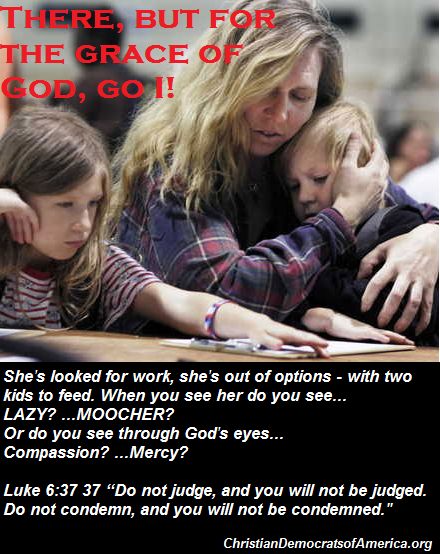
Well today I declare that NONE of it is acceptable! It is not OK to blame the poor. It is not OK to stereotype food stamp and welfare recipients. It is not OK to make a judgement about another person’s circumstances when you have not walked in their shoes. “There, but for the grace of God, go I!” And it is certainly not OK with me, as an American, that half of our citizens be stereotyped – we are the hardest working, most giving people in the world.
Does Romney and so many of his followers truly believe it is FUN to stand in line at a food bank? That people want to live off of $600 or less a month? People are suffering, right here in America, without options. What the government provides is not enough to sustain a quality life for a family and especially not enough to work their way up out of poverty! I have known people who have looked for work for years, wanted so badly to work…but would have to actually turn down jobs because they would lose their healthcare, food stamps, low cost housing, etc., if they made even $20 more than the limits. They would not be able to survive if they took that job. They would literally be on the streets if they took that job. If we really want to provide a path off of welfare, we need to fix a path that is realistic for struggling families, that they can work their way up and out. And yes, as Christians and Democrats we want to see them working. We want to see them with good jobs. But you see, it is the SYSTEM that is broken…but maybe even more broken is our attitudes towards our brothers, sisters…towards humanity.
I’ve said enough and it’s time to let my songwriting speak for itself now, with “My Brother’s Keeper” which I wrote for such a time as this. And better yet, let us simply allow Jesus speak for himself. But one last thing…
Are there some people who game the system, who take advantage, who “double-dip”? Of course. There always are. So let me ask then, as a Christian…do you stop loving people because they might not love you back? Do we stop providing a humane society for abandoned animals because one of those dogs might bite? Cut off a child from a school lunch program and let him go hungry because he isn’t grateful or didn’t earn his lunch? Or, what was it Jesus said…”if someone takes advantage of you, cut everyone off who may also take advantage of you and make sure you protect your own treasures?”
Luke 6: 27-37 “If someone slaps you on one cheek, turn to them the other also. If someone takes your coat, do not withhold your shirt from them. Give to everyone who asks you, and if anyone takes what belongs to you, do not demand it back. Do to others as you would have them do to you. If you love those who love you, what credit is that to you? Even sinners love those who love them. And if you do good to those who are good to you, what credit is that to you? Even sinners do that. And if you lend to those from whom you expect repayment, what credit is that to you? Even sinners lend to sinners, expecting to be repaid in full. But love your enemies, do good to them, and lend to them without expecting to get anything back. Then your reward will be great, and you will be children of the Most High, because he is kind to the ungrateful and wicked. Be merciful, just as your Father is merciful. Do not judge, and you will not be judged. Do not condemn, and you will not be condemned.”  (emphasis added)
James 1:26 Those who consider themselves religious and yet do not keep a tight rein on their tongues deceive themselves, and their religion is worthless. 27 Religion that God our Father accepts as pure and faultless is this: to look after orphans and widows in their distress and to keep oneself from being polluted by the world.
Isaiah 58: “Is not this the kind of fasting I have chosen:
to loose the chains of injustice
and untie the cords of the yoke,
to set the oppressed free
and break every yoke?
Is it not to share your food with the hungry
and to provide the poor wanderer with shelter—
when you see the naked, to clothe them,
and not to turn away from your own flesh and blood?
Then your light will break forth like the dawn,
and your healing will quickly appear;
then your righteousness[a] will go before you,
and the glory of the Lord will be your rear guard.
Then you will call, and the Lord will answer;
you will cry for help, and he will say: Here am I.

Voter Suppression: Coming to a State Near You?

If you're planning on voting in November, here's a few things you should know.

| Mon Sep. 17, 2012 3:00 AM PDT

Since the start of 2011, more than 180 bills have been introduced in 41 states (and counting) that could make it harder for you to register to vote, prove that you're eligible to vote, vote early, or vote by mail. In fact, the Brennan Center for Justice estimates that at least 5 million voters nationwide could be affected by these bills. Thanks, local legislators!
To find out how new restrictions might affect your vote, click on the hypothetical profiles we've created below. You can also track where your state's restrictions currently stand at our database, powered by research from theBrennan Center for JusticeNational Conference of State Legislatures, and ProCon.org, which are monitoring these bills.

I tried but could not embed the cute chart, so click the Block the Vote and check it out.

Block The Vote

Choose a voter to see how these laws could affect someone like you.


Jose is a Latino student at a Florida high school. He just turned 18 and isn't registered to vote yet.
For many years, Jose's US government teacher has been helping her students register to vote. But Florida passed onerous new restrictions on voter registration efforts. Rather than risk paying a $1,000 fine for turning in her students’ registration forms late, Jose's teacher has decided to abandon voter registration this year. The restrictions disproportionately target African American and Latino voters, as well as first-time voters like Jose, who are more likely to register through drives than whites.
202,000 votes nationwide are threatened by this type of restriction
STATES WHERE SIMILAR LEGISLATION IS ALREADY IN PLACE OR BEING PROPOSED