Pages

Thursday, February 2, 2012

Pete Sessions Applauds Vote to Repeal Unworkable CLASS Act

February 2, 2012


Washington, DC – U.S. Congressman Pete Sessions (R-TX-Dallas), a Member of House Republican Leadership, today released the following statement regarding the House’s vote to repeal the Community Living Assistance Services and Supports (CLASS) Act:
“I applaud today’s action to repeal the unworkable long-term health program created by ObamaCare.  Even President Obama and the Secretary of the Health and Human Services Department have sided with Congressional Republicans, warning that the program is unsustainable and cannot be continued. ObamaCare included this financially irresponsible entitlement program because Democrats chose to legislate without revealing the contents of the bill to the American people. The CLASS Act was little more than a cynical budgetary gimmick to sell the unpopular government takeover to the American people, allowing Democrats to claim the new health care law cost $80 billion less than it actually does.
“Repealing the CLASS Act is only the latest of House Republicans’ efforts to stand with the American people in the fight against a government takeover of our health care system.  American families and small businesses have already witnessed firsthand the devastating impacts of ObamaCare – rising health costs which discourage employers from hiring new workers, fewer choices and damaging cuts to Medicare. That is why House Republicans continue to pursue opportunities to repeal the health care law and promote an alternative plan to provide affordable, patient-driven solutions for the American people.”

Romney and the Poor: An Unforced Error by the GOP Front-Runner

An Iowa talking point resurfaces, awkwardly, on a day when lots of eyes are upon him.

Updated: February 2, 2012 | 11:05 a.m.
February 2, 2012 | 6:00 a.m.

AP Photo/Gerald Herbert
Romney's comments are unlikely to doom or even appreciably slow his post-Florida momentum toward the nomination. It’s in the general election that they could hurt.

After a week of near-perfect campaign execution that culminated in a blowout victory over his top rival, Mitt Romney awoke in Florida ready to tighten his grip on the Republican presidential nomination and turn his attention and rhetoric toward the general election. Instead, Romney committed what in tennis is known as an unforced error, setting off on a mission of declaring solidarity with the middle class but ending up in a thicket of class politics that did everything but describe America's poor as coddled.
During a CNN interview on Wednesday morning, Romney waved off the needs of both the poor and the rich. He did so in an answer to how he would "fix" a problem that shows up repeatedly in polling data -- that large swaths doubt he can relate to the needs or problems of average Americans.
"I'm not concerned about the very poor," Romney said. "We have a safety net there. If it needs repair, I'll fix it." Romney also said America's wealthy need no help from Washington and that he would remain relentlessly focused on the ailing middle class. Even so, his remarks about the poor struck CNN anchor Soledad O'Brien as so startling, she asked Romney to clarify, so he repeated them almost verbatim.
It was not the first time Romney has made remarks like this about the poor. The difference is this time he was fresh off a huge primary victory and looking for all the world like the putative GOP nominee. It seemed exactly the wrong time repeat a formulation as awkward, and ripe for picking by political foes, as his assertion last summer that “corporations are people.”
At a town hall on Oct. 20 at Morningside College in Sioux City, Romney said the poor were not his concern. His direct quote (about 20 minutes in) was prompted by a question on tax reform. Romney said tax cuts should focus squarely on the middle class: "The people who need the help the most are not the poor, who have a safety net; not the rich, who are doing just fine; but the middle class."
Then and now it sounds as if Romney is disconnected from the hardships of millions of Americans suffering prolonged joblessness and limited economic options other than federal assistance worth a fraction of their former earnings. In a Pew Research Center survey this week, 55 percent of respondents said President Obama "understood the problems of average Americans" very well or fairly well, while only 39 percent said Romney did. The gap was about the same among independent voters. Even 30 percent of GOP voters said Romney didn’t understand such problems.
Romney's Democratic critics see his "poor" comments as part of a pattern -- one they intend to exploit. "Pundits say the problem with the long primary is how the Republicans will beat up on each other," said Bill Burton, head of the pro-Obama super PAC Priorities USA. "What we've learned over the course of this campaign is that Mitt Romney's biggest problem is Mitt Romney. Left to his own devices, he will be relentless in demonstrating just how out of touch he is."
Some Republicans said Romney spoke a simple truth, one the middle class understands. “Romney was saying that the very rich can take care of themselves and the very poor receive numerous government benefits, and that it is the working middle class that is often overtaxed and neglected in tough economic times," said veteran GOP strategist Greg Mueller. "This is true, and Romney's point was the best way to raise all boats is through limited government and a free economy, not socialism. We will win that argument."
Rob Collins, another GOP strategist, was a bit less enthusiastic. "Every candidate has their 'clings to God and guns' moment, no matter how disciplined they are," Collins said, referring to a comment then-Sen. Barack Obama made during the 2008 campaign when he said rural Americans cling to religion and firearms to cope with economic frustration. "While this dents his momentum, it's only a small dent -- if handled properly. Romney needs to stop the bleeding, pivot away from this moment, and sin no more."
Not long after Romney spoke to CNN, he ventured back to the press cabin of his campaign plane to stop the bleeding. He was immediately asked what he meant, and ended up repeating all of the points that raised eyebrows in the first place. He also protested that "you've got to take the whole sentence," not just part of it. But context is the first casualty in politics, as Romney can well attest. His campaign has defended its TV ad which seemed to show Obama saying he couldn’t win this year if he talked about the economy. Obama was actually quoting an aide to 2008 nominee John McCain talking about the McCain campaign.
Romney's comments are unlikely to doom or even appreciably slow his post-Florida momentum toward the nomination. It’s in the general election that they could hurt, particularly with the types of voters George W. Bush courted with his “compassionate conservatism” -- women, moderates, and independents.
The next GOP contest is Saturday in Nevada, a place that once believed its tourist-fueled economic expansion would shield it from a long and grinding economic downturn but now tops the nation in unemployment and foreclosures. Romney won the state’s caucuses easily in 2008 (52 percent to 12 percent each for McCain and Ron Paul). He is even better organized now and is expected to win again. But Nevada in a general election is where Romney’s comments could take a toll. The closely divided state is key to winning the White House, and a good example of why Romney can’t afford to add any more fuel to the "out-of-touch" narrative.

House Approves Federal-Worker Pay Freeze


Dems say GOP included congressional pay to set up campaign attacks.

Updated: February 2, 2012 | 6:38 a.m.
February 1, 2012 | 7:18 p.m.
Chet Susslin
House Majority Whip Kevin McCarthy speaks at a press conference in July.
A Republican bill to freeze the pay of federal workers and members of Congress alike through 2013 passed the House on Wednesday night.
The prospects in the Democratic-led Senate are uncertain for the measure, which supporters say would save taxpayers $26.2 billion.
The final vote was 309-117, but the outcome was in doubt until the final gavel. That’s because the House Republican majority placed it on the expedited suspension calendar, which requires two-thirds support of all the members present in the chamber. That meant backing was also needed from a chunk of Democrats as Republicans do not hold that many seats.
In the end, 72 Democrats voted for the bill.
Republicans knew well beforehand that many Democrats did not support the legislation, usually a cue to opt for easier passage through regular order. However, GOP leaders chose the suspension process, usually reserved for noncontroversial bills, daring Democrats to vote against freezing their own pay.
Many Democrats oppose freezing government workers' pay for three straight years, suggesting it penalizes them for the state of the economy. Instead, they support President Obama's plan give federal workers a 0.5 percent cost-of-living increase in the next fiscal year.
Democrats say GOP leaders combined the government workers' pay freeze with one for members of Congress so they could bash Democrats on the campaign trail.
On Wednesday morning, Majority Whip Kevin McCarthy, R-Calif., seemed to do just that, telling reporters: “Democrats are trying to actually block freezing our pay.”
“Disingenuous,” complained Maryland's Elijah Cummings, the top Democrat on the House Oversight and Government Reform Committee during floor debate.
Cummings and two other Washington-area lawmakers representing thousands of federal workers—Chris Van Hollen, top Democrat on the House Budget Committee, and House Minority Whip Steny Hoyer, both of Maryland—pointed out angrily that Republicans refused on Wednesday to bring a Democratic bill to the floor that would have only frozen congressional pay.
“I am for bringing a bill to the floor that would freeze our salaries,” Hoyer said. On Tuesday, Hoyer characterized his GOP counterparts' maneuvering on the bill as “clever,” and suggested it would result in 30-second political attack ads.
Republicans, including the bill’s sponsor, Rep. Sean Duffy, R-Wis., said such claims were baseless. During debate, Duffy said the Democratic-led 111th Congress was the first to freeze federal workers' pay back in 2010. His bill would merely extend that, he said, and freeze their own pay as well.
“The only difference in my bill is that I included members of Congress,” Duffy said.

Trump to Endorse Gingrich

Updated: February 2, 2012 | 6:26 a.m.
February 1, 2012 | 10:03 p.m.
Real estate mogul Donald Trump is preparing to endorse GOP presidential candidate Newt Gingrich, sources confirmed to National Journal/CBS News.
Earlier Wednesday evening, Trump wrote on Twitter that he would be in Las Vegas on Thursday to make a "major announcement," but didn't elaborate.
Trump, who flirted with running for president himself, met with each of the Republican presidential candidates who sought his support. After the two men met in December, Gingrich described the flamboyant reality-show star as "a genuine American icon."
But another controversial figure -- Sharron Angle, a favorite of the tea party movement who narrowly lost to Senate Majority Leader Harry Reid in 2010 -- has decided to go with a different presidential candidate. Angle announced late Wednesday that she is supporting Rick Santorum, according to National Review Online.

Romney campaign: Trump will endorse former governor

By Daniel Strauss - 02/02/12 10:08 AM ET
Donald Trump will endorse Mitt Romney for president, according to a source close to the former Massachusetts governor's campaign.
Trump, who has been teasing an endorsement in the presidential race for some months now, will make his announcement in Las Vegas.

“I will be making a major announcement tomorrow (Thursday, February 2) at 12:30 pm at Trump International Hotel & Tower, Las Vegas, Nevada,” Trump tweeted on Wednesday. “I will be arriving this evening at approximately 11:30 pm. The announcement will pertain to the Presidential race. All media welcome.”
The confirmation caps a dizzying morning in which a number of news outlets reported that the real estate mogul — who himself has toyed with a presidential run — was going to endorse former House Speaker Newt Gingrich (Ga.). Those reports conflicted with other ones that said Trump would back Romney.
According to The Associated Press, Gingrich told his campaign advisers on Wednesday that he expected to get Trump's endorsement.
Trump met one-on-one with a number of GOP presidential candidates in 2011. In discussing whom he might endorse, Trump said that he had a “good, good sight on everybody.”
“We have some good people,” Trump said in November.
Trump had also spoken about launching a possible independent bid himself.
On Sunday, Trump said that he expected to endorse a GOP candidate, but that if his selection failed to win the nomination, he would consider entering the race as an independent. “I actually think the right independent could win, Trump said on CBS's "Face the Nation."
Romney and Trump did not appear to have had the best of relationships earlier in the GOP race. In early December, Romney was one of a number of candidates who ended up boycotting a debate that Trump was scheduled to moderate.
Earlier last year Trump had also criticized Romney, saying that he was a "small-business guy."
"I’m much bigger than this man and have a much, much bigger net worth. I mean my net worth is many, many, many times Mitt Romney," Trump said in response to a question about who was the more successful businessman.

Commentary: A slim hope for justice in the housing crisis

  • Posted on Tuesday, January 31, 2012

Before they proceed with their latest housing crisis task force, U.S. Attorney General Eric Holder and New York Attorney General Eric Schneiderman ought to sit down with Jose Rodriguez.
That would require that Holder and Schneiderman leave Washington and New York, and spend time in the unglamorous city of Stockton, which competes with Las Vegas for having the highest foreclosure rate in the nation.
"Never," Rodriguez answered when I asked if he had ever seen anything like it. For 16 years, Rodriguez has led El Concilio, a nonprofit in downtown Stockton, which counsels families facing crises including foreclosure. "I have never seen so many people without hope, without an expectation that things will get better."
Rodriguez watched last Tuesday as President Barack Obama delivered his State of the Union address in which he announced that he had directed Holder to create "a special unit of federal prosecutors and leading state attorneys general to expand our investigations into the abusive lending and packaging of risky mortgages that led to the housing crisis."
On Wednesday, the White House said Schneiderman would represent states on the task force.
The housing crisis began in 2007. It careened out of control in 2008. The president took office in 2009. More than 3 million homes have been repossessed since 2007; the number could double by next year, according to RealtyTrac Inc.
The president did create a task force in 2009, the Financial Fraud Enforcement Task Force. Top officials including Holder issued press releases about it. They held press conferences in Nevada, Fresno and Los Angeles. They promised justice.
The other day, Reuters news service reported that before becoming attorney general, Holder was a partner at the blue chip law firm Covington & Burling, which represents a variety of industries including banking in its law practice and its Washington lobbying operation.
Covington's Washington lobbyists represent the American Banking Association, among others, and have billed lobby clients $28.5 million since the start of the Obama administration in 2009, the nonpartisan Center for Responsive Politics discloses.
"Our (lobby) practice is politically balanced and enjoys respect in the House and Senate and in both political parties," the firm says on its website. "Capitol Hill policymakers frequently turn to us for help based on our expertise and professionalism."
On behalf of the American Bankers Association, Covington lobbyists helped shape the federal Dodd-Frank Act, the 2010 legislation that seeks to regulate financial institutions, the firm boasts.
There's no evidence that Covington asked anything of Holder. Partners at the firm wouldn't be that stupid, and Holder probably wouldn't listen. But they don't need a discussion. That's how the Washington-Wall Street connection works.
Speaking of the Wall Street-Washington connection, Schneiderman's appointment came as the Obama administration pressures states to join a nationwide settlement of the so-called robo-signing scandal in which mortgage servicers signed mortgage documents without reading them or verifying their accuracy.
Schneiderman had walked away from the talks last year, contending that other states were giving up too much. Now, that he's inside the Justice Department's tent, my guess is that he will be OK with the deal.
On behalf of the Obama administration, Shaun Donovan, head of the U.S. Department of Housing and Urban Development, convened a meeting in Chicago on Monday of state attorneys general and their representatives to sell the deal.
California Attorney General Kamala Harris didn't attend, though she sent a representative. She, too, broke away from the robo-signing negotiations and faces pressure to rejoin. Unlike Holder or Schneiderman, however, she drove to Stockton last week to meet Rodriguez.
He introduced her to a husband and wife in their 40s who are losing their home after his construction work dried up. Another couple took a mortgage that was beyond their means based on a promise that they could refinance. A third couple in their 60s could no longer work and lost their home when they couldn't get their mortgage payments modified.
"The reality," he said, "is that for some of these folks, it is not going to get better. The number of people we see crying, I have never seen anything like this."
In his speech, the president declared that the new unit will "hold accountable those who broke the law, speed assistance to homeowners." But years have passed since the crisis began. Evidence needed to gain convictions will be more difficult to obtain than it would have been in 2009.
We are in 2012. Obama's Justice Department hasn't brought any criminal cases against major banks or Wall Street executives related to the housing crisis. In Stockton, people will continue to come to El Concilio looking for help. Rodriguez will do what he can. But he shouldn't hold out much hope for justice.

Romney Hits Obama on Solyndra, But Bain Got Government Subsidies, Too

| Thu Jan. 19, 2012 6:47 PM PST

Mitt, doin' work. 
At Thursday night's CNN debate, Mitt Romney attacked the Obama administration's loan guarantees for the now-bankrupt solar panel manufacturer Solyndra as a prime instance of the government picking winners and losers in business, and losing big. But Bain Capital, the private equity firm Romney founded, frequently received similar help from state governments, including subsidies and tax breaks. The subsidy-tracking folks over atGood Jobs First compiled a vast database on just how much states have bailed out companies that were bought and—in a number of cases—gutted by Bain Capital. Some of the highlights:
Sealy. A year after the 1997 buyout of this leading mattress company by Bain and other private equity firms, Sealy received $600,000 from state and local authorities in North Carolina to move its corporate offices, a research center and a manufacturing plant from Ohio (Greensboro News & Record, March 31, 1998). In 2004 Bain and its partners sold Sealy to another private equity group.
GS Industries. In 1996 American Iron Reduction LLC, a joint venture of GS Industries (which had been taken private by Bain in 1993) and Birmingham Steel, sought some $20 million in tax breaks in connection with its plan to build a plant in Louisiana’s St. James Parish (Baton Rouge Advocate, April 6, 1996). As the United Steelworkers union noted recently, GS Industries later applied for a federal loan guarantee, but before the deal could be implemented the company went bankrupt.
AMC Entertainment. After being promised more than $40 million in subsidies, this movie chain (bought in 2004 by Bain and other private equity firms) agreed to move its headquarters from downtown Kansas City, Missouri to a nearby suburb across the state line in Kansas. The deal was criticized as an egregious case of taxpayer-financed sprawl. [Even though Romney left Bain in 1999, he's continued reaping millions in lightly taxed investment income since then.]
As for the office supply store Staples, a supposed success Romney frequently touts? In 1996, the company chose to move its distribution center to Maryland in exchange for a healthy $4.2 million subsidy deal.
Romney says that President Obama's record of aiding private enterprise proves the president doesn't have a clue about how capitalism works—that, in the Obama's view, capitalism necessarily relies on the generosity of government largesse. But if we're to judge Romney's understanding of capitalism based on how he ran the show at Bain, it's tough to see how business success doesn't often rely on government help.

Democrats Received Over Twice As Much Bain Cash As Republicans Did

| Fri Jan. 20, 2012 3:55 AM PST

One of the co-founders of Bain Capital, we've been told.: MittRomneys/FlickrOne of the co-founders of Bain Capital, we've been told. MittRomneys/FlickrAlex Bolton has a piece atThe Hill that should come as a big shock to...virtually no one:
During the last three election cycles, Bain [Capital] employees have given Democratic candidates and party committees more than $1.2 million. The vast majority of that sum came from senior executives. Republican candidates and party committees raised over $480,000 from senior Bain executives during that time period.
Recipients include Democratic senators facing tough reelection races this year, such as Jon Tester (Mont.), Claire McCaskill (Mo.),Sherrod Brown (Ohio) and Bill Nelson (Fla.)...President Obama received a sizable share as well. He has accepted more than $80,000 from Bain employees since the beginning of 2007. Bain Capital employees gave $27,500 to Obama during the first three quarters of 2011.
Yes, that's the same Bain Capital that Mitt Romney co-founded. And yes, some Republican congressional candidates in battleground states have—given the Bain-related hits Romney has faced lately from both liberalsand fellow Republicans—already started to use this information as ammunition against their Democratic opponents.
This doesn't look terribly good from a PR standpoint for Democrats, but it's not that surprising. It's no secret that Barack Obama and manyother Democratic politicians have received tens of thousands of dollars in donations from Bain employees. And considering the president's rather cozy relationship with big business and Wall Street, it seems only natural that his reelection campaign is awash with financial-sector cash.
Now that Bain executives have one of their own as the clear front-runner for a major party nomination, their political giving reflects that:
As of Dec. 21, fundraising reports show Bain employees gave $123,000 to the Democratic National Committee in 2011...The Democratic fundraising advantage, however, was offset by at least $750,000 that Bain Capital employees gave to Restore Our Future, a pro-Romney super-PAC, in 2011.
According to the Center for Responsive Politics, Romney has bagged more campaign contributions from Bain Capital employees than any other federal candidate over the last five years. In the first three quarters of 2011 alone Romney hauled in nearly $85,000 from Bain executives and employees.
So, this story essentially just shows the folks at Bain Capital shelling out campaign donations in pragmatic and predictable ways. But it also lays out the key problem with the "corporate raider" attacks Democratic strategists have been itching to deploy against Romney in a general election fight. As Bolton notes, "Democrats could be forced to justify attacking Bain—which specializes in buying companies and boosting profitability, often by laying off workers—while accepting campaign funds from the same executives who made the cost-cutting decisions." There are major distinctions to be drawn between accepting campaign cash from a private equity firm and presiding over said firm as CEO. But if Democrats choose to commit to this line of attack, they might have to live with the impact being dulled, especially when the words "receivedtwice as much money from Bain Capital" enter the debate.

Italian divers on Tuesday gave up their search

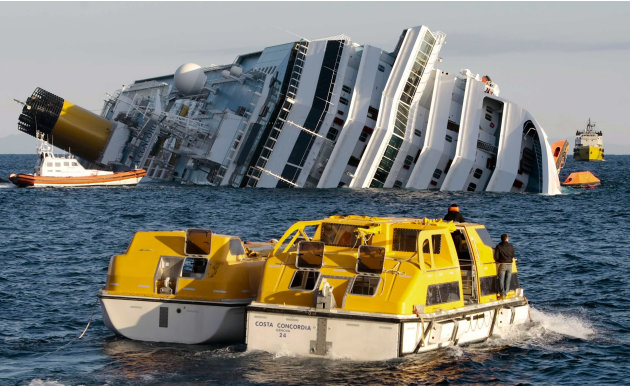
Italian divers on Tuesday gave up their search on the wreck of the Costa Concordia, in which 32 people are feared to have died, as workers prepared to start pumping out fuel to avoid an oil spill.

"We have definitively stopped the underwater search inside the ship," said Luca Cari, fire brigade spokesman on the island of Giglio, explaining that conditions inside the giant half-submerged liner were becoming too risky.

"The conditions are no longer acceptable," he told AFP.

  •  Graphic showing possible ways of refloating the Costa Concordia. Italian divers have halted the search for 15 people still missing from the Costa Concordia shipwreck on the Tuscan island of Giglio in which a total of 32 people are feared to have died. (AFP Photo/)


The civil protection agency, which has been overseeing rescue efforts following the January 13 disaster, said in a statement it had contacted the families of the missing and foreign embassies involved to explain its decision.

It added that rescuers would continue to inspect the above-water part of the liner and use specialist equipment to check for corpses on the sea bed in an 18-square-kilometre (seven-square-mile) area around the wreck.

The 114,500-tonne Costa Concordia with more than 4,200 people aboard ran aground on rocks off Giglio and lurched on to its side as passengers were settling down to dinner shortly after the start of a Mediterranean cruise.

Seventeen bodies have been recovered from the sea and the wreck and 15 people remain missing.
The search has had to be suspended several times due to choppy seas and small movements of the wreck, which sparked fears that the massive ship could slip off the rocky shelf it is resting on and sink entirely.

Divers have described tricky conditions inside the ship, with corridors cluttered with furniture and turbid waters. Dives have been limited to a maximum of 50 minutes, making it difficult to penetrate far into the vessel.

A spokeswoman for the civil protection agency said the last unidentified body was "very probably" that of a German woman born in 1945 but added that the formal identification had not yet been made.

Meanwhile Pier Luigi Foschi, the chief executive of operator Costa Crociere, part of US-based giant Carnival Corp, told a Senate committee hearing that fuel pumping from the ship would start within the next 24 hours.

"The first operation will be to empty the ship, the second to clean up the wreck and the third to move the ship, which will be a truly enormous operation that has never been done before," Foschi told senators.  
"We believe that the wreck can no longer be put in use," he said of the ship, which cost 450 million euros (590 million dollars) to build and was launched in 2006.

Environmentalists fear that the 2,380 tons of heavy fuel oil in the Costa Concordia's tanks could begin leaking out into the area's pristine waters.

The chief executive of the ship's owner Costa Cruises told an Italian Senate committee Tuesday that all safety systems on board had been in order at the time of the accident but there had potentially been delays leading up to evacuation.

"We know there is a sequence of orders that has to be given before the evacuation. Some of these orders were given, but we are not certain of the timing or who gave them," CEO Pier luigi Foschi said.
"Possibly the period of time between one order and the next was too long," he added.

The ship's captain, Francesco Schettino, is under house arrest and is blamed for causing the accident. He is also accused of abandoning ship before the evacuation was complete.

Italy's top-ranking Coast Guard official, Marco Brusco, said last week that Schettino lost "a precious hour" which made evacuating the ship more difficult.  Passengers have complained the evacuation was chaotic, with some left waiting in lifeboats for two hours before being able to leave the ship. Several bodies were found by divers in submerged evacuation assembly points, wearing life vests.


Island residents concerned about the impact on tourism have called for the ship to be removed quickly and have launched a protest after the civil protection agency said it would take up to a year.
Costa Cruises has offered 11,000 euros in compensation to each of the passengers aboard the liner, in a bid to limit the legal fallout of the accident.The head of the consumer association group Codacons, which is taking part in a class action lawsuit against Carnival Corp and Costa Crociere, said it had requested that the wreck be removed within 30 days.

The head of Costa Crociere's crisis unit, Roberto Ferrarini, who was alerted by the captain on the night of the disaster, also spoke to investigators on Tuesday, the first executive to be heard by prosecutors.
Captain Francesco Schettino and first officer Ciro Ambrosio are accused of manslaughter and abandoning ship.

A medical officer on the ship, Gianluca Cosentino, said in an interview published on Tuesday that Schettino seemed "shaken and no longer lucid" on the night of the disaster and was not coordinating rescue operations as he claimed. "I was very surprised to see Schettino in civilian clothes in the harbour at around half past midnight," Cosentino told Il Mattino daily.

Foschi said that Costa Cruises, a unit of Carnival Corp, remained a strong company despite the disaster.
"The firm is financially strong, it's structured to be strong. My concern now is how we can recover our image and the confidence of customers in Italy and the world," he said.
 

Inside the Costa Concordia


A scuba diver inspects the inside of the Costa Concordia cruise ship which ran aground off the west coast of Italy at Giglio island in this still image taken from video shot by Italian firefighters, January 30, 2012. Search operations at the Costa Concordia resumed on Monday after being suspended for a day 

A frame grab taken from a video made available by Italian Firefighters Monday, Jan. 30, 2012, showing an underwater view of the cruise ship Costa Concordia grounded off the Tuscan island of Giglio, Italy. Residents of Giglio are growing increasingly worried about threats to the environment and the future of

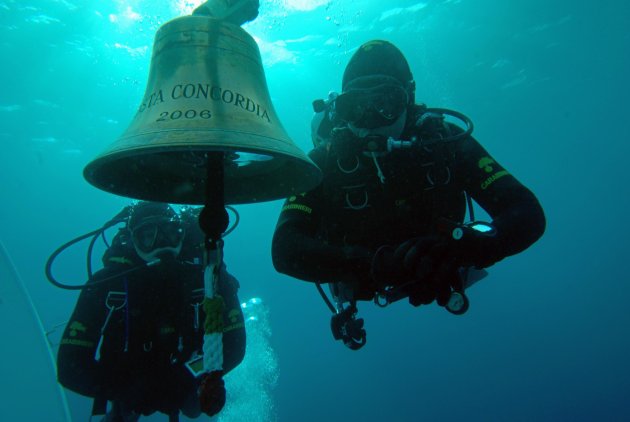
Italian divers swim past the bell of the stricken Costa Concordia cruise liner. Italian divers on Tuesday gave up their search on the wreck of the Costa Concordia, in which 32 people are feared to have died, as workers prepared to start pumping out fuel to avoid an oil spill. (AFP Photo/)

  
Experts aboard a sea platform carry oil recovery equipment as they return to the port of the Tuscan island of Giglio, Italy, where the cruise ship Costa Concordia, visible in background, ran aground, Saturday, Jan. 28, 2012. Rough seas off Italy's Tuscan coast forced a delay in the planned Saturday start of the operation to remove a half-million gallons of fuel from the grounded Costa Concordia, and officials said pumping may now not begin until midweek. (AP Photo/Pier Paolo Cito)


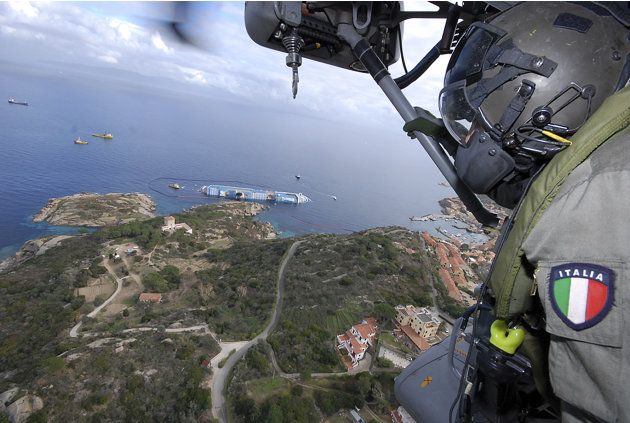
In this undated photo released by the Italian Navy Thursday, Jan. 26, 2012, the Costa Concordia cruise ship is seen grounded off the Tuscan island of Giglio, Italy. Italian authorities have identified the bodies of three German passengers as divers kept up the search for those still missing from the Costa Concordia cruise ship that rammed into a reef off Italy. Sixteen deaths have been confirmed so far in the disaster, but three of those bodies have yet to be identified. Another 16 people are still missing from the ship, which grounded Jan. 13, but officials have acknowledged that it would take a miracle to find any more survivors. Salvage experts worked Thursday so they could begin pumping tons of fuel off the ship starting Saturday to avert an environmental catastrophe. The stricken ship lies very close to a marine sanctuary. (AP Photo/Italian Navy)

  
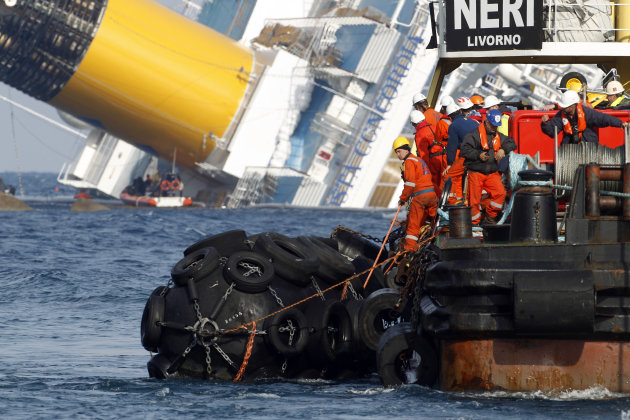
Oil recovery experts work on the grounded cruise ship Costa Concordia off the Tuscan island of Giglio, Italy, Tuesday, Jan. 24, 2012. A large platform carrying a crane and other equipment hitched itself to the toppled Costa Concordia on Tuesday, signaling the start of preliminary operations to remove a half-million gallons of fuel from the grounded cruise ship before it leaks into the pristine Tuscan sea. Actual pumping of the oil isn't expected to begin until Saturday, but officials from the Dutch shipwreck salvage firm Smit were seen on the bow of the Concordia and in the waters nearby making preparations to remove the fuel, while the search for missing passengers continues. (AP Photo/Pier Paolo Cito)

  
FILE In this In this Saturday, Jan. 14, 2012 file photo Francesco Schettino, right, the captain of the luxury cruiser Costa Concordia, which ran aground off Italy's tiny Tuscan island of Isola del Giglio, is taken into custody by Carabinieri in Porto Santo Stefano, Italy. Seamen have expressed almost universal outrage at Capt. Francesco Schettino, accused of manslaughter, causing a shipwreck and of abandoning his crippled cruise ship off Tuscany while passengers were still on board. The charge of abandoning his ship carries a potential sentence of 12 years in prison. Seafaring tradition holds that the captain should be last to leave a sinking ship. But is it realistic to expect skippers _ only human after all _ to suppress their survival instinct amid the horror of a maritime disaster? To ask them to stare down death from the bridge, as the lights go out and the water rises, until everyone else has made it to safety? From mariners on ships plying the world's oceans, the answer is loud and clear: Aye. (AP Photo/Giacomo Aprili, File)


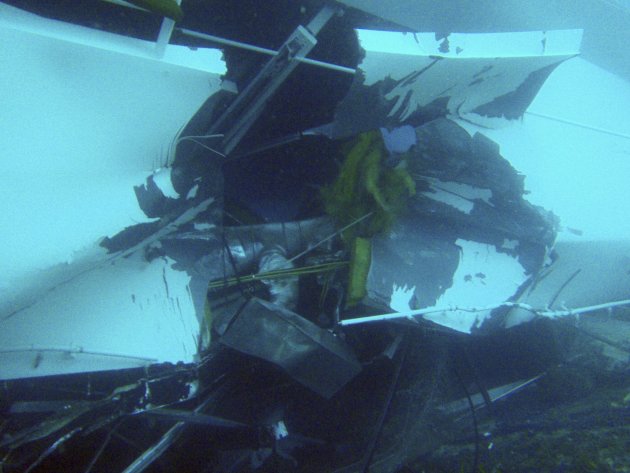
A breach on the side of the Costa Concordia cruise ship is seen underwater after it ran aground off the west coast of Italy, at Giglio island in this photo released on January 16, 2012. Rescue squads used controlled explosions on Tuesday to enter a stricken Italian cruise liner in the increasingly despairing hunt for survivors, as authorities almost doubled their estimate of the number missing to 29 people. Picture taken January 16, 2012. ...


Investigators approach the luxury cruise ship Costa Concordia which leans on its starboard side after running aground in the tiny Tuscan island of Isola del Giglio, Italy, Sunday, Jan. 15, 2012. The Costa Concordia cruise ship ran aground off the coast of Tuscany, sending water pouring in through a 160-foot (50-meter) gash in the hull and forcing the evacuation of some 4,200 people from the listing vessel early Saturday, the Italian coast guard said. (AP Photo/Gregorio Borgia)

Wednesday, February 1, 2012

Romney: 'I'm Not Concerned About the Very Poor, We Have a Safety Net'

February 1st, 2012
08:11 AM ET


Starting Point|Added on February 1, 2012 
Mitt Romney says he's worried about middle-income Americans and that the "very poor" in the U.S. have a safety net.


After winning the Florida primary, GOP presidential nominee hopeful Mitt Romney explains to CNN anchor Soledad O'Brien that he is focused on a particular portion of the American population in his campaign.
Romney says, "I'm not concerned about the very poor. We have a safety net there. If it needs a repair , I'll fix it. I'm not concerned about the very rich.... I'm concerned about the very heart of America, the 90-95 percent of Americans who right now are struggling."
O'Brien asked him to clarify his remarks saying, "There are lots of very poor Americans who are struggling who would say, 'That sounds odd.'"
Romney continues, "We will hear from the Democrat party, the plight of the poor.... You can focus on the very poor, that's not my focus.... The middle income Americans, they're the folks that are really struggling right now and they need someone that can help get this economy going for them."


The GOP front-runner says the middle class has been most hurt by the 'Obama economy'

Updated: February 1, 2012 | 5:33 p.m.
February 1, 2012 | 5:00 p.m.

Ralf-Finn Hestoft
GOP Presidential Candidate Mitt Romney makes a major policy address before supporters at the Blackhawk Hotel in Davenport, Iowa on Dec. 27, 2011. 
MINNEAPOLIS – A day after a resounding Florida victory that revived his unofficial title of front-runner for the Republican presidential nomination, Mitt Romney found himself trying to dig out of comments he made about the “very poor” in a CNN interview.
"I'm not concerned about the very poor. We have a safety net there. If it needs a repair, I'll fix it," Romney said on CNN's Starting Point. "I'm not concerned about the very rich. They're doing just fine. I'm concerned about the very heart of America, the 90, 95 percent of Americans who right now are struggling." Asked by host Soledad O’Brien to elaborate, Romney repeated that he was not “focused” on the very poor because they had a safety net.
Romney's chief rival Newt Gingrich blasted the remark. "I am fed up with politicians in either party pitting Americans against each other," Gingrich said. "I am running to be the president of all the American people, and I am concerned about all the American people."
Gingrich then discussed the founding fathers' intentions for the nation and said, "Let me shock Governor Romney. The founding fathers meant the very poor, who they called Americans."
The comments also set off a flurry in social media. Later, as Romney flew from Tampa to Minneapolis for a campaign rally, he said his focus is middle income families because they have been “most hurt by the Obama economy.”
He also defended his remarks on CNN. “You’ve got to take the whole sentence,” he said, and not just a fragment of it. “I've said throughout the campaign my focus, my concern, my energy is going to be devoted to helping middle income people, all right? We have a safety net for the poor in, and if there are holes in it, I will work to repair that. And if there are people that are falling through the cracks I want to fix that.”
Asked if he thinks there are holes in the safety net, Romney replied: “Oh, I'm sure there are. I'm sure there are places where people fall between the cracks. And finding those places is one of the things that is the responsibility of government.”
But he said there is “a very ample safety net in America, with Medicaid, housing vouchers, food stamps, earned income tax credit.” The real challenge now, he said, is how to “get more people in the middle class and get people out of being poor and becoming middle income."

Mitt Romney’s February to-do list


“In another era of American crisis, Thomas Paine is reported to have said, 'lead, follow, or get out of the way,'” Romney said. “Mr. President, you were elected to lead. You chose to follow, and now, it's time for you to get out of the way.”


After his resounding 15-point victory in Florida, Mitt Romney has taken a giant leap toward securing the Republican presidential nomination.
The nomination is now Romney's to lose as he heads into February and some very friendly turf in upcoming contests in Nevada, Colorado, Arizona, and his native Michigan.
But Romney won't be able to coast. If he is to wrap up the battle for the nomination in a position of strength by Super Tuesday (and that is the goal of his campaign), he will need to accomplish all of the items on his hefty to-do list.
1. Assuage conservatives: Newt Gingrich likes to refer to Romney as a "Massachusetts moderate" or a "Massachusetts liberal," in an effort to sow real disenchantment with Romney among very conservative Republican voters. Despite Romney's sweeping victory, 41 percent of Florida GOP primary voters said Romney is not conservative enough on the issues, according to the exit poll conducted by Edison Research on behalf of the Associated Press and the five television networks.
2. Boost his favorability: The intensified and, at times, brutally negative Republican nomination battle has taken its toll on Romney's standing with voters. In a Washington Post/ABC News poll released last week, Romney had his highest unfavorable ratings ever recorded. Of those polled, 49 percent viewed him unfavorably compared to only 31 percent who viewed him favorably. If Romney doesn't reverse this trend soon, he'll have a much deeper hole to climb out of when the general election begins in earnest.
3. Straddle successfully: As Romney made clear in his Florida victory speech, he is setting his sights on President Obama. He did the same on the night of his New Hampshire victory, only to be snapped back into the thick of a battle against Gingrich in South Carolina and Florida.
Romney's big February challenge is to successfully straddle the need to run both a general election campaign against Obama while simultaneously keeping his foot on Gingrich's neck in their intra-party contest. Romney spent much of 2011 calibrating that precise straddle with great skill, but in the thick of the fight and with attacks coming from all directions it proved much harder for him to prosecute both cases in January.
4. Quietly nudge: This task requires the most artistry from Romney and, more important, from his advisers and top surrogates. As the economy continues to show spurts of growth and with President Obama fully engaged in campaign mode, Romney can ill afford to lose any time building his case against the incumbent. And, yet, the remaining Republican hopefuls will demand that his time be spent paying attention to them.
The Romney campaign needs to be ready to open a constructive conversation with Newt Gingrich about how his pledge to continue all the way to Tampa might hurt the party's chances at winning the White House. And yet the last thing Romney would like to have happen too quickly is for Rick Santorum to leave the race and have that embolden Gingrich.
Romney's ability to successfully check through his to-do list between now and Super Tuesday will tell us a lot about what kind of general election candidate he is likely to be in the fall.