Pages

Monday, February 7, 2011

Is Our Man in Cairo a Pro-Mubarak Lackey?

WASHINGTON, DC – Frank Wisner, President Obama's envoy to Egypt, ignited a firestorm over the weekend by asserting that "President Mubarak's continued leadership is critical." The remark contrasted starkly with Obama's previously stated calls for an "orderly transition" to begin in Egypt immediately. Why the mixed messages? Well, it may have something to do with the fact Wisner is on the payroll for a New York-DC law firm that works for the Egyptian government. The Independent's Robert Fisk discovered the apparent conflict of interest earlier today:
The US State Department and Mr Wisner himself have now both claimed that his remarks were made in a "personal capacity". But there is nothing "personal" about Mr Wisner's connections with the litigation firm Patton Boggs, which openly boasts that it advises "the Egyptian military, the Egyptian Economic Development Agency, and has handled arbitrations and litigation on the [Mubarak] government's behalf in Europe and the US". Oddly, not a single journalist raised this extraordinary connection with US governmentofficials – nor the blatant conflict of interest it appears to represent. 
Responding to Fisk's story, the law firm Patton Boggs is denying that Wisner ever worked for the Egyptian government. A managing partner at the firm tells Salon that Patton Boggs recently carried out a "very small legal matter" for the Egyptian government but Wisner wasn't involved. Is this much ado about nothing or a glaring conflict of interest?
  • This Is Shameful, writes Robert Fisk at The Independent: "It is inconceivable Hillary Clinton did not know of his employment by a company that works for the very dictator which Mr Wisner now defends in the face of a massive democratic opposition in Egypt. Mr Wisner joined Patton Boggs almost two years ago – more than enough time for both the White House and the State Department to learn of his company's intimate connections with the Mubarak regime.
  • This Reflects Poorly on Obama, writes Marcy Wheeler at Fire Dog Lake: "By and large, the Obama Administration response to this admittedly difficult challenge has been not-horrible. But both Wisner’s selection as envoy (which would have been horrible even without the Patton Boggs connection, given his ties to his daddy’s coup-happy CIA, Enron, and AIG) and Hillary’s outspoken support for Omar Suleiman were unforced errors." Glenn Greenwald at Salon adds, "I'm sure there's some reasonable explanation for the State Department's conduct here; I can't wait to find out what it is."
Patton Boggs is a massive firm with 600 attorneys spread across nine locations. It represents 200 international clients from more than 70 countries. Did Wisner work directly on the Egypt account? If so, problem. At the other far end of the spectrum, he might not even have known the firm represented Egyptians interests. Don't laugh. He's not a managing partner. He's just an 'adviser,' whatever that is, exactly. Now one would think that he knew, but one would think a lot of things that don't turn out to be true.
  • Either Way—It's Odd, says Nicholas Noe, an American political researcher interviewed in Fisk's piece:  "The key problem with Wisner being sent to Cairo at the behest of Hillary is the conflict-of-interest aspect... More than this, the idea that the US is now subcontracting or 'privatising' crisis management is another problem. Do the US lack diplomats?"

The psychology of Egyptian protest


Dr. Deepak Chopra, author of ‘The Soul of Leadership’, discusses the psychology that drives not only Egyptian protestors’ collective behavior but also the abuse tactics deployed against them.


Stand for Freedom


FEB 14, 2011, VOL. 16, NO. 21 • BY WILLIAM KRISTOL


Our friend Charles Krauthammer began his column last week by asking, “Who doesn’t love a democratic revolution? Who is not moved by the renunciation of fear and the reclamation of dignity in the streets of Cairo and Alexandria?”
/><p class=Newscom
Some on the right, that’s who.
It’s understandable that conservatives should be wary of people taking to the streets—even when they are entitled to do so. It’s also reasonable for conservatives to warn of the unanticipated consequences of ostensibly hopeful developments.
As Krauthammer puts it, “All revolutions are blissful in the first days. The romance could be forgiven if this were Paris 1789. But it is not. In the intervening 222 years, we have learned how these things can end.”
True enough. And Krauthammer goes on to make an argument for an American policy more focused on the Egyptian Army, less supportive of the Egyptian people, more fearful of the Muslim Brotherhood taking over this broad-based uprising, more cautious and muted in terms of the pressure that the American government can put on the regime, than we at The Weekly Standard have been recommending.
Reasonable people will differ in their analyses of rapidly changing circumstances half a world away—a fact that should make us somewhat tolerant of the Obama administration’s own stumbles. But Krauthammer does hasten to add, “The Egyptian awakening carries promise and hope and of course merits our support.” And, he writes later on, “our paramount moral and strategic interest in Egypt is real democracy in which power does not devolve to those who believe in one man, one vote, one time.”

So, whatever our differences in historical interpretation or foreign policy tactics, we agree with our skeptical comrade that the United States must support the Egyptian awakening, and has a paramount moral and strategic interest in real democracy in Egypt and freedom for the Egyptian people. The question is how the U.S. government can do its best to help the awakening turn out well.
In his column, Krauthammer refers to the French, Russian, and Iranian revolutions. They all turned out badly. But before 1789 was 1776. After 1917, there was 1989. And after 1979, there was also 2009, when the Obama administration shamefully and foolishly did nothing to help topple the most dangerous regime in the Middle East.
Furthermore, in the last quarter century, there have been transitions from allied dictatorships to allied democracies in Chile, South Korea, the Philippines, and Indonesia, to name only a few. The United States has played a role in helping those transitions turn out (reasonably) well. America needn’t be passive or fretful or defensive. We can help foster one outcome over another. As Krauthammer puts it, “Elections will be held. The primary U.S. objective is to guide a transition period that gives secular democrats a chance.”
Now, people are more than entitled to their own opinions of how best to accomplish that democratic end. And it’s a sign of health that a political and intellectual movement does not respond to a complicated set of developments with one voice.
But hysteria is not a sign of health. When Glenn Beck rants about the caliphate taking over the Middle East from Morocco to the Philippines, and lists (invents?) the connections between caliphate-promoters and the American left, he brings to mind no one so much as Robert Welch and the John Birch Society. He’s marginalizing himself, just as his predecessors did back in the early 1960s.
Nor is it a sign of health when other American conservatives are so fearful of a popular awakening that they side with the dictator against the democrats. Rather, it’s a sign of fearfulness unworthy of Americans, of short-sightedness uncharacteristic of conservatives, of excuse-making for thuggery unworthy of the American conservative tradition.
It was not so long ago, after all, when conservatives understood that Middle Eastern dictatorships such as Mubarak’s help spawn global terrorism. We needn’t remind our readers that the most famous of the 9/11 hijackers, Mohammed Atta, was an Egyptian, as is al Qaeda’s number two, Ayman al Zawahiri. The idea that democracy produces radical Islam is false: Whether in Pakistan, Saudi Arabia, the Palestinian territories, or Egypt, it is the dictatorships that have promoted and abetted Islamic radicalism. (Hamas, lest we forget, established its tyranny in Gaza through nondemocratic means.) Nor is it in any way “realist” to suggest that backing Mubarak during this crisis would promote “stability.” To the contrary: The situation is growing more unstable because of Mubarak’s unwillingness to abdicate. Helping him cling to power now would only pour fuel on the revolutionary fire, and push the Egyptian people in a more anti-American direction.
Let’s hope that as talk radio hosts find time for reflection, and commentators step back to take a deep breath, they will recall that one of the most hopeful aspects of the current conservative revival is its reclamation of the American constitutionalist tradition. That tradition is anchored even beyond the Constitution, of course, in the Declaration of Independence. And that document, let’s not forget, proclaims that, “Whenever any form of government becomes destructive of these ends [life, liberty, and the pursuit of happiness], it is the right of the people to alter or to abolish it.”
An American conservatism that looks back to 1776 cannot turn its back on the Egyptian people. We should wish them well—and we should work to help them achieve as good an outcome as possible.
Conservatives are used to focusing on the downsides of situations. And there are potential downsides ahead, to be sure. But there is also a huge upside to a sound and admirable outcome in Egypt. American conservatives should remember our commitment, in the words of Federalist 39, to “that honorable determination which animates every votary of freedom, to rest all our political experiments on the capacity of mankind for self-government.”
Egypt turns out to have its votaries of freedom. The Egyptian people want to exercise their capacity for self-government. American conservatives, heirs to our own bold and far-sighted revolutionaries, should help them.

We can all be as one! Why can't governments keep out of it.......


"All God's creatures are His family (dependents); and he is the most beloved of God who does most good to God's creatures." - Prophet Muhammad (pbuh) as narrated by Anas. Mishkat al-Masabih.

"O mankind! We created you from a single (pair) of a male and a female, and made you into nations and tribes that ye may know each other (not that ye may despise each other). Verily the most honored of you in the sight of God is (he who is) the most righteous of you. And God has full knowledge and is well acquainted (with all things)."
(The Qur'an, Al Hujurat, 49: 13)

"That which is on earth We have made but as a glittering show for the earth, in order that We may test them--as to which of them are best in conduct."
(The Qur'an, Al Kahf, 18: 7)

"Those who believe (in the Qur'an) and those who follow the Jewish (Scriptures) and the Christians and the Sabians and who believe in Allah and the last day and work righteousness shall have their reward with their Lord; on them shall be no fear nor shall they grieve."
(The Qur'an, Al Baqarah, 2: 62)

"[If] anyone slays a human being-unless it be [in punishment] for murder or for spreading corruption on earth-it shall be as though he had slain all mankind; whereas, if anyone saves a life, it shall be as though he had saved the lives of all mankind. [...]
(The Qur'an, Al-Ma'idah, 5: 32)

"Let there be no compulsion in religion: Truth stands out clear from Error: whoever rejects evil and believes in God has grasped the most trustworthy hand-hold, that never breaks. And God hears and knows all things."The Qur'an, Al-Baqara, 2: 256)

"Say: "O People of the Book! come to common terms as between us and you: That we worship none but God; that we associate no partners with him; that we erect not, from among ourselves, Lords and patrons other than God." If then they turn back, say: "Bear witness that we (at least) are Muslims (bowing to God's Will)." (The Qur'an, Al-Imran, 3:64)

"Anybody who believes in God and the Last Day should not harm his neighbor, and anybody who believes in God and the Last Day should entertain his guest generously, and anybody who believes in God and the Last Day should talk what is good or keep quiet (i.e. abstain from all kinds of evil and dirty talk).“ Prophet Muhammad (s) in a hadith reported by Abu Hurayrah in Sahih Al Bukhari, Vol: 8 Hadith 47.

"You who believe, be steadfast in your devotion to God and bear witness impartially: do not let hatred of others lead you away from justice, but adhere to justice, for that is closer to awareness of God. Be mindful of God. God is well aware of all that you do." (The Qur'an, Al-Maida, 5:8)


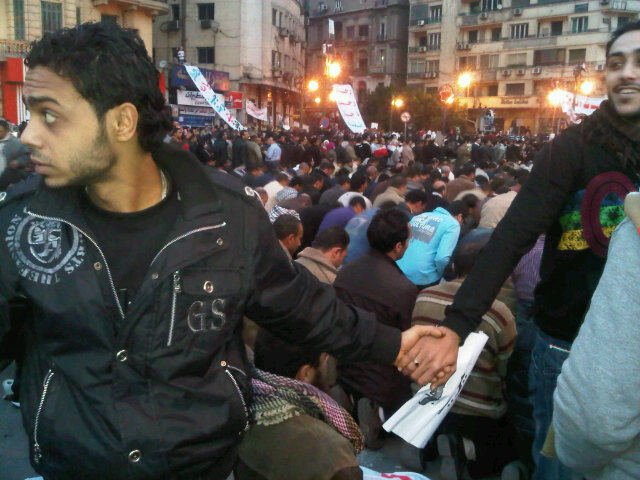
Christians Protecting Muslim Protesters in Egypt During Prayer

Pro-Mubarak Goon Squads and Thugs Beat up Protesters in Tahrir Square

245 GMT: Journalist Maryam Ishani gives this account of the afternoon in Tahrir Square:

I’m basically stuck between what they’ve established as two cordons around Tahrir. One is established by pro-Mubarak demonstrators, whose job it is to keep people out of the square. That includes ambulances and anyone who’s not on their side. They ask you if you’re pro- or against. They’re looking for Americans and foreigners. They’re saying things like, “You brought Baradei. This is your fault. You’re trying to break Egypt.” They’re quite hostile. They physically hit me with sticks. I went in to film them throwing stones and they knocked me back pretty hard, which is not the mood of the demonstrators inside the square.The second cordon is also pro-Mubarak demonstrators, who are just beating up the demonstrators inside Tahrir. They have swords — I’m not exaggerating — they have things that look like machetes with a 12-inch blade or longer, sticks, pipes, automatic weapons. This is why people [are] saying they’re actually police. They’re in very large numbers, not just people who collected. They’re generally all men between the ages of 20 or 30.
Among them are some pretty thuggish types. I walked down a street into a crowd of about 10 of them and I was so uncomfortable with the look on their face that I just turned right around. It literally looks like their job is to just beat people up. They’re working their way into Tahrir an inch at a time with the cordon behind them keeping everyone out, specifically the press. They’re confiscating cameras. They’ll take things away and break them. They’re throwing stones. They mean business in a way that hasn’t been the case so far.
The army is not intervening at all on either side. There are a lot of injuries. I’m seeing ambulances treating four of five people with head injuries and cuts to the body from, I’m guessing, the knives.
There’s a lot of live fire. It’s difficult to tell which direction it’s coming from. But I’m hearing both shotguns and automatic weapons. I really can’t see what’s happening inside the square, but it’s certainly nothing good.

FEBRUARY 5, 2011 · 8:41 PM

Egyptian Muslims reciprocating for Christians’ helping them in Tahrir Square

From Twitter, #Egypt, Feb 5, 2011:

Egyptian Copts to hold Sunday services in Tahrir tom, Muslims to surround them for protection – returning Friday’s favor
 

Google Executive Wael Ghonim Admits He Was El Shaheeed

by Mike Giglio
Wael Ghonim, freed from Egyptian prison today, confirms to Mike Giglio in his first interview with international media that he is the man behind the Facebook page that sparked revolt. Plus, full coverage of Egypt’s uprising
In his first interview with English-language media, the senior Google executive released today after twelve days in Egyptian custody, confirmed that he was the anonymous force behind the Facebook page that sparked Egypt’s revolt.
Article - Giglio El Shaheed
Taro Konishi / AP PhotoWael Ghonim, noticeably exhausted, stressed repeatedly that he did not consider himself a leader of the swelling pro-democracy movement.
“Actually, I did the easiest thing, which was writing,” said Ghonim, the 30-year-old Google executive and father of two, the day he was released from Egyptian detention. “At the end of the day, it was about the power of the people.”
Named in honor of a blogger beaten to death by police this summer, the Facebook page “We Are All Khaled Said” became a rallying point for last week’s demonstrations. It was run anonymously by Ghonim, who referred to himself simply as “El Shaheeed,” which in Arabic means “the martyr.” Ghonim also created the Web page for Mohamed ElBaradei, the Nobel Prize winner who has returned to Egypt to become one of the main leaders of the opposition.
After Ghonim’s disappearance two weeks ago, friends, family, and Google officials frantically tried to track him down, fearing for his safety.
“A lot of people died,” Ghonim said on Monday, trying to downplay his own role; he was unhappy, he said, that he had become such a prominent face of the movement. “That was not my plan, and I hate it, but it was out of my hands,” he said.
Ghonim was detained by Egyptian authorities on the morning of Jan. 28. His arrest was noteworthy because his Facebook page played a key role in inspiring the protests, and associates feared he had become a political prisoner of an increasingly unstable regime. Family members were reportedly bombarded with anonymous calls saying Ghonim was being “taught a lesson.”
“His wife is really scared for his safety,” one of Ghonim’s friends told Newsweek/The Daily Beast last week. “She’s really emotional about this. She’s really tired. She hasn’t slept for a long time. She’s praying for his safe return.”
“Actually, I did the easiest thing, which was writing,” said the 30-year-old Google executive and father of two, the day he was released from Egyptian detention. “At the end of the day, it was about the power of the people.”
Last week, two people with inside knowledge of the movement confirmed to Newsweek/The Daily Beast that El Shaheeed was actually Ghonim. His wife, however, requested that the story not be published. “I feel that [it] will put his life in danger,” she said.
The Facebook page that Ghonim ran sounded the call for the initial protest on January 25. As the page’s following approached 400,000 people, and word of the event spread, it hosted a constant stream of news, photo and video, downloadable flyers, and emotional entreaties for all Egyptians to join the push.
Ghonim is Egyptian but lived in Dubai, where one of Google's Middle Eastern offices are based. Friends describe him as passionate about both technology and his country. “If you see him, you think he’s your average Joe, but he’s extremely smart,” said one associate.
Ghonim’s Facebook page started as a small campaign against police brutality but quickly mushroomed into an all-out effort against human-rights abuses in Egypt. Using crowd-sourcing, it even documented the fraudulent November parliamentary elections.
As pro-democracy protests got under way, Hosni Mubarak’s regime cracked down hard on Egyptian and international journalists and bloggers, beating some, arresting others, and prompting protests from Washington. “There is a concerted campaign to intimidate international journalists in Cairo,” State Department spokesman P.J. Crowley said Friday on Twitter. “We condemn such actions.”
Esraa Abdel Fatah, a cofounder of the pro-democracy April 6 Youth Movement, which has also played a crucial role in organizing the protests, sounded frantic in a phone call last week. “All the activists, all our friends are arrested now,” she said. “The police and the army arrested all the journalists, and [took] all the cameras and everything … I am OK, but I don’t know what will happen.”
Fatah often collaborated with El Shaheeed not knowing his identity. The two even met in Qatar on January 20, during a conference on cyberactivism. She last saw Ghonim five days later in Tahrir Square, as he joined the protest he had done so much to arrange.
“It was a dream come true,” Ghonim said in the interview Monday. “We were dreaming for a better future.”
At the time, a Google spokeswoman declined to comment on the executive’s political involvement but confirmed that he was missing. “Right now our focus is on finding out where he is,” she said at the time.
In an interview a week before the protest, Ghonim, posing as El Shaheeed in a Gmail chat, said the Tunisian revolution had inspired him to challenge Egypt’s longstanding authoritarian rule but he refused to delve into personal details, or even speak over the phone, saying he feared arrest. He did, however, admit to keeping a breakneck schedule, getting little sleep as he tried to juggle his activism with a demanding day job. “I’m a workaholic,” he said.
Ghonim described himself as an amateur activist who was inspired to create the page after seeing photos of how the blogger, Khaled Said, had been brutally beaten to death and his maimed body left in the street. “That killed me. I felt in pain. And I wanted to do something,” he said. “It happened that I created this page, and it happened that 375,000 people [are] on it. So I'm using it to reveal the truth that the government is trying to hide.”
Just before he disappeared, Ghonim said anonymity suited his purpose. “This isn’t about me,” he said. “It’s about Egypt.” Other activists said his anonymity lent the page credibility and made the protest push more appealing to regular Egyptians.
In fact, Ghonim seemed eager to disappear among the swelling crowds. "I am mobilizing people,” he said. “Getting them to know their rights. And everyone then does what they want.”
Mike Giglio is a reporter at Newsweek.
Like The Daily Beast on Facebook and follow us on Twitter for updates all day long.
For inquiries, please contact The Daily Beast at editorial@thedailybeast.com

SUPERBOWL 45 2011 HALF TIME BLACK EYED PEAS [HD] (Property of NFL/Fox)

SuperBowl XLV Chysler, VW, and Chevrolet Commercials are a HIT!


Chrysler and VW score with Super Bowl ads

Auto commercials on the Super Bowl XLV broadcast had mixed results in generating interest in the products they were pitching, according to auto information company Edmunds.com. Vw
Chrysler and Volkswagen had the biggest increase in people searching Edmunds.com after the broadcast of the advertisements; Chrevrolet, Hyundai and the German luxury auto brands had less success.

Chrysler aired a two-minute “Imported From Detroit” ad during the third quarter that used singer Eminem to make the case that Chrysler, working in the heart of America, can put out cool vehicles.
Edmunds.com said traffic for the Chrysler brand shot up 267% in the hours after the commercial aired, including a 1,619% spike for the new Chrysler 200.

“Chrysler’s ad reaffirmed the company’s loyalties to Detroit in an emotionally powerful way, and it looks like viewers responded to that message in a major way,” said Michelle Krebs, an Edmunds.com analyst.

Volkswagen also scored with commercials for the Beetle and the Passat. Traffic rose 271% for the Beetle after the computer-animated ad aired in the fourth quarter. The Passat, whose second-quarter ad featuring a child dressed like Darth Vader who attempts to use "the force" to manipulate various objects, including the new Passat, saw its traffic surge 114%.

Chevrolet and Hyundai had comparatively modest traffic gains after their commercials.

Meanwhile, traffic for the Audi A8 rose only 14% after its “Release the Hounds” ad in the first quarter, while Edmunds.com measured no lift at all for BMW after the “Defying Logic” ad for the X3 in the second quarter.


Chrysler Eminem Super Bowl Commercial - Imported From Detroit 

Two-Minute Ad Delivers Huge Post-Super Bowl Traffic Hike for Chrysler on Edmunds.com

SANTA MONICA, Calif. --(Business Wire)-- Edmunds.com, the premier online resource for automotive information, reports that site traffic for Chrysler, Volkswagen and Chevrolet saw the most significant spikes after their ads ran during Super Bowl XLV. The traffic spikes represent important returns on investment for companies that reportedly spent as much as $3 million on a 30-second ad spot during the big game.
Highlighting the surge in traffic on Edmunds.com was Chrysler, who made a big bet with its two minute "Imported From Detroit" ad that aired during the third quarter. Traffic for the Chrysler brand overall shot up 267% on Edmunds.com in the hours after the commercial aired, including a 1619% spike for the Chrysler 200.
"Chrysler's ad reaffirmed the company's loyalties to Detroit in an emotionally powerful way, and it looks like viewers responded to that message," said Michelle Krebs, senior analyst at Edmunds' AutoObserver.com
Other car brands and models seeing a boost in traffic on Edmunds.com include:
  • Volkswagen had two big winners with the Beetle and the Passat. Traffic rose 271% for the Beetle after its ad aired in the fourth quarter. The Passat, whose second quarter ad featuring a child dressed like Darth Vader, saw its traffic spike 114%.
  • Chevrolet ran several comercials for a few of its models. There were noticeable spikes for the Camaro (+69%) and Cruze (+63%), with smaller boosts coming for the Volt (+15%). Overall, interest in Chevrolet shot up 21% on Edmunds.com in the hours after the Super Bowl.
  • Hyundai ran two commercials for the Elantra and saw a surge of 79% on Edmunds.com. They were less successful with its Sonata Hybrid, whose traffic ticked up only slightly (+4%) after its ad ran in the fourth quarter.
  • Luxury brands were less successful in driving interest through Super Bowl advertising. The Audi A8 gained a 14% lift in traffic following its "Release the Hounds" ad in the first quarter, while Edmunds.com measured no lift at all for BMW after the "Defying Logic" ad for the X3 in the second quarter.  

Dream TV Interview With Wael Ghonim: Part 1 – With English Subtitles


Video courtesy Alive in Egypt

Blogger's release 'reignites' Egypt


Google executive Wael Ghonim speaks after release from Egyptian custody, sparking outpouring of support from protesters.
Last Modified: 08 Feb 2011 01:59 GMT
Egypt's demonstrations have been ongoing since January 25 as protesters call for Mubarak to resign 

Egyptian anti-government protesters have welcomed the release of a Google executive who disappeared in Cairo last month after playing a key role in helping demonstrators organise.
Wael Ghonim was released on Monday by Egyptian authorities, sparking a fast and explosive response from supporters, bloggers and pro-democracy activists on the internet.
Ghonim's release came nearly two weeks after he was reported missing on January 28 during protests against Egyptian president Hosni Mubarak.
"Freedom is a bless[ing] that deserves fighting for it," Ghonim, Google's head of marketing for the Middle East and North Africa, wrote in a message posted on his Twitter account shortly after his release.
He said he was seized in the Egyptian capital, Cairo, late last month as he joined tens of thousands of protesters in the city's Tahrir Square, the focal point of protests aimed at calling on Mubarak to step down from his 30-year-rule in Egypt.
Ghonim said he was picked up by three plainclothes men on the street, pushed into a car and taken off for interrogation by state security members.
'Not a hero'
The prominent blogger spoke to Egypt's On TV after his release on Monday, pleading with reporters not to call him a hero.
"Please don't make me a hero. I'm not a hero. I have been asleep for 12 days," he said.


Part one of Ghonim's interview with Dream TV. For part two and a translation of both, click here for our live blog. All rights to video belong to Dream TV.
"I hope that we would be able to put an end to all the rubbish in this country. The rubbish really needs to be cleaned up."
Ghonim gave a subsequent, emotional interview to the privately owned Egyptian channel Dream TV later on Monday.
"I am not a symbol or a hero or anything like that, but what happened to me is a crime," he told Dream TV.
"If you want to arrest me, that's your right. But there are laws and I am not a terrorist or a drug-dealer. We have to tear down this system based on not being able to speak out."
Ghonim said he was blindfolded during his 12 days in the custody of state security so that he could not identify his interrogators, but he said that he was not physically tortured.
He described his abduction as a "crime which we are fighting", adding that the law that allows such actions such be changed - a reference to the country's emergency laws.
Al Jazeera's correspondent in the northern Egyptian city of Alexandria said the interview will "no doubt have a massive impact on the number of pro-democracy protesters" in the country.
"I expect their numbers to increase dramatically tomorrow and Friday because of this show," our correspondent said.
"The show also included an interview with a former state TV presenter who dismissed her previous employers as liars and propaganda artists for Mubarak.
"The show ended with a plea from her: 'To all the children watching this show, go to your parents, tell them: mum, dad, if you want me to have a brighter future, a good education, then take me to Tahrir square tomorrow'."
Sparking the uprising
Activists said Ghonim was the person behind a page on the social networking site Facebook that is credited for helping spark the uprising in Egypt.

The "We are all Khaled Said" page and Facebook group was named after an Egyptian activist who rights groups said was beaten to death by police in the northern port city of Alexandria. Two officers are now facing trial in the case.
Pro-democracy protesters have continued their sit-in in Cairo's Tahrir Square since mass protests began on January 25. The demonstrations showed no signs of being appeased on Tuesday by talks between the government and opposition groups on Sunday.
But the number of protesters in the streets has decreased since the height of the protests on January 28, a day demonstrators billed the Day of Wrath.
However, immediately after Ghonim's interview on Dream TV on Monday, activists asserted that the blogger had breathed new life into the protests.
"Left breathless by Wael Ghonim. InshaAllah his sincerity & patriotism, beamed into Egypt's living rooms, will ignite this revolution #Jan25," Twitter user Desert_Dals wrote.
"My aunt called me crying after Ghonim's interview saying "I'm going to Tahrir tomorrow! God Bless him! He made us proud!" Twitter user MennaGamal wrote on her account.

"Ghonim just became the mayor of Tahrir Square!" Twitter user AngelSavant wrote.

DFMorrison, another Twitter user wrote, "If you feel recharged by #Ghonim for the Egyptian Revolution to reach its goals, Retweet! #Tahrir #Egypt #25Jan."
The UN says at least 300 people have been killed in the violence since the demonstrations began, with Human Rights Watch, the international rights group, putting the number killed in the cities of Cairo, Alexandria and Suez at 297 on Monday.
Ghonim, in his interview on Monday, paid tribute to those killed.
"I want to say to every mother and every father that lost his child, I am sorry, but this is not our fault.
"I swear to God, this is not our fault. It is the fault of everyone who was holding on to power greedily and would not let it go."