Pages

Thursday, May 20, 2010

Redford on Oil Disaster with Keith Olbermann


Markey to Get Live Feed of BP Oil Spill on Website


BP Acquiesces to Markey’s Request, Will Release Video Stream Tonight to Chairman

May 19, 2010 – Following a demand from Rep. Edward J. Markey (D-Mass.) for a live feed of the BP oil spill to be made publicly available on the web, BP said they would release the feed and it will be shown on Rep. Markey’s committee website at www.globalwarming.house.gov. The release of the live link to Rep. Markey is expected tonight.
“This may be BP’s footage, but it’s America’s ocean. Now anyone will be able to see the real-time effects the BP spill is having on our ocean,” said Rep. Markey, who conducted a briefing today with independent scientists where he reiterated the call for a video feed. “This footage will aid analysis by independent scientists blocked by BP from coming to see the spill.”
Markey sent letters earlier today to BP America’s CEO Lamar McKay asking for the footage to be made public on BP’s website. If BP could not host the footage, Rep. Markey offered to host it on his website free of charge.
“BP is going to have to pay for the cleanup of this spill and the long-term damage. Hosting this video on our website is the only freebie they’re going to get,” Rep. Markey said.
The letter sent to McKay today can be found here.
Rep. Markey has frequently queried BP for more information on the exact size of the spill and on their refusal to engage with outside scientists. Independent scientists have examined video, satellite photos and other aspects of the spill and determined that it may be much bigger than estimated. Today at a briefing Rep. Markey held in his Energy and Environment Subcommittee, independent scientists from Purdue University and Woods Hole Oceanographic Institution said that the estimate of a 5,000 barrel per day leak was an underestimation of the flow. The scientists said with more data, they could better calculate the flow of oil from the sea floor.
"This is 4th grade math. We know the numerator here—the couple thousand barrels a day BP is siphoning out of the sunken pipe. But we still don’t know the denominator," said Rep. Markey. "BP is capturing a fraction of the oil, but they don’t know what that fraction is. By releasing this video, we’ve taken the first step towards allowing better access to the information BP has about this spill."

Live video placed on internet of Deepwater Horizon


Transcript of Civil Rights Act (1964)

An Act
To enforce the constitutional right to vote, to confer jurisdiction upon the district courts of the United States to provide injunctive relief against discrimination in public accommodations, to authorize the Attorney General to institute suits to protect constitutional rights in public facilities and public education, to extend the Commission on Civil Rights, to prevent discrimination in federally assisted programs, to establish a Commission on Equal Employment Opportunity, and for other purposes.
Be it enacted by the Senate and House of Representatives of the United States of America in Congress assembled, That this Act may be cited as the "Civil Rights Act of 1964".
TITLE I--VOTING RIGHTS
SEC. 101. Section 2004 of the Revised Statutes (42 U.S.C. 1971), as amended by section 131 of the Civil Rights Act of 1957 (71 Stat. 637), and as further amended by section 601 of the Civil Rights Act of 1960 (74 Stat. 90), is further amended as follows:
(a) Insert "1" after "(a)" in subsection (a) and add at the end of subsection (a) the following new paragraphs:
"(2) No person acting under color of law shall--
"(A) in determining whether any individual is qualified under State law or laws to vote in any Federal election, apply any standard, practice, or procedure different from the standards, practices, or procedures applied under such law or laws to other individuals within the same county, parish, or similar political subdivision who have been found by State officials to be qualified to vote;
"(B) deny the right of any individual to vote in any Federal election because of an error or omission on any record or paper relating to any application, registration, or other act requisite to voting, if such error or omission is not material in determining whether such individual is qualified under State law to vote in such election; or
"(C) employ any literacy test as a qualification for voting in any Federal election unless (i) such test is administered to each individual and is conducted wholly in writing, and (ii) a certified copy of the test and of the answers given by the individual is furnished to him within twenty-five days of the submission of his request made within the period of time during which records and papers are required to be retained and preserved pursuant to title III of the Civil Rights Act of 1960 (42 U.S.C. 1974--74e; 74 Stat. 88): Provided, however, That the Attorney General may enter into agreements with appropriate State or local authorities that preparation, conduct, and maintenance of such tests in accordance with the provisions of applicable State or local law, including such special provisions as are necessary in the preparation, conduct, and maintenance of such tests for persons who are blind or otherwise physically handicapped, meet the purposes of this subparagraph and constitute compliance therewith.
"(3) For purposes of this subsection--
"(A) the term 'vote' shall have the same meaning as in subsection (e) of this section;
"(B) the phrase 'literacy test' includes any test of the ability to read, write, understand, or interpret any matter."
(b) Insert immediately following the period at the end of the first sentence of subsection (c) the following new sentence: "If in any such proceeding literacy is a relevant fact there shall be a rebuttable presumption that any person who has not been adjudged an incompetent and who has completed the sixth grade in a public school in, or a private school accredited by, any State or territory, the District of Columbia, or the Commonwealth of Puerto Rico where instruction is carried on predominantly in the English language, possesses sufficient literacy, comprehension, and intelligence to vote in any Federal election."
(c) Add the following subsection "(f)" and designate the present subsection "(f)" as subsection "(g)": "(f) When used in subsection (a) or (c) of this section, the words 'Federal election' shall mean any general, special, or primary election held solely or in part for the purpose of electing or selecting any candidate for the office of President, Vice President, presidential elector, Member of the Senate, or Member of the House of Representatives."
(d) Add the following subsection "(h)":
"(h) In any proceeding instituted by the United States in any district court of the United States under this section in which the Attorney General requests a finding of a pattern or practice of discrimination pursuant to subsection (e) of this section the Attorney General, at the time he files the complaint, or any defendant in the proceeding, within twenty days after service upon him of the complaint, may file with the clerk of such court a request that a court of three judges be convened to hear and determine the entire case. A copy of the request for a three-judge court shall be immediately furnished by such clerk to the chief judge of the circuit (or in his absence, the presiding circuit judge of the circuit) in which the case is pending. Upon receipt of the copy of such request it shall be the duty of the chief justice of the circuit or the presiding circuit judge, as the case may be, to designate immediately three judges in such circuit, of whom at least one shall be a circuit judge and another of whom shall be a district judge of the court in which the proceeding was instituted, to hear and determine such case, and it shall be the duty of the judges so designated to assign the case for hearing at the earliest practicable date, to participate in the hearing and determination thereof, and to cause the case to be in every way expedited.
An appeal from the final judgment of such court will lie to the Supreme Court.
"In any proceeding brought under subsection (c) of this section to enforce subsection (b) of this section, or in the event neither the Attorney General nor any defendant files a request for a three-judge court in any proceeding authorized by this subsection, it shall be the duty of the chief judge of the district (or in his absence, the acting chief judge) in which the case is pending immediately to designate a judge in such district to hear and determine the case. In the event that no judge in the district is available to hear and determine the case, the chief judge of the district, or the acting chief judge, as the case may be, shall certify this fact to the chief judge of the circuit (or, in his absence, the acting chief judge) who shall then designate a district or circuit judge of the circuit to hear and determine the case.
"It shall be the duty of the judge designated pursuant to this section to assign the case for hearing at the earliest practicable date and to cause the case to be in every way expedited."

Transcript of Civil Rights Act (1964)
Here you can read the transcript in its entirety.

Rand Paul and Rachel Maddow on Civil, Federal and Business Rights


Preshow homework: Read the Civil Rights Act of 1964


Scott County, Mississippi, I think. Photo by Sarah Goodyear
Rand Paul bought himself a world of trouble last night with his objections to the Civil Rights Act of 1964. Today Paul, Kentucky's new Republican nominee for Senate, announced that he does indeed support the Civil Rights Act.
Here's the thing -- Paul told us he's not all that familiar with it. "To tell you the truth," he said last night, "I haven't really read all through it because it was passed 40 years ago and hadn't been a real pressing issue on the campaign. . ."
Famous last words, right? I'm betting a bunch of us have never read the full law, same as Paul, so it's tonight's homework. This Act
To enforce the constitutional right to vote, to confer jurisdiction upon the district courts of the United States to provide injunctive relief against discrimination in public accommodations, to authorize the Attorney General to institute suits to protect constitutional rights in public facilities and public education, to extend the Commission on Civil Rights, to prevent discrimination in federally assisted programs, to establish a Commission on Equal Employment Opportunity, and for other purposes.
As you might imagine, we'll have much more about Rand Paul and the Civil Rights Act on the show tonight. See you at 9 Eastern. Don't be late.

Exclusive: President Obama To Replace Director of National Intelligence Dennis Blair*

May 20, 2010 4:56 PM


ABC News has learned that President Obama will replace the Director of National Intelligence, Admiral Dennis Blair (ret.) His resignation will come as soon as tomorrow, sources tell ABC News.
For several weeks President Obama has been holding serious conversations about whether to ask Blair to step down and has interviewed candidates to replace him. After a discussion this afternoon between the president and Blair on a secure phone line about the best way forward, Blair offered to resign and the president said he would accept, sources told ABC News.
Multiple administration sources tell ABC News that Blair’s tenure internally has been a rocky one.
On the heels of a number of intelligence failures involving the Fort Hood shooter, failed Christmas Day bomber Umar Farouq Abdulmuttalab, and questions about failed Times Square bomber Faisal Shahzad, it was no longer clear that Blair -- tasked with coordinating the 16 intelligence agencies and ensuring that they cooperate and share information – still had the full and complete confidence of the president, sources say.
One official tells ABC News that President Obama sought Blair’s resignation earlier this week, but Blair pushed back, hoping to convince the president to change his mind.
That did not happen.
The official says that there were high-profile problems on Blair’s watch and those certainly didn’t help him, but the ultimate reason Blair is gone is because of the dissatisfaction President Obama and the National Security Staff had with Blair’s ability to share intelligence in a tight, coherent and timely way.
This was, the official said, the result of long pent-up dissatisfaction with Blair as the principal intelligence adviser to the president, responsible for briefing the president every day and briefing the National Security Staff. In short, officials didn’t think the briefings were relevant to what the president was focused on that day or time period. They weren’t crisp or well-presented.
At other times, Blair didn’t seem to take “no” for an answer, the official said. He was pushing an initiative dealing with intelligence and other countries, and he kept pushing it even after President Obama turned it down.
The news will not come as a surprise to those in the intelligence community. For months, Blair has turf battles while the White House made it clear that it had more confidence in others, such as counterterrorism and homeland security adviser John Brennan, taking the lead both publicly and privately.
Last November, the White House sided with CIA director Leon Panetta when Blair attempted, against Panetta’s wishes, to pick the chief U.S. intelligence officer in each country, a job that traditionally has gone to the CIA station chief.
At other points, Blair seemed simply out of the loop. In hearings looking into failed Christmas Day bomber Abdulmuttalab, Blair seemed unaware that the High-Value interrogation Group was not yet operational.  He later walked back his statement.
Just this week – after a scathing report on intelligence failures and Abdulmuttalab by the Senate Intelligence Committee  -- Blair acknowledged in a statement that “institutional and technological barriers remain that prevent seamless sharing of information.”
The Senate Committee report was a strong message of disapproval of the job being done by Blair and the National Counterterrorism Center.
Blair also noted some improvements to the National Counterterrorism Center, which he supervises, which now has a unit “to thoroughly and exhaustively pursue terrorist threat threads, including identifying appropriate follow-up actions by other intelligence and law enforcement organizations.”
Deputy Secretary of State James Steinberg was one of those considered for the job, but is no longer being considered for the post.

UPDATE: Later today, Blair issued the following statement: 
"It is with deep regret that I informed the President today that I will step down as Director of National Intelligence effective Friday, May 28th. 
I have had no greater honor or pleasure than to lead the remarkably talented and patriotic men and women of the Intelligence Community. 
Every day, you have worked tirelessly to provide intelligence support for two wars and to prevent an attack on our homeland. You are true heroes, just like the members of the Armed Forces, firefighters, and police whose job it is to keep our nation safe.
Your work over the past 16 months has made the Intelligence Community more integrated, agile, and representative of American values. Keep it up – I will be cheering for you."
-Jake Tapper

*This post has been updated with more information.

Senate passes financial reform bill

Vote represents major policy victory for President Obama

updated 16 minutes ago
WASHINGTON - The Senate has passed a sweeping overhaul of how the government regulates banks and Wall Street.
The legislation is aimed at preventing a repeat of the financial meltdown two years ago that plunged the nation into a deep recession.
The Senate passed the bill on a 59-39 vote, giving President Barack Obama a major policy victory.
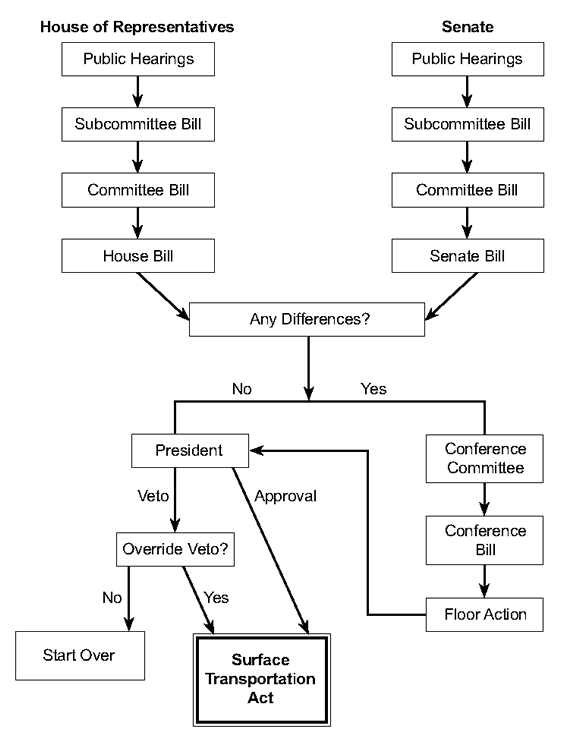
The bill now must be merged with a House version. A key House negotiator predicts the bill will reach Obama's desk by the Fourth of July.
The massive legislation touches all points in the financial sectors, from Wall Street CEOs and first-time home buyers, to high-flying traders and small town lenders.
The bill calls for new ways to watch for risks in the financial system.
Earlier in the day the Senate cleared the way Thursday for the most far-reaching restraints on big banks since the Great Depression. President Barack Obama cheered from the White House.
Breaking a Senate blockade by a single vote, lawmakers voted 60-40 to end debate and advance the massive financial regulation bill, which became a priority for Obama after the passage of his health care overhaul in March. Democrats had one more 60-vote hurdle to clear before they could pass the bill with a simple majority.
Obama said the financial industry had tried to stop the new regulations "with hordes of lobbyists and millions of dollars in ads."
Noting the near-meltdown of big Wall Street investment banks and the resulting costly bailouts, he said, "Our goal is not to punish the banks but to protect the larger economy and the American people from the kind of upheavals that we've seen in the past few years."
House Financial Services Committee Chairman Barney Frank, D-Mass., said he expected relatively few disagreements between House and Senate negotiators, and he predicted Obama will have a bill to sign before July 4.
The legislation calls for new ways to watch for risks in the financial system and makes it easier to liquidate large failing financial firms. It also writes new rules for complex securities blamed for helping precipitate the 2008 economic crisis, and it creates a new consumer protection agency.
"We'll soon have in place the strongest consumer protections in history" covering credit cards, student loans, mortgages and more, Obama declared.
Two amendments had stood between the bill and final Senate passage. One would ban commercial banks from carrying out speculative trades for their own profit. The other would exempt auto dealers from oversight by a new consumer protection bureau.
Under an agreement between Republicans and Democrats, the fate of the bank trading limits, a Democratic amendment, depended on the car dealer measure, a mostly Republican proposal.
Republicans considered dropping their regulatory exception for car dealers, in a move aimed at rejecting the bank trading restrictions. The Obama administration said it wanted most to assure that auto dealers would be regulated like other lenders.
Sen. Jeff Merkley, D-Ore., said that without the restriction on bank trading, banks are tempted to steer too many resources into "high-risk investing," leaving too little for conventional loans to businesses and families.
The two functions, he said, "don't belong under the same roof."
Three Republicans — Scott Brown of Massachusetts and Olympia Snowe and Susan Collins of Maine — voted to end debate and move ahead on the bill. Two Democrats — Russ Feingold of Wisconsin and Maria Cantwell of Washington — voted with other Republicans against it. 

Democrats succeeded in breaking through the Republican block by winning Brown's backing. The Massachusetts Republican, who had voted against ending debate on Wednesday, met with Reid Thursday morning to voice his concerns regarding the bill's effect on Massachusetts banks such as State Street and insurance firms such as MassMutual. House Financial Services Committee chairman Barney Frank, also of Massachusetts, weighed in Thursday with letters to Reid offering his own guarantees that the final bill would resolve Brown's concerns.
Cantwell and Feingold continued to object to the bill. Cantwell protested her inability to get a vote on an amendment that she said would toughen regulation of complex securities known as derivatives. Feingold has said the bill does not go far enough to restrain Wall Street. 

These are the New Cuts the Republicans want you to vote on

YouCut – a first-of-its-kind project - is designed to defeat the permissive culture of runaway spending in Congress. It allows you to vote, both online and on your cell phone, on spending cuts that you want to see the House enact. Vote on this page today for your priorities and together we can begin to change Washington's culture of spending into a culture of savings. Click here to learn more about our first week's winning item, a $2.5 billion spending cut.


Vote
Vote
Byrd Honors Scholarships
$42 Million in Savings in the First Year
($420 Million Over Ten Years)

The Robert C. Byrd Honors Scholarships program provides grants to States to provide $1,500 a year scholarships for up to four years to high-performing high school students entering an undergraduate course of study. The Obama Administration proposed terminating this program in their annual budget, stating "Byrd Scholarships are only available to a small number of elite students (around 0.3 percent of first-time postsecondary students receive the scholarship), and States are prohibited from considering financial need when awarding the scholarships. Reliable performance data are not available, and the design of the program suggests these scholarships do not generally facilitate postsecondary education opportunities that would not otherwise be possible for awardees. Given the high academic performance of the students who receive the award, many of these students would still enter an undergraduate course of study and graduate even without receiving the scholarship."
Vote
Vote
Eliminate the Proposed Federal Employee Pay Raise
Approximately $2 Billion in the First Year
(Approximately $30 Billion Over Ten Years)

As part of his budget, President Obama proposed providing federal civilian employees with a 1.4% pay raise next year. This year Federal employees received a 2% raise and since the year 2000 have received raises averaging 3.6% a year. USA Today recently reported that the typical federal worker is paid 20% more than a private-sector worker in the same occupation (median salary). This doesn’t include the value of benefits like health care and retirement. This proposal would expand upon the just enacted legislation to prevent Members of Congress from receiving a pay raise. This proposal would not impact the scheduled 1.4% pay raise for those in the military.
Vote
Vote
Suspend Federal Land Purchases
$266 Million in Savings in the First Year
($2.66 Billion Over Ten Years)

Last year Congress spent $266 million acquiring additional federal lands at the Departments of Interior and Agriculture. This is a 138% increase over the comparable amount of funding just four years ago. Given that the federal government already owns 29% of the land in America and has a multi-billion dollar maintenance backlog to maintain current land holdings, suspending new federal land purchases for five years would permit the government to focus on maintaining existing property while also saving taxpayers millions of dollars a year.
Vote
Vote
Terminate Funding for UNESCO
$81 Million in Savings in the First Year
($810 Million Over Ten Years)

Last year the administration proposed deleting the Department of Education’s attaché to UNESCO saving approximately $632,000 a year. Terminating U.S. support for UNESCO entirely would save taxpayers $81 million annually. The U.S. had not supported UNESCO for 19 years prior to the decision by the Bush Administration to rejoin in 2003. UNESCO routinely undertakes activities that are properly the responsibility of individual countries and their governments, including reviewing and making recommendations in areas related to education, arts, culture, ethics, science and technology, and historic preservation. UNESCO recently came under fire for their proposed International Guidelines for Sexuality Education. Membership provides little benefit to American taxpayers in light of the overall cost.
Vote
Vote
Eliminate Mohair Subsidies
Approximately $1 Million in Savings in the First Year
($10 Million Over Ten Years)

Federal price support for mohair was first enacted in 1947. The National Wool Act of 1954 established direct payments for wool and mohair producers. The purpose of the program was to encourage production of wool because it was considered an essential and strategic commodity. According to the Congressional Research Service, no similar purpose was stated for the mohair program. While this program was phased out in 1995, ad hoc payments were provided in 1999 and 2000 and the program was reinstituted in 2002. Eliminating this program once again would save taxpayers approximately $1 million a year. (Also proposed as part of the RSC Sunset Caucus.)
Then, Submit Your Ideas for Spending Cuts

YouCut is designed to defeat the permissive culture of spending in Congress. After you vote on this week's choices, we need your help in identifying which program and spending cuts should be featured on this website each week. Click the button below to submit your ideas!
Vote To End Debate On Financial Reform Falls Short In Senate


Ben Frumin | May 19, 2010, 4:38PM


Senate Democrats failed this afternoon to get the 60 votes they needed to end debate on the financial reform bill.

Two Republicans crossed the aisle and voted with the Democrats. But with multiple Democrats voting against cloture, and another absent, the Democrats fell just short. The final vote was 57-42.

Some Democrats whose votes were still in doubt earlier today -- like Sens. Carl Levin (D-MI) and Jeff Merkley (D-OR) -- voted in favor of cloture. But others -- Sens. Maria Cantwell (D-WA) and Russ Feingold (D-WI) -- voted against cloture.

Two Republicans voted with the Democratic majority -- Sens. Susan Collins (R-ME) and Olympia Snowe (R-ME). But with two Democrats opposed, and Sen. Arlen Specter (D-PA) absent, it wasn't enough.

Senate Majority Leader Harry Reid (D-NV) also voted against cloture, though this was simply for procedural reasons that allow him to bring up the motion again.

Before the vote, Reid said "we have really worked hard" and that "there has been a show of bipartisanship in this bill."

The vote was delayed from its scheduled 2 p.m. ET start time -- presumably while Democrats tried to sort out how to appease progressives who wanted votes on their amendments, or to try and convince Republicans to stop blocking votes on those amendments.

Also today, TPMDC confirmed that Sen. Chris Dodd (D-CT) plans to drop his push to weaken derivatives reform.

Late Update: Feingold has released the following statement explaining his "no" vote, saying that "Ending debate on the bill is finishing before the job is done."

After thirty years of giving in to the wishes of Wall Street lobbyists, Congress needs to finally enact tough reforms to prevent Wall Street from driving our economy into the ditch again. We need to eliminate the risk posed to our economy by 'too big to fail' financial firms and to reinstate the protective firewalls between Main Street banks and Wall Street firms. Unfortunately, these key reforms are not included in the bill. The test for this legislation is a simple one - whether it will prevent another financial crisis. As the bill stands, it fails that test. Ending debate on the bill is finishing before the job is done.

Later Update: After the vote, Reid told reporters that "a Senator broke his word with me." He didn't name names.
Republicans--And Two Democrats--Block Vote On Wall Street Reform


Two progressive Democrats joined 39 Republicans this evening to block a final vote in the Senate on Wall Street reform, putting the two parties in the same position they found themselves in nearly one month ago when the entire GOP held together, for several days, to delay the bill from coming to the floor.
Now, just as then, Democrats will bring to bear a relentless campaign of public pressure on key Republicans and private arm-twisting on hold-out Democrats, in order to corral the 60 votes they need to end debate on the bill. And they'll have an opportunity to do just that tomorrow, when Senate Majority Leader Harry Reid holds a revote.
Back in April, though, that effort led to a broad capitulation by the GOP. This time, Republican senators and aides say it will only net them the handful votes they need to get over the top. One top GOP aide predicted the filibuster will break tomorrow.
Failing that, Democrats will have to figure out a way to placate either Sen. Maria Cantwell (D-WA) or Sen. Russ Feingold (D-WI), both of whom joined the filibuster. Cantwell has been denied a vote on an amendment that would restore firewalls between investment and commercial banks, and--more importantly, she says--is demanding that language requiring derivatives to be traded more transparently be tightened.
But why did the vote fail? Reid clearly believed he had 60 votes lined up. Even Sen. Byron Dorgan (D-ND), who had threatened loudly to filibuster the bill, voted for cloture, telling reporters that a procedural vote on his signature issue had mollified him.
Explanations vary, but everyone agrees that at least one--if not more--Republicans who intended to vote yes ultimately chose to hold out for the time being. And it didn't help matters that Sen. Arlen Specter (D-PA), who suffered a career-ending primary defeat last night, was a no-show today.
The vote itself dragged on for nearly an hour, to accommodate a tardy Sen. Mark Begich (D-AK). During that time, Reid pleaded with Cantwell and Sen. Scott Brown (R-MA), to help bring debate on the bill to an end. Brown had communicated his intent to vote with the Democrats, and publicly waffled on the floor before finally voting no.
At an impromptu press conference after the vote, Reid, without naming names, told reporters "a senator broke his word with me."
Brown himself told reporters he moved into the no column because he thought concerns he'd voiced about the bill were not, in the end, addressed. That take was echoed by a Republican aide. But Sen. Bob Corker (R-TN) told reporters he believes the unexpected opposition by Feingold and Cantwell punctured the air of inevitability about the bill, and freed up a few Republican swing votes to vote no.
"When they saw there were two Democrats that voted against it, it sort of changed the dynamic on the floor," Corker said.
Democrats will have better odds tomorrow, after Specter returns from Pennsylvania. And Democratic leadership will be pressing both Cantwell, Feingold and Brown as well as other on-the-fence Republicans like Sen. George Voinovich (R-OH) to help break the impasse. They'll need at least one of those four to switch if they hope to avoid a repeat performance later in the week.

Senators preparing for final Wall Street reform vote this week

By Silla Brush - 05/17/10 07:24 PM ET

Senate Democrats are moving to vote as early as Wednesday on a sprawling Wall Street overhaul bill amid Republican and industry opposition.
Senate Majority Leader Harry Reid (D-Nev.) filed for cloture Monday night to end debate on the 1,400-page bill.
“This cannot be delayed any longer,” Reid said on the Senate floor. The cloture filing will set up a vote as early as midweek.
White House press secretary Robert Gibbs said Monday that he believes President Barack Obama will be able to sign financial overhaul legislation before July 4. “That sounds about right,” Gibbs said when asked about the timing.
Republicans have criticized numerous provisions in the bill, but it is unclear if they would close ranks to prevent a final vote on the legislation this week. Republicans held together three times in late April to stop Democrats from opening debate on the measure. Sen. Ben Nelson (D-Neb.) also voted against the motion, expressing a series of concerns about the consumer office and derivatives regulations.
Republicans eventually relented when Senate Banking Committee Chairman Chris Dodd (D-Conn.) and Sen. Richard Shelby (R-Ala.) agreed on provisions aimed at preventing taxpayers from being exposed to the costs of dissolving failing financial firms.
Republicans argued those changes, including the decision to drop a $50 billion fund paid for by the industry to dissolve failing firms, allowed them to let debate begin.
Dodd is continuing to work on a manager’s amendment to the measure, and a Republican aide said Shelby is reviewing the language. Neither senator has disclosed whether he is close to striking an agreement on the amendment.
A GOP aide said Republican senators continue to have concerns about the measure’s provisions related to the multitrillion-dollar market for financial derivatives, which many blame for exacerbating the 2008 financial crisis.
The Senate will continue to debate a series of controversial amendments that could toughen the bill’s impact on Wall Street. Senators have filed more than 300 amendments, most of which will not come up for a vote. Among others, lawmakers and lobbyists are focusing closely on the following amendments:
• Democratic Sens. Carl Levin (Mich.) and Jeff Merkley (Ore.) are backing an amendment that would ban proprietary trading at commercial banks as well as limit their ties to hedge funds and other alternative investment funds. The amendment would hit big Wall Street firms and require the Federal Reserve to impose higher capital requirements on large non-banks.
• Sen. Sam Brownback (R-Kan.) is the main sponsor of legislation that would carve out auto dealers from the oversight of a new consumer financial protection regulator. The amendment is backed by the National Automobile Dealers Association (NADA). The White House, Defense Department and Treasury Department have criticized the provision, with the administration releasing a rare statement solely in opposition to the amendment.
• A bipartisan group of senators is looking to alter the financial measure to restrict the ability of state attorneys general from enforcing consumer financial protection regulations. They are looking to ensure the federal government has strong power to pre-empt state officials, while the White House has pushed for more than a year to give states power to pursue tougher regulations than the federal minimum. Sen. Tom Carper (D-Del.) said he is pushing to retain current law on pre-emption.
• Senators continue to debate a controversial provision backed by Senate Agriculture Committee Chairwoman Blanche Lincoln (D-Ark.) that would require commercial banks to spin off their derivatives operations. Banks have lobbied hard against the provision. Federal Reserve Chairman Ben Bernanke, Federal Deposit Insurance Corporation (FDIC) Chairwoman Sheila Bair and Paul Volcker, adviser to Obama, have publicly opposed the provision.
New Congressional By-laws To Change Government Process

feature photo
Just about everyone in the United States agrees that there is a problem in Washington, D. C.  Some blame the Democrats, some the Republicans.  Some blame liberals, some conservatives.  Anyone placing this sort of blame is a part of the problem.  What the partisans fail to realize is that we are all on the same team.  We the people deserve a better government.  This does not mean any change to the Constitution of the United States – rather it means a change in the by-laws of the Congress.
Years ago I participated in a Project Management class by IBM.  I think it was 1985.  We met in New Orleans for a week.  I remember an exercise where the class was divided into three groups – all working for Company ABC.  Each group was given an assignment, points could be earned.  Everyone likes to earn points.  Some points would be earned for The Team and some would be earned for Company ABC – and sometimes strategies would result in either more points for The Team or for The Company.
Each team was sent to different rooms to form strategies.  Points for different strategies were easy to document.  Invariably – the teams chose the strategies that earned the most points for the team,regardless of the points earned for Company ABC.  We all grew up in America – where winning is the paramount value.
At the end of the exercise the entire class was dressed down by the instructors.  Each team had acted selfishly.  The Company did not earn the most points possible because individual teams within the company were too desperate to be the best – to earn the most points.  The IBM instruction was hard-nosed about this particular feature of human weakness.  Our desire to stand out as champions cost the company a lot of money.  Each of us came away with a sense of shame for choosing Team over Company.
And so it goes in Washington.  Many of us make jokes about ‘week long retreats in the Bahamas’ for government or corporate leaders.  It seems to me that a ‘week long retreat in an IBM Management Seminar” about teamwork might be useful for both the Democrats and Republicans.
It seems so cliche to say that the politicians should act on behalf of the America people.  And they, the politicians, claim that they are servants of ‘all’ of the people.  But the evidence is clear – most of the politicians in Washington seek points for their team, in spite of any gain or loss to the country as a whole.
There are fundamental structural problems in the Congress.  By-laws written to reward the Party in power have focused the attention of Team Members on the success of the team rather than the success of the Company.  By-laws written to grant some discretionary power to the minority Party are being used to block any effort of the majority.  These by-laws developed over many generations of legislators.  Many of the by-laws were well intentioned – we presume.
We see gridlock nearly everyday in the Congress.  We, as individual voters, stand up for our party .  Sometimes we are too embarrassed to claim a party so we say we are independent – that we vote for the ‘person.’  That sounds noble but in the end our vote is interpreted as supporting a particular party.
The people are angry.  Many are taking to the street in protest.  Malcolm X spoke with authority when he said, “…anger can blind human vision.”  Blinded by anger people charge the bull, waving their red flag of protest.  But the bull is not the problem.  The problem is the idea of fighting the bull in the first place.  The problem is the arena itself.  An arena designed to entertain and reward the gladiators (the politicians) but no real enemy is slain.  At the end of the show, at the end of the day, the people return to their dismal lives, hoping tomorrow their gladiator will win one for the team. In the mean time the people are gored.
The gladiators count the gate receipts and take a vacation in the Bahamas.
We find ourselves arguing constitutional perspective – free speech carries responsibility, the right to bear arms carries responsibility, the right to an attorney carries responsibility, the right to privacy carries responsibility – but these are not the real problems.  These become distractions from the real problem.
The real problem in America today is the misunderstanding of Team by the politicians who live long lives in the United States Congress.   These politicians appeal to our sense of competition.  They intentionally divide the country into opposing teams.  They intentionally keep the voters distracted so they can continue their game.
Our ‘free press’ falls in line.  The media, whether FOX News, or CNN, or MSNBC, or CBS, NBC, or ABC – all play the game by talking about the bull fight – no one is looking at the arena managers where the rules of the game are played.  These rules are buried in the by-laws of legislative process in both the Senate and the House.
There should be no reward for being an obstructionist.  There should be no reward for party bullying.  There should be no reward for earmarks that are charged to our credit card.  There should be no reward for catering to Wall Street.  There should be no reward for protecting the Insurance Companies.

There are such devices as Congressional Commissions and Presidential Commissions.  They are formed when devastating circumstances hammer our country.  Commissions were established to study the assassination of JFK, the Space Shuttle Challenger disaster, 911, Katrina, and now the BP Gulf Oil Disaster.

The acts of Congress in the past forty years are hammering our country.  Thefiresidepost.com is calling on congress to establish a special commission to study the methods and process of Congress.  Recommendations should be made in full view of the free press.  Let the debate begin anew – our Congress is dysfunctional because of the eroding power of hot air over time.  A renewal in a time of a more educated and informed public would serve all.