Pages

Monday, April 1, 2013

Jessica Lynch: Iraq still haunts my dreams 10 years after rescue

Former prisoner of war Jessica Lynch reflects on the decade since her rescue in Iraq, saying she still has nightmares about her ordeal and revealing she feels "the most pride" about being a mother.
Ten years after her dramatic rescue as a prisoner of war in Iraq made headlines, Jessica Lynch continues to persevere in the face of injuries and survivor’s guilt related to her ordeal.

“About every night I have some kind of dream where there’s someone chasing me,’’ she told TODAY’s Janet Shamlian on Monday. “It’s hard. It really is mentally and physically draining. I’m very blessed and happy to be here, and I think that’s what counts the most, and if I tell myself that I’m OK, I eventually I start (thinking), ‘You know what? I can do this.’’’

Lynch, now 29, became a household name in 2003 when she became the first American POW to be rescued since the Vietnam War. The Army private and her 507th Maintenance Company were ambushed in Nasiriya only days into the Iraq War, and she was captured and held by Iraqi soldiers at a hospital there before being rescued by U.S. Special Forces troops who stormed the facility. Lynch is now a mother, teacher and motivational speaker in her hometown of Charleston, W.V., and is working on a master’s degree.

“Every day I wake up, I have that ‘never give up’ attitude,’’ she told Savannah Guthrie on TODAY Monday. “As much as I have the up and down days, it doesn’t matter as long as you keep it in your mind that you can do anything, that’s what it’s all about is perseverance.’’

Lynch suffered several broken bones during her capture and has undergone countless hours of physical rehabilitation for her legs and arms. She has had 21 surgeries since her rescue and told Guthrie she still wears a brace on her left leg and experiences pain in her right foot.

“I do the best that I can, and I’m just thankful that I’m here,’’ she told Guthrie.


REUTERS file
Undated footage from a combat camera video shows U.S. PFC Jessica Lynch on a stretcher during her rescue from Iraq.

In the aftermath of her rescue, there were numerous extravagant media reports that painted her as a hero and had incorrect details of her capture and rescue. She worked to set the record straight, testifying before Congress that she never fired her weapon during the firefight because her M-16 rifle jammed and that she was knocked unconscious when her vehicle flipped.

“I know that there was a lot of fabricated, misconstrued stories, but I did what I had to do,’’ Lynch told Guthrie. “I came out and tried to tell the world what really happened. I set the record straight as much as I can and what people still want to believe or not believe, that’s on them, but I felt it was important to just let the truth be known. I did Congress and testified to really just let everyone know none of this happened, this is the real story.’’

Lynch has also dealt with the survivor’s guilt. During the 90-minute firefight in Nasiriya in which she was captured, 11 members of her company were killed. One of them was her best friend, Lori Piestewa, who was taken to the Iraqi hospital with Lynch after being captured and died on the bed next to her.

“It’s so hard to continue every day knowing that Lori didn’t make it home with me,’’ Lynch said. “The reason that she went over there was to be with me and our other comrades, and sadly she didn’t get to come back home, so (I’m) just having to deal with the fact that my best friend didn’t get to come back and I did. She had two beautiful kids. It’s just really hard to know they’re going to have to grow up without their mom.’’

Fortunately for Lynch, it was not long before she had a couple of new loves in her life – first a new fiancé, Wes Robinson, and on Jan. 9, 2007, a 7-pound, 10-ounce baby girl.

The couple named the baby Dakota Ann in honor of Army Spc. Lori Piestewa, Lynch’s tentmate and former Fort Bliss roommate, who was killed in the attack that injured Lynch. Ann was Piestewa’s middle name and Dakota came from the fact that Piestewa was part Native American.


Bob Bird/AP file
Jessica Lynch with her
daughter Dakota following
the South Charleston,Va.
Christmas Parade on
Dec. 10, 2011.


“There I’m not Jessica Lynch, I’m not prisoner of war Jessica Lynch, I’m Dakota’s mommy,’’ she told Shamlian.

Now that it’s been a decade since the ordeal that has become part of her story, Lynch is looking to move forward with her life.
“I’m kind of happy that we’re finally to this 10-year mark so that I can finally put Iraq in the past,’’ she told Guthrie. “I know that it will always be with me. It’s nice to make that mark of  ‘I’ve made it this far.’

It’s always going to be with my life, waking up every day and dealing with the injuries. I go on and I strive and I do the best that I can.’’

THEN
On March 23, 2003, just three days after the start of the invasion of Iraq, a U.S. Army supply convoy took a wrong turn and was attacked in Nasiriyah, a key town on the road to Baghdad. Eleven U.S. soldiers were killed and six captured, including Private First Class Jessica Lynch, a 19-year-old from West Virginia. She suffered spinal fractures, nerve damage and a shattered right arm, right foot and left leg when her Humvee crashed.

IRAQ TEN YEARS LATER: WHERE ARE THEY NOW?

'Buckwild' star Shain Gandee dead at 21

Updated at 5:06 p.m. ET: Shain Gandee, a star on the MTV reality program "Buckwild," has died, NBC affiliate WSAZ confirmed on Monday.

MTV
Shain Gandee.
The 21-year-old and his uncle, David Gandee, were reported missing on Sunday, according to the Kanawha County Sheriff's Office. The two were said to have been last seen at a Sissonville, W.Va., bar around 3 a.m., and they then planned to go four-wheeling.
According to Kanawha County Commission President Ken Carper, the bodies of Shain and two others were found in a truck in Sissonville on Monday.
The Kanawha County Sheriff's Office has identified the second person as 48-year-old David. There's no word yet on the identity of the third person.
Family members began to search for Shain and his uncle on Sunday before officially reporting them missing.
Shain, along with "Buckwild" co-star Shae Bradley, appeared on TODAY in January, to defend their then-new show from critics who feared their on-screen antics would reinforce negative stereotypes about West Virginians.
Shain's defense of the show now strikes a sad tone. "You only live once, so live it up," he said.
Last month, MTV renewed the show for a second season. However, in the wake of Shain's death, production on the show has been suspended, a network spokesperson told The Clicker. No further details were available.
In a statement to TODAY, MTV said, "We are shocked and saddened by the terrible news about Shain Gandee, and those involved in this tragic incident. We are waiting for more information but at this time, our main concern is for the Gandee family and their friends. Our thoughts and prayers are with them. Shain had a magnetic personality, with a passion for life that touched everyone he met and we will miss him dearly."

Immigration Reform for Thanksgiving

Apr 1, 2013 1:31pm
 
ap schumer mccain kb 130401 wblog Immigration Reform for Thanksgiving

Ross D. Franklin/AP Photo
Analysis by ABC News Senior National Correspondent Jim Avila:

The Senate Gang of 8 led by Arizona Sen. John McCain and New York Sen. Charles Schumer is poised to introduce a comprehensive immigration bill as soon as next Monday, April 8, according to sources briefed on the timetable. As  Schumer, a Democrat, said over the weekend the big moving parts of a bill have been agreed to in principle and details are being worked out this week.
Labor and business have agreed on a guest worker plan, and the senators in the Gang of 8 from the right and left have agreed on how “border security” will be defined. Although Schumer did not reveal the metrics involved, sources tell ABC News the definition of a secure border will largely entail how much money will be spent on new equipment from drones to planes to vehicles, and how many new border patrol agents will be hired before “a path to citizenship” is agreed upon.

Sen. Marco Rubio, R-Fla., warned over the weekend that after the bill is introduced there still have to be hearings and an opportunity for members of the entire Senate to add amendments. Sources close to Rubio tell ABC News he has not changed his mind on the principles of a secure border and path to citizenship agreed to in January.
The current timetable according to Hill sources is the Senate introduces its bill next Monday, holds hearings and votes by July. The House version will likely be introduced the week of April 14. The House Gang of 8 is still waiting to hear if leadership will endorse its bill. Sources close to the House members working on its version tell ABC News its version is likely to be “a couple inches to the right of the Senate’s” and voted upon in the fall.
A realistic timetable for a bill emerging from the House and Senate conference would then be Thanksgiving.
That may seem like a long time for those not versed in the ways of Capitol Hill. But that is actually lightning speed. It’s quite unusual for legislation to be introduced and passed in the same calendar year

Watch Live and Follow Online: The 2013 Easter Egg Roll

Today, the President and First Lady will host more than 30,000 people from all 50 states on the South Lawn of the White House for the 135th annual Easter Egg Roll. The curated live stream (above) is new this year, and features historic facts about egg rolls past and will highlight select events throughout the day.

Check out the complete Easter Egg Roll line-up, and go to WH.gov/live to watch additional live streams, including a feed from the Storytime Stage, where this year's readers include NASCAR’s Danica Patrick, Minnesota Viking Adrian Peterson, Elmo, Abby, Gordon and Rosita from Sesame Street, the full cast of Super Sprowtz, The Wanted, and actress Quvenzhané Wallis, or you can tune in to the Rocking Egg Roll Stage to see performances from Jordin Sparks, Austin Mahone, Coco Jones, Sesame Street, and The Wanted. You can also watch cooking demonstrations of healthy family favorites from top chefs at the Play with Your Food station, and of course you can follow all the day's action on social media using the hashtag #EasterEggRoll or on Storify, below.


Why we get pleasure from pranking


Reading this story will totally change your freaking life.
Ha. (Gotcha.) 

The rascally antics of April Fools' Day are exploiting yet again a realm that, somehow, has not been fully pranked-out by practical jokesters — the Internet, where today you may spot certain trending tomfoolery weeks in the planning. (And they say we have less free time.)
Like hundreds (thousands?) of fake Justin Biebers simultaneously tweeting via The Bieb’s icon and name.
Or, maybe (though highly, highly doubtful) Facebook will take the playful advice of many fans who suggest that, for one day, the site swap its status and search boxes so that all your friends can see who you’re about to stalk.
And, of course, there was loads of online chatter late last week about the upcoming launch of a sweet, new bacon-flavored Scope.
Why do we do these silly things? Why — and not just on April 1 — do we find such pleasure in punking our pals? According to Jonathan Wynn, a cultural sociologist at the University of Massachusetts Amherst, many of us get a swift psychological kick out of being the fooler and, for some, even the fool.
“Within a group, the jokester has always held a kind of magical status. I think of court jesters who were able to tease the king. These are people who gain an element of status as having a key role as being a prankster,” Wynn said.
On the painful end of the gag, (otherwise known as "the butt"), some victims of community trickeration may grow immediately uncomfortable because they realize they're so susceptible to being duped — or, more broadly, that they are just plain vulnerable, according to a 2007 paper authored by three college professors and published in the Review of General Psychology, a journal of the American Psychological Association.
For many caper casualties, however, there is a sort of charm that comes with being targeted by well-schemed hijinks.
When hierarchical groups such as law enforcement agencies or frat houses use certain tried-and-true shenanigans to momentarily embarrass newbies, the rough-housing is ultimately meant to bust down social boundaries and welcome fresh people into the group. In other words, it's meant to be flattering.
"It's about how well you respond. It’s clearly a test," Wynn said. "If you can respond graciously to a prank, you become initiated as a member of the group."
Just remember that as you're pulling up your pants and wiping the whipped cream out of your ear holes. Or, simply utter the immortal words of Kevin Bacon in "Animal House" - "Thank you, sir! May I have anothe

White House April Fools’ Day Prank

Apr 1, 2013 12:41pm
ht kid whitehouse mi 130401 wblog White House April Fools Day Prank


Image credit: The White House
The White House had a little April Fools’ Day fun this morning, with the help of Kid President.

It all began with a tweet from the official White House twitter feed telling everyone to be on the lookout.  ”At 10:00 a.m. ET, the White House will release a special video message from the President,” it read.
When viewers tuned in online, they saw the White House briefing room and heard “Hail to the Chief.”
And then…
Kid President popped up from behind the podium.
“It looks like you were expecting somebody else,” the 9-year old YouTube sensation said, as he leaned on the podium. “Well April Fools’ on all y’all.”
“I’m Kid President and I hope everyone has an awesome day!” he said.
Robby Novak, a.k.a. the Kid President, is a special guest at today’s White House Easter Egg Roll. “I made it to the White House! I’m here! Peace,” he exclaimed as he flashed two peace signs.
 

How the US oil, gas boom could shake up global order


As energy production in North America climbs, NBC News' Chief Foreign Correspondent Richard Engel explores what it will mean to oil-producing countries in the Middle East.
 

By Richard Engel and Robert Windrem, NBC News

Without fanfare, China passed the United States in December to become the world's leading importer of oil – the first time in nearly 40 years that the U.S. didn’t own that dubious distinction. That same month, North Dakota, Ohio and Pennsylvania together produced 1.5 million barrels of oil a day -- more than Iran exported.


America’s drive for energy independence

As those data points demonstrate, a dramatic shift is occurring in how energy is being produced and consumed around the world – one that could lead to far-reaching changes in the geopolitical order.

U.S. policy makers, intelligence analysts and other experts are beginning to grapple with the ramifications of such a change, which could bring with it both great benefits for the U.S. and potentially dangerous consequences, including the risk of upheaval in countries and regions heavily dependent on oil exports.

But many experts say the U.S. would be the big winner, in position to reshape its foreign policy and boost its global influence.

"People already are looking at the U.S. differently, seeing the U.S. as much more competitive in the world,” said energy analyst and author Dan Yergin, saying that he first noticed the change in the world view of the U.S. at the World Economic Forum in January in Davos, Switzerland.
Slideshow: Drilling down and out in Texas 

Jim Seida / NBC News
 

Watch a drilling crew at work near the small town of Garden City, Texas, as they drill an oil well that eventually will extend more than a mile deep and a mile sideways in the Permian Basin.


As detailed in the first two installments of Power Shift, an NBC News/CNBC special report, the United States is reaping the benefits of an energy boom created by new drilling technologies that have unlocked vast domestic oil and natural gas reserves. Coupled with decreasing demand due to energy efficiency and continued cultivation of alternative energy sources, an increasing number of experts believe the U.S. could achieve energy independence by the end of the decade – realizing a dream born during the gas crisis of 1973.

But who would be the global winners and losers in such a scenario?

Most U.S. policy makers and experts agree that the U.S. and its allies – particularly its North American neighbors -- would be the biggest beneficiaries.

Boom helps Iran sanctions stick
In fact, they say, the West already has realized one major benefit: the success of international sanctions against Iran over its nuclear program.

Carlos Pascual, the State Department’s coordinator for international energy affairs, noted last month at the CERAWEEK energy conference in Houston that increased U.S. oil production, coupled with a boost in exports from Iraq and Libya, has kept oil prices stable despite the loss, because of sanctions, of up to 1.5 million barrels a day in Iranian exports.

“What this has taught us, and helped underscore, is that within the world we live in today, hard security issues and energy policy issues have become fundamentally intertwined,” he said.


Where US energy is produced

NBC News
Interactive map: Where the US produces its energy. Click to enlarge.

Yergin, who also is a CNBC energy consultant and author of the energy-focused nonfiction best-sellers "The Quest" and "The Prize," put it this way: "People talk of the future impact. The increase in U.S oil production has already had an impact: Sanctions wouldn't have been effective without U.S. oil production. … We've added (within the last year) almost as much as Iran was exporting before sanctions.”

Hossein Moussavian, a former Iranian ambassador to Germany and nuclear negotiator who's now a fellow at the Woodrow Wilson School at Princeton University, said "the radicals" in Tehran failed to foresee the changing energy picture, believing that sanctions wouldn't be imposed and that, if they were, they wouldn't work because oil prices would surge.

"The Iranian mistake was to believe … the threats of referring Iran to the United Nations Security Council, imposing sanctions, was just a bluff," he said.

In the longer term, observers say that the Organization of Petroleum Exporting Countries (OPEC) and many of its member nations are likely to be the biggest losers if the U.S. continues to cut oil imports, likely decreasing oil prices in the process.

"A dramatic expansion of U.S. production could … push global spare capacity to exceed 8 million barrels per day, at which point OPEC could lose price control and crude oil prices would drop, possibly sharply," the U.S. intelligence community's internal think tank, the National Intelligence Council, said in its “Global Trends 2030” report in December. "Such a drop would take a heavy toll on many energy producers who are increasingly dependent on relatively high energy prices to balance their budgets."

With some analysts predicting that oil prices could drop as low as $70 to $90 a barrel – down from the current price of nearly $110 per barrel of Brent crude oil – a “scramble” among OPEC members for market share could ensue, said Edward Morse, an energy analyst with Citigroup and co-author of a recent report on titled “Energy 2020: Independence Day.”

An International Monetary Fund analysis indicates that many major oil-producing states need more than that lowest price level to meet their budgets and would be forced to increase output or reduce spending, which could trigger unrest. Among them, according to the report: Iran, Libya and Russia, at $117 a barrel; Iraq, $112; Yemen, $237; and the UAE, $84.

Iraq, which has had production from its rich oil fields curtailed by war or sanctions for half of the 53 years of OPEC’s existence, poses another challenge to the organization.

Now that it’s finally free of such interference, its production is increasing by between 500,000 and 900,000 barrels a year, making it the second fastest growing oil-producing country in the world after the U.S.

“And, by God, no one’s going to impose any quota limitations on them,” said Morse, referring to Iraq’s OPEC partners. “So part of the challenge to OPEC is internal as well as external.”

Can Saudis maintain market-maker role?
Analysts say OPEC heavyweight Saudi Arabia, which controls vast reserves of oil and needs $71 a barrel to meet its budget, according to the IMF, will do everything it can to remain the market-maker. But in that role, it will face new challenges, they say.

“Over time, it should become increasingly challenging for Saudi Arabia to ‘overproduce’ and bring down prices to punish wayward OPEC members; without this disciplinary mechanism, it is unclear whether OPEC can remain cohesive,” according to the Citigroup report.

For its part, OPEC professes to be not unduly alarmed by the U.S. oil and natural gas boom. It highlights the "considerable uncertainties" surrounding wells drilled using hydraulic fracturing, or “fracking,” and associated technologies.

Yergin said he believes that the Saudis will be able to withstand the turbulence, and that they will provide a buffer for the organization’s lesser producers.

“It's too quick to write the obit for OPEC,” he said. “… The Saudis will figure it out. They are re-orientated to Asian markets, turning left instead of right.”


New technology is creating a boom in energy extraction in the Permian Basin. For most residents, it's a welcome boost to the economy.

But some members of the oil cartel -- particularly Nigeria and Angola -- already are feeling the impact of the U.S. production surge, according to the Citigroup report. U.S. imports from the two countries dropped to 700,000 barrels a day at the end of 2012, down from 1.6 million barrels in 2007. That’s because U.S. production of light, sweet crude -- the kind of oil the West African nations produce -- has burgeoned in recent years. Citigroup forecasts that by the end of 2013, the market for Nigerian oil at Gulf Coast refineries could entirely dry up.

Longer term, say by 2020, cheaper heavy oil from Canada, freed from the so-called oil sands by new recovery technologies, could push similar oil from Venezuela out of the U.S. Gulf Coast market, (assuming the Obama administration approves construction of the Keystone XL pipeline to carry it), according to forecasts.

Mexico also is expected to increase production, offering the U.S. access to another convenient and friendly provider.

"The Eagle Ford formation in Texas extends into Mexico and if you look at the Gulf, you'll see thousands of black dots marking oil platforms on the U.S. side but nothing on the Mexican side,” said Yergin. “That's changing. There is a political consensus among the three major parties on energy. You will see less immigration from Mexico. Mexico could become more of a BRIC (the term used for fast-developing economies like Brazil, Russia, India and China) than Brazil."

Besides guaranteeing a stable domestic energy supply, those energy resources add tools to the U.S. diplomatic toolbox, said David L. Phillips, director of the Peace-building and Human Rights Program at Columbia University.

"Why permit ourselves to be held hostage to regimes hostile to our national interests and who give safe harbor to those who would do us harm?" he asked. "… The glaring example is Venezuela. (Hugo) Chavez was so strongly anti-American and he was providing energy to our enemies. They should pay the price for non-cooperation."

Current and former diplomats note that the U.S. also could use its increased natural gas production to weaken rival Russia’s near monopoly on natural gas exports to Europe, via its state-controlled energy giant Gazprom. Already, declining prices fueled by the U.S. boom have benefited the European market.

"What has emerged is a competitive market that allowed the utilities of Western Europe to renegotiate their contract with Gazprom, affecting both prices and financing terms," said the State Department’s Pascual.

Adding to the pressure, the U.S. firm Cheniere Energy last month signed a 20-year deal to export enough liquefied natural gas to the British utility Centrica PLC to heat 1.8 million homes starting in 2018 – the first pact of its kind.

Growth slowing in China, India
As for China and India, both of which are expected to import increasing amounts of energy for years to come, analysts see indications that economic growth is slowing in both countries.

“In a pattern similar to the abrupt slowdown in demand growth seen in the Asian Tigers in the 1990s, Chinese demand growth has slowed to a more tepid 3 (percent) to 5 percent rate as compared to the double-digit growth seen in the early 2000s,” said a Citigroup report by analyst Seth Kleinman released last week.

That slowdown is in part due to the diminishing competitive edge that China enjoys over the U.S., Yergin said.

“Chinese wages are going up 20 percent a year. U.S. energy efficiency and increased production helps the U.S. in the mix on the global competitive landscape, he said, noting that Dow Chemical recently announced it will invest $4 billion in U.S. petrochemical production. “…That doesn’t happen without the U.S. advantage in energy.”

Citigroup's Morse and other analysts said the slowing Chinese economy and energy insecurity could prompt China to more militarization in the Far East -- a dangerous development in a region already beset by nationalist disputes and where the U.S. is expected to focus increasing attention. But none suggests that the Chinese are likely to challenge the United States as a global power, saying Beijing has neither the military assets nor the desire. Its strategy remains regional and attuned to "short-range engagements," Morse wrote.

The impact of the rebalancing of global energy production could be more severe in other nations.

Trevor Houser, a former energy analyst in the Obama administration State Department, worries about the prospect of failed states.

"If you look at the consequences of more U.S. production and reduced sales from OPEC, some would see that as a benefit," said Houser, now a partner with New York-based Rhodium Group, a global market analysis firm. "But starving those economies of oil revenue will surely have disruptive effects. It is not necessarily a good development for U.S. foreign policy and geopolitical stability in general."


AP file/Hassan Ammar
A U.S. F-18 fighter jet, left, lands on the aircraft carrier USS Abraham Lincoln as a U.S. destroyer sails alongside during exercises in the Persian Gulf in 2012.

Houser also said that U.S. energy independence could lead to isolationist policies, but will not insulate Americans from global price disruptions.

"The price Americans pay at the pump will still be determined by events in the global oil market, yet falling U.S. oil imports (are) going to reduce political support for safeguarding those global markets, and no one is willing or able to step up to the plate to replace us,” he said. “... The U.S. economy will still be vulnerable if someone blows up a Saudi port."

More from Power Shift, an NBC News/CNBC special report:

Part 1: Energy boom dawning in America

Part 2: Oil, gas sector fuels US economy

That issue – specifically, “Do we leave the Middle East once our energy needs are secure?” – came up at the World Economic Forum in Davos, Switzerland, in January, said Yergin, recalling that “an oil minister came up to me and said, ‘Please don’t leave us.’”

Pascual, the State Department official, argues that such fears are overblown.

"These changes in no way change the U.S. commitment to global security, to peace and stability in the Middle East and to security in the transit lanes,” he said, referring to oil shipping routes. “Some people have asked is the United States going to become disinterested. The answer is no. It is absolutely in our self-interest to stay engaged.”

Richard Engel is NBC News' chief foreign correspondent; Robert Windrem is a senior investigative producer.

Coming next Monday: Digging into the environmental consequences of 'fracking'

Texas community in 'shock' over slaying of DA, wife

Texas district attorney Mike McClelland and his wife Cynthia were found dead, just two months after McClelland's top assistant was also shot dead. Authorities are exploring a link between the two crimes and a possible link to a  white supremacist group. NBC's Gabe Gutierrez reports.
An official in the Texas county where a prosecutor and his wife were shot to death over the weekend said Monday that the ordeal was “surreal” and that authorities there were on alert.
“We’re still in shock,” Kaufman County Judge Bruce Wood told reporters.
District Attorney Mike McLelland and his wife, Cynthia, were gunned down at their home outside Dallas on Saturday two months after another prosecutor there was shot to death.
A white supremacist group has been thought to be planning retaliation after indictments in a racketeering case, and the state has recently warned about Mexican drug cartels.
But authorities have not said the killings of the two prosecutors are linked and have not announced any leads in the McLellands’ deaths.
“We are very much on alert,” Wood said. “We have some folks out there that intend to do harm to public officials.”
He said that the county was open for business.
McLelland had vowed to catch the killer of the other prosecutor, Assistant District Attorney Mark Hasse, who was gunned down near the county courthouse on his way to work Jan. 31.
McLelland told reporters that day: “I hope the people that did this are watching. Because we're very confident that we're going to find you, pull you out of whatever hole you're in, bring you back and let the people of Kaufman County prosecute you to the fullest extent of the law.”
Mayor Darren Rozell of Forney, which is in Kaufman County, told NBC News after McLelland’s killing that it appeared to be targeted and that civilians probably were not at risk.
Asked about suggestions that a white supremacist group may have been involved, Rozell said he had seen media reports to that effect but “really couldn’t comment.”
On the day Hasse was killed, the Justice Department announced that the Kaufman County DA’s office was among investigative bodies involved in a racketeering case against the white supremacist group Aryan Brotherhood of Texas.
A district attorney and his wife were found shot dead in their Texas home on Saturday, a chilling crime that has become a murder mystery. NBC's Gabe Gutierrez reports.
The hate group was suspected of “actively planning retaliation” against police and prosecutors who helped gain indictments in Houston against dozens of its members, the Dallas Morning News reported in February.
In February, the state's Department of Public Safety issued a report highlighting the threat of Mexican drug cartels operating in Texas.
The FBI and the Texas Rangers were leading the investigations, which at one point examined possible ties to the March 19 shooting death of Colorado prisons director Tom Clements, Reuters reported, adding that no connection had been found.
The McLellands were “deeply in love,” Tonya Ratcliff, the county tax assessor and a longtime friend of the couple, told NBCDFW.com.
“You would never hear one of them say an ugly word about the other one,” she said. "They were just a wonderful couple, and it was a pleasure to be around them — and I will miss them.”
A tip line has been set up for the investigation. Anyone with information to share with investigators is asked to call 1-877-847-7522.

‘Justice for James Holmes is death’: Prosecutors seek execution for alleged Batman shooter

Prosecutors in Colorado are expected to announce whether they will seek the death penalty in the case against James Holmes, the accused gunman in the Aurora theater massacre that left 12 people dead and 70 others injured last July. NBC's LeAnne Gregg reports.

Prosecutors said Monday that they will seek the death penalty for James Holmes, the man accused of gunning down 12 people and wounding 70 at a Batman movie last summer in Colorado.
George Brauchler, the district attorney for Arapahoe County, said he made the decision after speaking with more than 800 victims and family members.
“Given all the input I considered and all the information available, it is my intent that justice for James Holmes is death,” he said at a hearing.
Brauchler had already rejected an offer from the defense to let Holmes plead guilty and serve a life sentence.
Judge William Sylvester of the Colorado circuit court entered a plea of not guilty for Holmes last month after his lawyers said they were not ready to plead. The judge left the door open for lawyers to mount an insanity defense.
The two cases in the legal case fought in public last week. After the defense made its offer, Brauchler said in a filing that Holmes’ lawyers were only trying to generate sympathy for their client.
The only conclusion, the prosecutor wrote, “is that the defendant knows he is guilty, the defense attorneys know he is guilty and that both of them know that he was not criminally insane.”
Brauchler wrote an Op-Ed in The Denver Post over the weekend defending the death penalty. Colorado legislators have considered banning it. He did not name Holmes but wrote of capital punishment as an important tool of justice.
“Repealing the death penalty would result in acts similar to those in Newtown, Conn., or the acts of Tim McVeigh being punished no differently than a single murder of one gang member by another,” the prosecutor wrote. “Each murder after the first would be a freebie.”


R.J. Sangosti / Pool
Aurora theater shooting suspect James Holmes listens at his arraignment March 12.
Holmes’ lawyers have said that jailers determined he was a danger to himself and needed a mental evaluation, and that he was held for several days in a psychiatric ward, sometimes in restraints.
He surrendered to police within minutes of the July 12 shooting rampage at a midnight screening of the movie “The Dark Knight Rises” in Aurora, Colo., a suburb of Denver.
At his first court appearance, Holmes had stark, red-orange hair and wore a blank stare. He has since appeared more stable and natural-looking. He showed up in court last month with a bushy beard.
The hearing Monday was set to begin at 11 a.m. EDT. Legal observers have pointed out that the two sides could still reach a plea deal later, even as prosecutors seek to put Holmes to death.

Gruesome basketball injury a 'freak accident,' doc says


Darron Cummings / AP
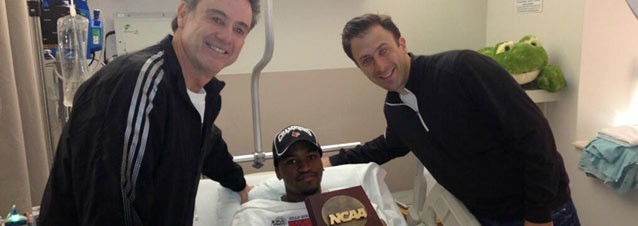
Louisville head coach Rick Pitino and trainers tend to injured guard Kevin Ware during the first half of the Midwest Regional final in the NCAA college basketball tournament against Duke, on March 31, 2013, in Indianapolis. Ware badly injured his lower right leg and had to be taken off the court on a stretcher.
The gruesome break that shattered Louisville Cardinals guard Kevin Ware’s right lower leg during Sunday’s Elite Eight playoff game was a “freak accident” rare outside of car accidents or other high-velocity trauma, a sports medicine expert said.
The 20-year-old sophomore from the Bronx apparently landed awkwardly in the heat of the NCAA Midwest Final game against the Duke Blue Devils, perhaps exacerbating an undetected stress fracture, said Dr. Frederick Azar, a vice president and spokesman for the American Academy of Orthopaedic Surgeons and chief of staff at Campbell Clinic in Germantown, Tenn., who consults for the Memphis Grizzlies NBA basketball team.

Published on Mar 31, 2013
Sophomore guard Kevin Ware suffered one of the most gruesome we have ever seen in the sport of basketball. In the first half Ware contested a shot from Duke's Tyler Thornton. CBS cameras showed how he landed awkwardly on his right leg, which we later learned was broken. **WARNING: VERY, VERY GRAPHIC.**
Watch more sports -
 
 
Kevin Ware Leg Broken | Worst Basketball Injury Ever | Louisville Versus Duke | 2013 March Madness 

Published on Mar 31, 2013
Kevin Ware's horrific leg injury during Louisville's (1) game versus Duke (2) of the 2013 NCAA Tournament Elite Eight Regional Final.

This is the worst injury I've ever seen in any sport much less college basketball. Louisville's Kevin Ware (#5) lands and rolls awkwardly on his right foot and leg which procedes to crumble underneath him as he falls to the floor. Siva, Blackshear, and Behanan all crumble to the floor at the sight of Ware's injury, visibly shaken and emotionally distraught.

He was medically assessed on the court and take to the hospital for surgery. Coach Rick Pitino stated that Ware had broken his leg in 2 places, "the same injury that Michael Bush had" and should make a full recovery in a year's time.

Still, that means Ware will be out for the rest of the tournament this year that has brought top seeded lousville to their 2nd consecutive Final Four appearance. Many say the Cards are due the coveted NCAA tournament title that was swatted away by last year's champion, UK, in a epic game between the life-long rivals in the Final Four.

Louisville turned the tight scoring game around to finish with a 22 point lead over the Blue Devils. During an interview after the game, Pitino said they won the game for Ware. It definitely seemed to bring many members of the Cardnials team alive especially Peyton Siva who started sinking almost every shot he put up.

This year Louisville will face the suprise candidate from the West region, Witchita St in the Final Four match up to see who will take the spot in the championship game. Witchita St has ponied up so far during the tourney shocking Gonzanga (1) in the second round.

Will it be enough to drop another #1 seeded team during March Madness? Not with the way Louisville is playing. After destroying a strong Duke team tonight, it seems like no NCAA team can stop their run. The Cardnials are on an 11 game winning streak.

“He may have just landed funny and torqued his tibia,” said Azar, who was watching the game. “It was a freak accident.”
Such injuries, don’t often happen at the low velocity of even high-level basketball, which raises the possibility that Ware had a preexisting stress fracture, Azar said.
The bone in Ware’s lower right leg apparently broke in two places and could be seen sticking out through Ware’s skin, observers said.
“To actually see it happen like that is rare,” Azar said. “A bone sticking out of the skin is really, really unusual.”
The injury, which occurred with 6:33 minutes left in the first half of the game, sent 6-foot-2 Ware to floor, stunned his teammates into sickened sobs and silenced the crowd at Lucas Oil Stadium in Indianapolis.
The Cardinals went on to win the game 85-63.
Known as a compound fracture or open fracture, the injury occurs when the bone protrudes through the skin, Azar said. Doctors likely washed out the injury to prevent infection and then quickly performed surgery to place a titanium or stainless steel rod in Ware’s leg.
“They’ll get him up and get him going by tomorrow,” Azar said. “You would hope he gets fixed tonight.”
Cardinals coach Rick Pitino told reporters that Ware would be out of  commission for a year, but Azar said that if surgery went well and there were no nerve complications or infections, the young, healthy player could be back on the court in time for next season, or within six months.
“That’s the good news: We have the technology to fix this,” said Azar.

Louisville’s Kevin Ware suffers a gruesome compound fracture vs. Duke


ware
 
Getty Images
Louisville guard Kevin Ware was taken off the court on a stretcher in the first half of Louisville’s Regional Final against Duke on Sunday afternoon after suffering the worst injury I’ve ever seen in a sporting event. (The Cardinals eventually won the game for a Final Four spot.)
After challenging a three that Tyler Thornton took from the wing, he landed wrong on his right leg and suffered a compound fracture. His shin bone was protruding from his skin.
I’m not going to embed or link any pictures or video of the injury itself. If you really want to see it, it won’t be difficult.


But we’ll turn to the AP for some on-scene color:
The injury happened in front of the Louisville bench, and the Cardinals were overcome with emotion.
Louisville forward Wayne Blackshear fell to the floor, crying, and Chane Behanan looked as if he was going to be sick on the court, kneeling on his hands and feet. Peyton Siva sat a few feet away, a hand covering his mouth.
Luke Hancock patted Ware’s chest as doctors worked on the sophomore and Russ Smith – who is from New York City like Ware – walked away, pulling his jersey over his eyes.
Someone finally pulled Behanan to his feet, but he doubled over and needed a few seconds to gather himself. As Ware was being loaded onto a stretcher, the Cardinals gathered at midcourt until coach Rick Pitino called them over, saying that Ware wanted to talk to them before he left.
The players on the Louisville team were reportedly vomiting on the bench. The Louisville team was in tears on the court. Coach Rick Pitino was as well. Ware, however, seemed to be the most calm member of the Louisville team. It was reported on the CBS broadcast that he told the team while laying on the floor, “Don’t worry about me. I’ll be OK. You guys go win this thing.”
source:
source:
On the CBS broadcast, Tracy Wolfson said that Ware had his leg immobilized and he was being taken directly to the emergency room. His girlfriend was with him and his family back home had been contacted.
Thoughts and prayers go out to Ware. We wish him a speedy recovery.

Louisville player after horrific injury: 'Don't worry about me. I'll be OK. You guys go win this thing'


Jeff Haynes / Reuters
Louisville Cardinals head coach Rick Pitino calls to the referees to stop the game as Cardinals guard Kevin Ware lays on the court with a broken leg in the first half against the Duke Blue Devils during their Midwest Regional NCAA men's basketball game in Indianapolis, Indiana, on March 31, 2013.

Darron Cummings / AP
Louisville players talk to guard Kevin Ware after Ware's injury during the first half of the Midwest Regional Final against Duke in the NCAA basketball tournament March 31 in Indianapolis, Ind.

By Rob Dauster, CollegeBasketballTalk on NBCSports.com
Kevin Ware was taken off the court on a stretcher in the first half of Louisville’s regional final against Duke on Sunday afternoon after suffering the worst injury I’ve ever seen in a sporting event.
After challenging a three that Tyler Thornton took from the wing, he landed wrong on his right leg and suffered a compound fracture. His shin bone was protruding through his skin.
Read the full story.

Andy Lyons / Getty Images
Wayne Blackshear #20 and Chane Behanan #21 of the Louisville Cardinals react after Kevin Ware #5 suffered a compound fracture to his leg in the first half against the Duke Blue Devils during the Midwest Regional Final round of the 2013 NCAA Men's Basketball Tournament at Lucas Oil Stadium on March 31, 2013 in Indianapolis, Indiana.