Pages

Monday, April 1, 2013

Texas community in 'shock' over slaying of DA, wife

Texas district attorney Mike McClelland and his wife Cynthia were found dead, just two months after McClelland's top assistant was also shot dead. Authorities are exploring a link between the two crimes and a possible link to a  white supremacist group. NBC's Gabe Gutierrez reports.
An official in the Texas county where a prosecutor and his wife were shot to death over the weekend said Monday that the ordeal was “surreal” and that authorities there were on alert.
“We’re still in shock,” Kaufman County Judge Bruce Wood told reporters.
District Attorney Mike McLelland and his wife, Cynthia, were gunned down at their home outside Dallas on Saturday two months after another prosecutor there was shot to death.
A white supremacist group has been thought to be planning retaliation after indictments in a racketeering case, and the state has recently warned about Mexican drug cartels.
But authorities have not said the killings of the two prosecutors are linked and have not announced any leads in the McLellands’ deaths.
“We are very much on alert,” Wood said. “We have some folks out there that intend to do harm to public officials.”
He said that the county was open for business.
McLelland had vowed to catch the killer of the other prosecutor, Assistant District Attorney Mark Hasse, who was gunned down near the county courthouse on his way to work Jan. 31.
McLelland told reporters that day: “I hope the people that did this are watching. Because we're very confident that we're going to find you, pull you out of whatever hole you're in, bring you back and let the people of Kaufman County prosecute you to the fullest extent of the law.”
Mayor Darren Rozell of Forney, which is in Kaufman County, told NBC News after McLelland’s killing that it appeared to be targeted and that civilians probably were not at risk.
Asked about suggestions that a white supremacist group may have been involved, Rozell said he had seen media reports to that effect but “really couldn’t comment.”
On the day Hasse was killed, the Justice Department announced that the Kaufman County DA’s office was among investigative bodies involved in a racketeering case against the white supremacist group Aryan Brotherhood of Texas.
A district attorney and his wife were found shot dead in their Texas home on Saturday, a chilling crime that has become a murder mystery. NBC's Gabe Gutierrez reports.
The hate group was suspected of “actively planning retaliation” against police and prosecutors who helped gain indictments in Houston against dozens of its members, the Dallas Morning News reported in February.
In February, the state's Department of Public Safety issued a report highlighting the threat of Mexican drug cartels operating in Texas.
The FBI and the Texas Rangers were leading the investigations, which at one point examined possible ties to the March 19 shooting death of Colorado prisons director Tom Clements, Reuters reported, adding that no connection had been found.
The McLellands were “deeply in love,” Tonya Ratcliff, the county tax assessor and a longtime friend of the couple, told NBCDFW.com.
“You would never hear one of them say an ugly word about the other one,” she said. "They were just a wonderful couple, and it was a pleasure to be around them — and I will miss them.”
A tip line has been set up for the investigation. Anyone with information to share with investigators is asked to call 1-877-847-7522.

‘Justice for James Holmes is death’: Prosecutors seek execution for alleged Batman shooter

Prosecutors in Colorado are expected to announce whether they will seek the death penalty in the case against James Holmes, the accused gunman in the Aurora theater massacre that left 12 people dead and 70 others injured last July. NBC's LeAnne Gregg reports.

Prosecutors said Monday that they will seek the death penalty for James Holmes, the man accused of gunning down 12 people and wounding 70 at a Batman movie last summer in Colorado.
George Brauchler, the district attorney for Arapahoe County, said he made the decision after speaking with more than 800 victims and family members.
“Given all the input I considered and all the information available, it is my intent that justice for James Holmes is death,” he said at a hearing.
Brauchler had already rejected an offer from the defense to let Holmes plead guilty and serve a life sentence.
Judge William Sylvester of the Colorado circuit court entered a plea of not guilty for Holmes last month after his lawyers said they were not ready to plead. The judge left the door open for lawyers to mount an insanity defense.
The two cases in the legal case fought in public last week. After the defense made its offer, Brauchler said in a filing that Holmes’ lawyers were only trying to generate sympathy for their client.
The only conclusion, the prosecutor wrote, “is that the defendant knows he is guilty, the defense attorneys know he is guilty and that both of them know that he was not criminally insane.”
Brauchler wrote an Op-Ed in The Denver Post over the weekend defending the death penalty. Colorado legislators have considered banning it. He did not name Holmes but wrote of capital punishment as an important tool of justice.
“Repealing the death penalty would result in acts similar to those in Newtown, Conn., or the acts of Tim McVeigh being punished no differently than a single murder of one gang member by another,” the prosecutor wrote. “Each murder after the first would be a freebie.”


R.J. Sangosti / Pool
Aurora theater shooting suspect James Holmes listens at his arraignment March 12.
Holmes’ lawyers have said that jailers determined he was a danger to himself and needed a mental evaluation, and that he was held for several days in a psychiatric ward, sometimes in restraints.
He surrendered to police within minutes of the July 12 shooting rampage at a midnight screening of the movie “The Dark Knight Rises” in Aurora, Colo., a suburb of Denver.
At his first court appearance, Holmes had stark, red-orange hair and wore a blank stare. He has since appeared more stable and natural-looking. He showed up in court last month with a bushy beard.
The hearing Monday was set to begin at 11 a.m. EDT. Legal observers have pointed out that the two sides could still reach a plea deal later, even as prosecutors seek to put Holmes to death.

Gruesome basketball injury a 'freak accident,' doc says


Darron Cummings / AP
Louisville head coach Rick Pitino and trainers tend to injured guard Kevin Ware during the first half of the Midwest Regional final in the NCAA college basketball tournament against Duke, on March 31, 2013, in Indianapolis. Ware badly injured his lower right leg and had to be taken off the court on a stretcher.
The gruesome break that shattered Louisville Cardinals guard Kevin Ware’s right lower leg during Sunday’s Elite Eight playoff game was a “freak accident” rare outside of car accidents or other high-velocity trauma, a sports medicine expert said.
The 20-year-old sophomore from the Bronx apparently landed awkwardly in the heat of the NCAA Midwest Final game against the Duke Blue Devils, perhaps exacerbating an undetected stress fracture, said Dr. Frederick Azar, a vice president and spokesman for the American Academy of Orthopaedic Surgeons and chief of staff at Campbell Clinic in Germantown, Tenn., who consults for the Memphis Grizzlies NBA basketball team.

Published on Mar 31, 2013
Sophomore guard Kevin Ware suffered one of the most gruesome we have ever seen in the sport of basketball. In the first half Ware contested a shot from Duke's Tyler Thornton. CBS cameras showed how he landed awkwardly on his right leg, which we later learned was broken. **WARNING: VERY, VERY GRAPHIC.**
Watch more sports -
 
 
Kevin Ware Leg Broken | Worst Basketball Injury Ever | Louisville Versus Duke | 2013 March Madness 

Published on Mar 31, 2013
Kevin Ware's horrific leg injury during Louisville's (1) game versus Duke (2) of the 2013 NCAA Tournament Elite Eight Regional Final.

This is the worst injury I've ever seen in any sport much less college basketball. Louisville's Kevin Ware (#5) lands and rolls awkwardly on his right foot and leg which procedes to crumble underneath him as he falls to the floor. Siva, Blackshear, and Behanan all crumble to the floor at the sight of Ware's injury, visibly shaken and emotionally distraught.

He was medically assessed on the court and take to the hospital for surgery. Coach Rick Pitino stated that Ware had broken his leg in 2 places, "the same injury that Michael Bush had" and should make a full recovery in a year's time.

Still, that means Ware will be out for the rest of the tournament this year that has brought top seeded lousville to their 2nd consecutive Final Four appearance. Many say the Cards are due the coveted NCAA tournament title that was swatted away by last year's champion, UK, in a epic game between the life-long rivals in the Final Four.

Louisville turned the tight scoring game around to finish with a 22 point lead over the Blue Devils. During an interview after the game, Pitino said they won the game for Ware. It definitely seemed to bring many members of the Cardnials team alive especially Peyton Siva who started sinking almost every shot he put up.

This year Louisville will face the suprise candidate from the West region, Witchita St in the Final Four match up to see who will take the spot in the championship game. Witchita St has ponied up so far during the tourney shocking Gonzanga (1) in the second round.

Will it be enough to drop another #1 seeded team during March Madness? Not with the way Louisville is playing. After destroying a strong Duke team tonight, it seems like no NCAA team can stop their run. The Cardnials are on an 11 game winning streak.

“He may have just landed funny and torqued his tibia,” said Azar, who was watching the game. “It was a freak accident.”
Such injuries, don’t often happen at the low velocity of even high-level basketball, which raises the possibility that Ware had a preexisting stress fracture, Azar said.
The bone in Ware’s lower right leg apparently broke in two places and could be seen sticking out through Ware’s skin, observers said.
“To actually see it happen like that is rare,” Azar said. “A bone sticking out of the skin is really, really unusual.”
The injury, which occurred with 6:33 minutes left in the first half of the game, sent 6-foot-2 Ware to floor, stunned his teammates into sickened sobs and silenced the crowd at Lucas Oil Stadium in Indianapolis.
The Cardinals went on to win the game 85-63.
Known as a compound fracture or open fracture, the injury occurs when the bone protrudes through the skin, Azar said. Doctors likely washed out the injury to prevent infection and then quickly performed surgery to place a titanium or stainless steel rod in Ware’s leg.
“They’ll get him up and get him going by tomorrow,” Azar said. “You would hope he gets fixed tonight.”
Cardinals coach Rick Pitino told reporters that Ware would be out of  commission for a year, but Azar said that if surgery went well and there were no nerve complications or infections, the young, healthy player could be back on the court in time for next season, or within six months.
“That’s the good news: We have the technology to fix this,” said Azar.

Louisville’s Kevin Ware suffers a gruesome compound fracture vs. Duke


ware
 
Getty Images
Louisville guard Kevin Ware was taken off the court on a stretcher in the first half of Louisville’s Regional Final against Duke on Sunday afternoon after suffering the worst injury I’ve ever seen in a sporting event. (The Cardinals eventually won the game for a Final Four spot.)
After challenging a three that Tyler Thornton took from the wing, he landed wrong on his right leg and suffered a compound fracture. His shin bone was protruding from his skin.
I’m not going to embed or link any pictures or video of the injury itself. If you really want to see it, it won’t be difficult.


But we’ll turn to the AP for some on-scene color:
The injury happened in front of the Louisville bench, and the Cardinals were overcome with emotion.
Louisville forward Wayne Blackshear fell to the floor, crying, and Chane Behanan looked as if he was going to be sick on the court, kneeling on his hands and feet. Peyton Siva sat a few feet away, a hand covering his mouth.
Luke Hancock patted Ware’s chest as doctors worked on the sophomore and Russ Smith – who is from New York City like Ware – walked away, pulling his jersey over his eyes.
Someone finally pulled Behanan to his feet, but he doubled over and needed a few seconds to gather himself. As Ware was being loaded onto a stretcher, the Cardinals gathered at midcourt until coach Rick Pitino called them over, saying that Ware wanted to talk to them before he left.
The players on the Louisville team were reportedly vomiting on the bench. The Louisville team was in tears on the court. Coach Rick Pitino was as well. Ware, however, seemed to be the most calm member of the Louisville team. It was reported on the CBS broadcast that he told the team while laying on the floor, “Don’t worry about me. I’ll be OK. You guys go win this thing.”
source:
source:
On the CBS broadcast, Tracy Wolfson said that Ware had his leg immobilized and he was being taken directly to the emergency room. His girlfriend was with him and his family back home had been contacted.
Thoughts and prayers go out to Ware. We wish him a speedy recovery.

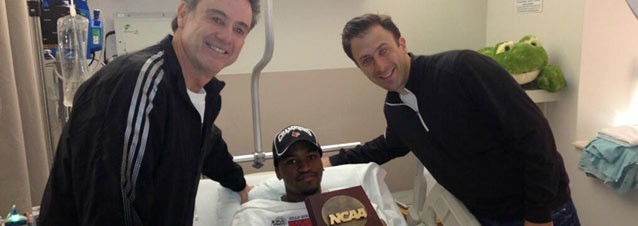
Louisville player after horrific injury: 'Don't worry about me. I'll be OK. You guys go win this thing'


Jeff Haynes / Reuters
Louisville Cardinals head coach Rick Pitino calls to the referees to stop the game as Cardinals guard Kevin Ware lays on the court with a broken leg in the first half against the Duke Blue Devils during their Midwest Regional NCAA men's basketball game in Indianapolis, Indiana, on March 31, 2013.

Darron Cummings / AP
Louisville players talk to guard Kevin Ware after Ware's injury during the first half of the Midwest Regional Final against Duke in the NCAA basketball tournament March 31 in Indianapolis, Ind.

By Rob Dauster, CollegeBasketballTalk on NBCSports.com
Kevin Ware was taken off the court on a stretcher in the first half of Louisville’s regional final against Duke on Sunday afternoon after suffering the worst injury I’ve ever seen in a sporting event.
After challenging a three that Tyler Thornton took from the wing, he landed wrong on his right leg and suffered a compound fracture. His shin bone was protruding through his skin.
Read the full story.

Andy Lyons / Getty Images
Wayne Blackshear #20 and Chane Behanan #21 of the Louisville Cardinals react after Kevin Ware #5 suffered a compound fracture to his leg in the first half against the Duke Blue Devils during the Midwest Regional Final round of the 2013 NCAA Men's Basketball Tournament at Lucas Oil Stadium on March 31, 2013 in Indianapolis, Indiana.

Sunday, March 31, 2013

Crude oil leaks in Arkansas suburb after ExxonMobil pipeline ruptures


An ExxonMobil pipeline rupture near Little Rock, Ark., Friday evening has resulted in a “major oil spill,” according to the Environmental Protection Agency -- and ignited further debate over the transportation of crude oil in the U.S.
Up to 10,000 barrels sprang from the pipeline, according to an incident report filed to the National Response Center by ExxonMobil early Saturday morning. Twenty-two residents were evacuated from their homes, according to a statement on the ExxonMobil website.
Mayflower, Ark., Chief of Police Bob Satkowski told Channel 7 News in Little Rock that those residents had to leave their homes because of health risks from the crude oil fumes and possible fires.
In a statement on the company website, ExxonMobil downplayed the environmental concerns, saying that the air quality doesn’t likely present a human health risk, “with the exception of high-pooling areas.”
KARK, an NBC affiliate station in Little Rock, reported that part of the pipeline runs through a water source that provides drinking water to nearly 400,000 residents in central Arkansas. The 20-inch wide pipeline goes through Lake Maumelle.
The pipeline, officially known as the Pegasus pipeline, transports heavy Canadian crude oil from Patoka, Ill. down to the Sunoco Logistics Nederland terminal in Texas, which feeds into Houston area refiners, according to the Exxon website. The pipeline, which can carry more than 90,000 barrels a day, was stopped Friday. ExxonMobil did not say when it would reopen.
EPA officials said the cleanup would be long and expensive, according to KARK. It was not reported who would pay for the cleanup.
The leak was first reported at 5 p.m. Friday, when someone called the National Response Center to report a drop in pipeline pressure.
Two hours later, a caller reported that there was a “significant amount of material release.” The caller said the oil leak lasted about three hours.
An updated report early Saturday said up to 10,000 barrels were discharged and that the product had been released “into flume pipes and into a pond, a tributary of Lake Conway.”
Friday’s spill prompted immediate response from critics of the proposed Keystone XL pipeline, which would transport about 800,000 barrels per day of Canadian crude oil to the Gulf Coast for refining.
Massachusetts Rep. Ed Markey took to Facebook to lash out against Canadian crude oil.
“This latest pipeline incident is a troubling reminder that oil companies still have not proven that they can safely transport Canadian tar sands oil across the United States without creating risks to our citizens and our environment,” Markey said. He is the top Democrat on the Natural Resources Committee.
“Tar sands oil is already the dirtiest, riskiest oil around, and should not be getting a free ride across America,” he continued. “It’s time that we recognize the real effects producing and burning this oil will have on our climate, and the real world damage it can cause when it is spilled in our neighborhoods.”
This has been a bad week for crude oil public relations. On Wednesday, according to Reuters, a train carrying crude oil derailed in Minnesota and spilled up to 30,000 gallons.
Last week, the Pipeline and Hazardous Materials Safety Administration recommended fining ExxonMobil Pipeline Company $1.7 million for how the company responded to a crude oil pipeline failure in the Yellowstone River in Montana.
The Mayflower spill may be 10 times more significant than the Montana spill, which leaked 1,509 barrels.
The 1989 Exxon Valdez spill poured 260,000 to 750,000 gallons into Alaskan waters.
These spills pale in comparison, however,to the 2010 Deep Water Horizon oil spill, the most significant oil spill in the U.S., which leaked 4.9 million barrels into the Gulf Coast.

Big depositors in Cyprus could lose up to 60 percent of savings

By Karolina Tagaris, Reuters

Major depositors in Cyprus's biggest bank will lose around 60 percent of savings over 100,000 euros, its central bank confirmed on Saturday, sharpening the terms of a bailout that has shaken European banks and saved the island from bankruptcy.

Initial signs that big depositors in Bank of Cyprus would take a hit of 30 to 40 percent - the first time the euro zone has made bank customers contribute to a bailout - had already unnerved investors in European lenders this week.

But the official decree published on Saturday confirmed a Reuters report a day earlier that the bank would give depositors shares worth just 37.5 percent of savings over 100,000 euros. The rest of such holdings might never be paid back. The toughening of the terms will send a clear signal that the bailout means the end of Cyprus as a hub for offshore finance and could accelerate economic decline on the island and bring steeper job losses.

Banks reopened to relative calm on Thursday after an almost two-week shutdown and the imposition of capital controls. The streets of Nicosia were calm on Saturday, filled with crowds relaxing in its cafes and bars.

There is no sign for now that ordinary customers in other struggling euro zone countries like Greece, Italy or Spain are taking fright at the precedent set by the bailout.

"Cyprus is and will remain a special one-off case," German Finance Minister Wolfgang Schaeuble, one of the architects of the euro zone's response to a debt crisis now in its fourth year, told German mass-selling daily Bild.

"The savings accounts in Europe are safe."

European officials have worked hard this week to stress that the island's bailout was a unique case - after a suggestion by Eurogroup chairman Jeroen Dijsselbloem that the rescue would serve as a model for future crises rattled European financial markets.

"Together in the Eurogroup we decided to have the owners and creditors take part in the costs of the rescue - in other words those who helped cause the crisis," said Schaeuble.

"Cyprus's economy will now go through a long and painful period of adjustment. But then it will pay back the loan when it is on a solid economic foundation."

Cypriot President Nicos Anastasiades said on Friday that the 10-billion euro ($13 billion) bailout had contained the risk of national bankruptcy and would prevent it from leaving the euro.

Cypriots, however, are angry at the price attached to the rescue - the winding down of the island's second-largest bank, Cyprus Popular Bank, also known as Laiki, and an unprecedented raid on deposits over 100,000 euros.

Etyk, a bank worker's union, called a rally outside parliament for Thursday to protest against potential job cuts and a hit on their pension funds.

North Korea: Nukes are our country's 'life'

NBC's Ian Williams reports on the latest tensions emanating from North Korea.
One of North Korea's top decision-making bodies is setting guidelines that call nuclear weapons "the nation's life" that won't be traded even for "billions of dollars,” The Associated Press reported.
The statement Sunday came after a plenary meeting of the central committee of the ruling Workers' Party attended by leader Kim Jong Un and other officials, the AP said.
It also followed a declaration on Saturday that it was entering a "state of war" with South Korea, the latest in a string of increasingly belligerent outbursts from the isolated state.
Sunday’s statement says nuclear weapons aren't "goods for getting U.S. dollars" or a "political bargaining chip." Outside analysts have said Pyongyang raises worries over its nuclear ambitions to spur nuclear-disarmament-for-aid talks, the AP said.

It said Pyongyang will also increase work to build up the economy. Kim has made fixing the moribund economy a focus.
On Thursday the U.S. sent two nuclear-capable bombers to South Korea, where they dropped inert munitions in a military exercise. The flight sparked an angry response from the North, which declared on Friday that it was preparing rockets aimed at American bases in South Korea and the Pacific.


Tucson shooting: Major findings in Loughner files

March 27, 2013 9:58 am


Documents released Wednesday provide new insight into how the Tucson shooting rampage occurred and the motivations behind gunman Jared Loughner.
One of the main themes to emerge was the increasingly erratic behavior of Loughner, perhaps summed up best by his father as he told investigators: He “just doesn’t seem right lately.”

A look at some of the major findings so far today:

LOUGHNER

The gunman was polite and cooperative with authorities who were holding him the afternoon following his morning shooting rampage. The conversation as Loughner sat in restraints in an interview room was mainly small talk. Little was said over the four hours. Loughner asks at one point if he can please use the restroom and says “Thank you” when allowed. At another point he complained that “I’m about ready to fall over.”

GUNMAN’S MOTHER

Loughner’s mother, Amy, described his run-ins with authorities, his use of marijuana and cocaine, his journals and his increasingly erratic behavior. She also says the parents took a shotgun away from Loughner after he was kicked out of a community college and tested him for drugs because his behavior was so strange.

GUNMAN’S FATHER

Randy Loughner said his son became increasingly difficult, and it was a challenge to have a rational conversation with him. “I tried to talk to him. But you can’t, he wouldn’t let you,” he said “Lost, lost, and just didn’t want to communicate with me no more.”

MENTAL ILLNESS

Despite their son’s increasingly bizarre behavior, Loughner’s parents never sent him to get help. Randy Loughner said that his son had never been diagnosed with a mental illness. Had he seen a doctor, the detective asked. “No,” replied the father. The parents were also asked about any journals or writings that Loughner kept. The father said they were written in an indecipherable script.

DISABLING HIS CAR

Loughner’s parents “noticed that Jared was not acting quite right … and believed it was to have started when he was kicked out of Pima Community College for a YouTube video he had created.”
Randy Loughner said his son had become “more and more distant from them and he would not communicate with Mr. Loughner about much of anything.”
Randy Loughner became so concerned about his son’s behavior that he “began to disable Jared’s Nova … to prevent Jarred from being able to drive anywhere at night.”
However, the night before the shooting, Randy Loughner did not disable the car and heard his son drive away at 6 a.m. Jared Loughner returned home an hour or two.
When Randy Loughner heard his son pull up, “he looked outside of his front window and saw Jared take what appeared to be a black backpack out of the trunk of his Nova.”

CHRISTINA’S BELONGINGS

Christina-Taylor Green’s parents asked for their daughter’s clothing, earrings and iPod Touch to be returned. Deputies returned the earrings as well as images from the iPod Touch. They gave the family a disc with the electronic files and 8x10 printouts of the photos.

GOING TO THE SCENE

Loughner went to a convenience store immediately before the shooting and had the clerk call a cab for him. As he waited for the car, he was pacing inside and outside the store and went to the bathroom three or four times. The employee said that as Loughner was waiting for the cab, he looked up at a clock and said, “nine twenty-five, I still got time.”

TRAFFIC STOP

Loughner was pulled over earlier in the day for a traffic violation by a wildlife agent. He inched toward the intersection, then drove through the red light while making eye contact with the agent in the rearview mirror. He cried and said, “I’ve just had a rough time,” and then composed himself, thanked the agent and shook his hand after he was let go with a warning. The agent asked Loughner again if he was OK, and Loughner said he was going home.

THE SCENE

Giffords intern Daniel Hernandez helped tend to his boss after she was shot in the head. In an interview, he described the chaos: “She couldn’t open her eyes. I tried to get any responses for her. Um, it looked like her left side was the only side that was still mobile. Um, she couldn’t speak. It was mumbled. She was squeezing my hand.
“I did some training as a Certified Nursing Assistant and as a phlebotomist, um, when I was in high school. So I knew that we need to see if she’s got a pulse. She was still breathing. Her breathing was getting shallower. Uh, I then lifted her up so that she wasn’t flat on the ground against the wall,” he said.

GUNS

Loughner bought a 12-gauge shotgun in 2008, but his parents took it away from him after he was expelled from college and administrators recommended that any firearms be taken away. The shotgun was the only gun his parents knew Loughner owned.

AMMUNITION

On the day of the mass shooting, Loughner tried to buy ammunition at a Walmart on La Cholla Boulevard.A store clerk thought he was acting so odd and erratic that he decided to lie and tell Loughner the store was out of stock.
Loughner bought the ammunition he wanted at another Walmart store on Cortaro Road.
Earlier that week, Loughner had told a Walmart employee that he tried to enlist in the Army and that he believed Americans are brainwashed by the government.

CARING FOR GIFFORDS

A firefighter described how he cared for Giffords after arriving at the scene. “You’d ask her to grab your hand and she would grab your hand,” he said. He and paramedics rushed her to the hospital in an ambulance, giving her oxygen and an IV.

THE ENCOUNTER

Hernandez described how constituents and other people were lining up to see Giffords, and he was helping people sign in. He recalled handing Loughner a clipboard. “The next thing I hear is someone yell, ‘gun,’” he said.

LOUGHNER FRIEND

One-time Loughner friend Zachary Osler was an employee at a store where Loughner later bought a Glock handgun before the shooting. Osler was questioned about seeing Loughner shopping inside, sometime before Thanksgiving. He describes an awkward encounter with his former friend. “His response is nothing. Just a mute facial expression. And just like he, he didn’t care.” Osler told investigators he had grown uncomfortable with Loughner’s personality, “He would say he could dream and then control what he was doing while he was dreaming.” Osler says Loughner never mentioned Giffords to him.Osler talking about Loughner in high school: “Weird kid. He'd say weird things. Talk about weird things like how he consciously dreams while he’s awake.”
“I do know he tried to join the Army at one point. And they did mental evaluations on him. And they didn’t accept him.”
Osler said when he learned that Loughner was the suspect in the shooting, “my jaw just dropped. And I was like I know this person. Why he would do it? What would his motive be? If he had people help him? I do not know.”

POSSESSIONS

In Loughner’s left front pocket were two magazines for a Glock, both fully loaded. In his other front pocket was a foldable knife with about a 4-inch blade. In his back right pocket, he had a baggie with some money, a Visa credit card and his Arizona driver’s license. He was wearing a black beanie, a black hoodie-type sweatshirt, khaki pants and Sketchers shoes, reports show.

WITNESS

A witness described seeing an ominous-looking man in his early 20s wearing a backpack near the shooting scene. The witness later described recognizing Loughner as the same person from photos on the news.

Banks Still Too-Big-To-Fail: Six Things The Fed Must Do

We can’t solve problems by using the same kind of thinking we used when we created them.
Albert Einstein

At a news conference last Wednesday, Ben Bernanke, the chairman of the Federal Reserve, conceded that the problem of too-big-to-fail is “still here”.  If new rules and international cooperation did not solve it, he said, “additional steps” will be needed. Chairman Bernanke didn’t say what “additional steps” he has in mind. Since neither Dodd-Frank nor conclaves of central bankers are getting the job done, let’s give the chairman some help, by pointing out six things the Fed must do.

Abandon nostalgia for a world that no longer exists


Let’s start with some popular non-starters. Simon Johnson, former chief economist of the International Monetary Fund, and a Professor of Entrepreneurship at the M.I.T. Sloan School of Management, writes in the New York Times writes that  “the clearest possible statement of how to think about the modern financial system – and make it less risky” lies in a speech by Richard Fisher, president of the Federal Reserve Bank of Dallas, entitled “Ending Too Big To Fail.”
Fisher argues that “the largest financial holding companies be restructured so that every one of their corporate entities is subject to a speedy bankruptcy process, and in the case of the banking entities themselves, that they be of a size that is ‘too small to save.’ …The downsized, formerly too-big-to-fail banks would then be just like the other 99.8 percent [of banks], failing with finality when necessary—closed on Friday and reopened on Monday under new ownership and management in the customary process administered by the FDIC.”
The world that Fisher yearns for—a banking system composed of small banks that are easy to regulate: closed down on Friday and reopened on Monday under new ownership and management—was a comfortable cozy world for regulators that existed for many decades. It was one in which the central bankers were unquestionably in charge. The problem is that that world no longer exists.
There is no way that the Fed is going to be able to slice a bank like JPMorgan Chase [JPM] with 260,000 employees operating in sixty countries in a multitude of different businesses, or a bank like Citigroup [C] with 200 million customer accounts in 160 countries and processing $3 trillion in transactions every day,  into sets of small, independent, easily monitored entities that can be closed down on Friday and reopened on Monday with scarcely a ripple on the surface of the financial ocean. Fisher’s world no longer exists. There is no way it can be re-created. Efforts to re-create it will be counter-productive.

Don’t apply linear solutions to complex problems


The Fed should thus observe the first lesson in coping with complexity: the principle of obliquity. Efforts to impose linear thinking on complex situations typically lead to the opposite of what is intended. Where explicit articulation of a goal will result in the complex environment pushing back in the opposite direction, an oblique approach will often be more effective.
The banks may be too big, but an effort by the Fed to break them up by direct action is likely to have the opposite effect, for a number of reasons. First, there is no consensus that size is the issue. Even a liberal critic like Nobel-Prize winning economist, Paul Krugman, has argued that size isn’t the problem. Second, even among those who think that size is the issue, there is no consensus on how big is too big. Third, studies suggest that larger banks are more robust in coping with crises. Fourth, all the financial crashes have been sparked by problems in smaller financial institutions, not big banks. Finally, the financial sector will exploit all the preceding issues in a furious counter-action that would end up discrediting the Fed if it were to launch an explicit effort break up the big banks.

Reinventing central banking: from inspections to managing complexity


Historically, banking regulators have always worked as a secretive bureaucracy, working quietly behind closed doors, concealing problems from the public, so as to avoid the kind of panic that might aggravate the very problem they are trying to avert, and issuing their unchallengeable decisions with imperial force: “This bank will close” and “That bank will stay open.”
The approach of secret inspections and controls is no longer adequate to cope with the forces of “innovation” that have been unleashed by the modern financial sector. The inspectors are always several steps behind the “innovators” aka rogues, such as the London Whale.
As my colleague Richard Straub points out, we need to keep in mind Albert Einstein’s dictum:  “We can’t solve problems by using the same kind of thinking we used when we created them.” To solve today’s problems, the Fed has to think differently.

The Fed’s most powerful and most under-used tool: knowledge


Although the conventional wisdom is that the Fed has done all it can to resuscitate the economy by pumping money into the banking system and hold down interest rates, the reality is that the Fed has barely begun to use one of its most powerful tools: knowledge. Knowledge can mobilize the forces the marketplace to achieve the Fed’s ends.
Whatever one might think about the policy approach of the Fed, few have ever questioned its professionalism. The problem is that the professionals have been largely keeping this expertise to themselves, instead of sharing it with investors who can also act on it. Instead of having a few inspectors trying to catch up with rogues like the London Whale, we need millions of investors with the knowledge to follow what is going on and to act on the consequences.
Investors have the power and the smarts to shift their money out of JPMorgan Chase if it behaves recklessly. The sanctions of the marketplace are swift and decisive—if the right knowledge is available. There are six things the Fed must do to enable this to happen.

1.      Expose the banks’ hidden $5 trillion in derivatives assets

For starters, stop letting the big US banks hide half their assets off their balance sheets—some $5 trillion in derivative assets, according to a recent report from the Milken Institute, That happens now because “generally accepted accounting principles” in the US (GAAP) allow banks to conceal trading in derivatives. Other countries follow International Financial Reporting Standards (IFRS) rules which would require those derivative assets to be included on bank balance sheets.


Accounting principles that allow half of the assets of the banks to be hidden are unacceptable. It is time that US banks are required to adopt International Financial Reporting Standards (IFRS) rules and make full disclosure of their assets in derivatives. Much of the rest of the world does it. Why not the US?
This would have another salutary effect: it would reveal the true book-to-market ratios of the banks. The ratios of all the biggest banks, except for Wells Fargo, are less than 1.0. In other words, Wall Street is saying: the big banks would be worth more broken up, than they are in their current form. If the banks’ accounts included their derivative assets, the correct book-to-market-value ratios would be very much less than 1.0, thus increasing the pressure of market forces to break up these banks, which are too big, not only for society but for the good of their own shareholders.

Memo to the Fed: A principal cause of the 2008 meltdown was regulatory inaction when commercial banks were keeping over half of their assets off balance sheets. Dodd-Frank does nothing to change this. The global derivatives market is now 30 percent larger than it was in 2008, and that much more dangerous. It is a dereliction of the Fed’s duty to permit this hiding of derivative assets to continue. Bringing accounting practices up to international standards is a minimal first step.

2.      End the banks’ deceptive accounting practices

As The Atlantic pointed out last December, “At the heart of the problem is a worry about the accuracy of banks’ financial statements.” The Atlantic took apart the Wells Fargo’s [WFC] 2011 annual report. On the surface the accounts appear to be about a traditional kind of bank, with income divided into the usual three categories: “interest income” (i.e. traditional banking), “non-interest income” (i.e. services) and “other” (i.e. presumably an unimportant category of minor residuals).

Department of Deceptive Terminology: When The Atlantic dug into the details the 2011 annual report of Wells Fargo, it found that the reality was very different.
  • The term “interest income” sounds like innocuous traditional bank lending. It’s not. When you read on, you find that “interest income” includes almost $1.5 billion from “trading assets”; and another $9.1 billion results from “securities available for sale.”
  • The term “non-interest income” sounds like customer fees. It’s not. “Non-interest income” includes $1 billion in “net gains from trading activities” and another $1.5 billion is income from “equity investments.”
  • In Wells Fargo’s report, the income category “other” sounds like a minor insignificant detail. It’s not. It amounted to $6.6 billion of Wells Fargo’s income in 2011, or more than a third of Wells Fargo’s income. It would take an extremely diligent reader another fifty pages to discover that the bank derives that most of the “other” income is again from “trading activities.”

Department of missing information: Information on critical aspects of Wells Fargo’s activities is missing.
  • Economic hedging” might be benign or not. Is Wells Fargo’s “economic hedging” like buying straightforward insurance? Or was it more like speculation—what the London Whale at JPMorgan did? Wells Fargo’s annual report provides no information.
  • Collateralized debt obligations (CDOs)”: There is no full disclosure of what Wells Fargo is doing in collateralized debt obligations (CDOs)—the derivatives that led to the 2008 meltdown. Instead there is just a brief but alarming reference at the bottom of page 164: “In 2011, we incurred a $377 million loss on trading derivatives related to certain CDOs.” Once upon a time, a loss of this magnitude would have been headline news. Now, it’s hidden from view. Worse: there is no way of knowing how much of this is going on at the bank or how much risk is involved.
  • Customer accommodations” is another innocent-sounding category on which Wells Fargo made more than $1 billion in 2011. How did it make so much money merely by helping customers? Later in the report, we learn the truth. Customer accommodation consists of “security or derivative transactions conducted in an effort to help customers manage their market price risks and are done on their behalf or driven by their investment needs.”
  • The risks from trades: The Atlantic asks: “How much risk is the bank actually taking on these trades? For which customers does it place a requested bet, then negate its risk by taking an exactly offsetting position in the market, so that it is essentially acting as an agent simply taking a commission? And for all these trades, what risk is Wells Fargo taking on its customers? Many of these bets involve the customers’ promises to pay Wells Fargo depending on how certain financial numbers change in the future. But what happens if some of those customers go bankrupt? How much money would Wells Fargo lose if it “accommodates” customers who can’t pay what they owe?” We simply don’t know.
When relevant accounting information is systematically missing, the issue goes beyond missing information: it turns into something else: deceptive accounting.
Kevin Warsh, a former Federal Reserve Board member appointed by George W. Bush, says woeful disclosure is a major problem. “Investors can’t truly understand the nature and quality of the assets and liabilities. They can’t readily assess the reliability of the capital to offset real losses. They can’t assess the underlying sources of the firms’ profits. The disclosure obfuscates more than it informs, and the government is not just permitting it but seems to be encouraging it.”

Memo to the Fed: The continuation of deceptive accounting practices is a dereliction of the regulators’ duty to the public. In collaboration with the SEC and OCC, the Fed should expose these practices for what they are and require the banks to present non-deceptive information to investors. Banks that don’t comply should be classified by the OCC as “unsatisfactory management”. The SEC should reject submissions that continue these deceptive practices.

3.      Expose the continuing use of special purpose entities

Of particular concern is the re-emergence of “special-purpose entities” i.e. the infamous accounting devices that Enron employed to hide its debts. These deals were called ‘off-balance-sheet’ transactions, because they did not appear on Enron’s balance sheet. They have now re-emerged, even in Wells Fargo, under the new name of “variable interest entities”. The Atlantic calls them “an even lower circle of financial hell” than proprietary trading. The article likens variable interest entities to “a horror film, which the special-purpose entity has been reanimated… The problem is especially worrisome at banks: every major bank has substantial positions in VIEs.”
As of the end of 2011, Wells Fargo, the “extremely safe bank”, reported “significant continuing involvement” with variable-interest entities that had total assets of about $1.5 trillion. The ‘maximum exposure to loss’ that it reports is much smaller, but still substantial: just over $60 billion, more than 40 percent of its capital reserves. The bank says the likelihood of such a loss is ‘extremely remote.’ As The Atlantic comments: “We can hope.”
Worse: “Wells Fargo… excludes some VIEs from consideration, for many of the same reasons Enron excluded its special-purpose entities: the bank says that its continuing involvement is not significant, that its investment is temporary or small, or that it did not design or operate these deals. (Wells Fargo isn’t alone; other major banks also follow this Enron-like approach to disclosure.)… The presence of VIEs on Wells Fargo’s balance sheet ‘is a signal that there is $1.5 trillion of exposure to complete unknowns.’”

Memo to the Fed: Do your job: expose these activities for what they are and require full continuous disclosure.

4.      Expose the banks’ role in the real economy

Chairman Bernanke has made job growth the Fed’s top priority for the first time in its 100-year history. The New York Times reports: “At his news conference last week, he spoke about the issue in personal terms. Asked when he last had spoken to an unemployed person, he said that one of his own relatives was out of work.  “I come from a small town in South Carolina that has taken a big hit from the recession,” Mr. Bernanke said. ‘The last time I was there, the unemployment rate was about 15 percent. The home I was raised in had just been foreclosed upon. I have a great concern for the unemployed, both for their own sake but also because the loss of skills and the loss of labor force attachment is bad for our whole economy.’”
Chairman Bernanke is thus very conscious that the Fed’s strategy of shoveling money into the banking system has yet to have much positive effect the real economy. The banks are better off. The big firms’ profits are up. The top executives are sitting pretty. But the real economy in which most people work is still struggling.
Why might that be? Could it that when even conservative banks like Wells Fargo make around two-thirds of their income from trading and derivatives the best minds in the banks are deployed, guess where? In trading and derivatives.
When I read JPMorgan’s own report on the London Whale, I was struck, not just by the arrogance and the errors, but also by the quantity and quality of brainpower being deployed in socially useless activities, i.e. managing billions of dollars or gambling on an obscure stock index. Just imagine what this talent could accomplish if it was deployed on expanding opportunities and reducing risk for the real economy?
Have not these big banks become similar to those Mafia families that had a legitimate business as a mere front (such as commercial banking) while their real business was out the back: gambling (derivatives trading)? Doesn’t the FED have a responsibility to track and make explicit to the public what proportion of these banks’ efforts are engaged in promoting the real economy and how much is devoted to socially-useless gambling? Isn’t “making money from money” without connection to the real economy what has been the cause of major financial crashes in the past?

Memo to the Fed: Monitor and publish an index tracking the proportion of effort devoted by the big banks to the real economy.

5.      Help expose the theory that causes the problems

Why have the banks lost sight of their primary function of expanding opportunities and reducing risk for an ever wider circle of citizens and enterprises and turned themselves into a vast gambling casino of no social value to society? The story is a complex one, but a principal thread is the idea that became prevalent in the early 1980s: “The object of a firm is to maximize shareholder value, that is, to make money for the firm.”
In the ensuing single-minded search for profits, banks started pursuing what are known as “bad profits”. These practices were not illegal, but they were not in the best interests of customers or society, and included price gouging, gaming the system, toll collecting, zero-sum trading and excessive compensation.


At first, these “bad profits” were achieved through practices that were shady but not strictly illegal. But in due course, the temptations became too great and the “bad profits” turned into practices that were illegal, including price fixing of LIBOR, abuses in foreclosure, money laundering of drug dealers and terrorists, assisting tax evasion  and misleading clients with worthless securities.
Beyond banking, the goal of maximizing shareholder value has also had disastrous economic consequences. It has ended up having the opposite effect of what was intended. Paradoxically, the goal of maximizing shareholder value has resulted in lower shareholder value in the medium term. Returns on assets and invested capital are in steep and steady decline, as Deloitte’s study of 20,000 US firms from 1965 to 2011 shows (the Shift Index).
The bottom line is that the shareholder value theory hasn’t worked, even on its own terms. In banking, shareholder value has not only led the banks into activities of dubious social benefit, of great risk to society, loss of trust and eventually illegality. What is important for today’s discussion is that it also had high opportunity cost for the banks. Pursuing profits has distracted banks from their true social purpose of reducing risk and increasing opportunities for an ever wider circle of citizens and enterprises. Innovation has been taking place in banking, but not in a way that provides sustained benefits for either the banks or society.

Memo the Fed: Help expose the false theory that has led to such disastrous economic consequences. Help document its origins. Track its impacts. Publish research comparing the financial results for shareholders of banks that pursue shareholder value and banks that pursue delighting customers profitably.

6.      Shift the Fed’s thinking from inspection to enablement

The Fed must shift its own thinking from a 20th Century perspective of secret inspection and controls to a 21st Century modality of open information and enablement. Basic change happens, not when vested interests are defeated, but when different strategies are used to pursue those interests. The Fed can play a major role in facilitating this change in mindsets and attitudes.
Dani Rodrik makes the case in a terrific article, “The Tyranny of Political Economy” that the trick in getting difficult political change is persuading the elites that it’s in their own interests. In effect, banks would be more profitable for shareholder and for the economy if they systematically pursued adding profitably value for customers, rather than pursuing short-term profits for themselves. The fact that that the smaller regional banks are more profitable on average than the big banks already proves the point.
The Fed needs to help persuade the leadership of the big banks their future depends on growing the real economy, not on hanging on to the illegitimate way they are making profits today. It must help show that while it may take more effort in the short term but it will eventually increase their power, wealth and prestige.
The Fed can encourage these forces in the financial sector by focusing its research on these key issues and sharing its knowledge with the world.

Other more difficult actions

There are other actions that might help if successful, but these would be much more difficult and much less likely to be successful.

a.      Break up the big banks:

As noted above, direct action is likely to be counter-productive. It would waste precious reputational capital in a battle which it would in the end lose.

b.      Measure the subsidies to the big banks

Governor Fisher, Simon Johnson and others are intrigued by measuring the exact subsidy that the big banks enjoyed, apparently in the hope that if the exact figure were known, it would help spur action on too-big-to-fail. The realization of that hope isn’t obvious. First, the exact figure will always be an estimate and estimates will inevitably differ depending on the assumption. Even if it were known exactly, it would still raise all the above issues of what to do about it.

a.      Smash the Dodd-Frank logjam

A massive and well-funded counter-campaign is under way by the financial sector to prevent the Dodd-Frank regulations from ever being completed, let alone taking effect. The disgraceful story is brilliantly documented in article by Haley Sweetland Edwards in the Washington Monthly. It’s horrifying reading, but it’s not obvious what the Fed can do to intervene. More on that shortly.

And read also:

'I love you, too': Cardinal Dolan says Catholic Church must embrace gays and lesbians

Gabriel Bouys / AFP - Getty Images file
U.S. Cardinal Timothy Dolan attends a mass at the St Peter's basilica before the papal conclave in this March 2013 file photo.

Prominent U.S. Cardinal Timothy Dolan acknowledged Easter Sunday that the Catholic Church needs to forge a better relationship with the gay and lesbian community.

“We gotta do better to see that our defense of marriage is not reduced to an attack on gay people,” Dolan said. “And I admit, we haven’t been too good about that. We try our darndest to make sure we’re not anti-anybody.”
Dolan, the charismatic Archbishop of New York, made his comments on ABC’s “This Week” nearly one week after the U.S. Supreme Court heard arguments for and against Proposition 8, California’s gay marriage ban, and the Defense of Marriage Act, the 1996 law that blocks federal recognition of gay marriages.
Dolan called for a more conciliatory approach to gay and lesbian Catholics who may feel alienated by Church doctrine, which is traditionally opposed to homosexuality.
“The first thing I’d say to them is, ‘I love you, too, and God loves you, and we want your happiness,’” he said.
But Dolan added that he wasn’t sure how Catholic leaders should conduct better outreach to homosexuals.
“I don’t know. We’re still trying. We’re trying our best to do it. We got to listen to people,” Dolan said. “Jesus died on the cross for them as much as he did for me.”
Despite the appeal for inclusiveness, Dolan said the Church is unlikely to reverse their position on same-sex marriage.
“Sexual love … is intended only for a man and woman in marriage, where children can come about naturally,” he said.

Senators: Immigration deal close, not complete

Congressional Democrats are saying a comprehensive immigration deal is in sight, but Republicans are cautioning that any talk of a deal is premature. NBC's Kristen Welker reports.
With the caveat that negotiators still need to review and agree on legislative language, two key Senate lawmakers said Sunday that a deal on a comprehensive immigration reform bill is close but not complete after a breakthrough in talks between business and labor groups this weekend.
"With the agreement between business and labor, every major policy issue has been resolved on the Gang of Eight," said Democrat Sen. Chuck Schumer, one of the eight Senate leaders working on the legislation, during an interview on NBC's Meet the Press.
Noting that the group has pledged not to come to a final agreement until legislative language is finalized, Schumer said he is "very, very optimistic" that the group of lawmakers will have a deal by next week.
Republican Jeff Flake of Arizona, also a member of the Gang, agreed that lawmakers will be focused on the exact wording of the bill.
"We've still got a ways to go in terms of looking at the language and making sure that it's everything we thought it would be," Flake said on NBC. "But we're closer, certainly."
Another member of the group, Republican Sen. Lindsey Graham of South Carolina, said on CNN that negotiators have a 'conceptual' agreement.
"It’s got to be written up," he said. "We haven’t signed off; there’s a few details yet. But conceptually, we have an agreement between business and labor, between ourselves. It has to be drafted. It will be rolled out next week"
After the Chamber of Commerce and the AFL-CIO reached an agreement on the parameters of a guest worker program -- one of the main holdups in the negotiations -- Republican Sen. Marco Rubio warned that reports of an overarching Gang of Eight deal were "premature."
Schumer said Sunday that Rubio's statement did not indicate any kind of disagreement within the Senate group.
"As Senator Rubio correctly says, we have said we will not come to final agreement until we look at all the legislative language, and he's correctly pointing out that language hasn't been fully drafted," Schumer said. "There will be little kerfuffles but I don't think any of us expect there to be problems."
Rubio, the son of Cuban immigrants whose biography and conservative credentials make him a key GOP voice on immigration, also wrote in a letter to Senate Judiciary Committee Chairman Patrick Leahy and again in a press statement early Sunday that proponents should not rush the legislation to passage.
"Arriving at a final product will require it to be properly submitted for the American people’s consideration, through the other 92 senators from 43 states that weren’t part of this initial drafting process," Rubio said. "In order to succeed, this process cannot be rushed or done in secret.”
Flake echoed that sentiment Sunday, pledging that the draft legislation will be amended in the Senate Judiciary Committee process and on the Senate floor.
"There will be input, there should be input," Flake said. "It will make it a better product."
Schumer rejected the notion that Rubio could break from the Gang of Eight over concerns about the process.
"He is protecting some of the things that he thinks are very important in the bill, but I don't think that will stand in the way of any final agreement," Schumer said. "I think we're all on track."
Calling Rubio is "extremely important" to the bipartisan coalition, Flake said he's confident that the Gang of Eight will remain united.
"I think that we'll stick together as a Gang," he said. "And I hope that we can pull some Republicans our way. I think a number of them are with us already."