Pages

Wednesday, March 13, 2013


Francis the First: World reacts to a new pontiff 

Natacha Pisarenko / AP
Pope Francis I blesses the crowd from the central balcony of St. Peter's Basilica at the Vatican.
By Becky Bratu and Matthew DeLuca, NBC News
As white smoke rose from the Sistine Chapel on Wednesday and the bells of St. Peter's tolled, the crowd of thousands that had gathered in the square began cheering the election of a new pope to succeed Benedict.
Reactions poured in swiftly from around the world following Argentine Cardinal Jorge Mario Bergoglio's first appearance as Pope Francis I on St. Peter's balcony.
Pictures of the new pontiff were splashed across the homepages of newspapers in Argentina as he was presented to the world for the first time.
Latin American Catholics thrilled by the election of the cardinal wept and cheered in churches across the region at Bergoglio’s election.
“It’s a huge gift for all of Latin America,” Jose Antonion Cruz, a Franciscan friar in Puerto Rico told the Associated Press. “We waited 20 centuries. It was worth the wait.”

“I’m happy that they were able to come to a choice as quickly as they did,” House Speaker John Boehner, who is a Catholic, told NBC News. The selection of a pope from South America is “another big step in the right direction for our church,” Boehner said.

The pontifical Twitter handle came alive Wednesday after a silence that began with the resignation of Benedict XVI. “HABEMUS PAPAM FRANCISCUM,” the pope’s Twitter proclaimed.

British Prime Minister David Cameron tweeted that it was a “momentous day for the 1.2 [billion] Catholics around the world,” as Pope Francis was appointed.

Outside St. Patrick’s Cathedral in New York City, home to papal contender Cardinal Timothy Dolan, there were no tears that the avuncular archbishop wasn’t elected.

“I think it’s great,” said Sister Lucy Grygorcewicz, who was visiting the cathedral with a group of Felician Sister. “He’s representing a large constituency and it’s new and different.”

And while the American contenders did not carry the day, a member of arguably the country’s most prominent Catholic family weighed in.

“Love his calm demeanor,” Maria Shriver tweeted of the serene Holy Father. “It’s a new world … let it begin.”
Edward Egan, the Archbishop Emeritus of New York, told NBC News' Brian Williams that this was “the moment of Latin America.”

“I can assure you he’s not feeble in any way at 76,” he said.
Excitement was high at Boston College, which hosts one of the largest communities of Jesuit priests outside the Vatican.

“As a Jesuit University we’re delighted with the selection of Cardinal Bergoglio as pope,” university spokesman Jack Dunn told NBC News. “He’s a man of great humility and empathy with the poor and those are characteristics that have long been cherished among Jesuit circles.”

Cardinal Dolan, president of the U.S. Conference of Catholic Bishops, greeted the election of Pope Francis I as a “great milestone in our church” in a statement released on Wednesday.

“The bishops of the United States thank God for the guidance of the Holy Spirit and the inspired choice of the College of Cardinals,” Dolan said in the statement.
Obama’s meeting with GOP conference: Cordial, but no white smoke of consensus 

By Frank Thorp and Carrie Dann , NBC News

Four thousand miles from the papal conclave in Rome, President Barack Obama and congressional Republicans held their own closed-door meeting Wednesday, as the president continued a high-profile campaign for bipartisan comity in Washington.

But -- while Obama told reporters that he informed GOP attendees of the papal news -- there’s still no white smoke of consensus over the Capitol.
Related: Actions don’t match charm offensive words

House Speaker John Boehner talks about President Obama's meeting with House members on Capitol Hill Wednesday.

Though Republicans described the 90-minute meeting as cordial -- with the GOP conference even offering Obama a standing ovation before his remarks -- members said the talks yielded no major breakthroughs on the budgetary dispute that has locked the two parties in political combat for months.

“Republicans want to balance the budget, the president doesn’t,” House Speaker John Boehner told reporters after the meeting. “Republicans want to solve our long term debt problem, the president doesn’t.”

“But having said that, today was a good start,” he added. “I hope that these kinds of discussions can continue even though we have very real differences, [because] our job is to find common ground.”
Boehner said the tone of the meeting was “respectful” and that the discussion was “candid” and “productive.”

House Budget Committee chairman and former Republican vice presidential candidate Paul Ryan, who lunched with Obama last week, said that the president “did himself some good.”

But other members described the session as little more than rhetorical leftovers.
“His whole talk was just a bunch of platitudes and no substance to it,” griped Rep. Paul Broun of Georgia.

And Rep. Mike Rogers of Alabama charged that the president “wasn’t saying anything new.”

Sources in the room told reporters that Obama spoke about infrastructure and touched on gun control and immigration legislation.
House Administration Committee head Candice Miller also asked the president about the cancellation of White House tours due to budget cuts, a move that critics say is merely a play for publicity.

"I asked the president if there was some way in the spirit of reaching out and working together if we could help him with his problem in the White House," Miller said after the meeting. "He said it was a determination of the Secret Service, and the math wasn't as easy to do as just giving up the congressional White House party or the picnic or what have you.”

J. Scott Applewhite / AP
President Barack Obama, escorted by House Sergeant at Arms Paul Irving, right, arrives on Capitol Hill in Washington, Wednesday, March 13, 2013, for closed-door talks with House Speaker John Boehner and the House Republican Conference to discuss the budget.
The visit was the first meeting between the president and the full GOP conference since 2011, when members came to the White House to discuss the federal deficit. Obama last came to the Capitol to address House Republicans on their own turf in January 2009.

The president’s visit to the Capitol is the second of three trips down Pennsylvania Avenue this week. On Tuesday, he met with Democratic allies in the Senate; on Thursday, he is expected to address Senate Republicans. Last week, he shared meals with Republican lawmakers from both chambers.
But while his bipartisan outreach has received good reviews from participants -- with Republican senators calling the meetings cordial and candid -- some on the Hill are skeptical that the president’s calculation is more about headlines than harmony.

“I think that the general sense of the conference is the president is coming here because he saw his approval ratings dropping, and people were asking ‘why isn’t he in Washington negotiating?’” said one GOP aide before the meeting. “And we ask: Do we feel like we’re going to get different answers than scripted answers?”

Those Republicans found fodder Tuesday in a National Journal story that quoted an unnamed White House aide saying the outreach efforts are “a joke.”

“I hope you all (in the media) are happy because we’re doing it for you,” the senior official reportedly said in the story.

The targets of the president’s outreach say that the true value of the series of meetings will become apparent as negotiations over pending legislation continues.

"He's the president and I wholeheartedly want to believe everything that he says, but after everything that has occurred I'm going to wait for the action," Rep Michael Grimm, R-N.Y., said. "If the president is sincere and really wants to work with us then that'll show itself over the next several months as we try to work on some of the biggest challenges this country has ever faced."

Still, despite the skepticism, the rare occasion of a presidential visit was enough to prompt an unexpected warning from GOP leaders: no asking for souvenirs.
A House leadership aide said that at a morning meeting, members were warned not to take pictures of the president and not ask for autographs -- to make sure the meeting ran on time. 

And as for the white smoke?
Asked about the results of his own “conclave,” the president joked that the metaphor isn’t exactly a perfect match. 

“I think you’re stretching the analogy,” he said, laughing.
POPE FRANCIS I


HABEMUS PAPAM FRANCISCUM


Meet the new pope: Francis is humble leader who takes the bus to work

New pope is Cardinal Jorge Mario Bergoglio 


By Erin McClam, Staff Writer, NBC News
Pope Francis I, the first man in the modern era from outside Europe to lead the Roman Catholic Church, prizes compassion, humility and simplicity — so much that he gave up his chauffeur in Argentina and took the bus to work.

He is a member of the Society of Jesus, a Catholic order founded in the 16th century by St. Ignatius Loyola whose members, known as Jesuits, take a vow of poverty and are known for their work among the poor and their scholarship.

“A man who calmly stands for what’s right and just,” Cardinal Edward Egan, the archibishop emeritus of New York, told NBC News. “A man of great compassion for the poor. That is what they point to first and foremost.”

During an economic crisis that gripped his home country over the last decade, he asserted himself as a champion of the least fortunate and a defender of social justice.
“We live in the most unequal part of the world, which has grown the most yet reduced misery the least,” Bergoglio told Latin American bishops in 2007, according a recent profile in the National Catholic Reporter. “The unjust distribution of goods persists, creating a situation of social sin that cries out to Heaven and limits the possibilities of a fuller life for so many of our brothers.”

As archbishop, he had the option to live in a palace but chose a simple apartment, the profile said. He gave up a limousine for the bus, and cooks his own meals.

In the first act of his papacy, he chose the name Francis — and becomes the namesake of St. Francis of Assisi, who gave up his riches and chose a life of poverty and prayer.
He was born Jorge Mario Bergoglio in Buenos Aires in 1936, his father an Italian railway worker. He was elevated to cardinal in 2001 by Pope John Paul II.

At 76, he had been considered by some observers to be too old for the job — particularly following Benedict, who said that at 85 he was no longer healthy enough to lead the church. Francis has only one lung, the other removed because of an infection when he was a teenager.
Still, Egan said: “I can assure you that he is not feeble in any way.”
His official biographer has said that Francis has both keen political instincts and self-effacing humility, and that he would encourage a kind of shoe-leather evangelism within the church.

Related: Pope Francis I: 'Pray for me and I will see you soon'

Perhaps helping him overcome the traditional reluctance to elect a Jesuit pope, he was fell out of favor among some Jesuits in Argentina after he was elected to the title of Jesuit provincial in 1973.

He later was sent to a school in northern Argentina to teach high school chemistry, an assignment seen as a type of exile, before the archbishop of Buenos Aires recalled him to be his auxiliary bishop.

“He’s a strong man, a man who can put up with criticism,” said George Weigel, NBC News’ Vatican analyst. “Cardinal Bergoglio put up with a lot of criticism from his brother Jesuits for many years.”

Francis earned a degree in chemistry and was ordained a priest in December 1969. He was named archbishop of Buenos Aires in 1998.
He was said to be the runner-up the last time cardinals met to choose a pope. An anonymous account of the 2005 conclave said that he had the support of more liberal cardinals before giving up the fight and telling his supporters to vote for Cardinal Joseph Ratzinger, who became Benedict XVI.

The account was attributed to a cardinal who leaked his diary to an Italian publication. It said that Francis, then Bergoglio, amassed 40 votes, more than half of what he would have needed for election, but still trailed Benedict after three ballots. His candidacy faltered on the fourth ballot, the diary said.

As Bergoglio cast his ballot beneath Michelangelo’s “Last Judgment,” the account said: “He had his face fixed on the image of Christ judging the souls at the end of time. A suffering face that implored: God, don’t to this to me.” The cardinal later declined to comment on the account.
By choosing a name no pope had chosen before, he may be signaling an era of rebirth for a church troubled by corruption and a sexual abuse crisis.
“We have to avoid the spiritual sickness of a self-referential church,” the new pope said before the conclave, according to the National Catholic Reporter. “It’s true that when you get out into the street, as happens to every man and woman, there can be accidents. However, if the church remains closed in on itself, self-referential, it gets old. Between a church that suffers accidents in the street, and a church that’s sick because it's self-referential, I have no doubts about preferring the former.”

Dylan Martinez / Reuters
Newly elected Pope Francis, Cardinal Jorge Mario Bergoglio of Argentina, appears on the balcony of St. Peter's Basilica at the Vatican on March 13.


Habemus Papam Twitterus: Web reacts to news of a new pope
Moon pairs up with Comet PanSTARRS for big show 


Mike Massee
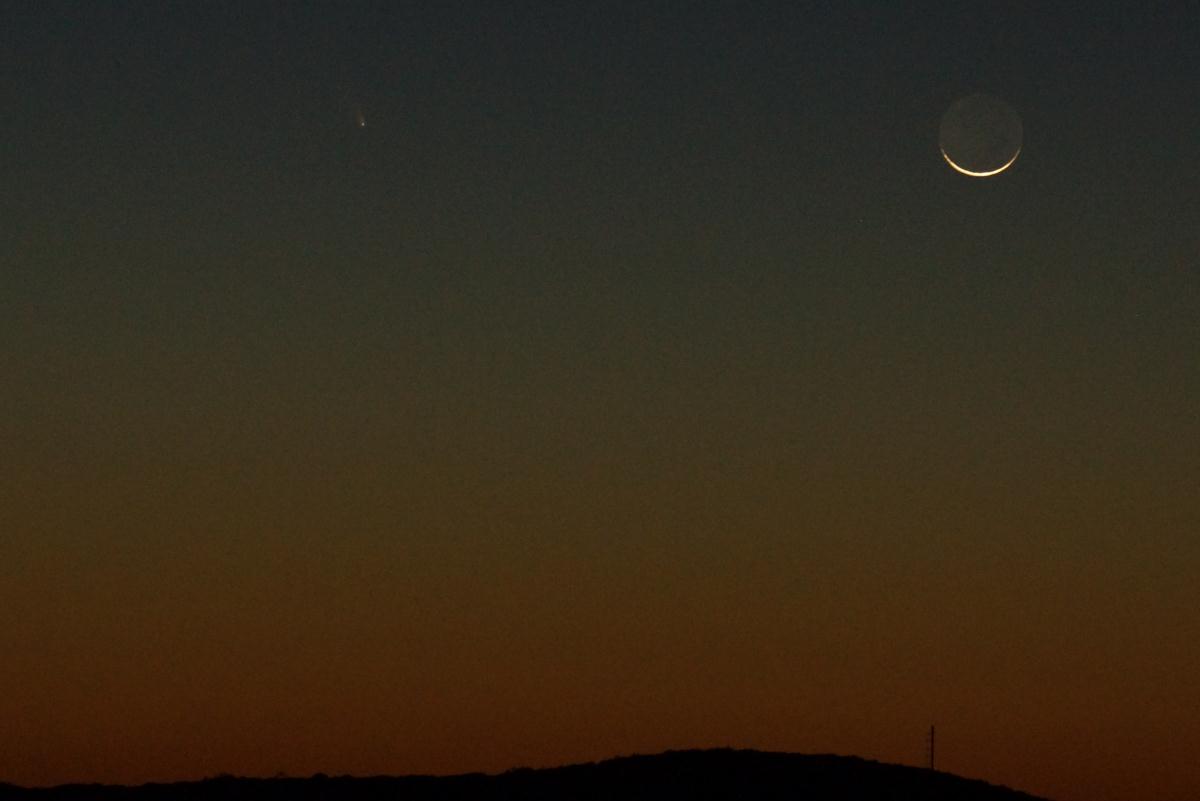
Comet PanSTARRS and the crescent moon loom over a mountaintop row of wind turbines near Mojave, Calif., on Tuesday night. The pairing of the comet and the moon made for one of the year's best opportunities for astrophotography.
By Alan Boyle, Science Editor, NBC News

Two elusive superstars came out on Tuesday evening to greet their adoring fans — in L.A. and Vegas, as well as in California's Mojave Desert and the mountaintops of Arizona and California. As a matter of fact, observers around the world could catch a glimpse of Comet PanSTARRS and the barely lit crescent moon, as long as the skies were clear.

Like most superstars, Comet PanSTARRS doesn't always live up to its advance billing. For months, skywatchers have been looking forward to PanSTARRS as one of the top sights in the night sky. The long-period comet is now thought to be at its brightest, due to the fact that it has just come out of its close approach to the sun. But finding it has proved more difficult than expected, because it's so easily lost in the glare of sunset.

XCOR Aerospace's Mike Massee acknowledged that it wasn't easy to capture his comet shot, which was taken in the last light of dusk from the Mojave Air and Space Port in California, where the XCOR rocket venture has its headquarters.

"At 7:20, neither the moon nor the comet were visible, but about five minutes later you could barely make out the sliver of the new moon. According to XCOR's resident astronomy guru, Randall Clague, the comet would appear about eight moon diameters to the left of the moon. So I set up an image with the moon on the right side of the frame and made some exposures," Massee said in an email.
"After a few minutes I could zoom in and see the comet in my camera, but not with the naked eye," he wrote. "As the sky grew darker the comet became more and more visible, and eventually you could just make out a fuzzy spot with your naked eye, but the camera was still the best way to review it after the shot was taken."
Over the next couple of weeks, Comet PanSTARRS will be better positioned for viewing by Northern Hemisphere observers in the western sky after sunset, but each night it's expected to grow dimmer. If there are clear evening skies, grab your binoculars and try to pick out PanSTARRS. This viewing guide can help.
While you're waiting for those dark, clear skies, check out this photo album, which includes a special shout-out to the Mount Lemmon SkyCenter's Adam Block and all those who contributed through NBC News' FirstPerson photo-upload website


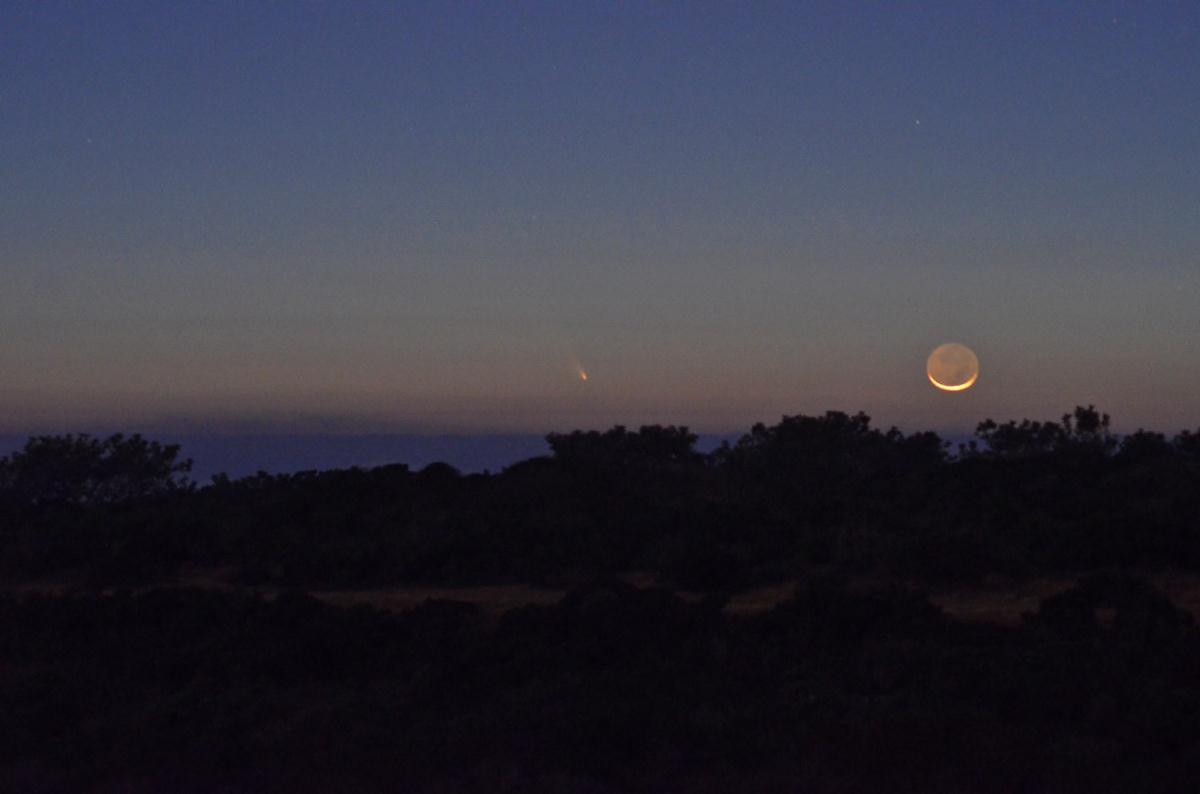
Adam Block
The sunset glow lingers in the skies over Mount Lemmon SkyCenter in Arizona as Comet PanSTARRS and the crescent moon shine on Tuesday night. Even the dark portion of the moon glows faintly, due to reflected "Earthshine" from our own planet.


Gene Blevins / Reuters
David Schaefer of Pasadena, Calif., uses an iPad to help him spot Comet PanSTARRS over Southern California. The comet should be visible from the Northern Hemisphere until the end of March in western skies after sunset.


Gene Blevins / Reuters
Comet PanSTARRS takes its place next to the waxing crescent moon in the skies over Los Angeles on Tuesday.


Craig Yacks via FirstPerson
Craig Yacks says he took this photo of Comet PanSTARRS (left) and the moon (right) from Highlands Ranch, Colo., "as the clouds opened up just after sunset." The photo was taken with a Nikon D800 camera, set for ISO 1000 with a four-second exposure. "Zoomed in to give a better view of the comet and the moon," Yacks said.

Slideshow: Catch the coolest comets in the cosmos


Cast your eyes on pictures featuring PanSTARRS, Hale-Bopp and other crowd-pleasing comets.


More PanSTARRS photos from FirstPerson fans:
Robert Schmidt from Newport News, Va.: "Comet PanSTARRS over the James River in Newport News. ... Spotty cloud cover made spotting the comet a bit difficult."
John Melson from San Marcos, Calif.: "Comet PanSTARRS and the moon ... from Double Peak Park in San Marcos, taken with a Sony A77 at 7:43 p.m."
Sergei Timofeevski from Carlsbad, Calif.: "Comet PanSTARRS next to young moon over the Pacific Ocean, San Diego, Torrey Pines State Natural Reserve, March 12, Nikon D7000, 110mm, f5.6, 8-second exposure, ISO 3200."
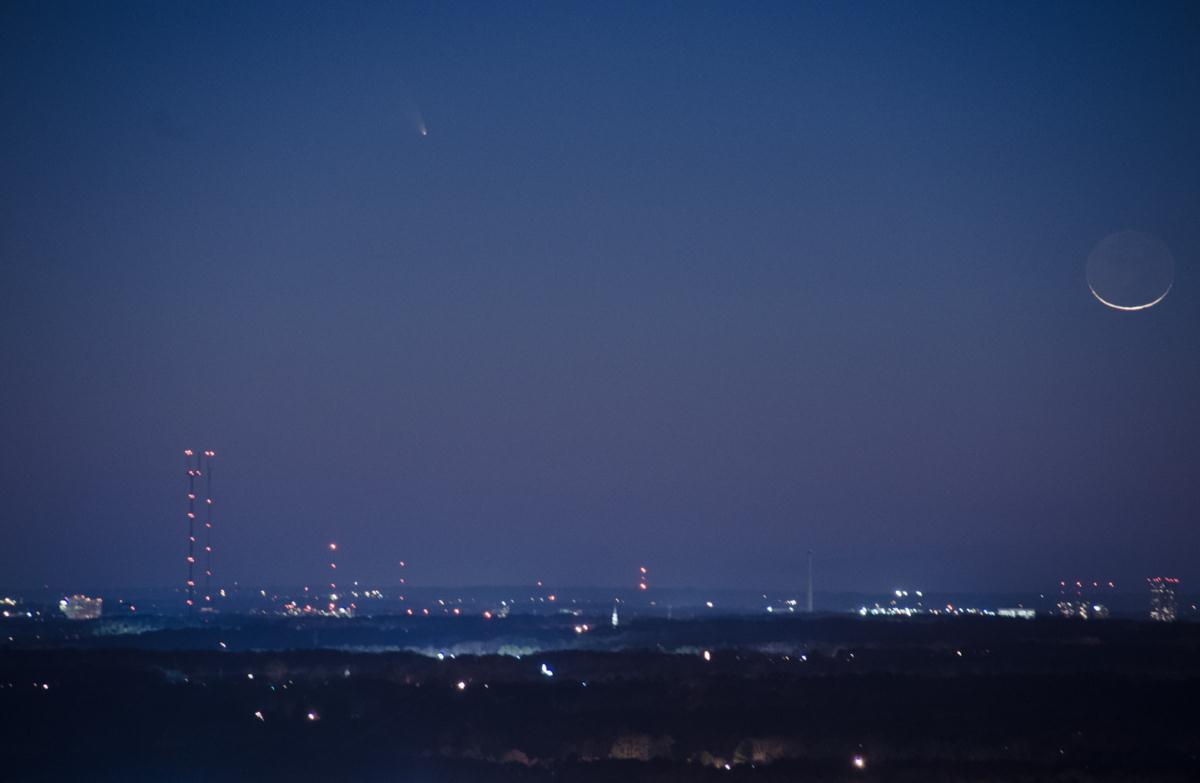
Richard Dervan, Atlanta, Ga.: "PanSTARRS over midtown Atlanta."
Kathy Newman, Rosamond, Calif.: "PanSTARRS and crescent moon."
Michael Wood, Honolulu, Hawaii: "Comet PanSTARRS over Joint Base Pearl Harbor-Hickam, Oahu, Hawaii."

White smoke pours from the Sistine Chapel signaling a pope has been chosen


FIRST LATIN AMERICAN


Image: Newly elected Pope Francis I appears on the central balcony of St Peter's Basilica.


AP

Cardinal Jorge Mario Bergoglio

Jorge Mario Bergoglio: The archbishop of Buenos Aires is the Argentine-born son of an Italian railway worker. Seen as a compassionate conservative, he reportedly came in second during the 2005 balloting that ultimately elected Benedict XVI. The 76-year-old Jesuit prizes simplicity and humility and would encourage priests to do shoe-leather evangelization, his biographer says.


White smoke rises from Sistine Chapel; new pope elected
 
It has been an hour since the white smoke flowed.
By Alastair Jamieson, Staff writer, NBC News

Cheers, shouts and applause erupted from the soaked crowd that had gathered in St Peter's Square despite torrential rain to await the decision of the 115 cardinal-electors.

The smoke came on the second day of behind-closed-doors voting and marked the beginning to a new era for a church combating scandal and internal strife.


The name of the new leader of the church's 1.2 billion worshippers was expected to be unveiled imminently on the balcony of St Peter's Basilica overlooking St. Peter's Square.

His appearance will be heralded by a Latin announcement begins with the phrase "Habemus Papam!" meaning, "We have a pope!"
The papal election follows the abdication of Pope Benedict XVI on Feb. 28.
Now known as the Pope Emeritus, he is now in a temporary lakeside residence at Castel Gandolfo while his permanent living quarters inside Vatican City are refurbished.

NBC's Keir Simmons takes a look at the nerve center of TODAY in Vatican City as Catholics around the world wait with bated breath to see the white smoke signaling a new pope has been selected.

The behind-the-scenes ballot process that has taken place in the Sistine Chapel should still remain a secret. Both the cardinals and staff working alongside them swore an oath of secrecy as the conclave got underway, with the threat of ex-communication for anyone breaking the church's ancient code.

Earlier, cardinals took a lunch break after failing to reach a decision after their morning deliberations.

“We feel the world watching at this exciting time for the church,” said Father Peter Verity, English priest and spiritual director of Rome’s Beda College, in his homily at Mass at the Basilica of St Paul Outside the Wall early Wednesday.

'Hairs standing on end'Among the dawn worshippers in the congregation were visiting pilgrims Julie Knight, 50, from Indianapolis, and her husband Karl.

“There’s a real sense of occasion in the city,” she said. “I can feel my hairs standing on end, it’s an incredible feeling.”

The smoke was created by the burning of ballot papers used by the cardinals in their deciding vote, with chemical cartridges being added to ensure the smoke appears either black or white.

At a news conference during the cardinals’ lunch break, Reverend Thomas Roscia, a Vatican spokesman, explained that five cartridges of mixed chemicals were released over a seven-minute period to alter the color of the smoke.

A mixture of potassium perchlorate, anthracene, and sulphur were added for black while a mixture of potassium chlorate, lactose and pine resin were added for white.

On purpose and by chance, Americans join crowd in St. Peter's Square to watch for signs of a newly elected pope.
Amid laughter, Rosica urged reporters to check the details. “I don’t study this stuff,” he said, “I study the Bible.”
Roscia also gave reporters a personal account of the atmosphere inside the Sistine Chapel before the conclave began.

“I realized this was no longer a movie,” he said. “I had chills going up my spine. As I looked at the cardinals gathered there, I saw not just their faces, but their nations. It was much bigger than I ever imagined.”
The word "conclave" comes from the Latin meaning "with key". It is a church tradition that began in 1268 when local officials became so fed up with the lack of a decision among cardinals — they had deliberated for more than two years — that they locked them away with limited food and water to encourage a result.

Such is the importance of secrecy that Vatican officials have installed jamming devices to prevent the use of cellphones by cardinals or hidden microphones by anyone wanting to hear their deliberations.


First question for new popes: 'By which name do you wish to be called?' 


Reuters; Hulton Archive/Getty Images
Left, Pope Benedict XVI blesses the faithful for the last time. Right, his namesake Pope Benedict XV, circa 1915.

By Erin McClam, Staff Writer, NBC New

The first clue about what kind of leader the next pope will be — liberal or conservative, reformer or by-the-book — will come only minutes after the smoke clears at the Sistine Chapel.

From a balcony at St. Peter’s Basilica, the world will learn not just who has been elected but what he chooses to call himself, a decision steeped in centuries of church history — and a good indicator of the new pope’s vision and inspiration.

Until the sixth century, popes went by their given names. There was a Pope Sylvester, a Pope Julius and a Pope Victor. Then, in 533, a priest named Mercurius was elected to lead the church and decided that a pope named after a pagan god — "Mercury" — just wouldn’t do.

He chose to go by John II. Since then, most popes have abandoned their birth names and adopted tributes to saints, popes and even relatives who have gone before.

“You’re trying to pick up some of the glow of your predecessor,” said the Rev. Thomas Reese, Vatican analyst for the National Catholic Reporter.
It is a solemn decision. Newly-elected popes are asked only two questions by the senior cardinal inside the chapel. The first is whether he wants the job. The second: “By which name do you wish to be called?”

The 115 cardinals were back behind closed doors this morning for two more unsuccessful secret votes to select who among them will be the new leader of the Catholic church. NBC's Lester Holt and Keir Simmons report.

When Cardinal Joseph Ratzinger was elected pope, in 2005, he chose Benedict XVI as a tribute to two men. One was the previous Pope Benedict, who guided the church through World War I. But Benedict XVI said that he also meant the choice as homage to St. Benedict, an intellectual like Ratzinger and one of the patron saints of Europe, for his “powerful call to the irrefutable Christian roots of European culture and civilization.”

In particular, Benedict XVI prayed to his saintly namesake to help Catholics keep Christ at the center of their lives.

“Benedict saw Europe as the key problem and the place where we really needed to focus,” Reese said.

But the choice is not always a nod to papal history. The reformer Pope John XXIII, elected in 1958, said he picked the name it part because it was the name of the small parish church where he was baptized. John is by far the most popular name for a pope to choose, making it difficult to predict what a John XXIV would be signaling by taking the name.

In 1978, Cardinal Albino Luciani declared himself Pope John Paul I, the first pope to choose a double name — and the first to declare himself “the First.”

On purpose and by chance, Americans join crowd in St. Peter's Square to watch for signs of a newly elected Pope.

He said that he meant the name as a tribute to his two immediate predecessors, John XXIII and Paul VI. They had led the church through the Second Vatican Council, which modernized the church’s relationships with the rest of the world and other branches of Christianity.

When John Paul I died just 33 days later, he was remembered so adoringly that Reese recalls making a bet with a colleague that the next pope would take the same double name.
“He just caught everybody’s imagination,” Reese said. “This smiling pope. It was just a whole month of very positive response to him.”


He won the bet, and Pope John Paul II led the church for the next 27 years.
This time around, only one bet would be a sure loser. No pope has chosen to be called Peter II. There’s no rule against it, but it is seen as poor form — an honor reserved for the first pope.

Church analysts say there are several names to watch for as hints to the new papacy.

The choice of Leo XIV could be a call for social justice, said Matthew Bunson, senior correspondent for the Catholic publishing nonprofit Our Sunday Visitor. Leo XIII, who served at the turn of the 20th century, and sought to help the world understand the dignity of workers.

Choosing Pius XIII, on the other hand, would be a more conservative choice, and a “statement of determination to defend the teachings of the faith,” Bunson said. Pius V led in opposition to the Protestant Reformation, and Pius VI and VII both died prisoners.

One-third of Americans who grew up in the Catholic Church have left, but the percentage of U.S. Catholics has held steady at 25 percent, largely because of Hispanic immigrants. NBC's Lester Holt reports.

John Paul III, even if only as a tribute to the beloved, globetrotting John Paul II, might be seen by the world as a repudiation of Benedict, Reese said.

Of course, the new pope could always choose to be called Benedict XVII — certainly a possibility because Benedict XVI appointed most of the cardinals who will choose his successor. But such a selection might disappoint Catholics who are hoping for a reformer after a papacy marked by a sexual abuse scandal, other missteps and shrinking membership in the United States and Europe.


Beyond that, it’s anyone’s guess. The new pope could choose to make his mark and choose a name never used before. Reese said he has always wondered why no one has adopted the name Pope Joseph.

Or he could set 1.2 billion Catholics around the world scratching their heads.

“The new guy,” Reese said, “could be John Paul Benedict I.”


Andrew Medichini / AP
Cardinals from around the world gather in the Vatican to elect the next leader of the Roman Catholic Church.


Florida Lt. Gov. resigns amid gambling scandal, racketeering probe 

By Domenico Montanaro, Deputy Political Editor, NBC News

Florida’s embattled Lt. Gov. Jennifer Carroll (R), the first African American elected statewide and first woman to serve as lieutenant governor, has resigned amid a gambling, racketeering, and conflict-of-interest scandal.

“Effective immediately, I hereby resign the Office of Lieutenant Governor of the State of Florida. It has been an honor to have served the State of Florida in this capacity,” Carroll wrote in a brief letterto Gov. Rick Scott (R).
Carroll had been seen as a rising Republican star before a rash of bad headlines. She served as one of the national chairmen for 2012 Republican nominee Mitt Romney's “Black Leadership Council" with ex-Rep. Allen West (R-FL) and now-Sen. Tim Scott (R-SC).

Both West and Scott are featured speakers at CPAC 2013, which kicks off tomorrow in the Washington area. Carroll spoke at CPAC Florida in 2011, but was not invited to the national conference this year.

The Tampa Bay Times:
“Tuesday she was interviewed by the Florida Department of Law Enforcement, who is assisting in a national probe of Allied Veterans of the World, a Florida-based non-profit that operates a chain of internet cafes. Carroll once owned a public relations firm that represented Allied Veterans, and she did work for the company at the same time she served in the Florida House. Scott will address the media after an afternoon press conference on the matter conducted by law enforcement.”

The Florida Times-Union:
"The resignation comes two days after Florida Law Enforcement officers interviewed Carroll about her involvement with Allied Veterans of the World, a non-profit that operates internet cafes in Florida. Officials from Allied Veterans and Nelson Cuba, the president of the Jacksonville Florida Order of Police, were arrested on racketeering charges after an investigation by the IRS and Secret Service. ...

"Rick Scott tapped Carroll, a Navy veteran, to be his running mate during a 2010 news conference outside Jacksonville Naval Air Station. Allied Veterans is accused of money laundering, using money from a nonprofit for personal gain and misrepresenting the amount donated to charities. Authorities say the group donated just 2 percent of its $290 million in proceeds to charities over about five years. They also say the former president received more than $1.5 million and the national commander got $250,000 from the organization. A firm Carroll owned, 3N & JC, did consulting work for Allied Veterans, and she starred in a commercial for the nonprofit in 2010. ...
"In 2011, the Times-Union reported that Carroll used falsified documents to make her firm eligible for a Jacksonville program that offers grants to minority-owned companies. Her firm was located in Clay County, but relied, in part, on falsified lease documents to appear based in Jacksonville, which was a program requirement. Additionally, former Carroll aide Carletha Cole was arrested after being charged with giving a reporter a recording of a secret conversation between her and Carroll’s chief-of-staff. The case has brought a lot of unwanted attention to the Scott administration. In court filings, Cole has accused Carroll of having an inappropriate relationship with another female staff member."

Scott's office confirmed both stories to First Read.

Where all 50 states stand on abortion, in two charts

Posted by Sean Sullivan on March 7, 2013 at 2:21 pm

Arkansas lawmakers overrode a gubernatorial veto on Wednesday to approve the nation’s most restrictive abortion law, banning (with some exceptions) abortions after the twelfth week of pregnancy. Opponents have vowed to challenge the law, so its ultimate fate remains to be decided.

So how does Arkansas’s new law stack up against restrictions in the other 49 states? The following chart, from a report published earlier this month by the Guttmacher Institute, a reproductive health research organization that started as an arm of Planned Parenthood, provides some answers. (Click inside the chart for a larger version.) Forty states have prohibitions based on a specified stage of pregnancy, none of which are as restrictive as the law Arkansas just adopted:


The next chart — click on it to go to a larger interactive version – from Remapping Debate, which our friends over at Wonkblog flagged in January, is a useful visual representation of which states have the most abortion restrictions in place. Each color represents a different restriction category. On one end lies Oklahoma, which has many restrictions; on the other, Oregon, which has none. (The data in this chart is primarily sourced to the Guttmacher Institute).

Dozens of new state limits on abortions added in 2012
Map & Data Resources | ByMike Alberti | Reproductive health services

There are charts to look at and interact with. 
Jan. 30, 2013 — Though the Supreme Court’s landmark decision in Roe v. Wade affirming a woman’s right to choose to have an abortion remains the law of the land, states enacted more restrictions on abortion in 2011 and 2012 than in any other years since Roe was decided four decades ago.

Updating our work from 2011, Remapping Debate has collected information from various sources on all of the many restrictions on abortion that have been legislated by individual states. We classified those restrictions into ten categories, ranging from state-imposed limitations on the ability of private insurance plans to cover abortions to requirements that the parents of minors be involved in their daughter’s decision to have an abortion. New to this update are a count of near-total bans on abortion that would become operative if Roe were overturned, as well as a count of the limitations on public financing of abortions.

We visualized that data in three graphs. The resulting picture is of an increasingly burdensome set of restrictions on access in numerous states. There may a nationally-guaranteed right to abortion, but real access is strongly influenced by the state where a woman happens to live. Oklahoma, for example, has 22 separate provisions restricting women’s access to abortion, while Oregon has none.

The primary source of our data is the Guttmacher Institute, a research group in Washington, D.C. and New York. According to Elizabeth Nash, the state issues manager there, while states in the Midwest and South have long had many laws limiting abortion access, the last decade has seen an explosion in such restrictions even in states that were previously supportive of abortion rights, such as Arizona. According to her research, one-third of women in 2000 lived in a state that was openly hostile to abortion. By 2011, that figure had jumped to half.

“What we’ve seen over time is a wholesale change in the abortion landscape,” Nash said. “Particularly in the last two years, we have just seen a tidal wave of restrictions rolling across the country.”

According to Nash, 92 new restrictions were enacted in 2011 and 43 were enacted in 2012, the highest and second-highest number of annual restrictions ever.

In particular, Nash said, many states have recently passed laws requiring physicians to be in the physical presence of the patient when prescribing mifespristone — a pharmaceutical drug that induces an abortion at a very early stage of pregnancy — effectively prohibiting doctors from prescribing the medication over the telephone and reducing access to abortion in rural areas. Onerous regulatory restrictions placed specifically on abortion providers (TRAP laws), bans on the coverage of abortionby health insurance policies that will be offered through state exchanges beginning next year as part of the Affordable Care Act, and laws requiring abortion providers to perform ultrasounds and show the image of the fetus to their patients before the procedure have also been common in the last two years, Nash said.

“None of these restrictions are based on scientific evidence concerning what is best for the health of the woman,” Nash said. “The kinds of restrictions we see being passed are meant to make it more difficult for providers to perform abortions and more emotionally difficult for women to choose them.”

The chart below is organized simply by the total number of abortion restrictions in a state (coded by category, with more than one restrictive provision possible in each category).

On page 2, we present a tool by which the user can assign relative weights to the different categories of abortion restriction. Note that in this second visualization, each separate provision within a category is assigned the weight, thus potentially underweighting a category with a single, specific restriction that the user believes has significant impact.

On page 3, by contrast, we present a tool by which the relative weight is assigned only to the category. Thus, in this last visualization, there is the possibility that the impact of one state that has just begun to put in place various restrictions within a category will be treated equally to a state that has numerous restrictions within that category.

Please review our other notes on sources and methodology.

Primary data gathering for the originally-published visualization was performed by Althea Webber.
The ’47% tape’ and the man who revealed the real Mitt Romney


The bartender who recorded Mitt Romney’s infamous 47% remarks at a fundraising dinner during the presidential campaign has come out of the shadows to talk about the recording that changed the course of the 2012 campaign.

“How big a decision was it for you to release the tape and to go through all of this,” Ed asked the videographer, whose identity will be revealed on-air Wednesday.

“It was tough,” he said. “And I debated for a little while, but in the end I really felt it had to be put out. I felt I owed it to the people who couldn’t afford to be there themselves to hear what he really thought.”

He went on to say:


“I simply wanted [Romney's] words to go out. And everybody could make a judgement based on his words and his words alone. The guy was running for the presidency and these were his core beliefs. And I think everybody can judge whether that’s appropriate or not or whether they believe the same way he does. I felt an obligation to expose the things he was saying.”
“Has there been any time where you feared for your life?” Ed asked.

“I was up against the most powerful, the richest people in the country and the stakes were pretty high and you never know what could happen,” said the man who shot the 47% video. “There’s nuts out there. You just don’t know. I’ve certainly had threats.”


For his part, Romney celebrated his 66th birthday Tuesday and is expected to speak at the Conservative Political Action Conference (CPAC) later in the week.

But no matter what Romney does for the rest of his public life, he will probably always be remembered for the 47% video secretly shot at a fundraising dinner in May 2012.

At the dinner, Romney said what he really thinks about 47% of Americans: They believe they are victims and they depend on the government. He also said it’s not his job to worry about these people:


“There are 47% of the people who will vote for the president no matter what. All right, there are 47% who are with him, who are dependent upon government, who believe that they are victims, who believe the government has a responsibility to care for them, who believe that they are entitled to health care, to food, to housing, to you-name-it. That’s an entitlement. The government should give it to them. And they will vote for this president no matter what. And I mean the president starts off with 48, 49…he starts off with a huge number. These are people who pay no income tax. Forty-seven percent of Americans pay no income tax. So our message of low taxes doesn’t connect. So he’ll be out there talking about tax cuts for the rich. … My job is not to worry about those people. I’ll never convince them they should take personal responsibility and care for their lives. What I have to do is convince the 5–10% in the center that are independents, that are thoughtful, that look at voting one way or the other depending upon in some cases emotion, whether they like the guy or not.”