Pages

Thursday, March 7, 2013

Hugo Chavez's last words: 'Please don't let me die,' general says

Tens of thousands of people wept openly in the streets of Caracas over the death of their "Commandante," President Hugo Chavez, while exiled Venezuelans in the U.S. cheered after learning of the socialist leader died.

By Fabiola Sanchez, The Associated Press
CARACAS, Venezuela - President Hugo Chavez died of a massive heart attack and inaudibly mouthed his desire to live, the head of Venezuela's presidential guard said late Wednesday.

"He couldn't speak but he said it with his lips ... 'I don't want to die. Please don't let me die,' because he loved his country, he sacrificed himself for his country," Gen. Jose Ornella told The Associated Press.

The general said he spent the last two years with Chavez, including his final moments, as Venezuela's president of 14 years battled an unspecified cancer in the pelvic region.

Ornella spoke to the AP outside the military academy where Chavez's body lay in state. He said Chavez's cancer was very advanced when death came but gave no details.

Ornella did not respond when asked if the cancer had spread to Chavez's lungs.

Slideshow: Hugo Chavez: 1954 - 2013

Ricardo Mazalan / AP
Supporters of Venezuelan President Hugo Chavez across the Americas mourn his death.
The government announced on the eve of Chavez's death that he had suffered a severe new respiratory infection. It was the second such infection reported by officials after Chavez underwent his fourth cancer surgery in Cuba on Dec. 11.

Venezuelan authorities have not said what kind of cancer Chavez had or specified exactly where tumors were removed.
During the first lung infection, near the end of December, doctors implanted a tracheal tube to ease Chavez's breathing, but breathing insufficiency persisted and worsened, the government said.


'He suffered a lot'Ornella said that Chavez had "the best" doctors from all over the world but that they never discussed the president's condition in front of him.

The general said he didn't know precisely what kind of cancer afflicted Chavez, but added: "He suffered a lot."

He said that Chavez knew when he spoke to Venezuelans on Dec. 8, three days before his final surgery in Cuba, that "there was very little hope he would make it out of that operation."
It was Chavez's fourth cancer surgery and previous interventions had been followed by chemotherapy and radiation.

Ornella echoed the concern of Vice President Nicolas Maduro that some sort of foul play was involved in Chavez's cancer.

Venezuelan government via EPA, file

The last pictures of Hugo Chavez made publicly available were taken on Feb. 14.

"I think it will be 50 years before they declassify a document (that) I think (will show) the hand of the enemy is involved," he said.

The general didn't identify who he was talking about, but Maduro suggested possible U.S. involvement on Tuesday. The U.S. State Department called the allegation absurd.
Maduro, Chavez's self-anointed successor, said Chavez died Tuesday afternoon in a Caracas military hospital.

The government said Chavez, 58, had been there since returning from Cuba on Feb. 18.

Sen. Chris Murphy Asks NASCAR to Reconsider NRA 500


By LeAnne Gendreau
| Thursday, Mar 7, 2013 | Updated 11:36 AM EST


Texas Motor Speedway

The deal Texas Motor Speedway and the National Rifle Association reached to call next month's race the NRA 500 is not sitting well with U.S. Sen. Chris Murphy.

Murphy, who has been at the forefront of the national discussion on gun violence prevention in the wake of the school shooting at Sandy Hook Elementary School in Newtown in December, is asking NASCAR to reconsider.

The Connecticut senator sent a letter to Brian France, chairman and CEO of the National Association of Stock Car Auto Racing on Thursday, urging him to reconsider the financial agreement that makes the NRA the title sponsor of the NASCAR Sprint Cup Series race on April 13 in Texas.

“After the horrific mass shooting in Newtown, Connecticut, which claimed the lives of 20 children and six educators, the NRA has taken an unprecedented extreme position in the debate over the proper response to this tragedy, placing themselves at odds with the overwhelming majority of the American people, and even their own members,” Murphy wrote in the letter. “Given the emotional state of the national conversation, I believe it would be imprudent for NASCAR to step into such a heated political debate and take sides in this debate by allowing the NRA the title role in the race.”

This race comes just weeks after NASCAR honored Sandy Hook during the Daytona 500 with a green and white 26 car decorated with a green Sandy Hook ribbon and instructions on how to donate to the Sandy Hook Support Fund.

"It's not about politics. It's about sports marketing," Texas Motor Speedway president Eddie Gossage told The Associated Press on Monday.

NASCAR said in a statement on Monday that "race entitlement partnerships" are agreements directly between the track and the sponsor though NASCAR reserves the right to approve or disapprove those sponsorships.

"The race sponsor for Texas Motor Speedway's April event falls within the guidelines for approval for that event," NASCAR's statement said.

But Murphy is hoping NASCAR reconsiders.

“In light of your extensive charitable work and generosity to the Newtown community, I hope that you will reconsider affiliating with the NRA at this time,” Murphy wrote.

Wayne LaPierre, the NRA's executive vice president and CEO, said he was excited about the deal in a video message played during the track's media day.
This is Murphy’s full letter to France:
Dear Mr. France,
On Monday, it was reported that NASCAR and the Texas Motor Speedway had just completed a deal to make the National Rifle Association (NRA) the title sponsor of a NASCAR Sprint Cup Series race on April 13th—the NRA 500. As a U.S Senator representing the community of Newtown, Connecticut, I write to you today to ask that you reconsider this decision.
After the horrific mass shooting in Newtown, Connecticut, which claimed the lives of 20 children and six educators, the NRA has taken an unprecedented extreme position in the debate over the proper response to this tragedy, placing themselves at odds with the overwhelming majority of the American people, and even their own members. Given the emotional state of the national conversation, I believe it would be imprudent for NASCAR to step into such a heated political debate and take sides in this debate by allowing the NRA the title role in the race.
NASCAR has a long history of supporting our troops, our children, and our communities, and your racing events attract fans from across Connecticut and the country. I also know how deep your own commitment to the Newtown community runs—your donation of $50,000 to Sandy Hook School Support Fund is the very example of NASCAR’s commitment to community. And less than two weeks ago, one of the cars at the Daytona 500 advertised a way to donate money for the Newtown community, and was dubbed #26 for the number of lives lost on December 14th.
But by giving the NRA sponsorship of a major NASCAR race, NASCAR has crossed a line – you have decided to put yourself in the middle of a political debate, and you have taken a side that stands in opposition to the wishes of so many Newtown families who support common sense gun reform. Whether or not this was your intention, your fans will infer from this sponsorship that NASCAR and the NRA are allies in the current legislative debate over gun violence. By announcing this new partnership at the very height of Congress’s deliberations over gun reform, NASCAR has inserted itself into a political debate that has nothing to with the business of NASCAR. To me, this seems an unwise break with precedent.
This tragic event has led many individuals and organizations to re-evaluate their views towards guns. Millions of Americans, including responsible gun owners, have resolved that our nation must do more to protect our children and citizens from gun violence. Reasonable measures that are being considered in Washington have widespread support. Consider that 92 percent of Americans, 91 percent of gun owners and 74 percent of NRA members support proposals to require background checks for all gun purchases. Yet, instead of playing a constructive role in this debate, the Washington-based leadership of the NRA has become more radicalized. For example, in 1999, after the horrific shooting at Columbine High School, NRA Executive Vice President Wayne LaPierre gave a full-throated endorsement of universal background checks. Yet, after Newtown, the NRA reversed their position, testifying recently before the Senate Judiciary Committee and the organization now opposes this proposal.

Furthermore, over the past two months my office has released a series of reports looking at the NRA, its sources of funding and its agenda on the state and federal levels. The findings may surprise you and make you reconsider their sponsorship. The NRA increasingly relies on support from the firearms industry, including manufacturers of military-style assault weapons that have been used at Newtown and other mass shootings. The NRA also pushes an extreme agenda in state capitols across our nation. Defying common sense the association has backed laws that allow gun owners to bring concealed weapons into bars, restaurants and sports stadiums. In possibly the most egregious example, the NRA supported an Indiana law that proscribed when an individual can use force, including deadly force, against a police officer.

NASCAR has historically been careful not to insert itself, and its hard-earned good reputation, into political and legislative fights. Why then, start now? Why take sides against the families of Newtown, Connecticut, by teaming up with the NRA in the middle of an intense legislative fight over gun laws?
In light of your extensive charitable work and generosity to the Newtown community, I hope that you will reconsider affiliating with the NRA at this time. Thank you in advance for your consideration.
Sincerely,

Christopher S. MurphyUnited States Senator
Will Catholics embrace change? The view from one parish in Rome


Keir Simmons / NBC News
Built in the 1970s, Rome's Our Lady of Guadalupe brings together a community of elderly and young families.

By Keir Simmons, Correspondent, NBC News

ROME -- Only a couple of miles from the Vatican, Our Lady of Guadalupe is a parish church much like thousands of others around the world.

Yet even in this relatively small congregation there are examples of division between those who want to look to the future and others who hope to hold on to the past – a rift that is reflected right the way up to the College of Cardinals gathering this week to choose the new pope.

Built in the 1970s, Our Lady of Guadalupe brings together a community of elderly and young families. During Mass, children sit at the front so that the priest can speak directly to them. The young generation is the center of the congregation.

Asked what he wants from the next pope, parishioner Dario Appetiti holds his wife's hand and gently rocks the buggy in which his 14 month old son, Lorenzo is resting.
“I think it's important that he will be able to reach the young people,” he says.

Many of the older members of this local church agree, but they aren't sure that the church should modernize too fast.

“I think it's tough because they're used to the pope waiting until he passes away,” says Father Brian Coe, a priest from Annapolis, Md., who is working at Our Lady of Guadalupe as part of his introduction to priesthood.
He explains that he sees wisdom in Pope Benedict XVI’s decision to abdicate, but that for older Italians it was a break from tradition that was hard to comprehend.

“Many Italians would like to see another Italian pope,” Coe says. But some of the cardinals who have arrived from around the world are hoping to look beyond Europe.

'Change must come'The church's name comes from a celebrated icon of the Virgin Mary found in Mexico City. Some believe a pope from Latin America, Africa or Asia would help the church usher in a new era.

“No matter who it is, these people will follow him, because they believe he is the vicar of Christ,” says Father Dermot Ryan, an Irish priest who also preaches at Our Lady of Guadalupe.

Slideshow: Pope Benedict XVI's departure


The pope delivers his final audience in St. Peter's Square as he prepares to stand down.
He is a traditionalist but says change is inevitable. “There will be changes and certainly, as in all institutions, I think change must come,” he says.

One reason there must be change, he recognizes, is the sex-abuse scandals that have rocked the church. “It's very sad to see what has happened.” As a younger priest he thought the abuse was “just rumors”. But now “all this blows up and I realize it wasn't just rumors,” Ryan says.

“Many other storms have hit the church in other centuries. This is one storm that has hit now, and I think we're pulling through, we're getting out of it. There are so many good faithful people working in the church for the good of all.”

With more than a billion followers worldwide, different views within the Catholic Church are inevitable – and are reflected within the College of Cardinals whose discussions this week in Rome are already shaping the outcome of the yet-to-be announced papal conclave.

“I can imagine these meetings getting a bit chippy, challenging, interesting... hard-hitting at certain points," said George Weigel, NBC News' Vatican analyst.

But even the smallest congregations agree on what is important, according to Ryan. “Simple people who believe and come to Mass ... they want to reach out for the weak, to listen to words of God.”


Related:

Riots, revenge, rigging: A history of papal conclaves

American cardinals fall silent amid Vatican concern at media leaks

Full coverage of the papal abdication from NBC News

FACT SHEET: UN Security Council Resolution 2094 on North Korea


U.S. Mission to the United Nations
New York, NY
March 7, 2013


FOR IMMEDIATE RELEASE

The UN Security Council today unanimously adopted a resolution to impose additional sanctions on North Korea in response to that country's February 12th announcement of a nuclear test. This resolution, the fifth since 2006, builds upon, strengthens and significantly expands the scope of the strong sanctions regime already in place. The Security Council's adoption of this resolution shows that the international community is united in its condemnation of North Korea's nuclear and ballistic missile programs and continued violation of UN Security Council resolutions.

The new sanctions contained in this resolution will significantly impede North Korea's ability to develop further its illicit nuclear and ballistic missile programs, as well as its proliferation activities. These strong sanctions -- in addition to the commitment to take additional measures in the event of a further launch or nuclear test -- demonstrate to North Korea that there are real costs for its continued violations of its international obligations.

2094 Highlights

· Condemns in the strongest terms North Korea's ongoing nuclear activities, including its uranium enrichment program, and reaffirms the obligation on North Korea to abandon all existing nuclear, other weapons of mass destruction and ballistic missile programs.

· Imposes new financial sanctions to block financial transactions in support of illicit DPRK activity, crack down on bulk cash transfers, and further restrict ties to North Korea’s financial sector, if there is a link to illicit DPRK activity;

· Strengthens states’ authority to inspect suspicious cargo and deny port and over flight access to DPRK-affiliated shipments where warranted;

· Enables stronger enforcement of existing sanctions by UN Member States.

· Sanctions new individuals and entities;

· Adds new items to the Security Council sanctions list.

Financial Sanctions

· Requires states to freeze or block any financial transaction or financial service that could contribute to North Korea's illicit programs or the violation of Security Council resolutions.

· Calls on states to prohibit the opening of North Korean bank branches on their territories if there is a link to North Korea's illicit programs or the violation of Security Council resolutions.

· Calls on states to prohibit their financial institutions from opening offices in North Korea if there is a link to North Korea's illicit programs or the violation of Security Council resolutions.

· Determines that financial sanctions apply to bulk cash transfers, including through cash couriers (a common way that North Korea has moved illicit funds).

· Requires states not to provide public financial support for trade with North Korea (e.g., export credits or insurance) if there is a link to North Korea's illicit programs or the violation of Security Council resolutions.

· Urges states to implement guidance from the Financial Action Task Force (a multilateral organization) involving proliferation finance.

Interdiction

· Requires states to inspect cargo on their territories, if the state has reasonable grounds to believe the cargo contains prohibited items (e.g., conventional arms, nuclear- or ballistic missile-related items, etc.).

· Requires states to deny port access to any North Korean vessel that refuses to be inspected or any other vessel that has refused an inspection authorized by that vessel's flag state.

· Calls on states to deny permission to any aircraft to take off, land in or overfly their territory if the aircraft is suspected of transporting prohibited items.

· Prompts states to provide information to the Security Council's North Korea Sanctions Committee regarding activity by North Korean aircraft or vessels to evade sanctions (e.g., renaming, re-registering).

Other Measures

· Determines that existing sanctions prohibit brokering sales of prohibited items (e.g., conventional arms, nuclear- and ballistic missile-related items).

· Expands the scope of the existing asset freeze to cover the subsidiaries and front companies of entities that have already been designated for targeted sanctions.

· Requires states to prohibit the travel of any individual determined to be working for a designated individual or entity or who is violating existing sanctions. If the individual is North Korean, then States are required to expel him or her back to North Korea.

· Calls on states to exercise enhanced vigilance over North Korean diplomats to prevent them from contributing to North Korea's nuclear or ballistic missile-programs, engaging in other activities prohibited by Security Council resolutions or evading sanctions.

· Directs the Sanctions Committee to update annually the lists of nuclear and ballistic missile technology that is prohibited for transfer to or from North Korea.

· Calls on and authorizes states to prevent the transfer to or from North Korea of any item that could contribute to North Korea's nuclear or ballistic missile programs or any other violation of Security Council resolutions.

· Specifies that prohibited luxury goods are banned for transfer to North Korea, including certain kinds of jewelry and precious stones, yachts, luxury automobiles and racing cars.

Sanctions Implementation

· Calls on states to report to the Security Council within ninety days on steps taken to implement these sanctions and to supply information regarding sanctions violations.

· Directs the Sanctions Committee to respond to sanctions violations by imposing targeted sanctions on individuals and entities responsible for such violations.

· Renews the mandate of the UN's Panel of Experts (a sanctions monitoring team) and expands the size of the group from seven to eight members.

· Applies force majeure to enable states to enforce the sanctions without fear of being sued.

Political Track

· Reiterates the Security Council's commitment to a diplomatic solution, welcomes efforts by other states to facilitate such a solution through dialogue, and reaffirms support for the Six-Party Talks.

· Affirms that the Security Council will keep North Korea's actions under continuous review and will adjust the measures as appropriate.

· Expresses the Council's determination to take “further significant measures” in the event of another North Korean launch or nuclear test.

Annexes: Sanction Designations (Individuals, Entities, Items)

The resolution has four technical annexes that specify:

1. Nuclear, ballistic missile, and chemical weapons-related technology that will be banned for transfer to and from North Korea;

2. North Korean companies that will be subject to a freeze of their assets and banned from doing any further business internationally;

3. Individuals who will be subject to a travel ban and freeze of their assets;

4. Lists of specific luxury goods that are included in the ban on transfer to North Korea.

###


PRN: 2013/023

UN passes sanctions despite North Korea threat of 'pre-emptive nuclear attack'

The communist nation of North Korea threatened this morning to launch a pre-emptive strike, after accusing the United States of using military drills in South Korea as preparation for its own nuclear strike.

By F. Brinley Bruton and Ian Johnston, NBC News
The United Nations Security Council slapped new sanctions on North Korea over its latest nuclear test hours after Pyongyang threatened to exercise its "right to pre-emptive nuclear attack" Thursday.
"Now that the U.S. is set to light a fuse for a nuclear war, the revolutionary armed forces of the DPRK will exercise the right to a pre-emptive nuclear attack to destroy the strongholds of the aggressors and to defend the supreme interests of the country," the North's foreign ministry spokesman said in a statement carried by the official KCNA news agency. "The U.S. is massively deploying armed forces for aggression, including nuclear carrier task force and strategic bombers, enough to fight a nuclear war under the smokescreen of 'annual drills'."

Later on Thursday, the U.N. Security Council passed sanctions aimed at North Korea's financial transactions and illicit cargo shipments, and its criminal activities such as drugs and counterfeiting.
After the vote, Susan Rice, the U.S. ambassador to the United Nations, said that the "entire world stands united in our commitment to the de-nuclearization of the Korean peninsula and in our demand that North Korea complies with its international obligations."

U.S. Ambassador to the United Nations Susan Rice describes approved sanctions against North Korea relating to the country's latest nuclear test.
Asked about North Korea’s threat to carry out a pre-emptive nuclear attack, Rice said that it would "achieve nothing by continued threats and provocations," adding that such comments would "only further isolate" the country and its people.
The vote was passed unanimously by the 15 members of the Security Council, including China, the North's one major diplomatic ally.
China’s ambassador to the U.N., Li Baodong, said China hoped to see the resumption of diplomacy to try to reduce tensions.
"We need wisdom, we need persistence, perseverance, we need teamwork … to bring down the heat," Li said. "This is our focus."
South Korea’s envoy Kim Sook said North Korea choosing the wrong path could lead to its "self-destruction."
"We all have seen (today's) announcement coming out of Pyongyang, which is very hostile," he said.


KCNA via EPA
North Korean soldiers cheer during combat training at an undisclosed location on Wednesday.

Earlier, a spokesman for South Korea's defense ministry told Reuters that the military was "watching the North's activities and stepping up readiness."
Saber-rattling?On Wednesday, the South Korean military said it would strike back at North Koreaand target its top leadership if Pyongyang attacks.
Tensions have ratcheted higher across the Korean Peninsula since the North, under youthful leader Kim Jong Un who took office just over a year ago after the death of his father, launched a long-range rocket last December. He followed this with a third nuclear test on February 12. 
Earlier in the week, Pyongyang threatened to end the 60-year truce that ended the Korean war. 
Angus Walker, a Beijing-based correspondent with NBC News' partner ITV News, said the current consensus was that North Korea did not have a missile that was capable of carrying a nuclear warhead.
"There is always a lot of saber-rattling when the U.S. and South Korea stage large-scale military exercises," he said.

North Korea continues military drills and exercises in support of a top general's threat to back military action against South Korea and the United States. NBCNews.com's Dara Brown reports.

The North does have smaller missiles, as seen during military parades, and South Korea's capital Seoul is within artillery range.

While the North has in the past threatened to hit Seoul with a "rain of fire," claiming it can launch 250,000 artillery shells in an hour at the South Korean capital, the reality is that those artillery batteries could be destroyed very quickly, Walker said.

War-game scenarios have suggested that a war on the peninsula would be over quickly, with the North under U.S. and South Korean control within 24 hours, he said.

However, Walker suggested the nightmare scenarios are that the North could somehow get a truck-loaded device into the South or launch a "dirty bomb" in an artillery shell.
Earlier this week, the Korea Economic Institute warned that Pyongyang could "certainly inflict serious damage along the Southern side of the [demilitarized zone] in the event of a surprise attack" using artillery. 
It added:

Taken together, North Korea’s forward deployed long-range artillery could launch as many as 20,000 shells an hour at downtown Seoul ... However, it is important to underscore that these are best-case figures (from North Korea’s military point of view) and in all reality, performance and frequency of the bombardment would be much lower than the numbers detailed above.

...300 artillery pieces in direct range of Seoul is of course a serious concern for allied commanders. A “sea of fire” might not be the result in case of their use, but it is evident that tens of thousands of civilians could die and even more injured if they were used in an indiscriminate way.

The Korea Economic Institute also pointed out that North Korea "reportedly has chemical munitions" that could be fired using artillery. In 2011, Pyongyang reportedly had 1.2 military personnel at its disposal.

Slideshow: North Korea's young leader, Kim Jong Un

The youngest son of Kim Jong Il succeeded his late father in 2011, becoming the third member of his family to rule the unpredictable and reclusive communist state.
Launch slideshow


Next stepsSeoul-based analyst Daniel Pinkston, North East Asia deputy project director with the International Crisis Group, said North Korea’s comments were "a little bit more serious" than its usual hostile rhetoric. He said Pyongyang appeared to see the moves to impose further sanctions on North Korea as similar to the preludes to the U.S.-led invasions of Afghanistan and Iraq.
Pinkston said President Barack Obama should respond by stressing there was no intention to invade North Korea. But he also said the president should warn North Korea that if it "were ever to use nuclear weapons it would be your complete destruction and all the leadership would perish."

Pinkston said it would be suicide for North Korea to launch a nuclear attack, and doubted it would do so. But he added that there was "some kind of miscalculation" was always possible.

He said the U.S. had to stay in a diplomatic "Goldilocks" zone: It had to appear strong to deter North Korean aggression, but not so strong that the regime decided an attack was imminent.

"I think displaying a formidable amount of force that’s credible and can impose huge costs on them, I think that gets their attention and they are more likely to behave themselves," Pinkston said.

Reuters and The Associated Press contributed to this report.


Related:
Huge military exercise highlights 'rebalancing of US policy toward Asia'

North Korea's propaganda poets stay true to their muse despite world's laughter

First Thoughts: A tale of two Senates

A tale of two Senates on display last night… Obama’s dinner with 12 GOP senators vs. Rand Paul’s filibuster… Paul’s filibuster actually forces a debate… Principle vs. politics… Obama’s dinner gets positive reviews, but it raises three questions… And Obama follows that dinner with lunch with Paul Ryan and Chris Van Hollen… And Messina defends OFA.

By Chuck Todd, Mark Murray, Domenico Montanaro, and Brooke Brower, NBC News

*** A tale of two Senates: On a day when much of Washington was snowed in -- or rained/slushed in, as it turned out -- we saw a night of contrasts among Republican senators. On the one hand, President Obama dined with 12 GOP senators at a fancy boutique hotel, where they talked about ways to end the budget impasse between Democrats and Republicans. It was a hat tip to the “good old days” that many folks in DC claim existed but sometimes is exaggerated. On the other hand, there was Rand Paul, who was later joined by some of his colleagues, mounting a nearly 13-hour old-school filibuster against Obama’s pick to head the CIA due to the administration’s drone policy. In many ways, it was a tale of the Old Senate vs. the New Senate. One was warm and cordial, behind closed doors, and attended by those who have had a history of working across the aisle; the other was boisterous, great for TV, and largely fueled by the Tea Party (Paul, Marco Rubio, Ted Cruz). To be sure, there were some key exceptions to this dynamic: Tea Party Sen. Ron Johnson joined the Obama dinner, while a Democratic senator (Oregon’s Ron Wyden) took part in the Paul filibuster. Still, the contrast was striking, and it highlighted the two tensions inside the U.S. Senate -- the desire to work together and the desire to hold things up, whatever the reason.


Charles Dharapak / AP

Sen. Rand Paul, R-Ky., walks off the floor of the Senate to applause after his filibuster of the nomination of John Brennan to be CIA director on Capitol Hill, early Thursday, March 7, 2013.

*** Marathon Man: Say what you will about Rand Paul’s marathon filibuster -- whether it was a noble cause, a vanity project with 2016 overtones, or a protest over a hypothetical -- but it makes the case for filibuster reform requiring senators to actually SPEAK if they want to hold things up. Why? Because it truly forced a debate, in this case over the administration’s drone policy targeting terrorists. Just look at the conversation it started. And compare that with yesterday’s other filibuster, against Obama judicial nominee Caitlin Halligan, whose nomination was blocked without a marathon speaking performance. Guess what: We know a lot more about the administration’s drone policy than why Halligan shouldn’t serve on the D.C. Circuit. (Apparently, the reason for the filibuster against Halligan had to do with the NRA and gun manufacturers.) As the New York Times Gail Collins writes, “Would any Republican have spent a night fending off hunger, thirst and the need for bathroom breaks to stop Halligan’s nomination? We’ll never know. All McConnell had to do was just say no. Harry Reid, the majority leader, needed 60 votes to proceed. End of story. End of Halligan.”

*** Principle vs. politics: We’ll say one more thing about Paul’s filibuster last night: We’re pretty sure he would have mounted it against a Republican White House, too. (Remember how his father, Ron, railed against the Bush administration’s Iraq war. When it comes to issues that civil libertarians hold near and dear, the Pauls are true believers.) But can you say the same about the other Republicans who participated in the filibuster? Would they have blasted a Republican administration’s drone policy? After all, some of these senators agree with the policy. It was fascinating how some Republican senators seemed to wait to see which way the wind was Tweeting before climbing aboard. We’ll let others guess the motivations some had (2016 was in the air for some, 2014 for others, nabbing a piece of the spotlight for themselves for others). But this was Rand Paul’s moment, no matter how many others tried to climb aboard his bandwagon.

*** Obama’s dinner gets positive reviews, but it raises three questions: As for Obama’s dinner last night, it went very well, according to various NBC conversations with the GOP participants. It was serious. It was respectful. And it was informative. (In fact, one senator told us that he learned, for the first time, the actual cuts that the president has put on the table. Leadership hadn’t shared that list with them before) And the overall suggestion from the dinner was that Obama would have to give cover for any cuts to Medicare, while Republicans would have to pony up additional revenue to get it. But here are the questions no one was able to answer: How do you get to the next step? How do these talks become legislation? And after working around leadership, how do you bring them back into the fold to ultimately try to pass any deal? A final point: You can tell that last night’s dinner had new Chief of Staff Denis McDonough’s fingerprints on it. Yes, the expansive dinner was Sen. Lindsey Graham’s idea, and the guest list was also his. But don’t forget that McDonough had a great relationship with Graham (and McCain) when he served as Obama’s deputy national security adviser. Oh, want more evidence the damage the sequester debate had on Obama? He has just a 45%-46% approval rating in the latest Quinnipiac poll.

*** Last night’s dinner followed by Obama’s lunch with Paul Ryan: And after last night’s dinner, NBC News has confirmed that Obama is having lunch today at 12:25 pm ET with House Budget Committee Chairman (and failed VP nominee) Paul Ryan at the White House. NBC’s Frank Thorp has confirmed that Ryan’s Democratic counterpart, Rep. Chris Van Hollen, will also attend the lunch. Per Politico, “The idea for the chat-and-chew came during an extended phone conversation between Obama and Ryan earlier this week... By speaking directly with Ryan, Obama is hoping to enlist a powerful ally in convincing leadership to abandon its insistence on subjecting all future measures on the debt, deficit, taxes and entitlement reform to "regular order," the tortuous committee process dominated by party conservatives, according to a person close to the process.”

*** Messina defends OFA: After President Obama’s Organizing of Action has receiving plenty of criticism -- including from us -- for offering potential access to big donors, former Obama Campaign Manager Jim Messina writes aCNN op-ed trying to soften the criticism. He states that Organization for Action is an issue advocacy group, not an electoral one (he even uses the phrase “social welfare” group); he argues that it will disclose all of its donors on a quarterly basis; and he contends that the organization won’t accept donations from corporations, federal lobbyists, or foreign donors. As for the access, Messina adds, “But just as the president and administration officials deliver updates on the legislative process to Americans and organizations across the ideological spectrum, there may be occasions when members of Organizing for Action are included in those updates. These are not opportunities to lobby -- they are briefings on the positions the president has taken and the status of seeing them through.” In other words, these folks will be able to meet with the president. Here’s another thing to consider: While OFA won’t take corporate money, nothing is there to stop, say, a particular CEO from writing a $500,000 check. This op-ed was clearly intended to calm down the critics, but other than eliminating the possibility of corporate donors, it doesn’t get to the larger criticism that campaign-finance advocates are upset about.

*** The end justifying the means: The larger question this op-ed doesn’t answer is why does the president, when presented with a campaign finance fork in the road, always take the one that is the “ends justifies the means” course. By creating and supporting an organization like this, the president is setting a precedent for future presidents to go around their own political parties when searching for support and they are only contributing to what everyone from BOTH 2012 campaigns claim is a problem: the growing role of big money in politics.

LA's Cardinal Mahony tweets: We're close to setting conclave date


Max Rossi / Reuters
Cardinal Roger Mahony, shown here arriving at Saint Peter's Basilica on Wednesday, says a conclave date will be set soon.

By Tracy Connor, Staff Writer, NBC News

American Cardinal Roger Mahony tweeted Thursday that his fellow princes of the church are close to setting a date for the conclave that will choose the next pope.

"Days of General Congregations reaching a conclusion. Setting of date for Conclave nearing. Mood of excitement prevails among Cardinals," wrote Mahony, who was stripped of his public duties in January over his handling of sex abuse claims in Los Angeles. He still retains a vote in the conclave.


Andrew Medichini / AP


Vietnamese Cardinal Jean-Baptiste Pham Minh Man arrives at the Vatican on Thursday. He was the last of the 115th electors to arrive in Rome for the conclave.
Mahony took to Twitter a day after all cardinals agreed to a media blackout after concern was raised that some of them -- chiefly the Americans, who held two press briefings -- were talking too much.

His prediction that the pre-conclave meetings known as general congregations were almost over came as the the last of 115 voting cardinals finally arrived in Rome from Vietnam.
The cardinals have been meeting each day since Monday to discuss church business under an oath of secrecy. After Thursday's morning session, they announced no conclave date had been set.

The three-hour meeting focused instead on a report from the Vatican Secretary of State, Cardinal Tarcisio Bertone, about the state of Vatican finances. Sixteen cardinals spoke, some of them about what attributes the next pontiff should have.

There will be no more press conferences from U.S. Cardinals in Rome. A series of press briefings were a popular way of providing information, but provoked ire in some quarters. NBC's Anne Thompson reports.

The cardinals are having an afternoon session Thursday and a conclave date could be announced then.
Vatican watchers have said that the insider cardinals who control the Roman Curia, the bureaucracy of the Vatican, are hoping for a quick conclave to keep outsider candidates from coming to the fore.

NBC News' Claudio Lavanga contributed to this report.

Related:
Riots, revenge and royal rigging: A history of controversial conclaves
Will Catholics embrace change? The view from one parish in Rome


Vatican spokesman, Rev. Federico Lombardi, announced Thursday that no date for the conclave was established at the morning session of the cardinals' general congregations.

Homeland Security: Let's be clear about aerial drone privacy

A privacy review, intended to "clarify any misunderstandings that exist" about the controversial unmanned aircraft, comes as concern grows about limited restraints on police use of drones.


by Declan McCullagh February 22, 2013 8:59 AM PST

The Draganflyer X4-P can carry still and video cameras or thermal imaging sensors.(Credit: Dragan)

A Homeland Security office says it plans to review the privacy implications of using drones to monitor U.S. citizens.

The department's Office for Civil Rights and Civil Liberties has created a working group that will "clarify any misunderstandings that exist" about DHS's drone program, as well as make an effort to "mitigate and address any outstanding" privacy concerns.

Tamara Kessler from DHS's civil rights office and Jonathan Cantor, DHS acting chief privacy officer, sent the memo (PDF) describing the review to Secretary Janet Napolitano last September. It was released this week.

It isn't clear how rigorous the review will be. The department's privacy office lacks key investigative powers, and last fall it blessed the controversial practice of monitoring social media as perfectly acceptable. In 2006, however, it did slap down the Transportation Security Agency for "privacy missteps" when collecting details on millions of air travelers.

Related posts
Growing pressure in Congress to fix flaws in DMCA law
Small drone spotted dangerously close to jet over NYC
DHS built domestic surveillance tech into Predator drones
Cyber, drone operators now eligible for 'Distinguished Warfare' medal
Remote-vision quadcopter soars over LeWeb

Domestic police use of drones to monitor U.S. citizens raises privacy concerns because unmanned aerial vehicles, or UAVs, are far cheaper than manned helicopters or fixed-wing planes and can stay aloft far longer. That means law enforcement could monitor Americans in their backyards, cars, or at political gatherings in ways that would not have been possible before.

While there are no federal regulations in place limiting how police agencies may use drones -- the ACLU has suggested they should be used only with warrants and be unarmed -- some states are currently considering restrictions. A bill that President Obama signed into law a year ago accelerated their use by requiring the Federal Aviation Administration to "safely accelerate" the deployment of drones.

Last week, Rep. Zoe Lofgren (D-Calif.) and Ted Poe (R-Texas) introduced legislation called the Preserving American Privacy Act that would establish safeguards on police use of drones, including prohibiting them from being equipped with firearms or explosives. The FAA said last week that it will "address privacy-related data collection" by drone operators at its six test ranges; the Electronic Privacy Information Center warns (PDF) that "there are substantial legal and constitutional issues involved."
Reps. Zoe Lofgren and Ted Poe Introduce Bipartisan Bill to Protect Americans’ Privacy Rights from Domestic Drones
WASHINGTON, D.C. - Reps. Zoe Lofgren (D-CA) and Ted Poe (R-TX) have introduced legislation, H.R. 637, The Preserving American Privacy Act, to establish due process protections for Americans against government-operated unmanned aircraft systems (UAS) in U.S. airspace. The bipartisan legislation would also forbid law enforcement and private UAS from being armed with firearms or explosives while operating within U.S. airspace.
"The expanded use of drones on U.S. soil raises serious Constitutional and civil liberties issues that Congress needs to address," Rep. Lofgren said. "These devices should be used in a safe, open, and responsible manner. This bill would ensure that drones follow strict guidelines to protect Americans' privacy while still realizing their practical applications for science, border security, public safety, and commercial development."
"As we enter this uncharted world of drone technology, Congress must be proactive and establish boundaries for drone use that safeguard the Constitutional rights of Americans," Rep. Poe said. "Individuals are rightfully concerned that these new eyes in the sky may threaten their privacy. It is the obligation of Congress to ensure that this does not happen. Just because Big Brother can look into someone's backyard doesn't mean it should. Technology may change, but the Constitution does not."
Specific provisions governing the use of UAS in the Preserving American Privacy Act include:
  1. Government-operated UAS must obtain a warrant to collect information that can identify individuals in a private area;
  2. Government-operated UAS must obtain a court order and provide public notice beforehand to collect information that can identify individuals in defined public areas;
  3. The warrant and court order requirements are subject to exceptions for emergencies, border security, and consent;
  4. Private UAS cannot capture visual images or sound recordings of individuals engaging in personal activities in certain circumstances in which the individual has a reasonable expectation of privacy;
  5. State laws on the use of UAS in the airspace of the state are not preempted;
  6. Private and law enforcement UAS cannot use or operate UAS equipped with firearms or explosives in U.S. airspace.
Click here for a section-by-section of the bill.
Among federal government agencies, Homeland Security's Customs and Border Protection is one of the most significant domestic operators of drones. It flies the MQ-9 Predator B drone (PDF) "in support of law enforcement and homeland security missions at the nation's borders."

Some legal scholars and civil libertarians say they're worried that the Obama administration has not explicitly ruled out the possibility of assassinating U.S. citizens inside the country using armed drones. In a written response to the Senate (PDF) this month, John Brennan, Obama's nominee for CIA director, declined to answer this question: "Could the administration carry out drone strikes inside the United States?"

Pushing the wrong button: Bad button placement leads to drone crashes
Poor ergonomic design on drone-control stations invites accidents.
by Sean Gallagher - Mar 1 2013, 9:16am EST


A drone that crashed on the roof of an Iraqi house is recovered by Marines in 2006.
US Marine Corps Photo

Unmanned aircraft crash. In fact, they crash a lot—though there's no recent specific data, the Congressional Research Service reported last year that despite improvements "the accident rate for unmanned aircraft is still far above that of manned aircraft." And while many of those accidents can be attributed to hostile fire or terrible flight conditions, a significant percentage of drone crashes is caused by human error. A December 2004 Federal Aviation Administration (FAA) study of Defense Department drone crashes found human factors to be a causal factor in about a third of the cases the researchers examined.

But as four human factors engineering researchers have found, sometimes the accidents are by design. That is, the design of the systems that operators use to fly the drones are so bad that they invite accidents. A recent Ergonomics in Design article reported that a small but significant number of crashes could be directly attributed to bad ergonomics on ground control station hardware. These factors may have played a major part in crashes that were attributed to other causes.

Take, for example, one drone crash in 2006. As the operator brought the drone in for a landing, he meant to flip the landing gear button on the control joystick but accidentally hit the nearby ignition switch instead—shutting off the engine in mid-flight. The $1.5 million drone plummeted to the ground, a total loss. On another occasion, glare on a screen was so bad that a drone operator couldn't read an alert and mistook it for a landing signal—again killing the engines before the drone had landed.

Unmanned aircraft have been pushed into service so quickly in the last decade that their control systems were often still in development when they arrived on battlefields in Iraq and Afghanistan. Despite many of the systems being based on technology very similar to the average PC—and the level of automation in drones continuing to increase as operations move from flying with a joystick to a mouse—the Department of Defense has still not developed human factors standards for ground control station systems, even as the systems have matured. Considering how much human factors engineering goes into nearly every bit of other weapons system procurement (and having worked as a contractor at the Army Test Lab at Aberdeen Proving Grounds at one point, I can attest that it's significant), that's a bit of a surprise.

The authors of the report were Dr. Qaisar "Raza" Waraich (an engineer at Smartronix who recently completed his PhD at George Washington University) and GWU faculty members Dr. Thomas A. Mazzuchi, Dr. Shahram Sarkani, and adjunct instructor David F. Rico (who has also done UAS design work for the US Navy). They surveyed 20 drone operators about the characteristics of their ground-control station systems and found that there was a 98 percent overlap in the input and output devices used by ground control workstations and those used by general purpose computers. Some devices even drew from the realm of computer and console gaming.

Therefore, they concluded, drone systems could benefit greatly from the application of well-established ergonomic standards for general-purpose computing workstations—specifically, the Human Factors and Ergonomics Society and American National Standards Institute's ANSI/HFES-100-2007 standards for computing workstations.

"The IO category of ANSI/HFES 100-2007 specifies the ergonomic shape of auxiliary input devices that best conforms to humans, bodily constraints, and layout," Waraich and his co-authors wrote. If the DOD used the standard as the basis for acceptable drone pilot workstations, such as button layout specifications that take hand and finger movements into account and try to avoid those that can cause hand fatigue, "many [drone] mishaps may be avoided."

Hopefully, the FAA will take human factors into account before it starts certifying any drones to fly in US airspace.

Beware the drones of March: FBI seeks quadrocopter that buzzed airliner

Cheap, small, and hard to trace, microdrones pose threat to bigger aircraft.

by Sean Gallagher - Mar 6 2013, 5:40pm EST
Related news articles
  1. CYBERWAR
  2. GOVERNMENT
  3. NATIONAL SECURITY
A Microdrones quadrocopter drone performing an autonomous aerial photo survey.
Microdrones Gmbh

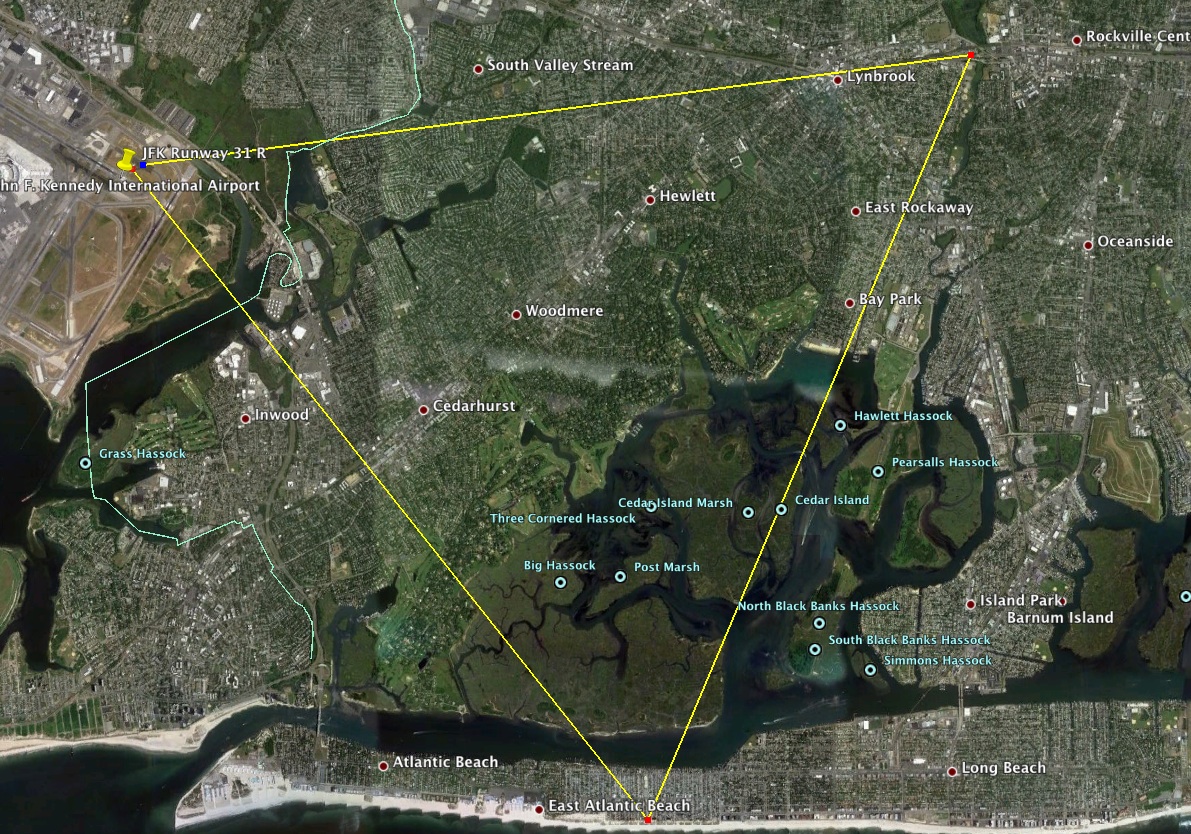
On March 5, the pilot of an Alitalia flight on its final approach to Runway 31 R at New York's JFK International Airport spotted something odd in the air—a small, black flying machine with four propellers flying too close for comfort. The aircraft, likely a "quadrocopter" style drone, passed within 200 feet of the Alitalia airliner at an altitude of about 1,750 feet.

Yesterday, the FBI issued a call for help from the public, requesting anyone with information about the drone or its operators to contact the FBI's New York field office. An FBI spokesperson told Ars that there had been no new developments in the case. While investigators believed the drone was a quadrocopter, they had not officially confirmed this detail. But given the size of the drone—less than three feet across—and the pilot's report that it had four propellers, the vertical-takeoff quadrocopter design is the most likely suspect.

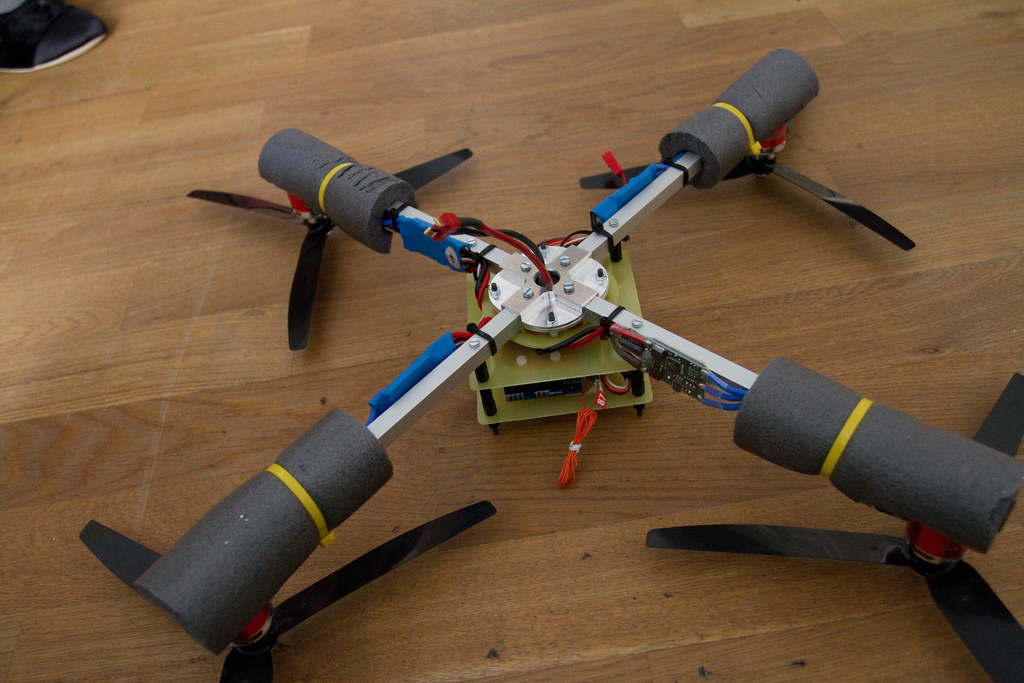
Commercial drones in the "microdrone" class, such as the Microdrones quadrocopter recently snatched up by an Italian university student, are expensive and not widely available to individuals. They are, however, available used on the aftermarket for about $20,000. More traditional radio-controlled commercial drones used in film and video production, such as those made by Quadrocopter, sell for slightly less.

 A DIY "Arducopter" drone, built with an Arduino controller.


But kit quad-rotor drones, like the ArduPirates drones built using Arduino programmable microcontrollers and ArduCopter code, can be built for around $300 and use GPS to navigate on a programmed course. The Parrot AR Drone, controllable by mobile devices based on Apple's iOS and Google's Android, is also in that price range. Though while that drone could operate at 1,750 feet, it would need modification to be controlled from the ground at that altitude.
The Scout 3, an autonomous quadrocopter drone based on the ArduPirates platform.

There's been some speculation that the drone may have been flown out of Brooklyn's Floyd Bennett Field, a popular spot for model aircraft hobbyists. But given the size of the drone (under three feet across, according to the pilot who spotted it) and its type, it's more likely the device was launched somewhere east of the airport in the Five Towns area in Nassau County, a collection of affluent suburbs on Long Island's South Shore.


Enlarge  The final approach path for Alitalia Flight #608 passed over an area full of potential backyard drone launchpads.
Sean Gallagher, with Google Earth

This drone could simply have been flying into commercial airspace by accident or malfunction. But small drones could just as easily be launched with malicious intent. While a quadrocopter drone of the size described in the March 5 incident would weigh no more than about 12 pounds (and much less if it was a hobbyist's kit drone), it could still do serious damage to an airliner during takeoff or landing.

A collision with a small drone could have an effect on a jetliner similar to a birdstrike. Birds colliding with aircraft have broken windscreens of jets and have even, in the case of US Airways Flight 1549, taken out engines. In January of 2009, just a few days before the geese took down Flight 1549, a helicopter carrying oil platform workers in Louisiana hit a red-tailed hawk and crashed, killing eight of its nine passengers.

A drone intentionally GPS-guided into an airport's approach or takeoff airspace could do more than just crash into aircraft. If a drone was built with the intent of causing damage to a plane or distracting its crew at a crucial moment, it might carry a small explosive or a camera-aimed laser pointer, for example.

Given how easily small drones can be built or obtained and how difficult it is to track them, it will require a lucky break for authorities to track down the drone and its operator. And this isn't a problem that regulation will solve—drones of this size can be assembled by someone with fairly basic technical skills. You can already download and 3D-print most of the parts for a quadrocopter drone, much like you can with firearms.

As Drone Use Grows, So Do Privacy, Safety Concerns

9:22 AM, Mar 7, 2013 | 0 comments

A U.S. Customs And Border Patrol drone in-flight (AP)
By Ann Zaniewski Detroit Free Press

DETROIT -- Last September, a gunman barricaded himself on the top floor of his West Bloomfield, Mich., home. He had already killed one police officer and fired shots at others.

Oakland County Sheriff Michael Bouchard sent a deputy to a Brookstone store to buy a $300 Parrot A.R. Drone 2.0 App-Controlled Quadricopter.

Bouchard hoped that the camera-equipped, remote-controlled drone, with its ability to hover in midair, would allow police to see inside the house without putting more officers' lives at risk.

"I was unwilling to send my people into a firefight without having any kind of information on what they were going into," Bouchard recalled.

Perhaps best known for their role in military operations overseas, an increasing number of drones are taking to U.S. skies.

Most are much smaller and far less sophisticated than the Predator drones used by the U.S. military.

They can be deployed in a police standoff, sent up to give firefighters real-time information on a fire or used by a real estate company to create an aerial video tour of a home for sale.

A federal law enacted last year streamlined the process for public agencies, including police departments, to get drone licenses and paved the way for commercial use. About 7,500 small, commercially operated drones -- not including drones flown by public bodies -- will be active in the U.S. in about five years, according to the Federal Aviation Administration.

As domestic drone use has grown, so have concerns about privacy, safety, regulation and the potential for abuse, including fears of unwarranted spying on people by police agencies or even by other citizens. Lawmakers in several states, including Michigan, are weighing rules to regulate the use of drones.

"The bill is really designed to make sure that we're protecting people's rights," said state Republican state Rep. Tom McMillin of the drone legislation he intends to introduce next week. "We don't want Big Brother flying over watching all our activities."


The changing face of warfare
From a shipping container-size control room on a quiet, but highly secure airbase somewhere in America, Air Force technicians are glued to their screens, using joysticks to unleash drone warfare thousands of miles away. 
These young men and women don't look like the muscled Marines you might imagine as warriors. But since 2001, they've killed thousands of foreign fighters -- and then returned home to sleep safely in their beds each night.

It's the changing face of war for America, and the shift is coming quickly. By 2023, the U.S. Air Force says, one-third of its attack and fighter planes will be drones.

Here, an MQ-1 Predator unmanned aerial vehicle and F-16 Fighting Falcon are seen after returning from an Operation Iraqi Freedom combat mission. Both aircraft provide intelligence, search and reconnaissance gathering features, as well as munitions capability to support ground troops and base defense.

These pilotless planes are just a hint of what's to come, as the Air Force believes drone warfare is still in its infancy. These weapons can fly themselves using GPS at undetectable altitudes; they're lighter and more efficient than jets, burning 300 times less fuel than a fighter jet; and they have a global reach that works around the official authorizations for war in the United States.
February 7, 2013 5:12 PM PSTPhoto by: U.S. Air Force/1st Lt. Shannon Collins| Caption by: James Martin
Less-expensive options

The FAA has allowed drones, also known as unmanned aerial systems, to be used domestically for years for environmental monitoring, firefighting, disaster relief and search and rescue. The Department of Homeland Security uses them to monitor borders and ports.

Drones can be equipped with high-powered cameras, microphones, infrared devices and other high-tech tools.

A technically advanced cousin of remote-controlled model planes, the commercial and hobbyist versions range in price from less than $100 to thousands of dollars, depending on their size and sophistication. Drones available for purchase online or in stores today for hobbyists range in size from about 5 inches wide up to 3 or 4 feet.

Ryan Calo, a privacy law expert and professor of law at the University of Washington, said the widespread use of drones in the U.S. seems inevitable.

"Often when the cost of surveillance goes down, people do more of it. It's expensive to have a helicopter. It's expensive to have a plane. It's less expensive to have a drone," he said.

The cost of drones versus helicopters makes them appealing to cash-strapped police departments.

At the barricaded gunman scene in West Bloomfield, the quadricopter, designed to be controlled by a smartphone or tablet, was not stable enough to be useful. But Bouchard said the incident was a perfect example of when a similar device could be valuable to law enforcement.

He also pointed to a train derailment years ago that spewed toxic fumes in the air, preventing a helicopter from getting close.

"When people hear the word drone, I think they think of what's being deployed in the Middle East," Bouchard said. "High altitude, many hours of orbiting and, in some cases, carrying a lethal payload. ... What we picked up from Brookstone is what you can pick up for your 10-year-old kid."

Harry Arnold paid more than $4,000 to make and equip the four-propeller drone he uses in his home-based business, Detroit Drone. He takes aerial images for construction companies and other clients.

For safety reasons, Arnold said, he welcomes better regulations over civilian drone use.

"For right now, there's no law stopping a 13-year-old from buying one of these at Best Buy and flying over (Comerica Park). ... I want to see it be regulated before aforementioned 13-year-old flies his drone around (Comerica Park) during the first inning because he thinks he will be cool and he crashes and hurts everybody, and all of a sudden, drones are illegal," he said.

Legal issues

Under the FAA Modernization and Reform Act of 2012, Congress directed the FAA to develop guidelines for safely accelerating the integration of drones into the national airspace system by September 2015. Calo said the act was intended to streamline the process by which public and private entities can get licenses to fly drones.

Since 2007, the agency has issued 1,428 certificates of authorization allowing for drone use to police departments, universities and other public bodies. According to the FAA, 327 of those permits were still active as of Feb. 15.

Private companies, such as drone manufacturers, can fly drones for testing, demonstration and training after getting an experimental airworthiness certificate from the FAA.

Hobbyists and recreational users of model aircraft currently don't need any special licensing but are encouraged to follow guidelines that are outlined in a 1981 circular. The guidelines say model aircraft should be operated at a site that is a "sufficient distance from populated areas" and not flown above 400 feet.

Right now, there are no provisions for commercial, for-hire unmanned aircraft operations, but Calo said that's expected to change.

Many states aren't waiting for the federal government to address concerns about privacy. Lawmakers in more than 25 states have proposed legislation related to drone use.

Some cities, fearful of abuse, have banned or considered banning their use by law enforcement. Police in Seattle recently scrapped plans to use two high-tech drones following protests from residents.

Data collection

In Michigan, McMillin is working on legislation that would prohibit government use of drones except under limited circumstances.

It is based on model legislation created by the American Civil Liberties Union, which says that law enforcement should only use the devices with a warrant or in emergency situations when a person's safety is imminently threatened. The bill also sets parameters on how data is collected, used and retained.

The technology behind drones is evolving quickly, McMillin said.

"I think there's probably going to be legal issues tomorrow that we don't know about today. It's uncharted territory, for sure," he said.

A Jan. 30 Congressional Research Service report prepared for members of Congress outlined some of the legal questions.

"Several legal interests are implicated by drone flight over or near private property. Might such a flight constitute a trespass? A nuisance? If conducted by the government, a constitutional taking?" the report asked.

Courts have generally upheld the principle that people do not enjoy a reasonable expectation of privacy in public, even on portions of their own property visible from a public vantage. The Fourth Amendment to the Constitution protects against unreasonable searches and seizures by the government.

An ACLU report about drones says the U.S. Supreme Court has allowed some warrantless aerial surveillance from manned aircraft but has not taken a position on whether the Fourth Amendment limits government use of drone surveillance.

"I think the nexus is this concept of what is public, and what is private?" said Shelli Weisberg, legislative director for the ACLU of Michigan. "Just because you're out in public, does it mean that nothing you're doing is private? Is the conversation with the person you're walking with private? Those are the things that will be (eventually) tested by the courts."

Both Weisberg and Calo said that when it comes to drones, current privacy law is inadequate.

"If the idea (is) that these things are going to follow folks around or patrol a particular neighborhood, there isn't much in American privacy law that stands in the way. That's both on the Constitutional law side and the civil law side," Calo said.

Privacy isn't the only concern.

This week an Italian airline pilot reported spotting a small, black drone hovering just a few hundred feet from his passenger plane as it made a final approach for a landing at New York's JFK Airport.

The pilot reported the drone was flying at about 1,800 feet some 3 miles from the airport, according to various published reports.

Although the plane landed safely, the incident drew the attention of the FAA and counterterrorism officials in New York and at the FBI.
SENATE SESSION MARCH 6,2013 
Senator Ran Paul filibustered the confirmation of Brennan for director of CIA

Some interesting points of view. 

I have several articles about 

drones and their use.


The Senate convened and resumed consideration of the nomination of Caitlin Halligan to be United States Circuit Judge for the District of Columbia Circuit. The Senate rejected cloture. At approximately 11:45 a.m. (offset time of 1 hour, 17 minutes) Senator Rand Paul (R-KY) began a filibuster of the confirmation of John Brennan as director of the Central Intelligence Agency.