 | |
Memo to Congress, White House: Get serious on debt
 | |
The continual fiscal brinkmanship of the past two years — in which policymakers go from crisis to crisis, avoiding catastrophe at the last moment and providing nothing more than usual “small ball” solutions that fail to address our underlying structural problems — has ground all progress to a halt. The failure to get our debt under control, reform our Tax Code and put our entitlement programs on a fiscally sustainable course is robbing us of the ability to invest in our future and will leave us without the resources we need to meet other challenges facing our nation. And moving forward will be out of our reach as long as we continue to “pass the buck” on the debt crisis. It is critical that leaders in both parties come together in an honest and meaningful way to put our fiscal house in order if they have any hope of addressing the other challenges and opportunities that we face as a nation. Congress could barely come to agreement on a last-minute, short-term compromise on the fiscal cliff at year’s end. All Washington has managed to do since our commission submitted its report is the easy stuff. Through a combination of the work done in the continuing resolution, the Budget Control Act and the pitiful revenue deal at year end, Washington has capped discretionary spending without being specific on what it will actually cut, and it has raised taxes on the rich. It has done nothing to reform the Tax Code or reduce the rate of growth of health care spending to no more than 1 percent above the rate of growth in the economy. Nor has it done anything to make Social Security sustainably solvent. This is the hard stuff that must be done to finally put our nation’s fiscal house in order. An agreement large enough to complete the job may seem out of reach. However, looking at where the parties were in the negotiations last year, it seems clear that it is possible to reach agreement on a plan if both sides are willing to go beyond their comfort zones and come to a principled compromise. President Barack Obama and Speaker John Boehner originally made substantial progress toward a comprehensive deficit reduction plan that could have gotten us most of the way. Importantly, these negotiations focused beyond the near-term crisis, with real discussions on structural entitlement reforms as well as comprehensive tax reforms. Both sides identified potential areas of agreement: using chained CPI to index both spending programs and the Tax Code with protections for low vulnerable populations; identifying additional savings from defense and domestic discretionary programs and unjustified subsidies; and finding savings in mandatory programs that can and should be included in a comprehensive deficit reduction plan. That last round of negotiations should be the starting point for the next round — however, both sides will have to go further. The president deserves credit for putting forward Medicare savings in his budget and offering further entitlement savings in the negotiations, but he and his fellow Democrats must be willing to do more to reform our entitlement programs. Reaching an agreement to achieve the amount of savings necessary to slow the rate of growth in health care to no more than 1 percent above the rate of growth in the economy will require a combination of Republicans and Democratic ideas for achieving savings from those programs. For health savings, we’ll have to look at everything from increasing premiums for well-off beneficiaries to reducing reimbursements to providers and drug companies to modernizing cost-sharing rules to tort reform. We will also need to reorient incentives to change the delivery of care and make adjustments to reflect the aging of society. In short, it will require taking on favored and well-entrenched constituencies across the health care system. Remember, health care is the largest single driver of our future debt. On the tax side, Republicans must be willing to acknowledge that more revenue will be needed as part of an agreement to meet our deficit-reduction goals, but those revenues need not be generated by “tax increases” but through comprehensive tax reform that broadens the base and lowers rates. The Tax Code is riddled with more than $1 trillion of annual tax breaks — most of which are just government spending in disguise. By reforming them, we can reduce individual and corporate tax rates in a way that keeps the Tax Code progressive while promoting economic growth and reducing the deficit at the same time. If both sides move as one beyond their comfort zone on health and tax reform, those changes could be combined with the other spending cuts discussed in the negotiations last December to produce a package large enough to stabilize and begin to reduce our debt as a share of the economy. Even with such a package, however, further steps would be needed to ensure long-term fiscal sustainability in light of the major demographic and health care pressures expected in the coming decades. Social Security will still need to be reformed to achieve sustainable solvency over 75 years; though these reforms could be gradual and designed to protect the most vulnerable. We will also need to continue implementing reforms of the health care system as we learn more about which policies are effective in controlling costs. We need to keep the pressure on to take further action to reduce health care spending if the policies we enact now are not sufficient to limit the growth to a sustainable level that grows no faster than GDP plus 1 percent. The events over the past few weeks have demonstrated that neither party will be able to deal with this problem on its own and that any solution will require a bipartisan agreement based on principled compromise. Our generation created this mess, and it’s our generation’s responsibility to clean it up together. We do not have the time or the luxury of leaving this problem for the next generation to solve. If America is to compete successfully in this global economy, the time for responsible action is now. One thing is certain, if our generation does not solve this problem we created, the brute force of the markets will, and that will not be a pretty sight. Erskine Bowles is a former White House chief of staff; Alan Simpson is a former Republican senator from Wyoming. They were co-chairmen of the National Commission on Fiscal Responsibility and Reform. © 2013 POLITICO LLC |
Tuesday, February 19, 2013

Exclusive: Disney discovers unreleased Mickey Mouse sketch from 1938

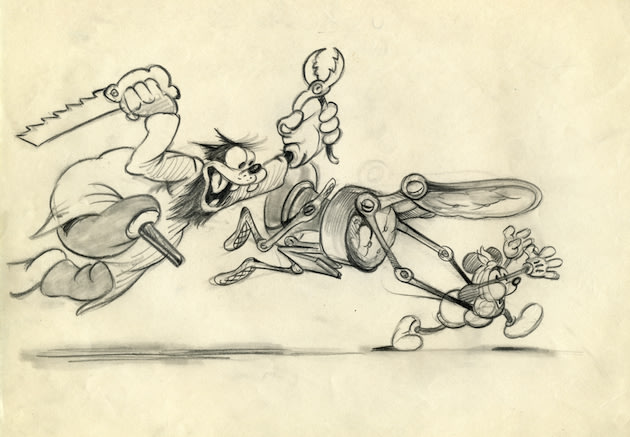
"Mickey's Toothache," from 1938 shows the famous mouse being chased by a dentist's chair and nemesis "Pete" during …
More than 80 years after his creation, Mickey Mouse continues to surprise.
The Disney archives have released a newly discovered sketch from 1938, “Mickey’s Toothache,” part of an incomplete cartoon that was part of an effort to make Mickey a more complete character.
In “Mickey’s Toothache,” created in April 1938, artist Ferdinand Horvath has the newly adventurous Mickey experiencing something akin to a psychedelic nightmare. In the words of Disney Archives Director Becky Cline, Mickey has traveled to the dentist and fallen under the influence of too much laughing gas. The overdose sends Mickey into a “nightmarish world inhabited by living teeth, dental floss, a psychotic dentist’s chair and a vengeful pair of dental pliers," said Cline.
Mickey’s then-nemesis Pete also makes an appearance in the nightmare scenario. It culminates with Mickey being put on trial led, of course, by a judgmental wisdom tooth, who charges Mickey with tooth neglect.
The previously forgotten piece of artwork was discovered in the Walt Disney Archives, hiding out in a folder lost for more than 74 years. It was unearthed just a few months ago.
“Mickey’s Toothache” is just one of several unveilings being planned as part of this year’s D23 Disney Fanniversary Celebration, an event that began last year as a way to include members of Disney’s official fan club in some of the company’s milestone events. The Horvath image will be included in a 90-minute presentation showcasing some of this year’s other major Disney anniversaries in 10 different U.S. cities (Boston, Chicago, Los Angeles, Newark, Orlando, Phoenix, San Diego, San Francisco, Seattle and Washington, D.C.).
“Mickey has been a superstar from almost the beginning. He was immediately popular,” Cline told Yahoo News. “By 1938, he was just about to step into a finished version of himself. He was boyish and impish. During this period of his growth he became larger than life in some ways.”
Cline says the artwork showcases the transformation of America's favorite mouse from popular fad to American icon. It's one that can be seen as well in released cartoons of Mickey engaging in various adventures in locales including the deepest jungles of Africa, or in the 1936 cartoon “Through the Mirror.”
“Mickey was kind of growing and stretching. He left the barnyard, and he started to become more adventurous,” Cline said.
Though most people think of Walt Disney himself in relation to his most-famous individual creation, Horvath was a significant part of the early Disney years. Born in 1891 Horvath spent time in a Russian concentration camp where he taught himself to draw before immigrating to America on Armistice Day 1921. He worked for the studio from 1934 through 1944, producing between 70 and 80 animated shorts along the way and working on the production of "Snow White."
Last year, we brought you the story of a newly discovered, 85-year-old Oswald the Rabbit sketch, “Harem Scarem.” Since then, Disney has pushed forward with efforts to bring Oswald, a Mickey prototype of sorts, back into the Disney fold.
So, will we ever see a complete version of “Mickey’s Toothache”?
“It’s possible,” Cline said. "The animation research library still goes back and refers to those older cartoons. ... Even though we’re still discovering some of this material for the first time in decades, they’re not lost.”
Teen takes parents to court over abortion fight
Monday, February 11, 2013
Texas parents agree not to pressure teen to have abortion By Ashley Fantz , CNN updated 12:04 PM EST, Tue February 19, 2013 (CNN) -- The boyfriend of a 16-year-old, pregnant Texas girl who says her parents tried to force her to have an abortion told CNN on Monday that the couple never considered terminating the pregnancy. "We were always determined to have the baby," Evan Madison told CNN's Piers Morgan. The parents of the girl, who is 10 weeks pregnant, agreed Monday in a state court not to coerce her to have an abortion, an anti-abortion group representing the girl said. "We just achieved an agreed order," Stephen Casey, a lawyer and founder of The Texas Center for Defense of Life, told CNN in a telephone interview Monday afternoon. Casey had argued that Roe v. Wade, the historic 1973 Supreme Court decision that guaranteed women the right to have an abortion, works both ways. "Roe was about the right to choose," Casey told CNN prior to the order being signed. "This young woman has the right to choose to have her child." Legal experts said that no one can force anyone, minor or not, to undergo an abortion. Monday's legal action was intended, the girl's lawyer said, to stop the parents from trying to influence their daughter to undergo the procedure. Madison, 16, said he and the girl plan to get married. The legal age to marry in Texas is 16 with parental consent. Both teens were in the courtroom on Monday. They sat separately from the girl's parents, who are divorced. The girl lives with her mother. The parents have denied the allegations in the lawsuit and called the case baseless. Their attorney did not respond to requests from CNN for comment. The center, which is active in Republican politics nationwide, says it is dedicated to "aggressively defending the sanctity of human life." The lawyers were first contacted by the boy's mother, who said that the girl's parents were threatening both teens, according to Casey, who said the center then contacted the girl and offered their services gratis. The lawsuit alleged that the girl's mother threatened to "slip (the teen) an abortion pill," took her daughter's phone and car and kept her home from school to punish her for choosing not to abort her fetus. The mother told the teen that she was "making the biggest mistake of her life" by choosing to have the child and that the mother herself had undergone numerous abortions, so her daughter should, too, the lawsuit said. It added that the pregnant girl's father told her he "was going to look into canceling" her health insurance. He texted his daughter that she "needs an ass whoopin'," the document said. The parents told their daughter she could "continue to live in misery" in their home or she could "have the abortion and tell everyone it was a miscarriage," the lawsuit added. The girl's parents denied in court records all allegations and asked to have the cost of retaining an attorney reimbursed. That request was not granted. In the interest of protecting the girl's privacy, CNN is not identifying her or her parents. However, the restraining order includes the parents' names. "Under Texas procedure when it's a case involving and alleging abuse of a minor, the minor's identity should be protected, and the girl's attorneys might have violated that," said Susan Hays, an attorney and legal adviser to Jane's Due Process, an Austin-based nonprofit organization that represents pregnant minors in the state. Jane's Due Process, which supports the right to legal abortion, is not involved in this case. "There's an understanding that we will not make law on the back of a 16-year-old girl, and that's what her attorneys are doing," said Hays. "I'm appalled that they've done this to this girl. Putting the girl's parents' names in court documents ... her attorneys have done a lousy job protecting her confidentiality." Hays said the lawyers could have used the parents' initials or included less detail about the family. Casey responded that the courts had notified child protective services about the abuse allegations. Last year Casey's group represented a 14-year-old from Corpus Christi who said her family wanted to force her to have an abortion. The girl didn't want to abort the fetus, Casey said, and her grandmother and cousins were allegedly abusive to the teen. The lawyer in that case, which was settled and a confidential agreement reached, did not disclose the girl's name, Casey said. He would not say whether the girl had an abortion. Catholic hospital backpedals on fetus argument Texas Teen Wins Right to Give Birth Over Parents’ Objections
Feb 19, 2013 10:05am
A pregnant teen who sued her parents, claiming they were coercing her to have an abortion, will be able to give birth to her baby. Attorneys representing the 16-year-old girl were granted a long-term injunction against the girl’s parents in Texas family court on Monday, according to court documents. The teen is 10 weeks pregnant and the injunction will last for the duration of her pregnancy. As part of the order, the girl will be able to use her car to go to school, work and medical appointments. Her parents had taken away the use of the car as part of their effort to force an abortion, court papers stated. The teen’s parents will be liable for half of the hospital bill when she gives birth, unless she is married to the baby’s 16-year-old father. “We are extremely happy with the judge’s decision today and we are very proud of our teenage client for being strong enough to stand against her parents to save her unborn child’s life,” Greg Terra, president of the Texas Center for Defense of Life, said in a blog post on the group’s website. Attorneys filed a lawsuit on the teen’s behalf earlier this month arguing that her parents “are violating her federal constitutional rights to carry her child to term by coercing her to have an abortion with both verbal and physical threats and harassment.” The teen, identified in the lawsuit only as R.E.K. since she is a minor, was “beside herself” when she called the center for help, her lawyer Stephen Casey told ABCNews.com last week. The group claims it has previously represented teens in similar situations and won their cases. 
The 16-year-old girl's boyfriend and lawyer appeared outside of court on Monday. (Image Credit: ABC News)
“These girls are in a bind, particularly in a situation where their parents are forcing them to do something they don’t want to do,” Casey said. “Regardless of the [situation], that’s her parents and she should expect support from them in this situation, not resentment and anger.” When the pregnancy was confirmed, the teenager’s father allegedly “became extremely angry, was insistent that R.E.K. was not having the baby, and that the decision was not up to her, according to the lawsuit. He stated he was going to take her to have an abortion and that the decision was his, end of story.” The teen claimed in the lawsuit that her parents had taken away her phone, pulled her out of school, forced her to get two jobs and took away her car in an effort to “make her miserable so that she would give in to the coercion and have the abortion.”‘ |
The Court Is Ready to Double Down on Citizens United, Beyond the Super PAC

Reuters
Alexander Abad-Santos 12:52 PM ET
The Supreme Court announced on Tuesday that it would hear a case in its next term that challenges the limit on how much individuals can donate directly to candidates and their political parties, and given the increasing acceptance from the Roberts court of the concept of money as free speech, legal watchers are already saying that, yes, there's more than a good chance this could lead to the end of federal limits on campaign-finance contributions.
The case is McCutcheon v. Federal Election Commission, with the plaintiff challenging the FEC's limit on $123,2000 in donations over two years — the total amount you're allowed to spend on all candidates, traditional PACs, and parties combined:

Basically, Shaun McCutcheon is an Alabama businessman and GOP booster who did not want to be limited by that $123,200. He's a man with plenty of disposable income who spent, as Politico's Tarini Parti reports, $33,088 on 16 different candidates in the 2012 election — and reportedly wanted to spend closer to $129,400. With current federal limits in place, McCutcheon would only be able to max out at around 18 candidates over two years.
McCutcheon, with the backing of the Republican National Committee, argued in a lower court that the limits "violate donors' free-speech rights and severely restrict the ability of candidates and parties to compete in an age of free-for-all spending by super PACs and political non-profit groups," USA Today's Fredreka Schouten reports. The U.S. Court of Appeals in D.C. upheld the limits anyway.
That's curious because McCutcheon, thanks to the Supreme Court's landmark 2010 ruling on Citizens United, could already donate as much as he wants to the Super PACs supporting the candidate of his choice. Remember, this past election Sheldon Adelson reportedly spent between $70 million to $100 million this election and around $32 million on Mitt Romney and Romney-related Super PACs — only to have his guy lose, proving that even well-funded Super PACs and candidates aren't bulletproof. But McCutcheon — and, by proxy and its response today, the RNC — wants unrestricted donation power directly to candidates and the parties they come from, without federal limits and without donations bundled through Super PACs.
With the Citizens United ruling and now the McCutcheon case, the Supreme Court's next move could do more than chip away at campaign finance rules — they could jackhammer them. The rules were instituted in the first place to clean up politics, to stop the buying of politicians, as Jeffrey Toobin wrote last year:
We've sort of come a long way from that, with the chunk of the work already done by way of the Supreme Court's 5-4 ruling on Citizens United.
So what happens if the Supreme Court sides with McCutcheon? Or, rather, what's left of campaign finance?
"Dismantling the federal limit also could cast into doubt on state laws around the country. In New York, for instance, an individual cannot contribute more than $150,000 to candidates and political committees in the Empire State," writes Schouten at USA Today. Richard Hasen, a campaign-finance professor at the University of California at Irvine, went further in Politico's report:
Politico's Kenneth Vogel, who was last seen sparring over campaign finance with Nate Silver, thinks this case has more than a chance to vanquish the efforts of McCain, Feingold, and all the rest — what with Citizens United and the Roberts court:
The Supreme Court announced on Tuesday that it would hear a case in its next term that challenges the limit on how much individuals can donate directly to candidates and their political parties, and given the increasing acceptance from the Roberts court of the concept of money as free speech, legal watchers are already saying that, yes, there's more than a good chance this could lead to the end of federal limits on campaign-finance contributions.
The case is McCutcheon v. Federal Election Commission, with the plaintiff challenging the FEC's limit on $123,2000 in donations over two years — the total amount you're allowed to spend on all candidates, traditional PACs, and parties combined:
Basically, Shaun McCutcheon is an Alabama businessman and GOP booster who did not want to be limited by that $123,200. He's a man with plenty of disposable income who spent, as Politico's Tarini Parti reports, $33,088 on 16 different candidates in the 2012 election — and reportedly wanted to spend closer to $129,400. With current federal limits in place, McCutcheon would only be able to max out at around 18 candidates over two years.
McCutcheon, with the backing of the Republican National Committee, argued in a lower court that the limits "violate donors' free-speech rights and severely restrict the ability of candidates and parties to compete in an age of free-for-all spending by super PACs and political non-profit groups," USA Today's Fredreka Schouten reports. The U.S. Court of Appeals in D.C. upheld the limits anyway.
That's curious because McCutcheon, thanks to the Supreme Court's landmark 2010 ruling on Citizens United, could already donate as much as he wants to the Super PACs supporting the candidate of his choice. Remember, this past election Sheldon Adelson reportedly spent between $70 million to $100 million this election and around $32 million on Mitt Romney and Romney-related Super PACs — only to have his guy lose, proving that even well-funded Super PACs and candidates aren't bulletproof. But McCutcheon — and, by proxy and its response today, the RNC — wants unrestricted donation power directly to candidates and the parties they come from, without federal limits and without donations bundled through Super PACs.
With the Citizens United ruling and now the McCutcheon case, the Supreme Court's next move could do more than chip away at campaign finance rules — they could jackhammer them. The rules were instituted in the first place to clean up politics, to stop the buying of politicians, as Jeffrey Toobin wrote last year:
In 1907, Congress passed the Tillman Act, named for the eccentric rogue Pitchfork Ben Tillman, the South Carolina senator who sponsored the legislation. The law barred corporations from contributing directly to federal campaigns, and established criminal penalties for violations. Loopholes proliferated, allowing, for example, individuals to give as much as they wanted to political campaigns and to be reimbursed for the contributions by their employers. Still, the Tillman Act was a first step toward what Congress described as its goal: elections "free from the power of money.”
We've sort of come a long way from that, with the chunk of the work already done by way of the Supreme Court's 5-4 ruling on Citizens United.
So what happens if the Supreme Court sides with McCutcheon? Or, rather, what's left of campaign finance?
"Dismantling the federal limit also could cast into doubt on state laws around the country. In New York, for instance, an individual cannot contribute more than $150,000 to candidates and political committees in the Empire State," writes Schouten at USA Today. Richard Hasen, a campaign-finance professor at the University of California at Irvine, went further in Politico's report:
"The ability to get around it does undermine the case for limits," Hasen said. But the case could have broader implications. It will be the first time since Citizens United that the court decides how to judge campaign finance laws."How good does that look? Slate's Dave Weigel writes:
So, could the court rule for the plaintiff and destroy campaign finance limits? Anything's possible, but the recent experience hasn't been good for the let-money-flow crowd. When we last saw McCutcheon, it was being dismissed by the D.C. Circuit.
Politico's Kenneth Vogel, who was last seen sparring over campaign finance with Nate Silver, thinks this case has more than a chance to vanquish the efforts of McCain, Feingold, and all the rest — what with Citizens United and the Roberts court:
If conservative justices could follow Citizens United blueprint, they cud use McCutcheon to abolish contrib. limits: politico.com/story/2013/02/… — Kenneth P. Vogel (@kenvogel) February 19, 2013The GOP is already celebrating this victory:
Pleased SCOTUS will hear our case: McCutcheon et al. v. FEC, that challenges aggregate biennial contribution limits on party & candidates. — RNC (@GOP) February 19, 2013The case will be taken up in the Supreme Court's next term, which begins in October.
Looming budget freefall is one neither party can afford
Published February 19, 2013
FoxNews.com
In order to understand the political battle over deficit reduction and automatic spending cuts looming on March 1, it is necessary to visit the voting history of the Budget Control Act of 2011, a bill crafted to reduce the deficit and avoid default.
That bill created a supercommittee on deficit control, with the provision that if the supercommittee did not come to an agreement, automatic spending cuts -- sequestration -- would be imposed on all discretionary spending, including the military. The expiration of various tax cuts would also mean tax increases for millions of Americans.
On Aug. 1, 2011, an overwhelming majority of Republicans (174-66) in the House voted for the bill. House Democrats split down the middle, 95-95. Republican leaders John Boehner, Eric Cantor and Kevin McCarthy voted yes. Democratic leaders Nancy Pelosi, Steny Hoyer and Jim Clyburn voted yes. The bill passed the Senate the following day, with 45 Senate Democrats supporting the bill, joined by 28 Republicans and one Independent.
President Obama immediately signed the bill -- the product of bicameral, bipartisan leadership in cooperation with the White House -- into law.
So you can imagine the surprise of Republicans when, in the October 22 presidential debate last year with Mitt Romney, President Obama denied he had anything to do with the sequester. He even poked fun at Romney, suggesting he was woefully ignorant and behind the times in his assessment of U.S. military readiness.
We need to get our $600 billion trade deficit turned around. We need to start taking care of things back home.“The sequester is not something that I proposed,” the president declared. “It’s something that Congress has proposed. It will not happen. The budget we are talking about is not reducing our military spending. It is maintaining it.”
It was a key moment in the final debate, which was generally scored in favor of the president. It could have gone the other way if Romney had known sequester would also create a spike in unemployment, up to 9.1 percent by the end of 2013, according to the Congressional Budget Office, which released the report just a little more than 24 hours after Romney conceded the election.
In fact, the idea of draconian cuts to the Defense budget came from the White House. Bob Woodward, in his book “The Price of Politics,” traced the sequester idea as a negotiating strategy that moved from the executive office to the Democratic leader of the Senate to Republican leaders, culminating in mutually flawed assumptions that a bipartisan agreement on the supercommittee would be reached because Republicans didn’t want defense cuts and Democrats wanted to avoid cuts in social programs. The supercommittee could not agree, and the automatic spending cuts of sequestration are now on the way.
As a member of the 112th Congress, I voted against the Budget Control Act of 2011. Is there waste in government? Yes! Do we need to cut spending? Yes. We need to cut spending for wars, interventions and any foreign aid that sets the stage for interventions. We borrowed money from China to wage an unnecessary, wrongful war against Iraq. We need to get our $600 billion trade deficit turned around. We need to start taking care of things back home.
The White House promoted sequester because it is prepared to agree to cut spending on important domestic programs, even to the extent of falsely injecting Social Security into the debt debate. Is this what a "Liberal" administration looks like? The American Taxpayer Relief Act, 2013, passed on January 1 this year, recovered for taxpayers a substantial amount of money that would have been lost due to the expiration of tax cuts, reducing the adverse impact of substantial tax increases on the economy.
With automatic spending cuts looming, the president will continue to distance himself from the sequestration process, and Republicans will try to bring him back to where he started: As the Initiator. After all, it was his idea and he signed the bill.
Watch for the White House to shift to a “share the pain” approach to deficit reduction, but perhaps not in time to avoid sequester. The Democrats will attack Republicans for sequestration. Minority Whip Steny Hoyer has gone into high gear in attack mode, last week saying that if Democrats were in charge, sequestration would not happen -- although he voted to begin the process, as did other Democratic leaders in the House and Senate.
Senate Democrats ask for more tax revenue, or they refuse to pass a budget. They have, in fact, refused to pass a budget for years, so this latest move may not inspire their Republican colleagues to action.
House Republican leaders who voted for the sequester process will not even bother to bring new revenue issues to the floor of the House, mindful of the fact that on New Year’s night, their conference voted 151-85 against tax increases for people in the highest brackets.
On sequester, everyone is in. And everyone is out. But if congressional Democrats and Republicans are grappling with each other as they go over the sequestration falls, they may learn they have precipitated one crisis too many for an American electorate worried about the economy.
After Hiring of Axelrod, How Much Does Obama Control Message at NBC News?
 Reuters
February 19, 2013
The Atlantic Wire asks:
As the Obama administration continues to draw the ire of the Washington media for limiting exposure to the White House, the most White House-friendly network up and hired yet another former White House message man, David Axelrod. And that may all be part of the plan.
In the wake of, well, a golf game with Tiger Woods, Politico's Mike Allen and Jim Vandehai launched a long, accusatory missive last night about how the Obama administration never talks to reporters the way presidents used to. The "puppet master" president and his advisers like Dan Pfeiffer, Politico and on-the-record members of the White House press corps complain, now control their messaging through controlled content and social-media delivery, such as the White House's Flickr page. The White House press pool never gets to ask the hard questions like they used to, apparently, because Obama so rarely makes himself available to reporters — not because the White House Press Corps so rarely asks hard questions.
Is the Beltway press making a mountain out of a molehill here? Mostly, yes. But there are some credible arguments to be made here. The President himself doesn't speak to the White House press corps as often as he used to — and last night's off-the-record chat on Air Force One isn't going to help that. A press conference in November was the first time he took questions from them in over eight months, and while there have been more questions since, there have also been four years' worth of planted stories and 60 Minutes softballs.
And while the news funneling out of the White House might be heavy on spin, the spin zone is increasingly populated by guys who used to work in the White House. The administration couldn't control the timing of the announcement, on the same morning that the Politico report was boiling over, that David Axelrod will join NBC and MSNBC as a "senior political analyst." Axelrod, a longtime Obama advisor and MSNBC favorite, officially left his Senior Advisor job at the White House in 2011 to work on the 2012 campaign, but he's been a vocal supporter of his old boss from the political pasture every since. He's supported the President, on television or on Twitter, on guns, on immigration reform promises, and on that whole skeet-shooting controversy that's at the center of how the Obama administration beats off-message messages with its own message. (Flickr photo + Axelrod tweet = end of controversy, goes the thinking.) Axelrod he did say that the immigration bill leak was a dumb idea — on MSNBC, no less!
Only a few weeks ago, Robert Gibbs also joined MSNBC as a contributor — he, too, is a longtime MSNBC favorite, from his days as Obama's White House Press Secretary to his own efforts as an official campaign advisor. But he's actually made fewer headlines for defending the President than Axelrod has since leaving the inner circle. Gibbs defended this weekend's immigration leak as something outside of the White House's control. Or, to put it plainly, saying it wasn't intentional. But if one were to put on a tinfoil hat for a moment, that could be chalked up to the terrible response it got from just about everyone. Gibbs did deviate from the message slightly when he said Chuck Hagel seemed "unimpressive and unprepared" during his Defense Secretary confirmation hearing, but that was pretty obvious, and in the same breath he criticized the validity of the questions Hagel was asked by Republicans.
The Atlantic Wire asks:
As the Obama administration continues to draw the ire of the Washington media for limiting exposure to the White House, the most White House-friendly network up and hired yet another former White House message man, David Axelrod. And that may all be part of the plan.
In the wake of, well, a golf game with Tiger Woods, Politico's Mike Allen and Jim Vandehai launched a long, accusatory missive last night about how the Obama administration never talks to reporters the way presidents used to. The "puppet master" president and his advisers like Dan Pfeiffer, Politico and on-the-record members of the White House press corps complain, now control their messaging through controlled content and social-media delivery, such as the White House's Flickr page. The White House press pool never gets to ask the hard questions like they used to, apparently, because Obama so rarely makes himself available to reporters — not because the White House Press Corps so rarely asks hard questions.
Is the Beltway press making a mountain out of a molehill here? Mostly, yes. But there are some credible arguments to be made here. The President himself doesn't speak to the White House press corps as often as he used to — and last night's off-the-record chat on Air Force One isn't going to help that. A press conference in November was the first time he took questions from them in over eight months, and while there have been more questions since, there have also been four years' worth of planted stories and 60 Minutes softballs.
And while the news funneling out of the White House might be heavy on spin, the spin zone is increasingly populated by guys who used to work in the White House. The administration couldn't control the timing of the announcement, on the same morning that the Politico report was boiling over, that David Axelrod will join NBC and MSNBC as a "senior political analyst." Axelrod, a longtime Obama advisor and MSNBC favorite, officially left his Senior Advisor job at the White House in 2011 to work on the 2012 campaign, but he's been a vocal supporter of his old boss from the political pasture every since. He's supported the President, on television or on Twitter, on guns, on immigration reform promises, and on that whole skeet-shooting controversy that's at the center of how the Obama administration beats off-message messages with its own message. (Flickr photo + Axelrod tweet = end of controversy, goes the thinking.) Axelrod he did say that the immigration bill leak was a dumb idea — on MSNBC, no less!
Only a few weeks ago, Robert Gibbs also joined MSNBC as a contributor — he, too, is a longtime MSNBC favorite, from his days as Obama's White House Press Secretary to his own efforts as an official campaign advisor. But he's actually made fewer headlines for defending the President than Axelrod has since leaving the inner circle. Gibbs defended this weekend's immigration leak as something outside of the White House's control. Or, to put it plainly, saying it wasn't intentional. But if one were to put on a tinfoil hat for a moment, that could be chalked up to the terrible response it got from just about everyone. Gibbs did deviate from the message slightly when he said Chuck Hagel seemed "unimpressive and unprepared" during his Defense Secretary confirmation hearing, but that was pretty obvious, and in the same breath he criticized the validity of the questions Hagel was asked by Republicans.

Look: Gibbs and Axelrod could probably use the paycheck — MSNBC has been dishing them out to left-leaning talking heads for years, and CNN made an artform out of hiring the recently "retired" White House advisor and putting him behind a podium after the first and second terms of Bill Clinton. And what's cable news these days without a talking head for our elected officials? You can't go on a Sunday talk show these days without seeing the opposite of Gibbs and Axelrod — David Plouffe, who went from the campaign to inside the White House, is still on TV pushing the administration's method all the time.
For its part, MSNBC certainly knows its audience, though they would never admit it. And the administration certainly knows its message, its people, its social media, and its fading need for a White House press corps when it has guys like Axe and Gibbs to unofficially lean the right way on a left-leaning network. It's like what former press secretary Ben LaBolt said on Twitter in response to the Politico rant — the White House is "engaging Americans directly in the conversation." Their conversation.
Chris Christie to David Letterman: I'm 'the healthiest fat guy you've ever seen'
Chris
Christie has been the target of many jokes courtesy of David Letterman,
and Monday night he proved he's a guy who can take those jokes -- and
toss them right back. The New Jersey Governor appeared on Letterman's
"Late Show," brought a snack (a jelly doughnut), and declared, "I'm
basically the healthiest fat guy you've ever seen in your life."
He
told Letterman that if a joke is funny -- even if it's about himself --
that he'll laugh. But, he added only "about 40 percent" of the host's
jokes (362,000 by Christie's count) have seemed funny. He brought out
some notecards and read a few of the ones Letterman had lobbed at him
over the years, and then the two men got to talking about Christie's
weight.
The governor said both his cholesterol and blood sugar were fine ("startlingly good"), but said he thinks about going on a diet "every day." "But I just turned 50, and so the doctor ... (said) things are going to fall off of me if I don't get it together, but up to this point it's been pretty good."
The pair later talked more extensively about the long-term effects of Hurricane Sandy, and about getting funding to rebuild on the coastline. Christie earned some applause when he noted that members of both parties have stopped talking to each other, and that's part of the problem in Washington, DC right now.
In the end, the governor displayed a generous amount of grace, telling Letterman, "I watch you all the time. You're my favorite late night show."
Talk about being the bigger man.
The governor said both his cholesterol and blood sugar were fine ("startlingly good"), but said he thinks about going on a diet "every day." "But I just turned 50, and so the doctor ... (said) things are going to fall off of me if I don't get it together, but up to this point it's been pretty good."
The pair later talked more extensively about the long-term effects of Hurricane Sandy, and about getting funding to rebuild on the coastline. Christie earned some applause when he noted that members of both parties have stopped talking to each other, and that's part of the problem in Washington, DC right now.
In the end, the governor displayed a generous amount of grace, telling Letterman, "I watch you all the time. You're my favorite late night show."
Talk about being the bigger man.

NBC Declares War on Christians

FILE - In this Friday, Aug. 21, 2009, file photo, the NBC
logo glows in neon lights among other iconic signs at its headquarters
in New York. Comcast said Tuesday, Feb. 12, 2013, that it's buying
General Electric's 49 percent stake in the NBCUniversal joint venture
for $16.7 billion several years early, as the company takes advantage of
low borrowing costs and what CEO Brian Roberts called a "very
attractive price." (AP Photo/Bebeto Matthews, File) (A2009)
Published February 19, 2013
| FoxNews.com
That’s what I was wondering over the weekend as I watched “Saturday Night Live” blaspheme Jesus Christ in a violent and bloody Quentin Tarantino parody – just three days after Ash Wednesday.
The fake movie trailer for “Djesus Uncrossed” featured the Savior brandishing guns and blowing away Romans in classic Tarantino-style. Blood and gore and profanity spewed across flat screens from coast to coast; at one point Jesus sliced a man’s head in half.
“Critics are calling it a less violent ‘Passion of the Christ,’” the announcer declared. “I never knew how much Jesus used the N-word.”
Offending Christians is apparently what passes for entertainment these days.
A few days before the SNL episode, NBC Sports blogger Rick Chandler wrote a scathing smear against a prominent Christian church in Dallas.
The First Baptist Church in Dallas had invited Tim Tebow to speak at an upcoming service. Chandler urged the outspoken Christian football player to reconsider.
“Tim Tebow to speak at virulently anti-gay, anti-Semitic Dallas mega-church,” read the headline on Chandler’s hit piece.
Sing Oldham, a spokesman for the Southern Baptist Convention, told me he’s not surprised by NBC’s blistering assault on American Christians.
“It’s open season on those who profess personal faith in Jesus Christ and pattern their lives by biblical morality,” he said. “Evangelical Christians are treated with contempt and targeted for ridicule.”
And at the Peacock Network, the contempt and ridicule are on steroids.
NBC removed the words “under God” from the Pledge of Allegiance during a produced video that aired during the U.S. Open.
NBC medical editor Nancy Snyderman infamously denounced the religious part of Christmas during an episode of Today.
“I don’t like the religion part,” said Snyderman. “I think religion is what mucks the whole thing up.”
The “religion” she was referring to is celebrating the birth of Jesus Christ.
The network has also produced religion-bashing shows like “The New Normal” and “The Book of Daniel.” That particular show as so offensive it led American Family Radio Chairman Donald Wildmon to declare, “We are tired of NBC’s anti-Christian bigotry.”
I wish I could tell you that this sort of anti-Christian bigotry is an anomaly. Sadly, it is not.
We’ve seen the networks and national news publications denigrate the Christian faith with great flair -- from the “Good Christian B****es” of ABC to Newsweek’s Christmas essay about the “The Myths of Jesus.”
I find it interesting that the networks always mock and ridicule Christianity – but they give other religions a pass.
Why aren’t the writers at SNL churning out weekly skits about Islam – or the Prophet Mohammed? Where’s the mock movie trailer for “Jihad Undetonated?” Where’s the television show called “Good Muslim B****es?” Or the magazine essay about “The Myths of Mohammed?”
I suspect we all know the answer to why.
I’ve often wondered why the people at 30 Rock hold Christians in such contempt. Maybe they choose to attack Christians because we are easy targets.
Southern Baptist spokesman Oldham said it should come as no surprise that networks like NBC target Christians for ridicule.
“Jesus said, ‘the world will hate you because of my name,’” he said, referring to a passage in the New Testament.
As best as I can tell, the folks over at NBC are either ideological bullies or religious bigots.
Either one is enough for me to change the channel.
Obama blackmails taxpayers while blaming Republicans

Published February 19, 2013
| FoxNews.com
It appears likely sequestration will require $85 billion in cuts to defense and non-entitlement government spending.
Unwilling to acknowledge the government has a spending problem — over the last five years, outlays are up $1 trillion and three times the amount required by inflation — and that tax revenues are short because his policies have instigated the weakest recovery since the Great Depression, President Obama is threatening draconian measures if Republicans don’t agree to more taxes.
The president has announced meat inspectors will be furloughed and food shortages will result. His cabinet secretaries are threatening three-hour waits at airports to clear security, reducing embassy protection and border patrols, cutting the Persian Gulf Naval presence from two aircraft carriers to one, and the list goes on ….
Repeatedly, the president has exclaimed if congressional Republicans don’t cooperate, spending cuts now could derail the hard won recovery. It puzzles me how $85 billion in a $16 trillion economy could make such a difference, especially when tax increases of similar size, implemented on January 1 at the president’s behest, had no similar effect in his mind.
The Constitution charges the president with running the government effectively on the money Congress provides. While appropriation legislation limits the fungibility of funds, the administration has considerable discretion allocating the 10 percent cuts in non-entitlement spending.
Military bands have more personnel than the State Department’s Foreign Service has employees — I would rather jettison some tubas than Marine guards at embassies.
The Agriculture Department has one of the largest staffs of economists in the world, and the Social Security Administration employs a similar crop of dull numbers-crunchers. I fear for my brethren, but safe food is more important than yet another dull research paper.
To provide fuel and munitions to maintain the carrier presence in the Gulf, it would be better to trim ballooning military health care costs, something outgoing Defense Secretary Leon Panetta has expressed sympathy about addressing.
That would require longer-term reforms, but President Obama has refused to look at skyrocketing spending with a critical eye. He talks about balanced approaches to deficit reduction — half spending and half taxes; however, instead of matching increases in payroll and income taxes imposed January 1 with spending cuts, he pushed through more spending on unemployment insurance and other initiatives.
Now, the president is unwilling to manage effectively $85 billion in cuts across a $3.8 trillion government — remember administrative, research and public affairs outlays associated with entitlements are fair game, too. And what about the White House budget!
Instead, he would rather blackmail Americans with food shortages, long lines at airports and the like, and invoke the specter of another recession to gain political advantage over the Republicans.
Whether a second recession occurs is already baked in the cake. Obama’s high taxes, and those imposed by Democratic governors from Maryland to California, have forced consumers to trim purchases, retailers and wholesalers are reporting weaker traffic and are trimming inventories, and corporate leaders have announced plans to cut new investments and hiring, owing to weak demand and more burdensome health care costs and regulations.
When you can’t get hamburger at the supermarket and unemployment rises this spring, Obama will do what he does best, cast blame on Republicans for permitting sequestration, but it is the American people that bear the burden of presidential disregard for the responsibilities of his office and the harmful effects of his policies.
Perhaps, Obama should read less Lincoln and behave more like Truman. The man from Missouri often exclaimed “the buck stops here.”
2 Great Lakes hit lowest water level on record

John Flesher / AP file
In
this Nov. 16, 2012 photo, a sand bar is exposed on Portage Lake in
Onekama, Mich., due to low water levels. The waterway is connected by a
channel to nearby Lake Michigan where water levels have reached record
lows.
Two of the Great Lakes have hit their lowest water levels ever recorded, the U.S. Army Corps of Engineers said Tuesday, capping more than a decade of below-normal rain and snowfall and higher temperatures that boost evaporation.
Measurements taken last month show Lake Huron and Lake Michigan have reached their lowest ebb since record keeping began in 1918, and the lakes could set additional records over the next few months, the corps said. The lakes were 29 inches below their long-term average and had declined 17 inches since January 2012.
The other Great Lakes — Superior, Erie and Ontario — were also well below average.
"We're in an extreme situation," said Keith Kompoltowicz, watershed hydrology chief for the corps district office in Detroit.
The low water has caused heavy economic losses by forcing cargo ships to carry lighter loads, leaving boat docks high and dry, and damaging fish-spawning areas. And vegetation has sprung up in newly exposed shoreline bottomlands, a turnoff for hotel customers who prefer sandy beaches.
The corps' report came as shippers pleaded with Congress for more money to dredge ever-shallower harbors and channels. Shippers are taxed to support a harbor maintenance fund, but only about half of the revenue is spent on dredging. The remainder is diverted to the treasury for other purposes. Legislation to change that policy is pending before Congress.
"Plunging water levels are beyond anyone's control, but the dredging crisis is man-made," said James Weakley, president of the Cleveland-based Lake Carriers' Association.
Kompoltowicz said the Army corps might reconsider a long-debated proposal to place structures in a river to reduce the flow of water away from Lakes Huron and Lake Michigan, which are connected.
Scientists say lake levels are cyclical and controlled mostly by nature. They began a steep decline in the late 1990s and have usually lagged well below their historical averages since then.
But studies have shown that Huron and Michigan fell by 10 to 16 inches because of dredging over the years to deepen the navigational channel in the St. Clair River, most recently in the 1960s. Dredging of the river, which is on the south end of Lake Huron, accelerated the flow of water southward from the two lakes toward Lake Erie and Lake Ontario, and eventually into the Atlantic Ocean.
Groups representing shoreline property owners, primarily in Lake Huron's Georgian Bay, have demanded action to slow the Lake Huron and Michigan outflow to make up for losses that resulted from dredging, which they contend are even greater than officials have acknowledged.
Although the Army corps produced a list of water-slowing options in 1972, including miniature dams and sills that resemble speed bumps along the river bottom, nothing was done because the lakes were in a period of above-average levels that lasted nearly three decades, Kompoltowicz said.
The corps has congressional authorization to take action but would need money for an updated study as a first step, he said. The Detroit office is considering a funding request, but it would have to compete with other projects nationwide and couldn't get into the budget before 2015.
"It's no guarantee that we're going to get it, especially in this budget climate," Kompoltowicz said. "But there are serious impacts to navigation and shoreline property owners from this extreme event. It's time to revisit this."
Scientists and engineers convened by the International Joint Commission, a U.S.-Canadian agency that deals with shared waterways, issued reports in 2009 and last year that opposed trying to regulate the Great Lakes by placing structures at choke points such as the St. Clair River. The commission has conducted public hearings and will issue a statement in about a month, spokesman John Nevin said.
Roger Gauthier, a retired staff hydrologist with the Army corps, said a series of "speed bumps" could be put in the river at a reasonable cost within a few years. Without such measures, he warned, "it would take years of consistent rain" to return Lake Michigan and Lake Huron to normal.
© 2013 The Associated Press. All rights reserved. This material may not be published, broadcast, rewritten or redistributed.
4 arrested in Egypt after shoe thrown at Iran's President Mahmoud Ahmadinejad

Amr Abdallah Dalsh / Reuters
Iran's
President Mahmoud Ahmadinejad meets people as he visits the Al-Hussein
mosque, named after Prophet Mohammed's grandson Hussein ibn Ali, in old
Cairo on Feb. 5, 2013. Ahmadinejad was both kissed and scolded on
Tuesday when he began the first visit to Egypt by an Iranian president
since Tehran's 1979 Islamic revolution.
CAIRO -- Egypt's security arrested four men who were protesting outside a Cairo mosque, where the Iranian President Mahmoud Ahmadinejad was praying.
The men, including a Syrian, belong to the ultra-conservative Sunni Salafist movement.
One man threw a shoe at Ahmadinejad, a Shiite, who was never in any danger.
The Al-Hussein Mosque is revered by Shiite Muslims, who are widely disliked by conservative Sunni Muslims, including members of the Muslim Brotherhood. Egypt's President Mohammed Morsi was previously a member of the Brotherhood.
Many Sunni Muslim groups have denounced the Iranian president’s visit to Cairo and have called on Egypt’s government to prevent Ahmadinejad from visiting any religious sites that are significant to Shiite Muslims.
Ahmadinejad met with Sunni Islam's most senior scholar at Al Azhar shortly before he went to pray at the Al-Hussein Mosque.
Malala: ‘Today you can see that I’m alive’
7:34 PM on 02/05/2013
.
Today you can see that I’m alive,” said 15-year-old Malala Yousafzai on Monday in her first speaking interview since being shot by the Pakistani Taliban last October. Despite the terror of her attack, Malala remains obstinate in her fight to promote education for girls around the world.
“I can speak. I can see you. I can see everyone,” said Malala. “And I’m getting better day by day.”
In a five-hour, two-part operation, doctors at Queen Elizabeth Hospital in Birmingham attached a titanium plate to the left side of Malala’s skull, and implanted a cochlear device in her left ear to restore her hearing. Both operations were successful and she won’t need any further surgery, according to her surgeon, Dr. Anwen White.
After the shooting, Malala’s brain swelled on her left side where the bullet pierced her skull–fortunately missing her brain–and doctors had to remove part of her cranium to avoid brain damage. As the swelling went down, the removed skull-piece was retrofitted with a titanium plate and reattached.

The custom-made titanium plate which doctors will use to repair a hole in the Malala’s skull. (AFP Photo / University Hospitals Birmingham)
“God has given me this new life,” Malala said. “And I want to serve, I want to serve the people. I want every girl, every child to be educated. For that reason, we have organized the Malala Fund.”
The Malala Fund was established by Vital Voices, a non-governmental organization which advances women’s leadership through mentoring and outreach. Malala and her father Ziauddin are board members of the fund and will play a large part in deciding where and to which projects the money will go.
CEO of Vital Voices Alyse Nelson has said she wanted to “incubate” an organization that Malala could one day run. “She changes the way the world sees girls,” Nelson said last December. “And not as a victim: as an activist, as a visionary.”
The Tehreek-i-Taliban Pakistan have issued a warning that if Malala survives, they will target her again for being a “secular-minded lady.” Malala’s first words show that, despite threats, she’s not going to back down from the fight to educate girls the world over.
Dr. White hopes that Malala will be discharged from the hospital and allowed to go home “fairly soon.”
Malala, teen champion of girls' rights, nominated for Nobel Peace Prize

NHS via EPA
Malala Yousufzai of Pakistan leaving Queen Elizabeth Hospital Birmingham, Britain, on Jan. 4 after she was discharged. She will have to undergo specialist cranial surgery at a later date.
Malala Yousufzai, the Pakistani girl who rose to international fame after the Taliban nearly killed her for her efforts to promote girls’ education, has been formally nominated for the 2013 Nobel Peace Prize.
Her name was put forward by three members of the Norwegian parliament from the ruling Labor Party on their website Friday, which was the deadline for nominations.
Malala’s name was put forward because of "her courageous commitment to the right of girls to education. A commitment that seemed so threatening to the extremists that they chose to try and kill her," said parliamentarian Freddy de Ruiter on the Labor party web site.
De Ruiter made the nomination with fellow members of parliament Gorm Kjernli and Magne Rommetveit.
Malala was attacked in October with two other girls while traveling home from school in Pakistan’s Swat valley. The gunman boarded the van and asked for her by name before firing three shots at her — singling her out for writing a blog that criticized the Taliban for barring girls for getting an education.
A week later, Malala was flown to a hospital in the UK for treatment. She is now facing a final major surgery to place a titanium plate over the hole left in her skull. While in the hospital she has received thousands of messages from well-wishers around the world, and continued to speak out on behalf of her cause, becoming a global icon.
<br>
The Norwegian MPs said they believed that Malala was "a worthy winner for many reasons. She has become an important symbol in the fight against destructive forces that want to prevent democracy, equality and human rights."
She was also reportedly nominated by members of parliament in France, Spain and Canada. NBC News has not confirmed that information.
To be sure, it is very early in the Nobel process, which culminates with a winner in October.
The Stockholm-based Nobel Foundation, which has been awarding Nobel awards for physics, chemistry, physiology or medicine, literature and peace since 1901, said 231 names were submitted for the Peace Prize last year, including 41 organizations.
Nominations can be made only by a select group of people worldwide, including national lawmakers, university presidents and previous Nobel winners.
Malala Yousafzai, 15, was nominated for the Nobel Peace Prize for refusing to bow to pressure by extremists who don't want girls in Pakistan to receive an education. The winner will be announced in October. NBC's Lester Holt has more.
The foundation does not disclose the names of nominees until 50 years later. However, those who name the candidates sometimes disclose them, as in Malala’s case.
Among other reported nominees for the 2013 prize are Belarusian human rights activist Ales Belyatski, who is in jail, and Russian Lyudmila Alexeyeva.
The list of prior Nobel Peace Prize recipients is populated with presidents and large organizations — including UNICEF, Doctors without Borders, and the European Union in 2012 — and storied individuals, such as the Dalai Lama, Mother Theresa and Nelson Mandela.
If Malala were awarded the Nobel Peace Prize, she would be the youngest by far and one of just 15 female recipients.
The average age of the 100 individuals is 62, according to the Nobel foundation. The youngest Nobel Peace Prize laureate so far is Yemeni journalist Tawakkol Karman, who was 32 when he was awarded the honor in 2011.
Subscribe to:
Posts (Atom)