Pages

Sunday, December 9, 2012

Unemployed in danger of being pushed over fiscal cliff


House Speaker John Boehner is starting to sound like a broken record when he says there has been “no progress” on the fiscal cliff negotiations. But tell that to the 2.1 million Americans who could be launched over the cliff come January without the brace from the social safety net.

Unemployment insurance is on the chopping block in the looming fiscal crisis, and for those long-term jobless Americans, the dropoff from the cliff is steep. Emergency Unemployment Compensation (EUC) provides an additional federal safety net for workers who have already maxed-out their regular state benefits before landing a job. Last year, unemployment insurance lifted over 2.3 million people out of poverty, according to a study by the National Employment Law Project. More than 600,000 were children.

The November jobs report marked a four-year low in unemployment at 7.7% with the economy adding 146,000 jobs, but the “better than expected” report didn’t provide relief for the roughly $4.8 million Americans who are trapped in long-term unemployment.

And if Congress fails to reach a deal before the program is set to expire at the end of December, the number of people living in poverty is bound to increase for 2013 says Greg Kaufmann, a contributor at The Nation magazine. Kaufmann shared his reporting with host Melissa Harris-Perry on Saturday, in the telling the stories of the real Americans who will be directly and immediately affected by the so-called fiscal cliff–many he says are disproportionately elderly, of minority races, or women.

“These benefits are a real lifeline for them,” Kaufmann said.

Chad Stone, chief economist at the Center on Budget and Policy Priorities, outlined a doomsday scenario for workers if Congress continues in its stalemate for 2013:
Workers who lose their jobs in 2013 would receive only regular state unemployment insurance–a maximum of 26 weeks of benefits or less in nearly every state–in an economy where jobs remain hard to find. The latest jobs report, for October, shows that 5 million jobless workers–40.6% of the 12.3 million people who are unemployed–have been looking for work for 27 weeks or longer.
According to analysis by the nonpartisan Congressional Budget Office, fully renewing the temporary benefits would cost the government an estimated $30 billion. Doing so the CBO says would “lead to more consumer spending and increased demand for goods and services which…would boost overall output and employment in the short term.”

The return on the government’s investment is felt instantly says Carmen Wong Ulrich of Alta Wealth Management. ”That $30 billion actually turns into $48 billion in terms of spending, keeping jobs…and not just their jobs, but the jobs of other workers,” Ulrich said to Harris-Perry on Saturday. “These folks are not sitting around. The jobs don’t exist.”

See below the second half of the MHP conversation.


Visit NBCNews.com for breaking news, world news, and news about the economy


Ralph-124C41+ commented 19 hours ago
#1

"In danger?" President Obama tossed the unemployed over the cliff several years ago and now wants to raise taxes on them and their potential employers to keep them from crawling back up.

frankenx replied 19 hours ago
#1.1

In reply to: Ralph-124C41+ #1 if you can't find a job in 4 years you never going to find one now any ways... just another way to doll out money to lazy bummer

kailani1971 replied 19 hours ago
#1.2

If we go over the cliff, 25% of the deadbeats on unemployment will find a job as soon as their easy money checks are no longer!

Get a job. Any job!

Emilio Zapata replied 18 hours ago
#1.3

Are you guys (Repueblicans) still mad you lost the election, get over it. Better luck in 2016. I know it's all Obamas fault. Let me repaeat that for you: It's all Obamas fault, It's all Obamas fault, It's all Obamas fault, It's all Obamas fault, It's all Obamas fault, It's all Obamas fault, It's all Obamas fault, It's all Obamas fault, It's all Obamas fault, It's all Obamas fault, It's all Obamas fault, It's all Obamas fault, It's all Obamas fault, It's all Obamas fault, It's all Obamas fault, It's all Obamas fault, It's all Obamas fault, It's all Obamas fault, It's all Obamas fault, It's all Obamas fault, It's all Obamas fault, It's all Obamas fault, It's all Obamas fault, It's all Obamas fault, It's all Obamas fault, It's all Obamas fault, It's all Obamas fault, It's all Obamas fault, It's all Obamas fault, It's all Obamas fault, It's all Obamas fault, It's all Obamas fault does that make you retards feel better.

Janet Abraham Kloville replied 17 hours ago
#1.4

Republicans claim the jobs numbers reports are wrong, and that unemployment is actually much higher than stated, yet claim all the unemployed people are lazy. You can only pick one, not both.

Marco21 replied 2 hours ago
#1.5

No Emilio, its your fault for supporting Progressive Democrats who are incompetent fools and dont know how to grow an economy. Obama's supporters are responsible for the bad economy.

frankenx commented 19 hours ago
#2

The people who ae sucking the unemployment benefits for the last 4 years need to get out and find any job. Why would anyne look fo a job when they know that Obummber will give them benefits for sitting on their butt for unlimited time period. And of cource who are those people, poor and people of race... No Surprise.

iyamtoo replied 15 hours ago
#2.1

It's not unlimited. Are you stupid?
kailani1971 commented 19 hours ago
#3

I'll bet if we go over the cliff, 25% of all those on unemployment will find a job!

frankenx commented 19 hours ago
#4

MSNBC needs to shut down...they are the worst new broadcast in the whole world..All they shows give me headache... wonder who watches them...you have to be a troll to watch and listen to their news..

kailani1971 replied 19 hours ago
#4.1

Democrats and the unemployed watch MSNBC! I have 2 neighbors who brag about how much money they make under the table. An electrician (on disability and bowls in a scratch league) and brags he made $6,000. this past month installing services on a new apartment complex, as well as a contractor who has illegals for help. Wants to charge me $15.00 an hour for help with my landscaping, and pay the illegal $10.00 an hour. Naturally, no income reported by him or his help! Then he brags to me how glad he is Obama got reelected. Show me a crook or a deadbeat, I'll show you a Democrat!

Jonotorious replied 16 hours ago
#4.2
Unpublished

Ernesto Coto replied 14 hours ago
#4.3

What in hell is your problem!!!???? Is not like you know the details of every single case of the unemployed!! Or you are going to blanket everyone under your little story of the electrician and landscaper!! THAT WILL BE STUPID TO DO UNDER ANY STANDARD!!!! DOESN'T IT SMART HATER ASS!!!!

nychula8i3@AOL.COM replied 13 hours ago
#4.4
Unpublished
lawbaker commented 18 hours ago
#5

Havent we heard all this before? Campain is over . We know obama isnt going to sighn unless repubs give him the kitchen sink . Msnbc is hyping this to their base . Obama and dems will tell public it was repubs fault for the economy . While prez obama keeps spending like the dollar is going out of style which it very well could be ,and obama ride off in sunset planning his library somwhere . Onelast though msnbc will cover for him even when they know it it a lie . just ask my zimmmmerman about the truth .

Remmus52 commented 18 hours ago
#6

I lost my job along with over 5000 others a year ago, because the stinking teabaggers in congress decided to cut the existing budget to clean up a site where the government made nasty bombs to drop on Japan back in the 1940s. Now that nasty waste is seeping into the ground water that dumps into the Columbia River. So lets take a good look at the A-holes that made us unemployed. No one is sitting on their backside waiting for an unemployment check. We want to work, but there are not enough jobs! If you don't know what you are talking about then SHUT UP!

Existing

Marco21 replied 2 hours ago
#6.1

In reply to: Remmus52 #6 You're such a moron its amazing.
Americulchie commented 17 hours ago
#7

It seems that there is a lot of right wing trollery on this thread in lieu of real conversation of issues.Unemployment benefits need to be extended period,there are no jobs unless we are talking about low wage or part time work.For any one to insult people who really do want to work but can't even get one of the deadend partime jobs is pathetic and majorly unkind.

Stormguy53 replied 5 hours ago
#7.1

There is enough work to be done in this country in one way or another. The people drawing unemployment after some amount of time should be required to work a minimum number of hours doing something (feeding the homeless, cleaning the highway, etc etc etc) in order to continue receiving their benefits. Unemployment insurance was a policy that everyone paid into with a benefit that was supposed to last 26 weeks, not 99 or infinity. It is time for people who have been on unemployment for an extended time to do something to earn their checks.

jsut saying..
ejcarrig commented 16 hours ago
#8

Those who run programs related to education, healthcare, retirement, public safety and more (in both the public and private sectors) are shifting costs to us, so Americans are paying more from our pockets or through taxes (or are simply not getting these programs and services). We need better options, an easier way to participate and decide which solutions we prefer, and a way hold politicians accountable for implementing solutions that benefit all of us.

Jonotorious commented 16 hours ago
#9
Unpublished

Niseyde commented 4 hours ago
#10

I am unemployed, and Kailani, I wish I could find a job, in my field that is. I can't just get any job. I am a single mom and getting any job would end up costing me money in daycare for my 2 daughters. So on top of the bills that we all have I would be broke if I just got any old job. I continue to submit resume's to every job opening there is but call backs are few and far between. So if I did not have unemployement I would in rough shape. Be happy that you all have jobs, and can take care of your family and do not point the finger at those who took a hit because of the economy.

Niseyde replied 4 hours ago
#10.1

In reply to: Niseyde #10 I would like to add. My field I could make $25 bucks an hour, any old job making 7.50 big difference. times any old job wage x's 40, Now take that amout minus rent, food, utlities, childcare + me trying to find money to pay people. Right now my childcare is not a factor because I am home to take care of my kids. It allows me to find a job that I have a degree in.


newsynose62 commented 2 days ago


Knowing that the first comments posted here are from those that call themselves Republicans and listen to Fox News, need to wash their brains out, and start listening to people who are really hurting, and really looking for jobs. kailani1971, I understand your frustration, you happen to have talked with 2 idiots, who unfortunately have taken advantage of the system, but there are hundreds who are out there, who are honest, hard working Americans, who have been looking for jobs that are not out there. The first five commentors state that if we go over the cliff and the checks stop, that 25% of those bums will find jobs, well I pray that you are right, but I fear you are dreadfully wrong. Then there are those corporations, and we hear from them often that they are going to layoff large numbers of employees if the tax on upper 2% is raised, or if Obamacare is not repealed, because they do not want to take care of their employees. That tells me that the job makers of the economy do not give a damn about the middle class, and most of us commenting on this article are middle class. They would rather put us in a recession, then work with our President, duly elected by the People of the United States. Also do we want our taxes raised by over $2000.00, if we go over the cliff, no middle class tax cuts, no unemployment benefits, no jobs, our social security, medicare and medicaid put in jeopardy. We the people pay into ss and medicare through our paychecks, so do our employers. Somewhere there has to be a collective bipartisan agreement, or we are in deep do-doo. Instead of bickering, and name calling, and degrading people let me see some real down to earth discussion on what needs to be done. 

If you have the guts to come back here and suggest an idea that we can send to congress and the President, then meet here and lets actually discuss some real solutions, because we have real problems


Rusty-2589429 replied 2 days ago
#11.1

In reply to: newsynose62 #11
My attempts before at substantial conversation have only yielded people calling me names- but, I'll try again.

We do need to get balance back into the government spending. After the first of the year, we will hear about the Obama miracle with lots of new, unexpected revenue coming in. It will be an illusion. Lots of early and special dividends, lots of capital gains taking before the unknown hits- all taxable events that will skew the numbers. Politicians will use these numbers to claim a fix is on the way.

Now, I recently listened to Chris Hayse, and while I don't find myself aligned to his views at all, he is right on taxes. They must be raised, top to bottom. There simply aren't enough rich to make a difference. If balance is to be had through taxes, the let all the Bush cuts expire, go back to the Clinton rates across the board. Also, get rid of the social security tax break of 2 percentage points. It will destroy social security quicker than any other policy. Why AARP hasn't raised cane, I don't know.

Then, pull another trigger from Clinton's book. Develop a one-year only special tax rate for corporations to bring foreign income into the USA at a rate of about 8%. Tons of revenue will appear.

The original problem, housing, still exists. Plus, with Obamacare coming on, and adding no new Physicians, a new imbalance will be created. Additionally, new entrepreneurs are needed. Think of solutions on these issues as centered around high end immigration. The problem isn't too many rich, educated people. We need more, not less, and the quicker fix is to allow MD, PhD, etc to immigrate, buy high end houses, pay high end real estate taxes, buy high end goods and services, autos, etc. Also, greatly expand the guest worker roles. There isn't any problem with people here legally, paying taxes, etc.

Public pensions must be accounted for using the same rules as private pensions. Sometime in the early 90's, as I recall, the accounting rules changed and corporations took huge losses as they had to account for these costs as they were earned, not as they were paid, years later. In a real sense, that single rule did cause a lot of changes and the elimination of pensions, switching to defined contribution plans. Not as good, but very sustainable.

Just a start. Feel free to disagree, engage, etc. these are ideas I think are worthy of discussing. Funny, but there are a lot that have called me a tea party guy when I've brought these up before. People on this site are much more willing to grunt "bush bad" and the like than to think about solutions that will work.

Dennym68111 replied yesterday
#11.2

Those are suggestions to at least look at and also this. We wouldn't need to raise taxes if the companies that are making billions in profits after expenses would just say take 5% of their profits and invest in their people, give them raises. That would put more money into the economy take people off food stamps and day care assistance (entitlements as they say) government would reduce spending. Some are fortunate, (if you can say that when you have to work 2 jobs) if they could make enough on one job that frees up a job for someone else. As I said earlier no one wants to sit and wait for a check they may or not get, people, most of them want to pay their own way. It is depressing and a slap on one's pride who is used to working and taking care of themselves to have to need and depend one a unemployment check. Those that think otherwise just haven't been there.

Rusty-2589429 replied yesterday
#11.3

In reply to: Dennym68111 #11.2
Ok- we could ask them to do that. They would laugh at the suggestion. We have went through a painful, 20 year adjustment to where we are now competitive on a pay / productivity basis. It is now feasible to build factories in the USA, and many are being built.


Conservati commented yesterday
#12
Unpublished


Vera Raica commented 23 hours ago


newsynose62 commented 23 hours ago
#14
Rusty Your first paragraph on dividends and capital gains tax skewing the numbers, and politicians making hay about it for their purposes are numbers I do not know about, could you explain to me how the would be used to skew revenue numbers? I agree totally about letting the bush tax cuts expire completely, they only made the rich, richer. And added to the deficit, which is now everybodies problem.
I will let you know that i am new to all this, and am trying to learn, so that I can ask the questiions, follow the answers. I will be listing several articles I am reading, about the Clinton Era tax increases, and I will be adding them to my blog.
I read and read to understand, and learn. You mention a one-year only special tax rate for corporations to bring foreign income into the USA at a rate of about 8%. Is this when a foreign company does business with a company in the U.S. or when the company in the United States has a branch in another country and they want to send the parent company their portion of the profits. Am I at least in the ball park.
dennym68111 I am intrigued by your suggestion, because it would offer working employees a stable income, and hopefully off some entitlements, and yes if there were two jobs being able to quit one, would open up that position for someone who could really use it. The idea that people would want to stay on assistance is nuts. I have in my work time have had to have assistance, and it causes nerves, it is like you can't provide for you family. There are hard working, minimum wage jobbers out there who need assistance, because what they did make is not what they make now.
I am going to have to finish this post tomorrow. After I do some research on the topics in your post
 
Rusty-2589429 replied 9 hours ago
#14.1

In reply to: newsynose62 #14
thanks for the response. on the capital gains issue- for year 2012- the capital gains rate is 15% We don't know what it will be in 2013, but everyone has pretty well accepted the fact it will increase. Possibly, with the Buffett rule where millionaires all pay a minimum percent, maybe 30%, the capital gains rate would be effectively 30% for those people. As such, you're seeing a lot of volume in the stock market and in other places where people can sell, lock in the capital gains and pay 15% of whateve the gain was. When Clinton did this, he unexpectedly got a huge amount of tax revenue as people wanted to get their gains taken at the lowest rate possible. If someone has a $100,000 capital gains on a stock they have held for many years, they can sell it this year, and come April 15, will pay an additional $15,000 in taxes versus waiting for the new rate and paying a higher amount. If they like the stock they are in, they can buy back into it with the higher basis and zero capital gains accrued.

Likewise with the corporations and money earned and held overseas. Example- John Deere builds a tractor in Russia, and sells it there. Deere pays taxes on that profit to Russia. So long as they hold the money in a Russian account, they aren't taxed on it here in the USA. If they should want to bring that money into this country, say to use it to financed a new factory in Nebraska, they would pay USA taxes on it. The rate is 35%, but there are tons of offsets, etc, so they would possibly pay 20-25% in taxes. So, Deere keeps the monies separate and uses that money to fund expansions in Russia, untaxed in America. Clinton and the Republicans negotiated a very low rate- I think around 8%, on these "repatriated" funds. So, Corporations brought massive amounts of money back in to the country, the IRS got 8% of a very large number instead of 25% of a zero number. That's part of the "Clinton Miracle"- and it wasn't even forecasted, just a side benefit after the fact.

Current estimates of the amount of money sitting ouotside the USA that would be brought back in are staggering. All it takes is checkiing the ego at the door, stop talking about corporate profits and taxes in a negative way, and negotiate a low rate. Remember, in this example, Deere built, sold and serviced this tractor in Russia- and they have already paid Russian taxes on it.

A major case should be made for "build it where you sell it". In fact- Obama was in a German owned factory in Detroit yesterday campaigning for his tax plan, where the German's are making additional investments. They will sell these parts in trucks here in the USA.

newsynose62 commented 24 minutes ago
#15
Thank you Rusty, your explanation impressive, cause I understood it. I am still reading up on the rest of your comment. Because I do want to make a response.  When I respond if I do not get it, I will always ask for an explanation.  And I like both of these ideas, hell ya bring that money back home. What did you think of Gov Snyder and the bill he signed today.

More states consider welfare drug testing bills

(File Photo by Kelley McCall/AP)
Republican lawmakers in three states this week said they will introduce legislation that would require welfare recipients to undergo drug testing in order to receive benefits.

The Ohio State Senate held a second hearing Thursday night on a proposal to establish pilot drug-testing programs in three counties. Under the proposal, applicants would be required to submit a drug test if they disclose that they have used illegal substances. The proposal was first introduced in the spring, but pressure from opponents led Gov. John Kasich to squash the bill in May.

Virginia Republicans are also reviving a bill that was shelved earlier this year. The 2012 version failed after the state estimated it would cost $1.5 million to implement while only saving $229,000. The bill’s sponsor, Delegate Dickie Bell, has not introduced the updated version yet, but says he’s found more cost effective options.

In Florida, Republicans found similar results when they enacted the drug testing requirement for welfare recipients. The plan, which was touted as a cost-saving measure, turned out to be so expensive that it ultimately cost the state an additional $45,780–even after savings from benefits that were denied to applicants who failed the tests. The measure failed to move forward in part because only 2.6% of applicants did not pass the test–a rate three times lower than the percentage of estimated of illegal drug users in Florida. The law has been temporarily blocked by a federal judge since October.

A third drug testing bill is being in floated in Kansas where the rhetoric used to justify the policy focuses less on the potential costs, and more on the desire to help rehabilitate addicts. Republican State Senate Vice President Jeff King, who predicts the legislation will be passed this year, said the law is not intended to be punitive, adding, “If folks test positive, we need to help them get help and help them get the job skills they need to kick the habit to get a job and keep a job.”

The proposed Ohio legislation takes a similar approach, earmarking an additional $100,000 to go towards drug treatment programs.

Ohio, Virginia, and Kansas are not the first states to take up the measure since Election Day. Lone Star State Gov. Rick Perry himself filed a bill in the Texas state legislature in mid-November, saying he wanted to keep Texas money out of the hands of drug dealers.

Although it is on the books in a handful of states, a Michigan law requiring drug testing of welfare recipients was ruled unconstitutional nearly a decade ago, in a ruling that found it violates the Fourth Amendment’s protection against unreasonable searches.

Is the War on Drugs finally going to pot?


Washington state on Thursday became the first in the nation to allow adults the legal recreational use of marijuana.

Colorado will soon join the Evergreen state in enacting marijuana legalization laws after voters in both states approved ballot initiatives that defy federal laws deeming pot illegal. Saturday in #nerdland, host Melissa Harris-Perry took a look at Washington’s historic step, as well as the possibility of how regulated marijuana could provide a boost to the recovering American economy.

Doug Fine, author of “Too High To Fail: Cannabis and the New Green Economic Revolution,” spoke to the potential financial boon to cannabis farmers in a multi-billion dollar industry on the wholesale level.

“We’re talking about America’s biggest crop,” Fine said Saturday. “And so we’re looking at a $40 billion industry when the sheer nonsense of the drug war ends, which hopefully will be pretty soon.”

The possibility of the proverbial War on Drugs ending may not come anytime soon since, as the New York Times reported on Friday, the Department of Justice is considering what action it will take against Washington and Colorado.

But as Matt Welch, editor-in-chief of Reason, pointed out, politicians may have to carry out the will of the people as current drug policy may not be sustainable:
“We still have more than 700,000 people a year coming face to face with the justice system in America over marijuana. That is an outrage, it should be an outrage on everybody’s conscience. These are people who will have a criminal record for the rest of their lives. They won’t be able to get a job. It disproportionately affects poor minorities, always has, always will even though they don’t smoke it any more than white dudes with beards. It’s a shock on our conscience and what we should be focusing on right now at this historic pivot point is pressuring politicians, Democrats and Republicans, in particularly the President of the United States who has a choice: how are you going to change your policy, your enforcement policies in the wake of two states basically seceding from your policy and also a majority, a growing majority of Americans who want full legalization.”
Democratic Congresswoman Loretta Sanchez of California, a state which passed Proposition 215 in 1996 that legalized medical marijuana; spoke about the problems caused by the federal government intervening after states make individual decisions about marijuana:
“The unfortunate thing of the experience in California is that the federal government has come right in the middle of it. It’s gone to landlords and said, listen if you don’t get these medicinal marijuana places out we’re going to take over your asset because this is a Class 1 drug and you know that’s it. And I have said to the federal government, to President Obama you know get out of this. Let us take a look at how this works. Let us see if we can do this the right way and maybe we expand it.”
The bottom line once we get past the politics, are the people whose lives are ruined because of unnecessary incarceration for minor drug offenses. The documentary “The House I Live In” examined the failure of America’s drug war–and the film’s director, Eugene Jarecki, underscored the point today on MHP that this isn’t so much about the drugs themselves:
“This epidemic is an epidemic of man’s inhumanity to man here in America. So we can talk about small marijuana victories which are valuable because they show that the public taste, the public sort of opinion on this has shifted. The public does not want to see us waste billions anymore, criminalizing non-violent people as though they were violent. That’s the key.”
Washington and Colorado may not only serve as groundbreaking states allowing adults to use marijuana for recreational purposes. They may also signal the beginning of fair drug policy, and an end to the long and problematic war on drugs.

See the second half of the pot politics discussion below.


Visit NBCNews.com for breaking news, world news, and news about the economy


Niles Smith commented
The thousands of members of Law Enforcement Against Prohibition (LEAP) might take exception to the discussion's assertion that "law enforcement is uniformly against legalization".


Duncan20903 replied
As does the Superintendant of the Indiana State Police.


Mike-3664357 commented

Public sentiment and SCIENCE don't support the current policy of marijuana prohibition.  JMHO, but the administration is waiting for the Fed Court to determine if marijuana should be rescheduled.  That's their "Out" with dignity.

Same-sex couples wed in Washington for first time


At the stroke of midnight Sunday, same-sex couples across Washington state rushed to exchange wedding vows, marking the first time the state has legally recognized their “I do’s.”
To celebrate the victory for marriage equality advocates, MSNBC host Chris Hayes offered a toast in honor of his guest Dan Savage, founder of the “It Gets Better” project. Savage will be joining other gay couples who are walking down the aisle Sunday, after Gov. Christine Gregoire this week certified the citizen-passed measure that made Washington one of three states this election cycle to usher in marriage rights for same-sex couples. Sunday is the first day couples can officially wed.
“The marriage fight is over when we say it’s over, and it’s over when we win,” Savage told Hayes in a pre-taped interview.
Savage founded the “It Gets Better” project in support of LGBT people because he says he was tired of hearing tragic stories of people who feel they are alone and struggling. ”It’s talking to the kid but it’s also talking to everyone else, that this is all normal,” Savage said.
The timing behind Washington’s marriage law comes just days before the Supreme Court said it would take up two historic cases addressing same-sex marriage: the Defense of Marriage Act (DOMA), and California’s Proposition 8.
Public opinion in support of gay marriage, particularly among young people, has shifted dramatically in recent decades. In a new Gallup Poll out this week, 73% of Americans ages 18 to 29 said they approve of legal same-sex marriage to 26% who oppose. Savage expects those numbers to grow for even older populations as more straight households learn to accept LGBT people in their families.
“That’s our advantage,” Savage said. “It’s our superpower as a minority group.”
Judge Mary Yu, smiles as she declares Sarah Cofer, left, and Emily Cofer wed moments after midnight in the in the King County Courthouse, becoming among the first gay couples to legally wed in Seattle. (Photo by Elaine Thompson/AP)

Senate filibuster challenged in court

Filibusters in the US Senate have become the parliamentary maneuver everyone loves to hate. The technique may be losing its luster, but is it unconstitutional?

A federal court in Washington on Monday takes up a legal challenge to the Senate filibuster brought by four House Democrats and the political reform group Common Cause, which calls the procedure "an accident of history, not included in the Constitution and never contemplated by its drafters."

Recommended: US Supreme Court to take up same-sex marriage issue

At issue are Senate rules allowing discussion without time limit and requiring a vote of three-fifths of the members, or 60 senators, to end debate. That 60-vote super-majority, the lawsuit contends, is at odds with the Constitution, which specifies only a small number of circumstances in which more than a simple majority is required -- overriding a veto, impeaching the president, or expelling a member, for example.

Those rules, the lawsuit contends, "are unconstitutional because they are inconsistent with the principle of majority rule," replacing it with rule by the minority.      

The challengers claim that the filibuster has strayed from the purpose of protecting the right of the minority to debate the merits of a bill, dramatized by an exhausted Jimmy Stewart holding the floor in “Mr. Smith Goes to Washington.”  Instead, they claim, it is used today to prevent the majority from debating controversial bills.

"Actual or threatened filibusters have become so common that it is now virtually impossible as a practical matter for the majority in the Senate to pass a significant piece of legislation or to confirm many presidential nominees without 60 votes," argues Emmet Bondurant, the high-powered Georgia lawyer representing the challengers.

The lawsuit comes to court as some senators vow to change the rules to make filibusters harder to mount and to reduce the requirement for 60-vote majorities to transact important business.


Visit NBCNews.com for breaking news, world news, and news about the economy
The Supreme Court will take its first serious look at same-sex marriages. The justices will consider if the federal government can refuse to recognize them in states where they're legal, and what's to become of them in California. NBC's Pete Williams reports.

The Senate's original rules did not allow for unlimited debate. They were changed in 1806, though the first filibuster was not attempted until 1841. Only in recent years has its use exploded, with 92 by April of 2010, triple the total in the 1950s and 60s.

As the Senate operates now, a super majority of 60 votes is required to pass anything even remotely controversial.

Lawyers for the Senate urge the court to throw the lawsuit out, as federal courts have done with three previous challenges to the filibuster.

"This suit asks the court do what no court has ever done -- inject the judicial branch into the Senate's internal deliberations and usurp the Senate's power to determine its own rules and procedures," the body’s lawyers say in their court filings.

They also argue that the Constitution's speech or debate clause ("for any speech or debate in either house, [senators and representatives] shall not be questioned in any other place") bars the lawsuit, which is filed against Senate officials.  The Supreme Court, the Senate lawyers say, has ruled that the clause blocks lawsuits challenging the broad sphere of legislative activity.

And the Senate says the future of the filibuster is political question, not a legal one, beyond the power of the courts to settle.

Saturday, December 8, 2012

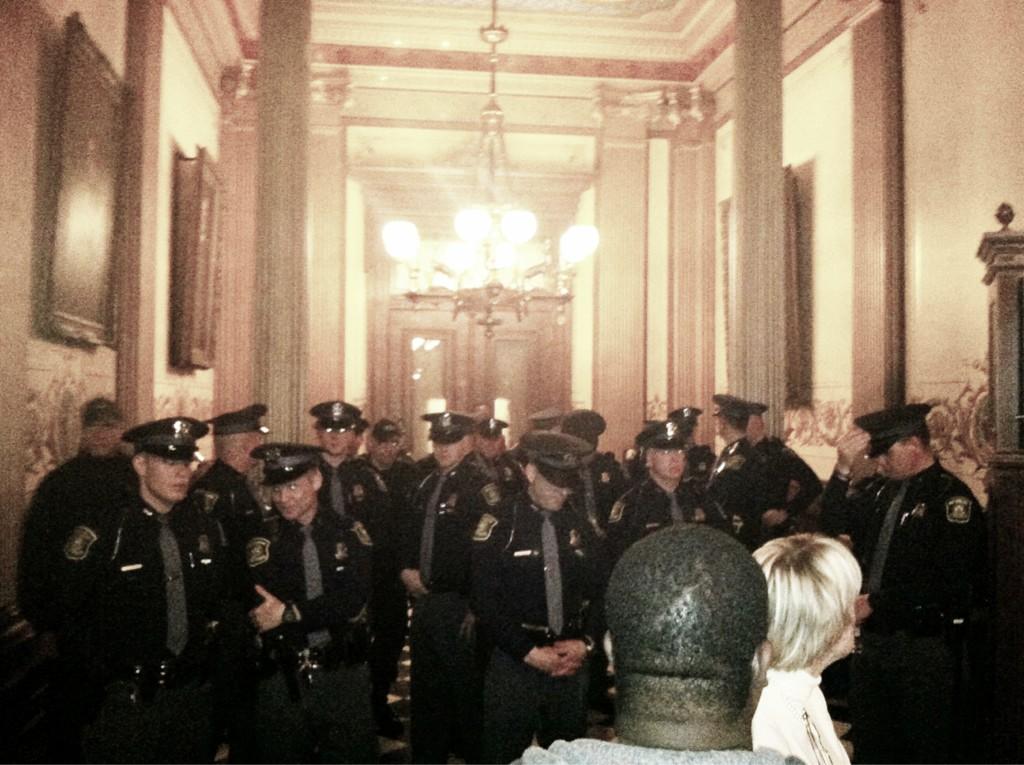
10 Things to Know About What Happened in Michigan On Thursday


Photo by @PeterKlein77 on Twitter

1.) The Michigan House and Senate yesterday passed so-called “right to work” bills. “Right to work” laws effectively defund the ability of workers to have a voice at their workplace. In 23 other states, these laws have lowered wages, weakened benefits, raised the poverty rate, and led to increased workplace injuries and deaths. The House passed one such bill and the Senate passed two.

2.) Republican leaders in Michigan were not honest about their intent. The morning began with Governor Rick Snyder reversing his earlier position on the “right to work.” He had previously said that the bill was “not on his agenda,” and that it was a divisive issue – but then yesterday, he suddenly urged the House and Senate to pass the bill and said he would sign it when it reached his desk. Similarly, Senate Majority Leader Randy Richardville previously opposed “right to work,” but expressed support for it on Thursday morning.

3.)  There were no committee hearings concerning the bills. With an issue this controversial, this is a highly unusual move. Republicans avoided the need for committee hearings by changing the intent of a previously passed bill.

4.) There was no floor debate concerning the bill. Another highly unusual move, considering the high profile “right to work” bill. But Republicans took advantage of their majority by ending debate on the bill before it started.

5.) 3,000 Michiganders showed up to express their opposition. Even though they only got word in the morning, there were 3,000 Michiganders at the Capitol in Lansing by 4:00pm when debate in the House was supposed to start.

6.) The public was not allowed inside the Capitol Building to observe the proceedings. Republican House Speaker Jase Bolger locked down the Capitol, locking approximately 3,000 Michiganders outside. It took a court order requested by Democrats to get the building opened again, but even then the Republican-controlled House did not pause their proceedings.

7.) Police arrested and in some cases used pepper spray on several individuals outside the building. These were Michiganders seeking to exercise their constitutional rights to assemble.

8.) The “right to work” bill is rigged so that it can’t be repealed. Republicans inserted a $1 million appropriation on the bill, which under Michigan law precludes it from being overturned by a citizen referendum. As blogger Chris Savage wrote, “not only was there no opportunity for public input before the bills were voted on, there will be none afterwards, as well.”

9.) Michigan Republicans are not unified around “right to work.” Six Republicans joined Democrats to oppose the bill in the House. It passed 58-52. In the Senate, four Republicans joined all 12 Democrats to oppose “right to work.” Furthermore, polling shows that a large majority of Michigan Republicans support collective bargaining.

10.) Time is short. Democrats put a “procedural speed bump” on moving the Senate bills to the House by one day, and there is a five-day mandatory waiting period before the House can take action.

Does all this undemocratic behavior make you mad? Us too. So here are 4 things you can do about this right now:
1.) Please join over
7,5008,500 advocates for working families by signing and sharing our petition to Gov. Snyder and the Michigan legislature.
2.) If you are in Michigan, you can call your State Senator now using our “click-to-call” system. Even if you don’t know who your Senator is, you can enter your address and get connected to the right person
3.) Join the #SaveMI Thunderclap by connecting your Facebook and Twitter accounts to spread the message about what’s happening in Michigan.
4.) Share, post, tweet, and email your friends and family about what’s going on. Follow @WorkingAmerica and @MIAFLCIO for updates, read Chris Savage’s excellent blog, and tweet with the hashtag #SaveMI.


Slam a spaceship into asteroid, save the Earth — it's that easy

This isn't stuff of movies — a physicist has proposed trying to deflect space rock in 2022       


NASA / JPL / JHUAPL
This color image of Eros was acquired by NEAR's multispectral imager on Feb. 12, 2000, at a range of 1,100 miles (1,800 kilometers). It is part of the final approach imaging sequence prior to orbit insertion and is intended to map the color properties of Eros across all of the illuminated surface.
By Tia Ghose

updated 12/7/2012 5:17:25 PM ET


It sounds like the plot of a bad Bruce Willis movie, but some experts are saying it should be a reality.

In order to prepare for massive asteroids that could aim for Earth in the future, researchers should ram a spaceship into a real asteroid to see if the space rock would shift course, scientists say.

The proposal, which was presented Wednesday at the annual meeting of the American Geophysical Union, would send two spaceships to deflect a small asteroid in a binary (double asteroid) system coming toward Earth in 2022. One spaceship would crash into the asteroid, hopefully deflecting it, while another would observe the collision.

"This is the biggest problem for planetary defense," said Andrew Cheng, a physicist at the Applied Physics Laboratory at Johns Hopkins, who is proposing the space mission. "There is a risk if we saw an asteroid coming towards us, we wouldn't know if we could do anything about it." 


Meteor impacts are rare, but they have devastated Earth several times in the planet's history. For instance, many scientists think a giant meteorite impact caused the massive extinction of the dinosaurs about 65 million years ago.

But while powerful space probes and telescopes can now see asteroids barreling toward Earth from far away, there's no real plan for stopping a giant one from wiping out humanity. While some have suggested bombarding asteroids with giant paintballs, or nuking an asteroid, Armageddon-style, very few of these schemes have been tested. NASA recently announced funding for a potential manned mission to an asteroid, slated for 2025.

In 2005, the European Space Agency floated a half-baked "Don Quijote" plan to aim a spacecraft into an asteroid to deflect it. But the plan targeted a very large asteroid that was pretty far away, making it both expensive and unlikely that scientists on the ground could actually measure the asteroid's deflection.
Instead, Cheng and his colleagues are betting that aiming at a small and close asteroid may be more feasible. Their goal is to crash into the smaller rock in a binary asteroid system called Didymos that is projected to travel past Earth in 2022. 

"We are targeting the smaller member of the binary," Cheng told LiveScience. "That will change the orbit of the system and that can be measured."

Because the asteroid is relatively modest-sized, about 500 feet (150 meters) wide, the spacecraft would be able to move it noticeably from its regular orbit, allowing the scientists to measure how much the spacecraft shifted the space rocks from their course. Since it will be just 6.5 million miles (10.5 million kilometers) from Earth, scientists can measure the deflection from the ground using telescopes, he added.

How it would work 

Cheng's team is proposing that NASA use a 600-pound (300 kg) spaceship to ram into Didymos, while another spacecraft funded by the European Space Agency, called the Asteroid Impact and Deflection Assessment (AIDA) would monitor the collision. Cheng's team has already applied to NASA for money to develop the idea, while a concept study for the ESA project is already funded, he said.

Testing the asteroid deflection on a binary system is smart, said Franck Marchis, an astronomer at the SETI Institute, who is not involved in the proposal.

"It's a perfect idea because the perturbations are more easily measured," Marchis told Space.com.

Even if successful, the deflection may not tell scientists whether a spacecraft could deflect a larger or different type of asteroid.

But this is just a first step, Cheng said.

"You've got to start somewhere."


Pearl Harbor (Never forget) 
On the morning of December 7, 1941, Japanese forces would initiate the eventual downfall of their own empire by conducting a surprise attack on the U.S.


World War II in Color: Pearl Harbor Attacked!
On December 7th, 1941 Japanese aircraft swooped down over Hawaii to attack the U.S. Pacific Fleet at Pearl Harbor prompting the U.S. to enter World War II. See it in color.


Pearl Harbor News: Live from Pearl Harbor
Watch this original video made from Pearl Harbor newsreels and radio broadcasts.


World War II in Color: Battle of the Coral Sea
May 4th-8th, 1942, the Imperial Japanese Navy plans to engage the U.S. Navy aircraft carries, but this time the U.S. and its allied forces are ready creating of the first naval battles in history.


World War II in Color: Japanese Navy's Gamble Fails
On June 3, 1942 Japan takes a gamble while attempting to attack U.S. Naval carriers, but a surprise awaits them.


Egypt arrests suspect in US ambassador's killing


Visit NBCNews.com for breaking news, world news, and news about the economy
Egyptian authorities have reportedly arrested a man suspected of being part of the deadly terror attack on the U.S. consulate in Benghazi, Libya. NBC's Ayman Mohyeldin reports.
By Ayman Mohyeldin and Charlene Gubash, NBC News

A suspect accused of involvement in the attack that killed U.S. Ambassador Christopher Stevens and three other Americans in Libya has been arrested in Egypt, two intelligence sources in Cairo told NBC News Saturday.

Mohammed Abu Jamal Ahmed, allegedly a member of a militant group, was detained in Cairo where he lives, the sources said.

In addition to the allegations that he was involved in the attack in Benghazi, he is also accused of transporting weapons from Libya to Egypt, the sources added.

Ahmed, in his late 30s, was in prison prior to the uprising that deposed former President Hosni Mubarak, but managed to escape in one of several prison breaks in the aftermath of the revolution, one of the sources said.
Ahmed has been known to Egyptian intelligence officials for several years and had "active relations" with radical militant groups involved in Iraq and Afghanistan, the source said.

The attack on the Libyan consulate, as it happened

Intelligence officials believe he was involved in trading arms in Egypt, many of which came from Libya.

Ahmed was being interrogated for a possible connection with the Benghazi attack because of his arms-trading connections with extremist groups both in Libya and Egypt, the source added.

Libya arrests four suspected in deadly US Consulate attack in Benghazi

The second source said Ahmed had fought in Libya during the uprising against ousted President Moammar Gadhafi.

But it’s not yet clear what exact role, if any, he may have played in the Benghazi attack.

Timeline: Political fallout from the attack on diplomats in Libya

He has not been charged in Egypt’s State Security Court, the judicial body that handles security cases.

There were conflicting reports as to when Ahmed was arrested with one source saying Friday and another saying he was detained a "few weeks ago.”

US Supreme Court to take up same-sex marriage issue


Visit NBCNews.com for breaking news, world news, and news about the economy
Just a day after Washington became the latest state to allow gay couples to marry, the U.S. Supreme Court will take a serious look at same-sex marriage for the first time ever. NBC's Pete Williams reports. (The playlist here shows all videos pertaining to equality of marriage and the high court)

By Pete Williams, NBC News justice correspondent

The U.S. Supreme Court agreed Friday to take its first serious look at the issue of gay marriage, granting review of California's ban on same-sex marriage and of a federal law that defines marriage as only the legal union of a man and a woman.

At the very least, the court will look at this question: When states choose to permit the marriages of same-sex couples, can the federal government refuse to recognize their validity? But by also taking up the California case, the court could get to the more fundamental question of whether the states must permit marriages by gay people in the first place.

The California case involves a challenge to Proposition 8, a constitutional amendment approved by 52 percent of voters in 2008. It banned same-sex marriages in the state and went into effect after 18,000 couples were legally married earlier that year.
A federal judge declared the ban unconstitutional, and a federal appeals court upheld that ruling, though on narrower grounds that apply only to California. Now that the Supreme Court is wading into the battle, the justices could decide the more basic issue of whether any state can ban same-sex marriage under the Constitution's guarantee of equal protection of the law. Or they could limit their ruling to apply only to the ban in California.

Recommended: O'Malley touts same-sex marriage - with signing photo and 'contribute' button

Nine states and the District of Columbia have moved to permit same-sex marriage or soon will — Connecticut, Iowa, Maine, Maryland, Massachusetts, New Hampshire, New York, Vermont, and Washington. 


Chip Somodevilla / Getty Images file
Same-sex marriage proponent Kat McGuckin of Oaklyn, New Jersey, holds a gay marriage pride flag while standing in front of the Supreme Court Nov. 30, 2012 in Washington, DC. 

The Supreme Court also agreed Friday to hear a challenge to the federal Defense of Marriage Act, known as DOMA, passed by overwhelming margins in both houses of Congress in 1996 and signed by President Clinton. A provision of the law specifies that, for federal purposes, "the word 'marriage' means only a legal union between one man and one woman as husband and wife."

Congress acted out of concern that a 1993 state court decision in Hawaii, which held that the state could not deny marriage licenses to same sex couples, might force other states to recognize gay marriage. As it turned out, Hawaii did not adopt same-sex marriage.

Because of DOMA, gay couples who wed in the nine states where same-sex marriage is permitted are considered legally married only under state law. The federal government is barred from recognizing their marriages. As a result, they are denied over 1,000 federal benefits that are available to traditional couples.

After first supporting DOMA in court, the Obama administration concluded last year that it violated the Constitution's guarantee of equal protection under the law.

"We cannot defend the federal government poking its nose into what states are doing and putting the thumb on the scale against same-sex couples," President Obama said in explaining the change.

Recommended: In lame duck session, positioning begins for immigration debate in 2013

Gay married couples in five states filed lawsuits challenging DOMA as an unconstitutional denial of their right to equal protection. After the Obama Justice Department declined to defend the law, House Republicans stepped in to carry on the legal fight.


Visit NBCNews.com for breaking news, world news, and news about the economy
NBC's Pete Williams reports on the Supreme Court's decision to take up two cases dealing with DOMA and California's Prop 8.

Defenders of DOMA argue that the law helps preserve traditional marriage.

"Unions of two men or two women are not the same thing as a marriage between a man and a woman. And only marriage between a man and a woman can connect children to their mother and father and their parents to the children," says Brian Brown of the National Organization for Marriage.

A Supreme Court decision striking down the Defense of Marriage Act would not, by itself, require states to allow same-sex marriages. But the federal government would be required to recognize those marriages in the states where they are legal.

The cases will be argued before the justices in March, with a decision expected by late June.


Visit NBCNews.com for breaking news, world news, and news about the economy

Rice under fire from left as Kerry's name won't go away
By Domenico Montanaro, 

NBC News Deputy Political Editor

It’s not just Benghazi anymore.


Image: U.S. Ambassador to the United Nations Susan Rice on Nov. 29.
One of the most controversial energy projects in the nation also has become a flash point in the drama surrounding who may become the next secretary of state – and it’s coming from the left instead of the right.

Back on Nov. 28, “OnEarth,” published by the Natural Resources Defense Council, dug into U.N. Ambassador Susan Rice’s financial disclosures and found that she and her husband have a stake in TransCanada, the company pushing for the Keystone XL Pipeline to be built.

NRDC officials say it's an important issue that must be discussed during the nomination process. But the timing of the report raises questions, as it is being surfaced by an environmental activist community that has previously given support to another potential secretary of state candidate – Massachusetts Sen. John Kerry.


Visit NBCNews.com for breaking news, world news, and news about the economy
NBC News' Mark Murray explains why the partisan divide over the potential nomination of U.N. Ambassador Susan Rice is intensifying. 

The decision on whether to approve the pipeline goes through the State Department.

“If confirmed by the Senate, one of Rice’s first duties likely would be consideration, and potentially approval, of the controversial mega-project,” Scott Dodd at “OnEarth” wrote. “Rice's financial holdings could raise questions about her status as a neutral decision maker.”

Dodd noted that “Rice owns stock valued between $300,000 and $600,000 in TransCanada, the company seeking a federal permit to transport tar sands crude 1,700 miles to refineries on the Texas Gulf Coast, crossing fragile Midwest ecosystems and the largest freshwater aquifer in North America.”

Bill McKibben, an anti-pipeline activist, told the publication: “It’s really amazing that they’re considering someone for Secretary of State who has millions invested in these companies. The State Department has been rife with collusion with the Canadian pipeline builders, and it’s really distressing to have any sense that that might continue to go on.”

Susan Casey-Lefkowitz, the NRDC's director of international programs, sounded a less strident tone a day later: "What's most important is that she rid herself of her holdings in TransCanada and other tar sands-related companies, and we're confident she will do that ... What's most important is that we have a good, thorough review done.”

Danielle Droitsch, a senior attorney for the NRDC and director of the Canada Project, told First Read: “We think Ambassador Rice has the credentials to be secretary of state, but if she were nominated, and then appointed, these holdings would have to be addressed.”

She added that “high-level officials dealing with Keystone should not have any conflicts of interest.”

The likelihood is that, if nominated, Rice will have to divest herself of her TransCanada investment to avoid a conflict of interest.


Visit NBCNews.com for breaking news, world news, and news about the economy
Will new Obama appointments come this week? Is there a way to get both John Kerry and Susan Rice into the Obama cabinet? NBC News' Chuck Todd and Time's Joe Klein join the discussion.

The environmental group’s effort to shed light on Rice’s financial interest in TransCanada could be just an attempt, if Rice is nominated, to get a “thorough review” and make sure it has a staunch ally in trying to thwart the project, as Casey-Lefkowitz said.

But could it also be a signal that the NRDC prefers another candidate for the job – Sen. John Kerry, the other of the final two candidates reportedly being considered for the post?

After all, environmental groups have strongly supported Kerry in the past and have a long working relationship with him. Like they would for most Democrats in a presidential election, for example, the NRDC and the League of Conservation Voters, among others, ran ads in the 2004 election boosting Kerry.
LCV even endorsed Kerry before the New Hampshire Democratic primary that year, although it has notably not spoken out about Rice.

Droitsch, however, would not address whom the NRDC prefers for the job.

“We’re trying to signal that the pipeline decision has to be conflict-free,” Droitsch said. “That would pertain to any potential nominee. The president has the prerogative to nominate the person he believes is best for the position.”

The Senate will then raise questions, however, she said. And “now is important to raise the issue ... We want to make sure that anyone who’s being considered would be free of those conflicts. That’s our primary interest right now.”

The NRDC, which has been very involved in efforts to block Keystone, is the environmental interest group most pressing the issue of Rice’s financials.

But others might not be as keen to see Kerry leave Capitol Hill. After all, consider that green groups already spent a lot of money trying to oust Republican Scott Brown from the Senate – and were successful.

But if Kerry becomes secretary of state (or even defense secretary), his seat would become vacant, raising the potential for a costly and competitive special election.

“Who cares if the U.N. ambassador has a TransCanada stock. Who cares if the head of the FDA has TransCanada stock,” said a Democratic strategist and ally of the administration who is a veteran of confirmation battles.

“If she [Rice] were to be nominated, she would go through a process by which we look for financials conflicts. Maybe this stock would be identified as something that posed a conflict, and she would sell," the strategist said. "But she hasn't gone through that process, because she's not a nominee to anything. If they want to say that if she is the nominee, she should sell the stock, that's fine. But you can't legitimately hit her for having it now. And that is likely why NRDC backed off and no other environmental groups have piled-on.”

What really is going on here likely has less to do with Rice and whether she should ascend to secretary of state, and more with the NRDC leveraging pressure on the president and the administration to make sure the pipeline is rejected again once it comes up for approval. And that could be soon.

The next step in that approval phase, in fact, could come as early as next week, Droitsch said. TransCanada has applied for a shortened pipeline in hopes of having that approved – something the NRDC strongly opposes. A Supplemental Environmental Impact Statement could be released by the State Department as early as next week, Droitsch said.

“It is critically important for there to be independent decision-makers, free of conflict of interest, who can take an independent view,” she said.

She then tied the administration’s decision on the pipeline to climate change, an issue that has regained prominence as a result of Hurricane Sandy. In the days following Sandy’s landfall, in fact, New York Mayor Michael Bloomberg endorsed President Barack Obama for his leadership on climate change.

How Obama decides on the pipeline “signals where the U.S. is headed in terms of importing dirty fuels, inconsistent with an administration that is committed to fighting climate change,” Droitsch said.

“We’re confident President Obama understands the seriousness around the issues surrounding this pipeline. Approving it sends the wrong signal about our country’s commitment to climate change. Yes, he’s under a lot of pressure, but the public is very concerned about this. It’s not a decision I know he’ll view lightly.”