Pages

Monday, November 5, 2012


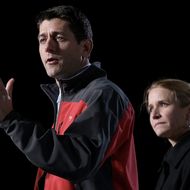
Ryan says Obama's policies threaten 'Judeo-Christian values'
24
hours ago  

                      
By NBC's Alex Moe
CASTLE ROCK, Colo. -- Less than 48 hours before polls open on Election Day, Republican vice presidential nominee Paul Ryan gave a firm warning to a group of evangelical Christians Sunday night: President Barack Obama’s policies jeopardize Judeo-Christian values. 

"And in these critical battleground states, it's going to make the big difference as to whether or not people are worried about where America's headed, worried about whether we're going to reassert our Constitution, or whether or not we're going to go down the path the president has put us on," Ryan said speaking on a Faith and Freedom Coalition tele-townhall with thousands of voters across the country.

He continued, "It's a dangerous path, it's a path that grows government, restricts freedom and liberty, and compromises those values, those Judeo-Christian, western-civilization values that made us such a great and exceptional nation in the first place."

A Ryan campaign spokesman told NBC News about Ryan’s comments: "He was talking about issues like religious liberty and ObamaCare - topics he has mentioned frequently during the campaign." 

Mitt Romney has also shared similar comments about Judeo-Christian values, such as during his commencement address at Liberty University in May 2012.

The Faith and Freedom Coalition is an influential evangelical grassroots organization headed by Ralph Reed. The tele-town hall tonight was only advised by the group and never by the Romney campaign. It was a call that had been re-scheduled at least once due to scheduling conflicts. Ryan fielded questions from several callers in between campaign rallies in Minnesota and Colorado.

Asked by a caller from Florida about how his faith has helped him as Romney’s running mate, Ryan said it “sustains” and “humbles” him.

“We [Ryan’s family] pray throughout the day. I keep a rosary in my pocket, whatever jacket I've got, and I'm given so many prayers from people,” the Wisconsin congressman said. “I'm one of those people who don't think you can separate your faith from your public life as an official from your private life. It informs you, it guides you, it makes you who you are, and it gives you great peace. First prayer I say every morning is the Serenity prayer.”

Ryan also noted he received an email from his pastor in Janesville, Wis. tonight with the words: “have no fear.” “And that's how the Lord sustains me. No fear,” Ryan added.

Paul Ryan Says Obama Threatens ‘Judeo-Christian Values’ With Health Care Plan


Yesterday at 11:22 PM

By Adam Martin

In public, Paul Ryan's attacks on the Affordable Care Act (a.k.a. Obamacare) have been largely economic ones, from that viral video of him arguing to the president in person that the plan merely hides spending and doesn't cut it, to his speech at the Republican National Convention, in which he argued, falsely, that the plan would raid Medicare. But in a conference call with evangelical voters on Sunday he changed tack dramatically, claiming a second Obama term would compromise "those Judeo-Christian values that made us a great nation in the first place."

The telephone town hall with the Faith and Freedom Coalition wasn't exactly a secret. Politico, NBC, and Buzzfeed have all posted stories on it, and Huffington Post's Amanda Terkel tweeted about it, not to mention the fact that it drew thousands of participants. But as Buzzfeed's Zeke Miller pointed out, the call "did not appear on his public schedule," which suggests the campaign didn't want to make it a media event.

There are a few angles to this that are worth considering. The first is that this is some pretty unhinged rhetoric for a candidate seeking national office. It's expected that Ryan would condemn President Obama's agenda, but to argue that the agenda threatens the values of "western civilization" is qualitatively different. It's the kind of extremism we might expect from a televangelist, not a vice presidential candidate two days before an election.

Second, the tele-townhall event was organized by the Faith and Freedom Coalition -- the group formed by disgraced Republican lobbyist Ralph Reed. Common sense might suggest the Romney campaign would keep its distance from such a scandal-plagued figure, but for months, the Republican ticket has done the opposite.

And finally, all of this serves as a reminder of the part of Ryan's persona that's often overlooked: the so-called budget wonk is also a fierce culture warrior.

The perceptions of Ryan in much of the media notwithstanding, Ryan has fought against contraception access; he's worked with Todd Akin to redefine rape; he believes the government should force women impregnated by rape or incest to carry their pregnancies to term; he co-sponsored a "Personhood" measure that would ban in-vitro fertilization and some forms of birth control; and twice voted for a constitutional amendment to prevent marriage equality.

It's with this record in mind that Ryan tells the religious right that the White House is at odd with "Judeo-Christian" values. The rhetoric is only surprising to those who forget what a culture warrior this guy really is. 
But calling the president a threat to people's very religious values is the kind of hyperventilating paranoia that a candidate should maybe stay away from here in the waning days of the campaign.


If Romney loses…
By: Alexander Burns and Maggie Haberman
November 5, 2012 04:39 AM EST
Mitt Romney is shown here. | AP Photo
If Romney loses, the GOP will have to go through a painful process of self-examination | AP Photo

For Republicans, the only thing harder than losing to Barack Obama might be explaining it.

By any reasonable standard, Obama is a seriously vulnerable incumbent: a president overseeing a limping economy, whose party got thumped in the 2010 midterm elections and whose signature accomplishment of health care reform is highly controversial. Whatever his strengths on national security and personal likability, Obama probably began the 2012 campaign as the most beatable sitting president in 20 years.
So if Obama manages to defeat Mitt Romney on Tuesday, the Republican Party will have to go through a painful process of self-examination and internal debate in order to explain what went so badly wrong.

The debate won’t just be fodder for political obsessives: It will also determine how Republicans approach governing next year and how the party campaigns in 2014, 2016 and beyond.

Even before tomorrow’s vote, the post-election arguments about why Romney lost — if he does — are beginning.

(PHOTOS: Final countdown to Election Day)

Here’s a POLITICO preview of the top arguments Republicans would use to explain and excuse it:

Mitt Romney was a historically bad candidate

If Romney wins on Tuesday, he’ll be president of the United States. If he loses, he’ll be the fall guy for the entire Republican Party.

Republicans weren’t overjoyed about nominating Romney in the first place, partly because he was a shade too moderate for their taste, but also because he was such an inept competitor in the 2008 primaries.

Win or lose, Romney has validated many of those fears, careening from misstep to misstep throughout the 2012 race. If Romney wasn’t fumbling his response to the Supreme Court’s Affordable Care Act ruling, he was offending the British on the eve of the London Olympics or getting caught on tape bashing Americans who don’t pay income taxes.
On a deeper level, Romney was a problematic candidate for 2012. In a campaign still shadowed by the meltdown of the financial services industry, the GOP picked a candidate as close to Wall Street as any in history. Former Mississippi Gov. Haley Barbour said in August that Democrats had branded Romney as a “wealthy plutocrat married to a known equestrian.” He was right, and Romney may have been more vulnerable to such attacks than any other major Republican in America.


If Romney loses, who's to blame?


Relentlessly attacked by Democrats for his Bain Capital record, Romney never responded in an effective way. He stuck to his script that Obama hadn’t successfully steered the economy back to solid ground, failing to flesh out his own agenda until late in the game and even then only vaguely.

If Republicans come up short in Senate or House races, too, they’ll gripe about the lack of Romney coattails. It probably won’t be fair for the party to blame Romney for all its failings down-ballot, but it’ll happen anyway.

Oh, Sandy

Over the weekend — days before the election ends — Republicans were already pointing toHurricane Sandy to explain a Romney loss. The argument goes like this: Wall-to-wall news coverage of the superstorm, combined with the loss of life and uncertainty about how to campaign in the shadow of a tragedy, stalled Romney’s momentum.

Obama took charge of storm-relief efforts, visiting hard-hit sites, and Americans tend to rally around the president in a crisis. The glowing praise for Obama from New Jersey Gov. Chris Christie, a top Romney surrogate, also didn’t help the Romney cause.

Karl Rove told The Washington Post that the storm allowed Obama to be a “bipartisan figure this week. His has been the comforter-in-chief and that helps.” Barbour told CNN’s Candy Crowley that the storm “broke” Romney’s momentum.

And News Corp. Chairman Rupert Murdoch attacked Christie on Twitter, declaring that he “must re-declare for Romney, or take blame for [the] next four dire years.”

There’s no question that the storm has aided Obama in terms of media coverage, and praise from the opposing party is always useful. But Christie’s power to swing an election — one largely being fought in Midwestern states unaffected by the storm — is seriously questionable. So, too, is the idea that Romney was assured victory in a tight, 2-point race before the storm hit.

We can’t know what would have happened if the storm hadn’t hit. But there were strong indications before it landed the week before the election that Romney’s momentum was stalling, and that the Republican had failed to capitalize on his strong first debate performance with enough gusto.

What’s more, had Romney run a more effective campaign over the past year, he wouldn’t have had so much riding on the last month of campaigning — and a single blown debate by Obama — to vault him over the top.

Stuart Stevens blew it

Every time Romney has flagged in the 2012 race, a chorus of conservative critics have directed their ire at Stuart Stevens, the flamboyant Mississippi native and auteur who serves as Romney’s chief strategist. The last man standing after a messy internal fight among Romney’s 2008 advisers, Stevens was a target from the beginning.

Stevens’s basic methodology for winning races goes like this: run a center-right candidate through a Republican primary by focusing on the general election, then focus relentlessly on the incumbent while taking as few specific policy positions as possible.

This approach appears to work better in statewide races than it does in a presidential campaign, when voters seek more specificity and a genuine personal connection with their candidates. Yet Stevens never strayed from this strategy, leaving Romney largely undefined to the national electorate as Democrats tore up his record at Bain Capital and as governor of Massachusetts.

Stevens was the chief speech writer, traveling strategist, ad-maker and overseer of the campaign’s in-house ad buying strategy. Romney’s convention speech, prepped on the fly, made a rookie mistake by omitting a reference to the Afghanistan War. Romney’s ads were criticized as banal, cookie-cutter pieces that never broke through. The ad-buying strategy, reviewed at length by POLITICO, left Romney outflanked by the Obama campaign in key markets across the country.

To be sure, Stevens is not the only person in Romney high command who would (and should) take blame for a loss. But as a favorite punching bag for conservatives throughout the cycle, there’s no doubt he would be a whipping boy on Nov. 7.

Immigration was a fatal blunder

It’s been one of the most consistent — and for Republicans, alarming — features of 2012 polling: Romney is getting blown out with Latino voters. And he pretty much made his own bed with this powerful and growing demographic.

As early as September 2011, when Romney was running to Rick Perry’s right on immigration — Romney’s most memorable line on the subject was that illegal immigrants should choose to “self-deport” to their native countries — Republicans privately fretted that Romney was digging himself a demographic hole.

They were right: Romney’s likely to lose Latinos by a wider gap than McCain’s 36-point margin of defeat. That could push states like Nevada, Virginia, Florida and Colorado into Obama’s column, and if Obama wins just a few of those battlegrounds, it will be exceptionally difficult for Romney to win nationally.

Should that scenario come to pass, Republican elites — who have long feared confinement to an aging and white voter base — will be ringing the alarm bells Wednesday morning. Some party leaders haven’t waited until after Election Day to raise the hue and cry.

In an interview with New York magazine, former Florida Gov. Jeb Bush compared the party’s predicament with Latinos to Monty Python’s hapless Black Knight: “We’re competing with ninjas, you know, guys with big, sharp knives, and we have no weapon, and we’re playing like we’re fighting them, and we get an arm cut off — ‘Oh, it’s just a flesh wound’ — and we’re down to the trunk.

It was a mistake to nominate a moderate — again

For much of the Republican base, the past four years carry a straightforward lesson: When you nominate an ideological squish like John McCain, you lose. When you run on big, bold, conservative ideas — as the party did in 2010 — you win.

Romney has embraced many of the ideas of the 2010-vintage GOP, selecting Paul Ryan as his running mate and embracing staunchly conservative goals like defunding Planned Parenthood. But for most on the right, Romney remains the “Massachusetts moderate,” as Newt Gingrich christened him during the GOP primaries.

Back in the Republican nomination fight, Rick Santorum called Romney the “worst Republican” to put up against Obama, since he couldn’t draw a bright-line contrast on health care and other issues. Should Romney lose on Tuesday, this argument will be back in force.

There are a bunch of holes in this argument. Romney has taken serious damage with women and Latinos as a result of hewing to the conservative line on abortion and immigration. It’s a dubious proposition that Romney would be better off campaigning harder on issues like privatizing Medicare.

But in the race’s final month, old Mitt — the one who passed universal health care in Massachusetts as governor — seemed to re-emerge on the campaign trail, promising no tax cuts for the wealthy and that government can indeed do good things. It was his strongest month of the campaign.

Where Romney has clearly fallen short is offering up a compelling positive vision for the country, not necessarily a compelling, orthodox conservative vision. His longtime conservative critics will still whack him on this count with verve.

It was all the media’s fault

Claims of media bias from both sides are nothing new in presidential politics. But the Romney campaign has long lamented that the press is out to get them, with the candidate, his wife and top surrogates openly complaining that they can’t get a fair shake.

Romney and his campaign have viewed their press coverage as routinely savage, feeding into the Obama campaign’s caricature of Romney as a non-mustachioed Snidely Whiplash. Reporters, the Romney team has complained, are more interested in gaffes than in policy, even if that means taking Romney out of context.

Yet the reality is Romney also did little to make an affirmative case for his candidacy and his character until late in the game. When the Obama team attacked, Romney and his spokespeople resisted responding to the press, declining to comment on stories and then attacking them as biased and factually flawed only after they appeared in print.

For most of the 2012 cycle, Romney’s campaign invested little energy into making its case to and building relationships with the national media. Romney conducted relatively few interviews, favoring softball appearances on Fox News and interviews with radio hosts like Hugh Hewitt. His spokespeople didn’t reliably answer press requests, even benign ones. The assumption was that the press is either irrelevant or simply trying to cause trouble.

But treating the media as a hostile force can be a self-fulfilling prophecy: Denying reporters basic access and refusing to answer straightforward questions about policy and strategy are a pretty surefire way to deprive yourself of positive coverage.

Democrats have complained about the media, too, attacking the press covering the 2012 campaign for not fact-checking Romney aggressively enough and for buying in too credulously to the “narrative” of Romney’s October momentum. But few on the left have made these complaints a primary explanation for the state of the race.


New Obama book has 2nd-term plan
By: Mike Allen
October 23, 2012 08:47 AM EST


Faced with persistent calls for more detail about what a second term would look like, President Barack Obama on Tuesday released a glossy, 20-page repackaging of the plans he has announced on subjects from energy to education.

Obama planned to unveil the booklet, “The New Economic Patriotism: A PLAN FOR JOBS & MIDDLE-CLASS SECURITY,” at an event in Delray Tennis Center in Delray, Fla.

The president, Vice President Joe Biden and other campaign surrogates plan to hold up the booklet at rallies as they barnstorm swing states in the final two weeks before Election Day on Nov. 6.

(Also on POLITICO: Media: Obama in fighting mood)

The campaign says 3.5 million copies are being printed, with 1.5 million of those being sent to field offices.

“We’re launching a full-scale, multiplatform organizational effort,” a campaign official said, “that will include direct mail, advertisements and distribution at field offices to ensure every voter knows what a second term of an Obama presidency would mean for middle-class Americans.

“The president, vice president and all of our surrogates will hold up the plan at events and ask our massive grass-roots network to do everything they can to share the plan with their family, friends, neighbors, co-workers and others to reach every undecided voter in the remaining days of this election and ensure they understand the choice between continuing to move America forward and going back to the same policies that devastated our economy and punished the middle class.”
A distilled version of the plan was available previously on the Web atwww.barackobama.com/plans.

Here are links to Obama’s booklet:

Cover and “Economy”…

—“Manufacturing” and “Energy” —“Small Businesses” and “Education” —“Tax Plan” and “Health Care” —“Retirement” and “Moving America Forward” —Back cover

(See also: The latest presidential polls)

Obama on Tuesday released his version of “Morning in America,” a 60-second spot, called “Determination,” that will air in seven states — Colorado, Florida, New Hampshire, North Carolina, Ohio, Virginia and Wisconsin.

Obama says to the camera: “There’s just no quit in America, and you’re seeing that right now. Over 5 million new jobs. Exports up 41 percent. Home values — rising. Our auto industry — back. And our heroes — are coming home. We’re not there yet — but we’ve made REAL progress, and the last thing we should do is turn back now.
“Here’s my plan for the next four years: Making education and training a national priority; building on our manufacturing boom; boosting American-made energy; reducing the deficits responsibly by cutting where we can, AND asking the wealthy to pay a little more. And ending the war in Afghanistan, so we can do some nation-building here at home. That’s the right path. So, read my plan. Compare it to Governor Romney’s, and decide which is better for you. It’s an HONOR to be your President. And I’m asking for your vote. So, together, we can keep moving America forward.”

See the ad here.


Over the next three days, the Obama advance machine will show its might, as the president hits seven states (two of them twice), starting in Florida on Tuesday morning, then meeting up with Vice President Biden in Dayton in the afternoon.

After overnighting at the White House, the president is off to Davenport on Wednesday to begin an “America Forward!” tour, which the campaign describes as “a two-day, around-the-clock campaign blitz.” He continues to Denver, then holds a late-night event in Las Vegas. He flies overnight to Tampa for a Thursday morning rally, then on to a tarmac event in Richmond.

After that, he goes home to Chicago to become the first sitting president to cast an early vote in person. Then, it’s back to Ohio for an evening event in Cleveland.

“As the President crisscrosses the nation,” the campaign said in its announcement, “he will spend time on Air Force One calling undecided voters, rallying National Team Leaders and volunteers and continuously engaging with Americans across the country about the choice in this election.”


Jobs.plan.Booklet


If Obama loses…
By: Alexander Burns and Maggie Haberman
November 5, 2012 04:39 AM EST


Barack Obama is shown here. | AP Photo
A loss for Barack Obama would be a traumatic letdown for the Democrats. | AP Photo


A defeat for Barack Obama on Tuesday would be no ordinary loss for Democrats.

It would be a traumatic experience: the death of the dream of liberal realignment embodied in Obama’s insurgent 2008 campaign. And it would be all the more distressing to Democrats because so many of them fervently believe they will win tomorrow.
Unlike Republicans, many of whom have no particular love for their nominee, Democrats admire and sympathize with the president, understanding he came into office at a difficult time. If Obama were to lose, Democrats would suddenly be leaderless for the first time in half a decade and would be forced to confront agonizing questions about the viability of their party’s agenda — health care reform, most of all.

Here’s POLITICO’s preview of how Democrats would try to explain an Obama defeat — including some of the foreseeable arguments and spin:

Obama threw it away in Denver

At the end of September, Obama led his opponent in essentially all credible national and swing-state polling, Mitt Romney’s personal favorability was stuck underwater and the former Massachusetts governor was caught in a whirlpool of controversy around the “47 percent” tape.
And then the first debate happened.

With a strangely passive debate performance, making no mention of the “47 percent” video and even suggesting he and Romney agreed on the the future of Social Security, Obama gave the Republican a massive new opening in the 2012 campaign. Romney’s swing-state numbers leaped upward, his personal favorability surged and in national Pew polling he went from a 8-point deficit to a 4-point lead over Obama.


If Obama loses, who's to blame?


If Romney emerges the victor on Tuesday night, some percentage of Democrats will say that the reason is really very simple: Obama self-immolated on a single night at the University of Denver. Had the president been the fierce competitor that night that he was in the two successive debates, he could have ended the race on Oct. 3. Instead, Obama barely showed up.

(Also on POLITICO: The best stories of 2012)

The Obama campaign doesn’t buy this read on the race. It has argued in recent weeks that the movement in polls following the first debate was just a matter of Republican-leaning swing voters coming home to Romney. Those voters, they say, would ultimately have voted for Romney anyway.

But it’s impossible to prove that hypothetical. All we know for sure is that Obama was securely in the lead before the debate and on the defensive afterwards.

The Bush economy killed him

The president has reminded the nation repeatedly during 2012 that the economic climate was horrendous when he arrived in the White House, after the 2008 housing meltdown and the collapse of Lehman Brothers and Bear Stearns. Some Democrats will certainly call a Romney victory just one more consequence of that crisis.

And there is no question the president took charge during very difficult times, as the country entered a long and painful recession. Obama has pointed to signs of life in the economy — an incrementally dipping unemployment rate, a revived auto sector — to argue that his policies have been effective, if not as robust as some voters would like.

Former President Bill Clinton bolstered Obama’s case at the Democratic National Convention, saying that no one — not Clinton and not any previous president — could have fixed all that ailed the nation in four years. Obama adviser David Axelrod has long pointed to George W. Bush’s policies to explain the bulk of Obama’s struggles, and the Obama campaign has hung Bush around Romney’s neck for months (an anchor Romney has struggled to jettison).

But Republicans argue in response that Obama had four years of his own to change course, and they have a point. Whether Obama’s own accomplishments — the stimulus and the Affordable Care Act in particular — were ultimately helpful or hurtful, there is room for criticism of Obama’s economic agenda over the last four years.

That won’t stop Democrats from arguing, however, that the damage Bush did to the economy was so deep, so lasting and so insurmountable that perhaps nothing at all could have saved Obama politically.

It was the second-term vision thing

Obama and his allies did a splendid job of tearing down Romney throughout the spring and summer. What the president hasn’t done nearly as effectively is lay out an inspiring agenda for the next four years.

The closest Obama came to detailing his second-term plan was in an off-record conversation with the editors of the Des Moines Register — an interview the White House subsequently released to the public. In it, Obama said over the next four years, he hoped to cut a big debt-reduction deal and pass immigration and education reform.

But Obama hasn’t been so specific or assertive on the campaign trail, touting the economic progress the country has made but giving voters little in the way of specific proposals to energize a stalled job market. Part of that is because Democrats are authentically optimistic that things are already on the right track and job creation will pick up naturally in the next four years anyway.

But another part of the problem is that Obama’s team expected the country to bounce back from the 2008 meltdown far faster than this. Since the V-shaped recession they anticipated failed to materialize, Obama has often seemed at a loss for new ideas and arguments about improving the economy.

Democratic strategists James Carville and Stan Greenberg — who have authored several memos needling the Obama team in 2012 — wrote a missive to the Obama campaign urging a more forward-leaning message for the president to stump on.

“To come back strong, the president must address future policy choices in a much bolder way,” the memo said, “and he must make this election about choosing a country that stands up for and elevates the 47 percent versus a country that tells its seniors, veterans, the working poor, the disabled, and, yes, the struggling middle class: ‘You are on your own.’”

Citizens United, the super PACs and the Koch Brothers did it

Pick practically any day in calendar year 2012, and odds are you can find a prominent Democrat lamenting the flood of outside money into the presidential campaign. And into Senate campaigns. And into House campaigns.

The 2012 elections have indeed been preposterously expensive. In October alone, outside groups disclosed over half a billion dollars in independent expenditures. Republicans have led the way, with American Crossroads, Crossroads GPS and the pro-Romney group Restore Our Future spending over $170 million together last month, according to an analysis by POLITICO’s Dave Levinthal.

If the president doesn’t get reelected, one of the most predictable Democratic excuses will be that all that money simply overwhelmed him.

The trouble with that argument is that Obama and his outside-group allies haven’t been slouches, either. While Democrats came late to the super PAC game, three such groups — Priorities USA Action, Majority PAC and House Majority PAC — spent $75.5 million in October. Obama and Romney have raised over a billion dollars each for their campaigns and national party committees.

And while Democrats still bemoan outside money, Priorities USA was the chief purveyor of the one of the sharpest and most effective attacks against Romney, turning his background at Bain Capital into a negative and leaving a permanent negative mark on his poll numbers.

And for all the money Obama’s foes have raised, the Wesleyan Media Project reported last week that pro-Obama ads have actually outnumbered pro-Romney ads by nearly 50,000 nationwide.

If the avalanche of spending in 2012 has had an impact on the presidential contest, it has likely been to blunt Obama’s natural strengths as an incumbent, more than to give Romney some kind of new advantage.

He lost for a noble cause: national health care

The Affordable Care Act was an albatross for the president for much of the last two years, even as internal polling on both sides shows it has gained popularity.

It was the defining policy initiative of the president’s term, but the process of enacting it wasn’t pretty. Republicans picked apart the law in the 2010 campaigns, using Nancy Pelosi’s infamous line — that Congress had to pass the law so that voters could find out what was in it — as a symbol of a messy and backroom legislative process. Members of the president’s liberal coalition, meanwhile, resented both the secretive negotiations and the lack of a single-payer option in its final version.

On the list of reasons why Democrats lost their sizable House majority in 2010, the law known as “Obamacare” ranks high.

In 2012, Republicans have continued to pummel the health care law — even with Romney, who passed a similar law as governor of Massachusetts, running as Obama’s opponent (Romney has said he would seek to repeal the law and issue waivers to states that don’t want to implement it). Lawmakers who voted for the ACA still hold it at arm’s length and few red-state Democrats have campaigned with the president.

In other words, Obama achieved one of the Democratic Party’s longest-standing policy objectives, but he paid a dramatic price for it.

Obama’s aides argue this was a worthwhile goal for the country, and wave off questions about the price tag, politics and legislative mechanics. Over the long run, they say, the country will embrace the law and appreciate what Obama achieved by signing it. But the cost of passing the law may look different if a President Romney guts it upon taking office.

It all comes back to race

Race has been a surprisingly little-discussed topic — at least among politicians, in public — during the term of the first African-American president in American history. But Obama’s race has hovered over the politics of the last four years, in ways many on the left might point to in explaining his defeat.

Over the summer, Democrats were livid over a series of Romney campaign commercials attacking an Obama administrative decision related to work requirements in the 1996 Clinton welfare reforms. Romney’s ads accused Obama of “gutting” welfare reform — a charge that wasn’t accurate, and which many Democrats argued played into lingering anxiety about Obama among working-class white voters. Few party leaders said so publicly, but in private they worried it would have an impact.

It’s with those voters that Obama has struggled most in the polls. He trails among whites nationwide and is losing by titanic margins in the South. Ohio, where Obama’s auto bailout is popular, is a notable exception as far as white support for Obama is concerned.

Obama’s race may not have hobbled him in the 2008 campaign, but if he cannot win another term, some in his party may at least partially blame it on once-dormant white resistance to the idea of a black president.

The president’s advisers believe race was a subtle issue throughout Obama’s term in office, despite his relatively strong performance with whites in 2008. But Obama and his team have mainly sought to avoid discussions of race since the 2008 campaign, believing it’s a losing proposition for them.

Obama has only engaged in race-related conversations on rare occasions. After criticizing Cambridge, Mass., police officers for having arrested Henry Louis Gates Jr., the prominent black professor, in his own home, Obama has typically steered clear of such controversies. Earlier this year, he spoke out on the shooting of a black teen, Trayvon Martin, in Florida. But he has also emphasized that he isn’t — as he told an African-American media outlet this year — “the president of black America.”

Monday's campaign round-up

  -  

Today's installment of campaign-related news items that won't necessarily generate a post of their own, but may be of interest to political observers:

* It's obviously late in the game for new ads, but the National Jewish Democratic Council released a video the other day featuring Barbra Streisand urging Jewish voters to support President Obama. It comes on the heels of an endorsement from Israel's Haaretz newspaper, who calls Obama "good for Israel."


* PPP's final Ohio poll shows Obama leading Mitt Romney by five, 52% to 47%.

* PPP's final Florida poll shows Obama up by one, 50% to 49%.

* PPP's final Iowa and New Hampshire polls show the president ahead by identical margins, 50% to 48%, though the final WMUR poll shows Obama up by four, 50% to 46%.

* PPP's final Colorado poll shows Obama ahead by six, 52% to 46%.

* PPP's final North Carolina poll shows the candidates tied at 49% each.

* In Connecticut, Republican Senate hopeful Linda McMahon is using materials that make it appear she and the president are on the same side, hoping voters forget which party's she's in.

* In Missouri, PPP's final poll shows Sen. Claire McCaskill (D) ahead of Todd Akin (R), 48% to 44%.

* In Massachusetts, a Western New England University poll shows Elizabeth Warren (D)leading Sen. Scott Brown (R) by four, 50% to 46%, while PPP finds Warren ahead by six, 52% to 46%.

* In Montana, PPP shows Sen. Jon Tester (D) with a two-point edge, while Mason-Dixon shows Rep. Denny Rehberg (R) ahead by four.
First polls open in 15 hours. 

  This is my opinion and it is with an open mind and palpitating heart whether Obama gets re-elected, or Romney gets to be the next president.  I will grit my teeth and dive into my blog with all the focus and love for my country that I have.

  I have been covering the Chronicling of Mitt's Mendacity, since the beginning. It has been eye opening. It has been awe inspiring.  I still find it hard to imagine that people would want an habitual liar as their President.  Tomorrow will tell that tail.  I am scared, I am constantly sick, there are times I can not eat, without barfing everything up. This man as our President, is frightening, I do not want this liar, this provocateur of the wealthy, the man, the republicans, who would take away women's rights and hand them to big government and the companies we work for to give us our health care.

  I worry about the debt and what Romney's plan will do to what we owe, I wish Obama had given more facts, more cohesiveness to his plan. The idea that Romney would, take Obamacare away from Americans, when it has not been totally implemented, and leave millions without health care, and he has no plans to do health care. Medicaid, medicare, Social Security, Food stamps, He plans to dismantle, block grant back to the states, voucherize, make market accounts tied to Wall Street, where people could lose everything. 

  I know that these have to be changed, streamlined, so that they will be available for future generations, I get that. I know that President Obama has tried to take these on and Democrats and Republicans have stepped in the way, and they all know they will have to compromise, a give and take, so lean across the aisle and shake hands and listen to each other and your constituents, because they are the ones that voted you in and they can vote your ass out. 

  Open your minds, open your hearts, turn up your hearing aides, and listen to what people have to say, their ideas, because somewhere there is an answer for both parties and the American people.      

  I sit here and think about what our world will be like if things go the Republicans way tomorrow, I am only one person, my daughter and son in law have several times threatened to cut me off from my political news, and that is because I get so fired up and do not take care of myself, they worry about me and keep telling me it is what it is and to stop killing myself.  I keep hoping I make a difference, even to one other person. I have been doing this blog since 2009, I missed the first several months, cause I hadn't really thought of following politics, news, current events.

   I will keep on following even if tomorrow at least for me turns out so very wrong, because I love this country, I still have high hopes for the people of this country, I will be following tomorrow very carefully, because I know there will be people trying to stop the vote, scaring people enough to get them not to vote.  New York and New Jersey, Connecticut, who will be voting in the most despicable conditions, they will be emailing votes, faxing votes, provisional ballots, and absentee ballots. They have had to move voting places around because of Sandy. Some of those votes, ballots may take up to ten days to be counted.  

   I am hoping that everything will turn out good, no problems, no hassles,  that all Americans will be able to vote tomorrow, no matter how late voting places might be open. I will be voting tomorrow, in Pennsylvania, where there is no early voting, and where there has been republicans who have tried to make voting harder for latino's, poor, blacks, and single women. 

  They say that conservatives are strongly saying Romney will win tomorrow, that the polls are 'biased' that they should show double digits for Romney, what some are worried about is if Romney loses, what is going to happen with conservatives, voting rigged, voting fraud, to court! -  to stop this skullduggery. Will it look like 2000 all over again.   Will the republicans yell foul! will the democrats yell foul! It will be an interesting next couple of days, or maybe weeks.  

A voting debacle in Doral causes chaos and confusion

By Patricia Mazzei, Amy Sherman and Kathleen McGrory

Posted on Sun, Nov. 04, 2012


El Nuevo Herald Staff / Hector Gabino


Miami-Dade voters wait in line Sunday, Nov. 4, 2012, at the elections office in Doral to pick up absentee ballots.
What began Sunday morning as an attempt by the Miami-Dade elections department to let more people early vote devolved into chaos and confusion only days before the nation decides its next president.Call it the debacle in Doral.

Elections officials, overwhelmed with voters, locked the doors to their Doral headquarters and temporarily shut down the operation, angering nearly 200 voters standing in line outside — only to resume the proceedings an hour later.

On the surface, officials blamed technical equipment and a lack of staff for the shutdown. But behind the scenes, there was another issue: Miami-Dade Mayor Carlos Gimenez.

The Republican had never signed off on the additional in-person absentee voting hours in the first place.

“That was counter to what I said on Friday, which was we were not going to change the game mid-stream,” he said. “I said, ‘No, there’s no way we did this.’”

But Gimenez, who is in a nonpartisan post, quickly realized it was better to let the voting go on, and the voting resumed.

The mayor said he found out early Sunday afternoon — from his daughter-in-law — about the extra voting hours.

The move had been approved by Deputy Mayor Alina Hudak at the request of Elections Supervisor Penelope Townsley. The plan was simple: Allow voters to request, fill out and return absentee ballots in person for four hours Sunday afternoon.

Early voting the Sunday before Election Day used to be allowed. But it was eliminated by the GOP-controlled state Legislature and Republican Gov. Rick Scott last year after Barack Obama used early voting to help him win Florida in 2008 — and therefore the presidency.

Gimenez said his initial reaction was to stop the last-minute Sunday voting.

But by then, around 180 people stood in line outside the elections office at 2700 NW 87th Ave. They shouted “Let us vote!” and banged on the locked glass doors.

“This is America, not a third-world country,” said Myrna Peralta, who waited in line with her 4-year-old grandson for nearly two hours before the doors closed. “They should have been prepared.”

“My beautiful Sunshine State,” she lamented. “They’re not letting people vote.”

Minutes earlier, a department spokeswoman had said the office did not have enough resources — only one ballot printer, five voting booths and two staffers — to handle the throng of voters and would begin turning new voters away.

“We had the best of intentions to provide this service today,” spokeswoman Christina White had said. “We just can’t accommodate it to the degree that we would like to.”

Calvin Sweeting, a 59-year-old from Opa-locka, was told he would be the last person to vote.

“They said I was the lucky one,” he said, shrugging. “It didn’t seem fair to me.”

Or to Jean Marcellus, 52, who stood behind him.

“This is ridiculous,” Marcellus shouted, holding up the ticket he was given to secure his place in the queue. “I’m the next one!”

So many voters showed up at the Miami-Dade elections headquarters in Doral to cast absentee ballots in person Sunday afternoon that the department shut down the operation less than two hours in, saying it did not have enough resources to help everyone.
MIAMI HERALD STAFF

Read more here: http://www.miamiherald.com/2012/11/04/3081614/florida-democratic-party-files.html#player_id=8659f4ba0443c8ebb2025b29016dfa0d&token=V07uQk9AGdbvCkZd7TVOCViKuE3DAshJ_W&ipodtoken=V07uQk9AGdbvCkZd7TVOCViJ8vlxMuzz5A&media_id=155100471&vmix_title=Voters%20in%20Doral%20chant%3A%20%22Let%20us%20vote%21%22&vmix_credit=Miami%20Herald%20Staff&vmix_descrip=So%20many%20voters%20showed%20up%20at%20the%20Miami-Dade%20elections%20headquarters%20in%20Doral%20to%20cast%20absentee%20ballots%20in%20person%20Sunday%20afternoon%20that%20the%20department%20shut%20down%20the%20operation%20less%20than%20two%20hours%20in%2C%20saying%20it%20did%20not%20have%20enough%20resources%20to%20help%20everyone.#storylink=cpy
Nearly all the voters stayed in line until a campaign worker reported her car had been towed from a private parking lot across the street. Scores of people ducked out of the line to check on their own cars. A second car had been towed.

Behind closed doors were back-and-forth phone calls among the department, the county attorney’s office and the mayor, who eventually decided to let the people outside the elections department vote. Democrats also unleashed a torrent of phone calls to reporters and the county.

“I’m upset at this change, but at the end, when you have 200, 300 voters out there ready to go, you really can’t disenfranchise them,” Gimenez said. Of the whole situation, he added: “I’m certainly embarrassed.”

The elections office reopened its doors at 3 p.m., after being closed for about an hour, apologizing and announcing that it had added a ballot-printing machine and more poll workers and would remain open until all voters in line at 5 p.m. had cast their in-person absentee ballots.

The crowd cheered. Around 400 people stood in line at 5 p.m. Campaign workers passed out bottled water and granola bars.

Despite lines up to seven hours long at times during eight days of early voting, Gimenez had decided late last week not to ask Gov. Scott to extend early-voting hours in Miami-Dade. The last early-voting polls officially closed at 7 p.m. Saturday, but they remained open until the last voter in line checked in with a poll worker — about 1 a.m. Sunday.

Gimenez defended his decision Sunday to refrain from asking the governor for more early-voting hours.

“We all knew what the rules were. When you start doing things like that, you’re opening to criticism of favoring one side or the other,” he said. “All of us knew it was going to be eight days of early voting. It was going to end on Saturday. There is going to be hundred of polling places [open] on Tuesday.”

The county did add poll workers, machines and voting booths to early-voting sites to alleviate some wait times.

On Sunday, Gimenez said he was angrier at Hudak, his deputy, than at Townsley, the elections supervisor.

“I’m going to have to deal with this internally,” he said. “I’m not saying somebody’s going to be lose their job, but somebody made a poor error in judgment that’s not really helping the community.”

Hudak told Miami Herald news partner WFOR-CBS 4 that she approved the decision, which at the time she did not see as a major policy shift.

“I apologized to the mayor,” she said. “I should have told him. I made a bad call.”

Gimenez said the elections department wanted to offer more hours of in-person absentee voting in part because some voters had yet to receive ballots the county had mailed them due to a post-office glitch.

Opening the elections office from 1 p.m. to 5 p.m. was a work-around to a provision in the state law that eliminated early voting the Sunday before Election Day. The Florida Democratic Party filed a lawsuit in the wee hours of Sunday morning seeking to somehow extend voting in Miami-Dade, Broward and Palm Beach counties before Tuesday.

The law allows elections supervisors to accept in-person absentee ballots through 7 p.m. Tuesday — including Sunday, at the elections supervisor’s discretion. As of Friday, Miami-Dade and Broward had planned to open Sunday only for voters to drop off absentee ballots.

Miami-Dade switched gears to also let voters ask for a ballot and fill it out on the spot. Palm Beach and two Tampa Bay-area counties, Hillsborough and Pinellas, did the same.

Broward did not initially follow suit but then a spokeswoman said it would try to accommodate voters — after assisting people who had made appointments to cast their ballots Sunday.

But there were no lines Sunday afternoon at the Lauderhill satellite office located at 1501 NW 40th Ave. Poll workers said they had assisted voters who had appointments as well as voters who had dropped by without an appointment to fill out a ballot.

Voters across the state can request and cast absentee ballots in person Monday. They can also drop them off at elections supervisor’s offices — but not at their precincts — on Election Day.

The Democrats’ lawsuit, filed in Miami federal court, argued that an emergency judge’s order was necessary to “extend voting opportunities” before Tuesday in Miami-Dade, Broward and Palm Beach, including allowing voters to cast absentee ballots in person.

It’s unclear exactly what more a court could have done, two days before Election Day. The lawsuit did not ask U.S. District Judge Patricia Seitz to reopen all early-voting sites.

“The extraordinarily long lines deterred or prevented voters from waiting to vote. Some voters left the polling sites upon learning of the expected wait, and others refused to line up altogether,” the lawsuit said. “These long lines and extreme delays unduly and unjustifiably burdened the right to vote.”

An attorney for the Miami-Dade elections supervisor filed a motion Sunday morning saying the lawsuit was moot because the county would allow for in-person absentee voting Sunday afternoon.

Democrats and Democratic-leaning groups had asked the governor late last week to extend early-voting hours by executive authority. Scott declined Thursday night.

On Friday, Monroe County Elections Supervisor Harry Sawyer Jr., a Republican, sent the governor a letter asking for more hours. Florida Secretary of State Ken Detzner responded that the early-voting reports he was receiving from elections supervisors across the state were positive.

Scott signed a law last year reducing the number of early-voting days to eight from 14 and eliminating voting on the Sunday before Election Day, which Democrats used to turn out supporters in 2008. The new law guarantees one Sunday of early voting.

The number of maximum hours offered stayed the same on the books, but four years ago, then-Gov. Charlie Crist effectively extended early voting by another 24 hours.

Separately, the party sued in Orlando circuit court asking to extend early-voting hours in Orange County after a bomb scare temporarily closed a polling place. On Sunday morning, a judge ruled that the Winter Park early-voting site should open for four hours.

Excluding that site and the counties that allowed in-person absentee voting, more than 4.4 million Floridians had voted early or absentee by Sunday morning. More than 2.4 million people had voted early — most of them Democrats. More than 2 million had voted absentee — most of them Republicans.

In 2008, more people voted early, and fewer voted absentee.

Miami Herald staff writers Marc Caputo, Diana Moskovitz and Charles Rabin contributed to this report.


Chronicling Mitt's Mendacity, Vol. XLI 


By Steve Benen
Fri Nov 2, 2012 2:45 PM EDT 
Getty Images

In a way, I blame my friend Greg Sargent. In the first week in January, he noted, almost in passing, that Mitt Romney seemed to be making a lot of false claims, and someone "really should document them all." That struck me as a good idea, so I decided to tackle this on my own.

After all, I thought at the time, how hard could this be? Once a week, I'd let readers know about Romney's whoppers, which I assumed would total about a half-dozen a week, and maybe after the election, I'd do a top 20 list of my favorites. The project would be a nice little Friday-afternoon feature.

Little did I know at the time that Romney would become an ambitious prevaricator, whose rhetoric would come to define post-truth politics. Nearly 11 months after Greg Sargent's harmless suggestion, I've published 40 installments in this series, which, before today, featured 884 falsehoods. (If you include today's edition, the new total is 917 falsehoods for the year.)

I wish that were a typo. It's not.

The outcome of next week's election remains in doubt, but regardless of who wins, I suspect this will be the final edition in the series. If President Obama wins, the project will have run its course. If Romney wins, I rather doubt I'll be able to keep this going every week for four years. So, with that in mind, enjoy the 41st and probably final installment of my weekly series, chronicling Mitt's mendacity.

1. At a campaign event yesterday in Roanoke, Virginia, Romney again suggested the president is to blame for the fact that "gasoline prices" have "gone up."

This is wildly misleading. It's true that when Obama took office, gas cost about $1.81 a gallon, and it's more than double now. And how did gas prices get so low in late 2008 and early 2009? Because there was a global economic catastrophe -- gas was cheap because the economy had fallen off a cliff, and demand crawled to a stop. As the economy improved, demand went up, and the price of gas started climbing. It's Economics 101.

2. In the same speech, Romney said he should be elected in order to prevent "four more years of trillion dollar deficits in Washington."

According to the budget plan Romney endorsed, we'll have four more years of trillion dollar deficits in Washington anyway.

3. Romney added he has a "five-point plan ... that'll get this economy going."

The five-point plan -- oil drilling, trade, privatizing K-12 education, vague assertions about debt reduction, and ambiguous promises about doing nice things for small businesses -- is a rehash of Bush/Cheney promises. No credible analysis of the vague agenda has found it capable of boosting the economy.

4. At a campaign event in Doswell, Virginia, Romney said "Obamacare" is "crushing small businesses across America."

There is literally no evidence to support this claim in any way. Indeed, a a significant portion of the ongoing cost of the Affordable Care Act is to give small businesses a tax break.

5. In the same speech, Romney also argued, "The president wants to raise taxes on small business."

In reality, Obama has repeatedly cut taxes on small businesses -- by some counts, 18 times -- and if given a second term, his tax plan would have no effect on 97% of small businesses.

6. Romney also vowed, "I will not raise tax on ... middle-class America."

There's ample reason to believe the exact opposite -- independent budget analysts have concluded that once Romney slashes taxes on the wealthy, increases defense spending, increases entitlement spending, and cuts corporate tax rates, all while promising to balance the budget, he'll have no choice but to ask more from the middle class. Indeed, there's no other way for Romney to keep his other promises.

7. In a television ad, Romney claimed Obama "gutted the work requirement for welfare."

This continues to be as obvious a lie as Romney has told all year.

8. In the same ad, Romney claimed there's been "record unemployment" under Obama.

The unemployment rate topped out at 10% a few years ago, and that's not even close to being a "record."

9. The ad went on to say the rates of "women in poverty" are at their highest rates "ever."

Poverty rates were vastly worse during the last global financial crisis, the Great Depression.

10. The same ad claimed Obama financed the debt by "borrowing from China."

The implication here is that U.S. debt is financed by the Chinese, but this isn't true -- China only holds about 8% of the nation's debt.

11. In a different ad, Romney claimed to "have a plan to help the auto industry."

Asked for a copy of that plan, the Romney campaign refused to provide one.

12. The same ad suggests Jeep production is moving "to China."

This is breathtakingly dishonest.

13. Romney said on Monday he'd cancel his campaign rally in Ohio on Tuesday, out of sensitivity for the victims of Hurricane Sandy.

He held a campaign rally anyway.

14. In a radio ad this week, Romney suggested Obama saved the auto industry "for China," adding that "GM cut 15,000 American jobs" because of the president.

GM itself responded to this by saying, "We've clearly entered some parallel universe during these last few days. No amount of campaign politics at its cynical worst will diminish our record of creating jobs in the U.S. and repatriating profits back to this country."

15. The same radio spot adds, "Mitt Romney grew up in the Auto Industry. Maybe that's why the Detroit News endorsed him."

No, the Detroit News specifically called Romney's approach to the auto rescue "wrong-headed."

16. At a campaign event in Avon Lake, Ohio, Romney claimed, "[W]e're at a 30 year low in the number of new businesses that have started up."

This still isn't true.

17. In the same speech, Romney said, "In Europe ... their corporate tax rate, which used to be higher than ours is now down to 25 percent. Ours is 35 percent. So businesses that are thinking of investing are interested in going elsewhere."

This is wildly misleading, since the actual income tax paid by corporations "is one of the lowest in the world."

18. Romney went on to say, "I'm going to make sure that we finally get America on track to have a balanced budget."

No he won't. Romney's plan slashes tax rates (which makes the deficit worse, not better), increases defense and entitlement spending (which makes the deficit worse, not better), and every independent analysis reaches the same conclusion: Romney's numbers don't add up.

19. Referencing the president, Romney said, "He's cut Medicare $716 billion."

This is deeply silly. Obama strengthened the Medicare system's finances by reducing payments to insurance companies and hospitals. Benefits for seniors have been expanded, not cut.

20. Romney also argued, "[T]he president's been spending massively more than he's been taking in."

Government spending is down, not up, under President Obama.

21. Romney went on to boast, "I have a plan that'll create 12 million new jobs."

Putting aside the pesky detail that Romney doesn't actually have a specific jobs plan, the claim about 12 million jobs has been definitely proven fraudulent. His own economic advisor was forced to concede the candidate's -- and the campaign's -- talking point was based on a falsehood.

22. Romney also claimed, "I was governor of a state with a legislature that was 85 percent Democrat. I knew from the very beginning to get anything done, I had to reach across the aisle and I did."

No he didn't.

23. At a campaign event in Tampa, Romney said, "Latin America's economy is almost as large as that of China."

That's actually not true.

24. In a speech on the economy in Ames, Iowa, Romney said Obama "doubled" the deficit.

Romney is still having trouble with the definition of "double." The deficit on Obama's first day was $1.3 trillion. Last year, it was also $1.3 trillion. This year, it's $1.08 trillion. When he says the president "doubled" the deficit, as he has many times, Romney's lying.

25. In the same speech, Romney said Obama has "proposed any solution at all" to address Medicare's finances.

Actually, Obama shored up Medicare's finances by finding $716 billion in savings, and has a long term plan through IPAB.

26. Romney went on to say the president "did not tame the spending and borrowing."

Not only did government spending go down under Obama, the deficit also went down under Obama.

27. Romney added that Obama "did not reach across the aisle."

Obama repeatedly pleaded with congressional Republicans to work on common solutions. GOP lawmakers responded by opposing every idea, including their own.

28. Romney also said the president "did not stand up to China's trade practices."

Yes he did.

29. Romney claimed Obama has "added almost as much debt held by the public as all prior American presidents in history."

He's said this before, but it's not even close to being true.

30. Romney also argued the president "launched an onslaught of new regulations, often to the delight of the biggest banks and corporations."

Putting aside the irony of Romney suggesting Obama is beholden to corporations, there has been no regulatory onslaught.

31. Romney went on to say, "Energy prices are up in part because energy production on federal lands is down."

Nice try, but no.

32. Romney claimed, in reference to Obama, "[H]is tax plan has been calculated to destroy 700,000 jobs."

Oh, please.

33. Romney added, "[C]utting one trillion dollars from the military will kill jobs and devastate our national defense."

Romney appears to be referring to cuts, which have not yet kicked in, and which were crafted by Romney's own party and endorsed by his own running mate.


Previous editions of Chronicling Mitt's Mendacity: Vol. I, II, III, IV, V, VI, VII, VIII, IX, X, XI, XII,XIII, XIV, XV, XVI, XVII, XVIII, XIX, XX, XXI, XXII, XXIII, XXIV, XXV, XXVI, XXVII, ,XXVIII, XXIX, XXX, XXXI, XXXII, XXXIII, XXXIV, XXXV, XXXVI, XXXVII, XXXVIII, XXXIX, XL,
EARLY VOTING and REPUBLICAN REGISTRARS 
who are trying to take away early voting and causing panic and confusion for voters.
Florida and Ohio are 2 swing states with early voting and republican governors and registrars who are trying to take your vote away except the courts will not let them.


KTVN Channel 2 - Reno Tahoe News Weather, Video -

allowscriptaccess="always" allownetworking="all" allowfullscreen="true" src="http://cdn.abclocal.go.com/static/flash/embeddedPlayer/swf/otvEmLoader.swf?version=fw1000&station=wtvd&section=&mediaId=8859037&parentId=null&cdnRoot=http://cdn.abclocal.go.com&webRoot=http://abclocal.go.com&configPath=/util/&site=">