Pages

Tuesday, August 14, 2012


Grover Norquist: Paul Ryan knows Democrats' tax tricks


Paul Ryan gets plenty of credit for his strengths as a candidate for the vice presidency with Mitt Romney: his youth, success in winning in a democrat leaning district conveniently placed in the now swing state of Wisconsin with 10 electoral votes, his pleasant personality, strong speaking skills, and his expertise and leadership in budget and tax issues in Congress.
  • Grover Norquist, president of Americans for Tax Reform.
    By J. Scott Applewhite, AP
    Grover Norquist, president of Americans for Tax Reform.

By J. Scott Applewhite, AP
Grover Norquist, president of Americans for Tax Reform.

But little focus has been paid to Ryan's first real live fire test — his participation in the Simpson-Bowles "deficit commission." The commission was the invention of President Obama and was designed to recreate the 1982 budget deal where Ronald Reagan agreed to $80 billion dollars in tax hikes over three years in return for a promise of spending cuts of $240 Billion — $3 in spending reduction for every dollar of tax hikes. The tax hikes were real and permanent. We still pay them 30 years later. Spending, however, was not reduced. Real spending increased.
This Lucy-and-the-football trick was repeated in 1990, when George H.W. Bush fell for a similar deal promising $2 of phony spending cuts for every dollar of real and painful tax hike. Bush lost the presidency as punishment.
Two Republican presidents were talked into agreeing to bad deals that violated their principled opposition to higher taxes in the hopes that Democrats would reduce spending.
Ryan led the House Republican delegation of three to the so-called deficit commission, and when he saw the proposal drafted by the two chairmen working alone — former Wyoming senator Alan Simpson and former Clinton chief of staff Erskine Bowles —Ryan led opposition to the plan.
The plan looked a great deal like the 1982 and 1990 budget deals. Nothing written down in legislative language, leaving plenty of fuzziness. Simpson and Bowles claimed they cut $3 of spending for every dollar of tax hike.
Ryan pointed out that the proposal called for increasing taxes such that the federal government would absorb not the 18.5% of GDP each year, the average over the past 30 years or so, but 21%. That meant $5 trillion in higher taxes over the decade.

Paul Ryan has already faced a test that even Reagan and Bush 41 failed, showing courage and a firm grasp of the lessons of history. Very presidential.
With the establishment news media and all the best minds in political punditry shouting from the sidelines to accept this massive tax hike disguised as a compromise, Ryan stood firm and called out the tax hike with vague promises of spending restraint for what it was: anotherTrojan Horse for higher taxes. He did what Reagan did in Reykjavik, Iceland. He had the strength to walk away from a bad deal even through it would disappoint the establishment.
Grover Norquist is president of Americans for Tax Reform.

Whose Plan Destroys Medicare — Obama’s or 

Romney-Ryan’s?


MONDAY, AUGUST 13, 2012
Stumping in Florida today, Mitt Romney charged President Obama’s Affordable Care Act will “cut more than $700 billion” out of Medicare.
What Romney didn’t say was that his running-mate’s budget — approved by House Republicans and by Romney himself — would cut Medicare by the same amount.

The big difference, though, is the Affordable Care Act achieves these savings by reducing Medicare payments to drug companies, hospitals, and other providers rather than cutting payments to Medicare beneficiaries.
The Romney-Ryan plan, by contrast, achieves its savings by turning Medicare into a voucher whose value doesn’t keep up with expected increases in healthcare costs — thereby shifting the burden onto Medicare beneficiaries, who will have to pay an average of $6,500 a year more for their Medicare insurance, according an analysis of the Republican plan by the non-partisan Congressional Budget Office.
Moreover, the Affordable Care Act uses its Medicare savings to help children and lower-income Americans afford health care, and to help seniors pay for prescription drugs by filling the so-called “donut hole” in Medicare Part D coverage.
The Romney-Ryan plan uses the savings to finance even bigger tax cuts for the very wealthy.
Spread the word. Don’t allow the GOP to get away with this demagoguery.


Meet Paul Ryan: Climate Denier, Conspiracy Theorist, Koch Acolyte

By Climate Guest Blogger on Aug 11, 2012 at 8:46 am
By Brad Johnson, campaign manager for Forecast the Facts
Rep. Paul Ryan (R-WI), Mitt Romney’s vice-presidential pick, is a virulent denier of climate science, with a voting record to match.
favorite of the Koch brothers, Ryan has accused scientists of engaging in conspiracy to “intentionally mislead the public on the issue of climate change.” He has implied that snow invalidates global warming.
Ryan has voted to prevent the Environmental Protection Agency from limiting greenhouse pollution, to eliminate White House climate advisers, to block the U.S. Department of Agriculture from preparing for climate disasters like the drought devastating his home state, and to eliminate the Department of Energy Advanced Research Projects Agency (ARPA-E):
Paul Ryan Promoted Unfounded Conspiracy Theories About Climate Scientists.
In a December 2009 op-ed during international climate talks, Ryan made reference to the hacked University of East Anglia Climatic Research Unit emails. He accused climatologists of a “perversion of the scientific method, where data were manipulated to support a predetermined conclusion,” in order to “intentionally mislead the public on the issue of climate change.” Because of spurious claims of conspiracy like these, several governmental and academic inquiries were launched, all of which found the accusations to be without merit. [Paul Ryan, 12/11/09]
Paul Ryan Argued Snow Invalidates Global Warming Policy. 
In the same anti-science, anti-scientist December 2009 op-ed, Ryan argued, “Unilateral economic restraint in the name of fighting global warming has been a tough sell in our communities, where much of the state is buried under snow.” Ryan’s line is especially disingenuous because he hasn’t been trying to sell climate action, he’s been spreading disinformation.  [Paul Ryan, 12/11/09]
Paul Ryan Voted To Eliminate EPA Limits On Greenhouse Pollution.
Ryan voted in favor of H.R. 910, introduced in 2011 by Rep. Fred Upton (R-MI) to block the U.S. Environmental Protection Agency from regulating greenhouse gas pollution. [Roll Call 249, 4/7/11]
Paul Ryan Voted To Block The USDA From Preparing For Climate Change. 
In 2011, Ryan voted in favor of the Scalise (R-LA) Amendment to the FY12 Agriculture Appropriations bill, to bar the U.S. Department of Agriculture from implementing its Climate Protection Plan. [Roll Call 448, 6/16/11]
Paul Ryan Voted To Eliminate White House Climate Advisers. 
Ryan voted in favor of Scalise (R-LA) Amendment 204 to the 2011 Continuing Resolution, to eliminate the assistant to the president for energy and climate change, the special envoy for climate change (Todd Stern), and the special adviser for green jobs, enterprise and innovation. [Roll Call 87, 2/17/11]
Paul Ryan Voted To Eliminate ARPA-E. 
Ryan voted in favor of Biggert (R-IL) Amendment 192 to the 2011 Continuing Resolution, to eliminate the Department of Energy’s Advanced Research Projects Agency (ARPA-E). [Roll Call 55, 2/17/11]
Paul Ryan Voted To Eliminate Light Bulb Efficiency Standards.
 In 2011, Ryan voted to roll back light-bulb efficiency standards that had reinvigorated the domestic lighting industry and that significantly reduce energy waste and carbon pollution. [Roll Call 563, 7/12/11]
Paul Ryan Voted For Keystone XL. 
In 2011, Ryan voted to expedite the consideration and approval of the construction and operation of the Keystone XL tar sands pipeline. [Roll Call 650, 7/26/11]
Paul Ryan Budget Kept Big Oil Subsidies And Slashed Clean Energy Investment.
House Budget Committee Chairman Paul Ryan’s (R-WI) proposed FY 2013 budget resolution retained a decade’s worth of oil tax breaks worth $40 billion, while slashing funding for investments in clean energy research, development, deployment, and commercialization, along with other energy programs. The plan called for a $3 billion cut in energy programs in FY 2013 alone. [CAP,3/20/12]
In short, Paul Ryan stands with Big Oil against scientific fact and the future of human civilization.
This piece has been updated.
Related Post:

Massive Cyclone Blows Over Central Arctic Ocean

CBC  |  Posted:  Updated: 08/12/2012 3:00 pm

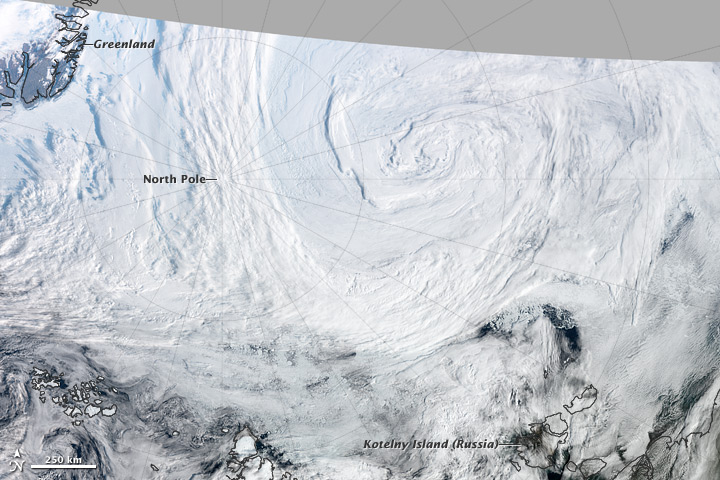
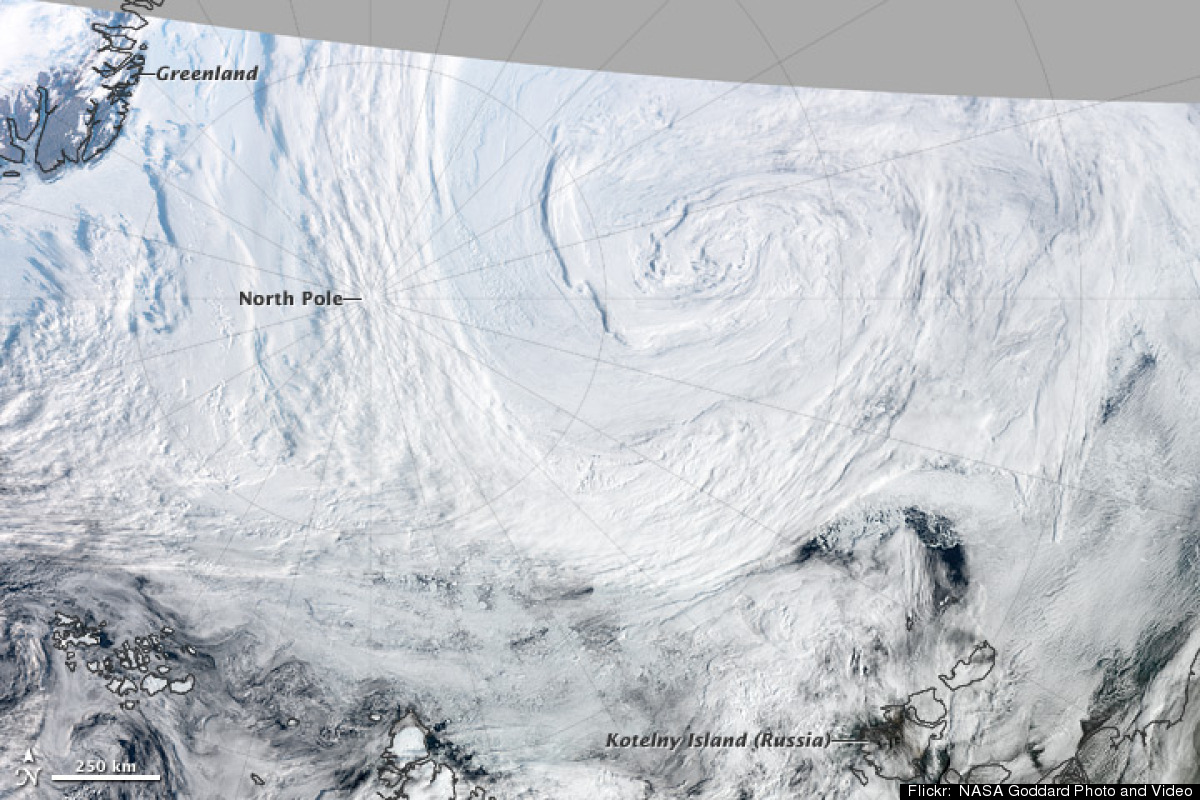
acquired August 7, 2012
A massive cyclone blew over the central Arctic Ocean this past week, north of the Beaufort Sea, and some Arctic researchers said they have never seen anything like it.
Mark Serreze, a senior research scientist from the U.S. National Snow and Ice Data Center, said cyclones are common at this time of year, but he said this week's storm was stronger than any he's seen.
Serreze said he believes the cyclone is causing Arctic sea ice to melt faster this year.
"It causes a lot of break-up of the ice floes. These can drift into warmer waters where the ice can then melt very quickly, and it looks like we're seeing some of that now, or we have, over the past week with the storm. So the point is, in terms of the sea-ice cover, it does have a big effect because with the strong winds and a big storm like that, it really chews things up," said Serreze.
He said it’s likely the Arctic sea ice cover will hit a new record low this year, thanks in part to the cyclone. Serreze added that about 600,000 square kilometres of sea ice was lost in the central Arctic in the last week.
Serreze said the Northwest Passage had been clear of ice, but now pieces have blown in to block the western entrance.

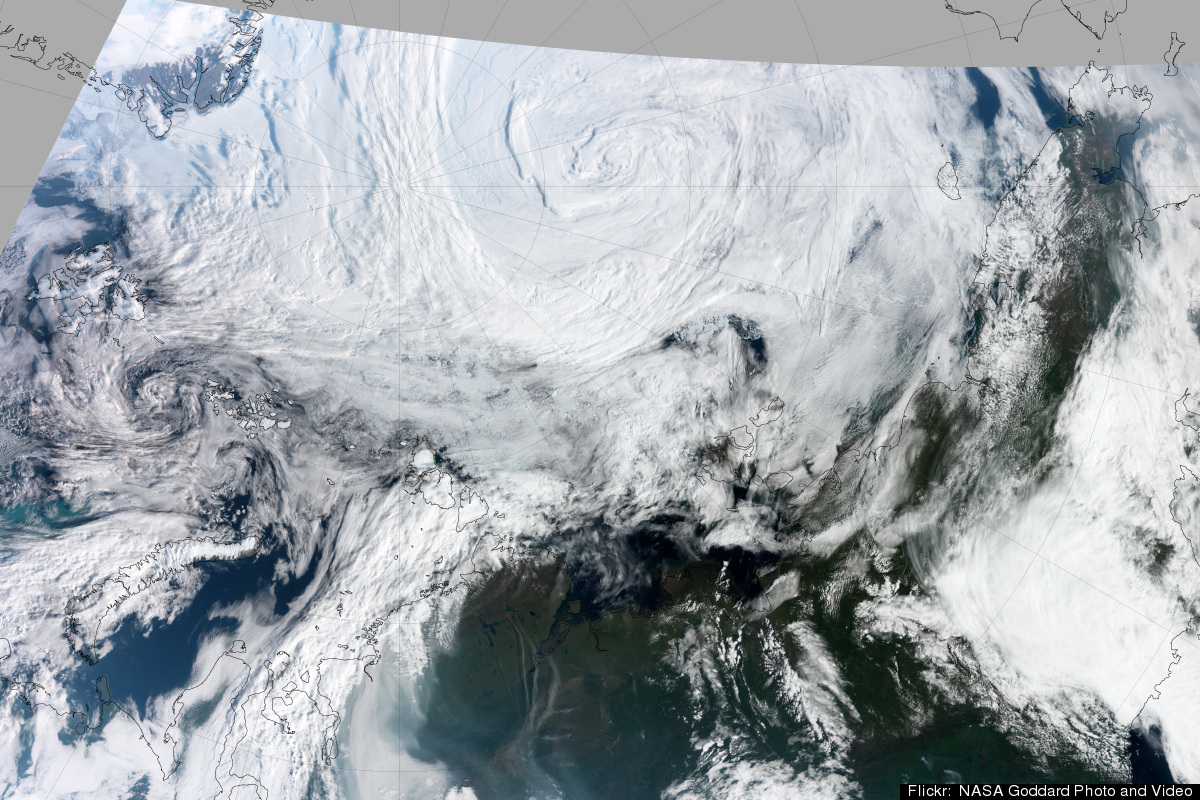
Suomi NPP View of Summer Arctic Storm
Suomi NPP View of Summer Arctic Storm [annotated]
Summer Storm Spins Over Arctic

Strong Summer Cyclone Churns Over the Arctic


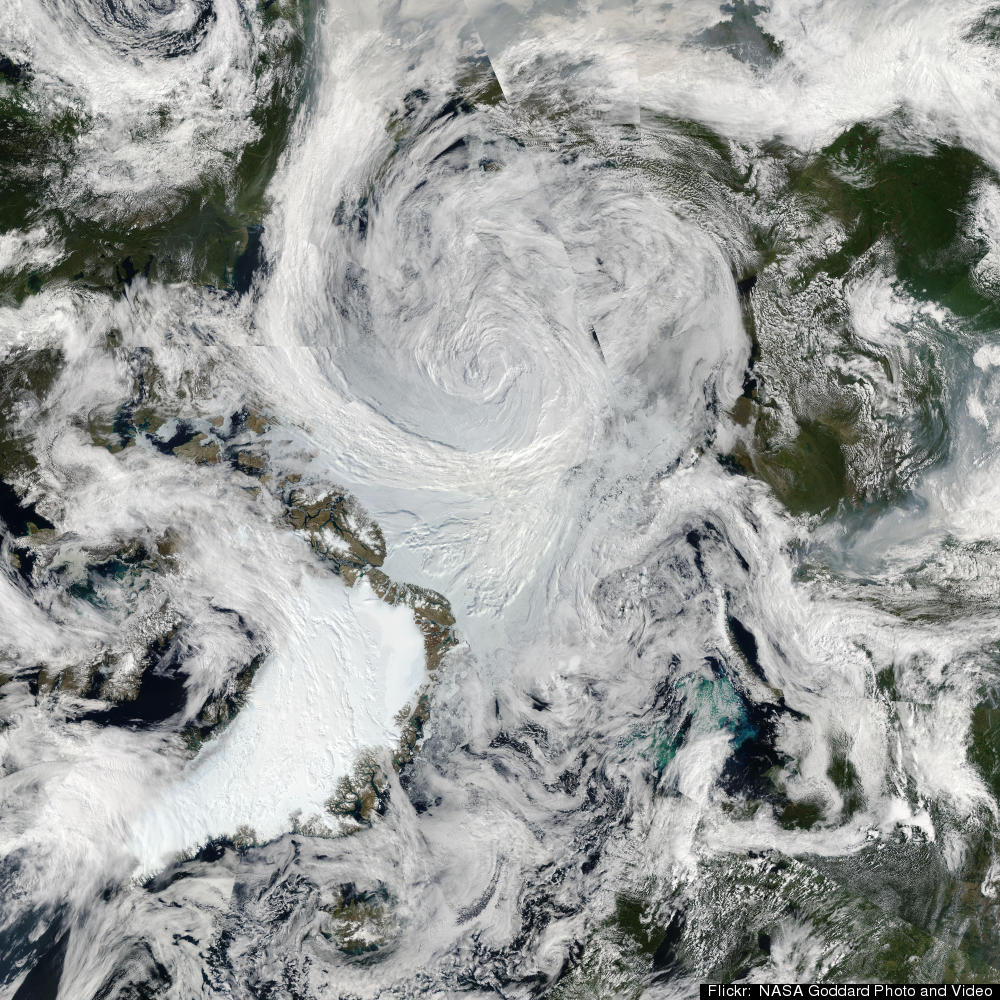
An unusually large, long-lasting, and powerful cyclone was churning over the Arctic in early August 2012. Two smaller systems merged on August 5 to form the storm, which at the time occupied much of the Beaufort-Chukchi Sea and Canadian Basin. On average, Arctic cyclones last about 40 hours; as of August 9, 2012, this storm had lasted more than five days.
The Visible Infrared Imaging Radiometer Suite (VIIRS) on Suomi NPP captured this view of the storm on August 7, 2012. The Moderate Resolution Imaging Spectroradiometer (MODIS) aboard Aqua captured a natural-color image of the storm as well.
Arctic cyclones are more common during the summer than winter; however, summer cyclones tend to be weaker than the storms that batter the region during the winter. This cyclone’s central sea level pressure reached about 964 millibars on August 6, 2012—a number more typical of a winter cyclone. That pressure puts it within the lowest 3 percent of all minimum daily sea level pressures recorded north of 70 degrees latitude, noted Stephen Vavrus, an atmospheric scientist based at the University of Wisconsin.
The number of cyclones affecting the Arctic appears to be increasing. According to a study of long-term Arctic cyclone trends authored by a team led by John Walsh and Xiangdong Zhang of the University of Alaska Fairbanks, the number and intensity of Arctic cyclones has increased during the second half of the twentieth century, particularly during the summer.
The cause of the increase is an open question, but climate change may be affecting Arctic cyclones. One studypublished in Atmospheric and Oceanic Science Letters, concluded that the total number of exratropical cyclones in the Northern Hemisphere would decline as the climate changed, but that the Arctic Ocean and adjacent areas would see slightly more and stronger summer storms.
One way climate change may affect Arctic cyclones is by changing the sea ice and ocean temperature. Climate change has caused sea ice to retreat markedly in recent decades and has also warmed Arctic Ocean temperatures. Such changes may be providing more energy and moisture to support cyclone development and persistence, Zhang explained.
However, scientists who study extratropical storms emphasize that pinning down how exactly climate change is affecting the size, frequency, or tracks of Arctic storms remains an important but unresolved question. “This past week’s storm was exceptional, and the occurrence of Arctic storms of extreme intensity is a topic deserving closer investigation,” noted Walsh. “With reduced ice cover and warmer sea surfaces, the occurrence of more intense storms is certainly a plausible scenario. The limitation at present is the small sample size of exceptional events, but that may change in the future.”
NASA Earth Observatory image by Jesse Allen and Robert Simmon, using VIIRS data. Caption by Adam Voiland with information from Robert Walsh, Xiangdong Zhang, and Stephen Vavrus.

 William Chapman, the University of Illinois, Urbana-Champaign, researcher who maintains the Cryosphere Today Web site, which was a source for some of the content on the Arctic Sea Ice blog. Below you can read his “Your Dot” description of the storm and analysis of its possible repercussions.
But before you read on, have a quick look at this short time-lapse video of sea ice and weather conditions in the central Arctic Ocean from early July through August 8, recorded by one of the two autonomous cameras set on the sea ice near the North Pole each spring by a research team from the University of Washington (the same folks I accompanied in 2003). [8:46 p.m. | Updated | Note: The center of the storm is hundreds of miles away from the drifting sea ice cameras.]
Here’s Chapman’s look at this summer’s powerful Arctic storm and its impact on sea ice:
I’ve been keeping an eye on this storm for a variety of reasons. First, it’s a rare event. This storm is intense for any time of year, but especially for summer, when the weather is normally fairly benign in the Arctic. This storm formed and intensified near the Beaufort Sea and moved to the central Arctic Ocean where it will slowly lose its intensity over the next several days. Ordinarily, the Beaufort Sea and the Arctic Ocean are dominated by high pressure, so having a low pressure system form and intensify here is quite uncommon. Although, it has been happening with more frequency over the past few decades as pressures have dropped significantly in the Arctic during this time and are projected to drop even more during the next century by the global climate models.
Second, we’re interested in the effects of the storm on the Arctic sea ice cover. Impacts on sea ice from storms like this are typically due to strong surface winds. Surface winds can impact the sea ice both through accelerated freezing or melting (via heat transfer from the atmosphere to and from the surface) and by blowing the ice from one place to another. This storm is intense and it covers a large area so the region of the Arctic that will be impacted by strong winds is quite large.
Strong winds are much more effective at transferring heat and moisture between the atmosphere and the ice/ocean surface. It’s why we blow on our tea to cool it off. The effectiveness of the heat transfer increases dramatically with increasing wind. It is a non-linear effect. However, the heat and moisture transfer is also dependent on the difference between the temperatures and moisture content between the air and the surface. In this particular case, since we are in the melt season, both the air and the ice surface are near the melting/freezing point of water and the air is near saturation, so while the winds are strong, the effects of the storm on transferring heat and moisture and therefore causing any freezing or melting will probably be limited.
The effects of this storm on the ice cover therefore will be limited to redistributing the sea ice by blowing it around. The effects may be more impressive than if it occurred during other parts of the year as we are only few weeks away from the annual summer minimum in sea ice area. The ice is at its thinnest, weakest and least compacted now so it’s more free to be blown about by the winds.
Low pressure systems tend to cause a divergence or spreading out of the ice pack (high pressure systems in contrast, cause convergence and compaction). The sea ice cover this summer was already very spread out. Much more of the Arctic ocean was comprised of individual broken ice floes and the pack ice had holes in it exposing ocean in many places. This storm should cause even more of that, especially in the far north where that storm will sit for a few days. To stay with the tea analogy, instead of a cup of iced tea with solid cubes floating on the surface, the storm will churn the tea into a more slushy consistency. The exposed open water caused by the wind divergence may absorb some additional sunlight and melt more ice than usual over the next few weeks (temperature-albedo feedback) [related NASA animation], but given that the sun is well on its way to setting for the winter, I think this effect will be fairly minimal.

Massive cyclone blows over central Arctic ocean

Scientist says cyclone is causing sea ice to melt faster this year

Posted: Aug 12, 2012 10:39 AM CT 

Last Updated: Aug 12, 2012 11:58 AM CT 

In this Aug. 24, 2009 picture provided by the U.S. Coast Guard, the U.S. Coast Guard Cutter Healy breaks ice ahead of the Canadian Coast Guard Ship Louis S. St-Laurent in the Arctic Ocean.

A massive cyclone blew over the central Arctic Ocean this past week, north of the Beaufort Sea, and some Arctic researchers said they have never seen anything like it.
Mark Serreze, a senior research scientist from the U.S. National Snow and Ice Data Center, said cyclones are common at this time of year, but he said this week's storm was stronger than any he's seen.
Serreze said he believes the cyclone is causing Arctic sea ice to melt faster this year.
"It causes a lot of break-up of the ice floes. These can drift into warmer waters where the ice can then melt very quickly, and it looks like we're seeing some of that now, or we have, over the past week with the storm. So the point is, in terms of the sea-ice cover, it does have a big effect because with the strong winds and a big storm like that, it really chews things up," said Serreze.
He said it’s likely the Arctic sea ice cover will hit a new record low this year, thanks in part to the cyclone. Serreze added that about 600,000 square kilometres of sea ice was lost in the central Arctic in the last week.
Serreze said the Northwest Passage had been clear of ice, but now pieces have blown in to block the western entrance.

ARCTIC CYCLONES 

Rationale behind the "Arctic cyclones" work package

FROM DOT EARTH
Vatican hires Fox's Greg Burke to help shape media message

Rome correspondent says he is 'a bit nervous but very excited' for challenge         


By
updated 6/23/2012 5:14:58 PM ET
The Vatican has brought in the Fox News correspondent in Rome to help improve its communications strategy as it tries to cope with years of communications blunders and one of its most serious scandals in decades, The Associated Press learned Saturday.
Greg Burke, 52, will leave Fox to become a senior communications adviser in the Vatican's secretariat of state, the Vatican and Burke told the AP.
"I'm a bit nervous but very excited. Let's just say it's a challenge," Burke said in a phone interview.
He defined his job, which he said he had been offered twice before, as: "You're shaping the message, you're molding the message, and you're trying to make sure everyone remains on-message. And that's tough."
The Vatican spokesman, the Rev. Federico Lombardi, confirmed the move to the AP, saying Burke will help integrate communications issues within the Vatican's top administrative office, the secretariat of state, and will help handle its relations with the Holy See press office and other Vatican communications offices.
Image: Greg Burke
AP
Greg Burke is shown in a 2007 photo by Fox News.
Burke, a native of St. Louis, Missouri, is a member of the conservative Opus Dei movement. Pope John Paul II's longtime spokesman, Joaquin Navarro-Valls, was also a member of Opus Dei.
The Vatican has been bedeviled by communications blunders ever since Pope Benedict XVI's 2005 election, and is currently dealing with a scandal over Vatican documents that were leaked to Italian journalists. While the scandal is serious — Benedict himself convened a special meeting of cardinals Saturday to try to cope with it — the Vatican's communications problems long predate it.

Benedict's now-infamous speech about Muslims and violence, his 2009 decision to rehabilitate a schismatic bishop who denied the Holocaust, and the Vatican's response to the 2010 explosion of the sex abuse scandal are just a few of the blunders that have tarnished Benedict's papacy.
Even the Vatican's response to the leaks from within the Vatican of sensitive papal documents hasn't involved a terribly sophisticated public relations strategy. Just last week the Vatican No. 2, Cardinal Tarcisio Bertone, blamed the media and the devil for fueling the scandal and accused journalists of "pretending to be Dan Brown."
Brown wrote "The Da Vinci Code," the best-selling fictional account that portrayed Opus Dei — of which Bertone's new communications adviser is a member — as being at the root of an international Catholic conspiracy.
Burke acknowledged the task ahead but said that after turning down the Vatican twice before, he went with his gut and accepted the third time around. "This is an opportunity and challenge that I'm not going to get again," he said.
He said he didn't know what, if any, role his membership in Opus Dei played. Opus is greatly in favor in the Vatican these days, particularly as other new religious movements such as the Legion of Christ have lost credibility with their own problems. Currently, for example, the cardinal who is heading the Vatican's internal investigation into the leaks of documents is the Opus Dei prelate, Cardinal Julian Herranz.
"I'm an old-fashioned Midwestern Catholic whose mother went to Mass every day," Burke said. "Am I being hired because I'm in Opus Dei?" he asked. "It might come into play." But he noted he was also in Opus when he was hired by Time and Fox.
Burke has been a Fox correspondent since he joined the conservative U.S. network in 2001. He was the Time magazine correspondent in Rome for a decade before that. At Fox, he led the network's coverage of the death of John Paul and election of Benedict, and has covered the papacy since then, traveling with the pope around the globe. But he has also used Rome as a base for non-Vatican reporting, including several stints in the Middle East during the last intifada, labor law protests in France and the terrorist attacks in London and Madrid.
He is a graduate of Columbia University's School of Journalism.

August 6 News: Mass Fish Die-Offs Increasing In Warming U.S. Rivers


Thousands of fish are dying in the Midwest as the hot, arid summer dries up rivers and causes water temperatures to climb in some spots to nearly 100 degrees.

About 40,000 shovelnose sturgeon were killed in Iowa last week as water temperatures reached 97 degrees. Nebraska fishery officials said they have seen thousands of dead sturgeon, catfish, carp and other species in the Lower Platte River, including the endangered pallid sturgeon.

Biologists in Illinois said the hot weather has killed tens of thousands of large- and smallmouth bass and channel catfish and is threatening the population of the greater redhorse fish, a state endangered species.

GOP lawmakers say this year’s harsh weather that has produced devastating wildfires and the most widespread drought in 50 years has not changed their minds on climate change. [The Hill]
At least 18 wildfires raged in Oklahoma on Sunday as  firefighters battled the consequences of a severe drought that shows no signs of letting up. [Los Angeles Times]
More quickly than any other place in the United States, the Alaskan Arctic is being transformed by global warming. The impacts of climate change are threatening a way of life. [Washington Post]
Ocean acidification caused by climate change is making it harder for creatures from clams to sea urchins to grow their shells, and the trend is likely to be felt most in polar regions, scientists said today. [Sydney Morning Herald]
Several biological challenges threaten to shrink the world’s coffee supply. [News Observer]
Deputy Prime Minister Nick Clegg will pledge 100 million pounds ($156 million) for two investment funds that seek to back renewable and energy efficient projects. [Bloomberg Businessweek]
THE REAL BATTLE IN 2012 AND BEYOND


WEDNESDAY, JULY 11, 2012

It’s not merely Republicans versus Democrats, or conservatives versus liberals. The larger battle is between regressives and progressives.
Regressives want to take this nation backward — to before Social Security, unemployment insurance, and Medicare; before civil rights and voting rights; before regulations designed to protect the environment, workers, consumers, and investors. They want to sabotage much of what this nation has achieved over the last century. And they’re out to do it by making the rich far richer, turning Americans against one another in competition for a smaller and smaller slice of the pie, substituting private morality for public morality, and opening the floodgates to big money in politics. 
Progressives are determined to take this nation forward — toward equal opportunity, tolerance and openness, adequate protection against corporate and Wall Street abuses, and an economy and democracy that are working for all of us. 
The upcoming election is critical but it’s not the end of this contest. It will go on for years. It will require that you understand what’s at stake. And that you energize, mobilize, and organize others. 
Please take a look at the accompanying video — and share it. 

I have a brain tumor but I'm getting on with my life, says Diana inquisitor Martin Bashir

By Katie Nicholl
Last updated at 10:31 AM on 08th June 2008

Martin Bashir, who became a household name after his extraordinary TV interview with the late Diana, Princess of Wales about the break-up of her marriage to Prince Charles, is suffering from a brain tumour.
The 45-year-old former Panorama presenter confirmed yesterday that he has a tumour growing on his pituitary gland but plans ‘to get on with his life’.

The potentially life-threatening condition was discovered after the celebrity interviewer was treated for a serious knock to the head last month.


bashir wife
'Doing well' Investigative journalist Martin Bashir with his wife Debbie in London

According to sources in New York, where Mr Bashir lives with his wife Debbie and their two children, the presenter suffered the injury on the set of his Nightline show for ABC news in America and was taken to hospital for stitches.
It was only following a scan that doctors discovered the tumour on Mr Bashir’s pituitary gland, which is at the base of the brain and helps to control growth.
‘It has been a very worrying time for Martin and his family but the good news is that the specialists do not want to operate on the tumour yet,’ a family friend said last night.
‘Martin was filming his show when he knocked his head pretty badly and had to go and have stitches.


bashir diana
Revelations: Princess Diana tells Bashir her inner secrets in 1995

'The next day he was still in a lot of pain so he went back to the hospital, where they did some tests. It was then that the doctors realised he has a tumour growing on his brain.
‘While of course it has been very upsetting, Martin is seeing it as a blessing in disguise. If he hadn’t had the knock to his head, he would never have known about the tumour.
‘The doctors say they have found it at a very early stage. They want to monitor it at the moment and not operate. Obviously it’s very serious and they are not unconcerned.
‘But tumours can stay static for many years. The doctors have done lots of scans and tests and there are no signs that the tumour is cancerous, or that it will grow, so he can live with this quite normally for the time being.
‘The last thing Martin wants is for people to think he’s going to pass away tomorrow. He wants everyone to know he is doing very well.’
Mr Bashir was last week presenting his show and this week he flies to Los Angeles to make a programme about gang murders in the United States for ABC, the American network to which he is exclusively signed.
‘Martin has been getting on with life as much as he can,’ added the source. ‘Of course, he was absolutely terrified to be told he has a brain tumour but he did his research and is not one to dwell on problems.
‘He wants to live his life as normally as possible. He was playing football in New York last week with his kids in the annual dads and lads match at his children’s school and he is keeping busy.
'There are no plans for him to scale back in his personal or professional life. He has told his family, and everyone is being very supportive.’
A spokesman for Mr Bashir last night told The Mail on Sunday: ‘Martin is getting on with his life and his career and is very busy making his TV shows.
‘He’s seeing it very much as a stroke of luck that he had a knock because  doctors have now discovered the tumour and it’s at a very early stage, where it can be monitored. He plans to get on with life as per usual.’
Mr Bashir became a household name by interviewing Diana in 1995. During the hour-long programme – the repercussions of which damaged the reputation of the Royal Family – the Princess spoke frankly for the first time about her separation from Prince Charles.
She described the Prince’s camp as the ‘enemy’ and said the Monarchy was in desperate need of modernisation.
Diana admitted an adulterous affair with former Army officer James Hewitt and described her hurt at her husband’s relationship with Camilla Parker Bowles.
‘There were three of us in this marriage, so it was a bit crowded,’ she famously said.
The Princess also spoke freely about her depression and bulimia, her children and the future of the Monarchy. 

And it was during this interview that she said she wanted to be the ‘queen of people’s hearts’.
Mr Bashir’s reputation has been enhanced by a series of other scoops. He secured the first in-depth interview with Michael Jackson in 2003 for ITV – gaining unprecedented access to the eccentric star at his Neverland ranch.
The show led to Jackson appearing in a California court on a charge of molesting a young boy. He was cleared by a jury.