Pages

Sunday, February 5, 2012

Auction 2012: How Drug Companies Game Washington

Paul Blumenthal

Auction2012
First Posted: 02/ 1/2012 12:24 pm Updated: 02/ 1/2012 12:56 pm


Auction 2012 is a weeklong series in collaboration with "The Dylan Ratigan Show" and United Republic.
When he first ran for president, Barack Obama campaigned against the influence of lobbyists in Washington, exclaiming in one ad in which he excoriated the top lobbyist of the drug industry, "I don't want to learn how to play the game better. I want to put an end to the game playing."
Then, Obama won the White House and sought to pass an ambitious health care agenda. To do so, he made nice with some of Capitol Hill's most notorious influence peddlers.
There are few industries with as much power in Washington as the pharmaceutical sector. Drug companies have spent $2.3 billion on lobbying and $183 million on campaign contributions since 1998, according to the Center for Responsive Politics. The industry also maintains a war chest for advertising and grassroots lobbying aimed at altering public opinion. The ready money serves as a strong deterrent against any legislative proposal that would lower costs for consumers and profits for the drug makers.
"The industry clearly had established a war chest ... to use on advertising on health care reform," said Richard Kirsch, the national campaign manager for Health Care for America Now and the author of the forthcoming book "Fighting for Our Health." "It was very clear that ... if the administration and Congress pushed for negotiating drug prices for Medicare in health care reform, that the industry would vociferously oppose that."
Fearing the drug industry would use its money and lobbyists to torpedo the entire reform package, the Obama White House made a deal to kill at least two major provisions that would have saved consumers money when they filled prescriptions. In exchange, the industry unleashed a $20 million-plus ad campaign to support the bill. Senate Finance Committee Chairman Max Baucus (D-Mont.), a top recipient of campaign contributions from the health care industry, was put in charge of shepherding the bill to passage.
But pharma's influence didn't start with the Affordable Care Act. The industry has been blocking pro-consumer drug policies for years.
In 2003, Congress passed a prescription drug benefit for seniors known as Medicare Part D. However, thanks to industry involvement in writing the bill, the agency in charge of Medicare was barred from negotiating with drug companies to lower prices, as the Department of Veterans Affairs does. The author of that legislation was none other than Rep. Billy Tauzin (R-La.), who barely a year later would retire from Congress and land on K Street as president of Pharmaceutical Research and Manufacturers of America -- in other words, the drug industry's top lobbyist.
When the Obama White House later sought support from the drug industry for health care reform, the administration had to shelve the idea of releasing Medicare from the negotiation ban. Studies indicate that keeping drug prices high for seniors adds $150 billion to $300 billion to drug industry profits over a 10-year period. The increased costs hit the pockets of both seniors and taxpayers.
In Wisconsin, some seniors get a better deal. SeniorCare, a popular state program covering 91,000 Wisconsinites that was created by then-Gov. Tommy Thompson (R), sets much lower drug prices than Medicare's prescription drug benefit. It only costs $522 on average to cover a senior through SeniorCare; it costs $1,690 on average under Medicare Part D. In 2009, SeniorCare saved seniors some $50 million.
When Gov. Scott Walker (R) came into office last year, he proposed gutting SeniorCare. Wisconsin lawmakers from both parties joined together to remove this provision from the governor's first budget.
Click image to enlarge.
Nino Amato, president of the Coalition of Wisconsin Aging Groups, told The Huffington Post that relying on Medicare Part D alone to hold down drug prices forces seniors to "make life decision trade-offs."
"Life decision trade-offs" can mean choosing between drugs or electricity or food. For millions of Americans, this is a real and growing problem.
According to a 2010 Kaiser Family Foundation study, drug prescriptions rose by 39 percent while drug prices nearly doubled over the last decade. More and more individuals, hard pressed to pay for medications, are opting to abandon their prescriptions. In 2009, the number of patients who did not fill or pick up prescriptions increased by 23 percent from the previous year and 68 percent from 2006.
Some Americans have tried to close the budget gap by quietly buying drugs from Canada, where government controls keep prices down. U.S. law, however, prohibits the reimportation of prescription drugs from other countries.
Efforts were made to lift the ban as part of the health care overhaul -- but the drug industry didn't like that, and the Senate Democratic leadership fell in line. Despite having previously won the support of enough senators to become law, an amendment to permit prescription drug reimportation, offered by then-Sen. Byron Dorgan (D-N.D.), was defeated amid mass vote switching.
After his amendment went down, Dorgan told reporters, "I believe seven days ago we had sufficient votes to pass it, but I think what is happening in the intervening period is other things developed. It's a great disappointment because it seems to me very hard to do health care reform without doing something about the escalating prices for prescription drugs."
Sens. Debbie Stabenow (D-Mich.) and Olympia Snowe (R-Maine) are now trying again, co-sponsoring a bill that would legalize reimportation of drugs from certain countries. They argue that the bill would save taxpayers $19.4 billion and let millions of Americans pay drug prices that are 35 to 55 percent less.
Beyond the health care deal, the pharmaceutical sector continues to fight other pro-consumer measures. During the last Congress, a provision attached to an appropriations bill would have banned "pay-for-delay," when brand-name drug makers pay off generic drug makers to keep generics off the market. The Federal Trade Commission estimates that pay-for-delay costs consumers billions of dollars annually.
The provision, which barely made it out of committee, was killed during the lame-duck 2010 Congress. Four Republican senators voiced their opposition to Senate Minority Leader Mitch McConnell (R-Ky.). The appropriations bill containing the provision was shelved, and Congress passed a continuing resolution to fund the government instead.
Again, those supporting a more pro-consumer policy have not given up. Sen. Charles Grassley (R-Iowa) is currently co-sponsor of a bill in Congress that would give the FTC authority to stop pay-for-delay litigation settlements. In a November 2011 press release, Grassley argued, "When people across the country are having a hard time making ends meet, this could be a real boost to their bottom line."
Perhaps ordinary Americans will win the next fight over pharmaceutical policy. In the meantime, drug prices rise while the drug industry thrives, backed by its powerhouse lobbying presence in Washington.
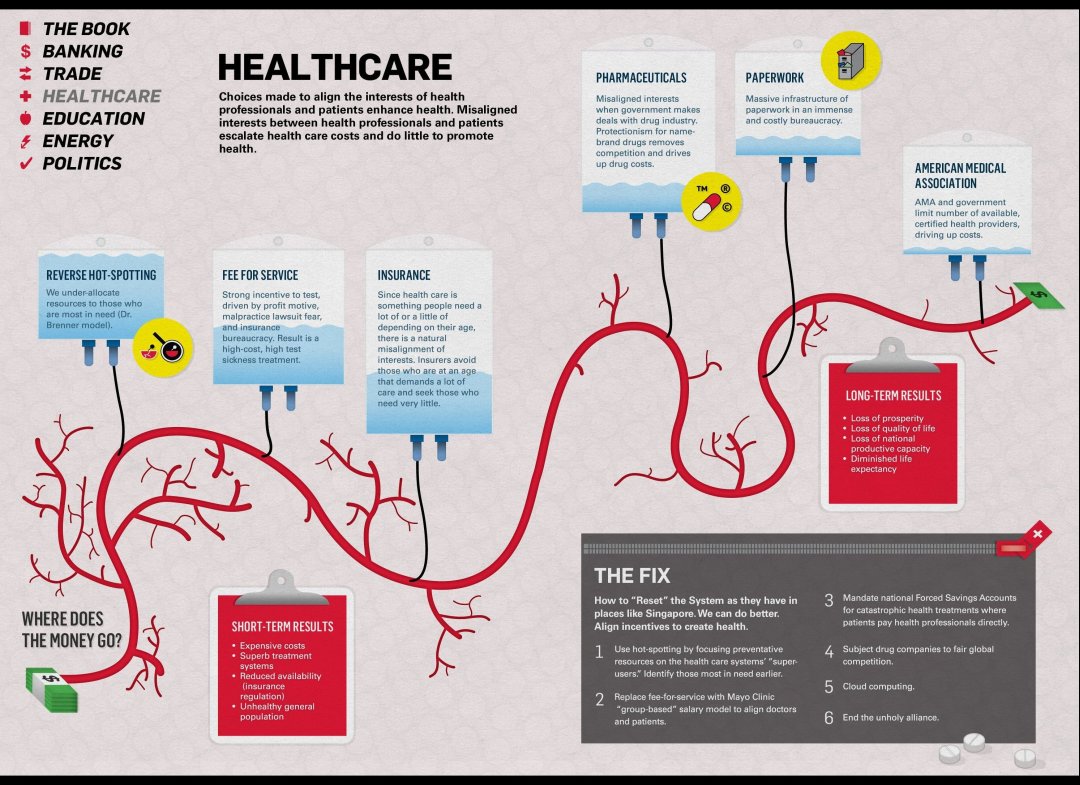
The Auction 2012 series explores the ways industries influence policymaking in five areas: banking, energy, health care, trade and education. Read Dylan Ratigan's blog post introducing the series and his blog post on health care.

Follow this diagram of the health care trade-off from Ratigan's book "Greedy Bastards":
Auction 2012: Big Money's Next Trade Goal Is 'NAFTA With Asia'

Auction2012
First Posted: 02/ 2/2012 1:16 pm Updated: 02/ 2/2012 2:16 pm
Auction 2012 is a weeklong series in collaboration with "The Dylan Ratigan Show" and United Republic.
The 1994 North American Free Trade Agreement soured the American public on trade deals that were supposed to boost the economy -- remember the giant sucking sound that followed? -- but it left America's globe-spanning corporate behemoths panting for more.
Since then, powerful business interests have cheered the signing of 19 more such agreements. The three most recent, with South Korea, Colombia and Panama, won congressional approval in October.
These trade agreements have been an enormous boon to multinational corporations, making it easier for them to shift production to lower-cost countries, move capital across borders, expand into new markets and overcome foreign legal hurdles. They are consistently a top priority for the big-business lobbying groups, including the U.S. Chamber of Commerce, the National Association of Manufacturers, the Business Roundtable, the Financial Services Roundtable, the American Farm Bureau, Pharmaceutical Research and Manufacturers of America, and the Retail Industry Leadership Association.
Despite being hawked as job-creating measures that open the world to American goods, however, these trade agreements have historically resulted in massive outsourcing of U.S. manufacturing jobs and increases in exports.
"They may be enhancing corporate efficiency, but they're not enhancing job creation here in the U.S.," said Michael Wessel, a trade strategist who works with the labor movement.
And now the White House is forging another one -- this time a regional compact, known as the Trans-Pacific Partnership (TPP) Agreement, with Australia, Brunei Darussalam, Chile, Malaysia, New Zealand, Peru, Singapore and Vietnam. It's the first trade agreement entirely negotiated by President Barack Obama, the biggest since NAFTA -- and potentially a lot bigger if and when China and Japan join in, as they are expected to eventually.
The goal, according to the Office of the U.S. Trade Representative, is "to enhance trade and investment among the TPP partner countries, promote innovation, economic growth and development, and support the creation and retention of jobs."
This is a whole new kind of pact, the trade representative says. It will include "new cross-cutting issues not previously included in trade agreements, such as making the regulatory systems of TPP countries more compatible so U.S. companies can operate more seamlessly in the TPP market."

A CONSPIRACY OF SILENCE

Figuring out what this agreement will actually do is difficult, as the public is being kept almost entirely in the dark regarding the ongoing negotiations. The draft text, for example, is only being circulated to "cleared advisers," who include dozens of corporate lobbyists and only a handful of labor and good-government advocates.
The first official word that ordinary people -- and Congress -- will get about what's been agreed to is when the deal is complete, and all that's left is an up-or-down vote.
In the meantime, however, common sense dictates that dropping trade barriers with a low-wage country like Vietnam, for instance, isn't going to do wonders for the U.S. textile or apparel industries. And leaked drafts of the occasional chapter have made consumer and good-government advocates fear the worst.
As Zach Carter reported in October for The Huffington Post, one set of leaked documents shows Obama administration negotiators trying to reverse reforms made during the George W. Bush administration that were designed to increase access to affordable medicines in developing countries. Instead, the U.S. would impose a set of restrictive intellectual property laws that would help American drug companies secure long-term monopolies overseas and increase drug prices.
The Electronic Frontier Foundation, one of the groups that led the recent, successful grassroots opposition to two bills that would have given corporations new powers to censor the Internet, sees the TPP as a backdoor effort to rewrite global rules on intellectual property enforcement -- including U.S. rules.
The proposed Stop Online Piracy Act and Protect IP Act were "bad laws prepared in secret, but they were defeated once they had to face public opinion," Maira Sutton, international outreach coordinator for the foundation, wrote via email. "The scary thing about secret agreements like TPP ... is that they may already be well along the process by the time the public has a chance to learn about them and speak up, which means that unpopular censorship provisions, like those in SOPA and PIPA, can be slid in under the radar."
Public Citizen, the nonprofit consumer advocacy group, warns that the pact will likely allow foreign companies to sue governments to enforce the agreement in United Nations and World Bank tribunals. There, Pubic Citizen argued, "they can demand taxpayer compensation for domestic policies that investors claim undermine their new privileges established in the pact."

THE POWERS THAT BE

"The polling shows Americans on a bipartisan basis hate our current system of trade agreements," said Lori Wallach, director of Public Citizen's Global Trade Watch. "In the light of this, in an election year, how is it possible that this huge NAFTA with Asia is being discussed -- much less that the Obama administration is rushing it forward, trying to get it done this summer?"
Wallach answered her own question: Major business interests use these trade agreements to push policies that won't fly even in a Republican Congress "by branding them as free trade, trade expansion -- all those appealing brands."
Behind this continuous stream of trade agreements, she said, are banks, multinational manufacturers, Big Pharma, Big Tobacco, oil and gas companies, agribusiness and other sectors -- all pursuing their bottom lines. "This literally is in one fell swoop one of the most elegant one-percenter corporate power grab mechanism ever designed," Wallach said.
Click image to enlarge.
The corporate lobbyists were certainly out in force this past fall, in the run-up to the vote on the latest three trade agreements, the biggest one of which was with South Korea.
The Chamber of Commerce combined forces with Boeing, Chevron, Pfizer, Goldman Sachs and Citigroup to form a U.S.-Korea FTA Business Coalition. Other big-business groups and major corporations joined them in their full-court press.
By contrast, the outgunned opposition was led by consumer groups and small, domestic companies, who, unable to seize the same opportunities available to multinationals, have found themselves steadily losing market share and forced to cut production and jobs.
The final House votes weren't even close. Republicans wanted the pacts so badly they overcame their aversion to supporting anything Obama proposes and voted overwhelmingly in favor. Most Democrats opposed the president -- but even among the opponents, Wallach said, the passion was dimmed.
Ever since the Supreme Court legalized unlimited political spending by corporations, Wallach said, "the dynamic is totally different." The greater threat that deep-pocketed corporations now pose to any incumbent with an even slightly contested seat looms over every exchange between lobbyists and members of Congress.

TO BRING MANUFACTURING BACK

In his 2012 State of the Union address, President Obama announced a plan to "bring manufacturing back" to the United States through tax code changes -- eliminating a tax break that rewards outsourcing, expanding a tax cut for domestic manufacturers and imposing a minimum tax on overseas profits.
But previous free trade deals have already made the incentives for outsourcing so strong that these measures, even if implemented, would likely fail, said Lee Sheppard, contributing editor at Tax Analysts, a nonprofit publisher of tax information.
"You can't use the tax law to make up for things that you gave away with trade deals," Sheppard said. U.S. jobs are lost, he said, "when we let in products made by poorly paid workers who live in dormitories and work 12 hours a day."
How will the TPP fare in the end? The corporate giants who will profit are bound to keep pushing it forward, as they have earlier trade agreements.
But Wessel, who looks at the effects of free trade agreements beyond the corporate bottom line, remains skeptical about these deals: "The benefits have not materialized." But he's holding on to some hope for the TPP "that there will be enough changes in the approach that they will maximize benefits for American workers. I think it is too early to tell."
Blocking a trade agreement, Wallach said, takes a combination of mass media coverage, grassroots activism and members of the public making clear they will hold their congressmen accountable. But the increasingly complex nature of the agreements, combined with their free-trade branding, has resulted in too little coverage of trade issues, she contended. "The mainstream media doesn't dig into it," Wallach said.
And that may make all the difference. "If people understood what this really was," she said, "they'd be surrounding the trade representative's office with pitchforks."
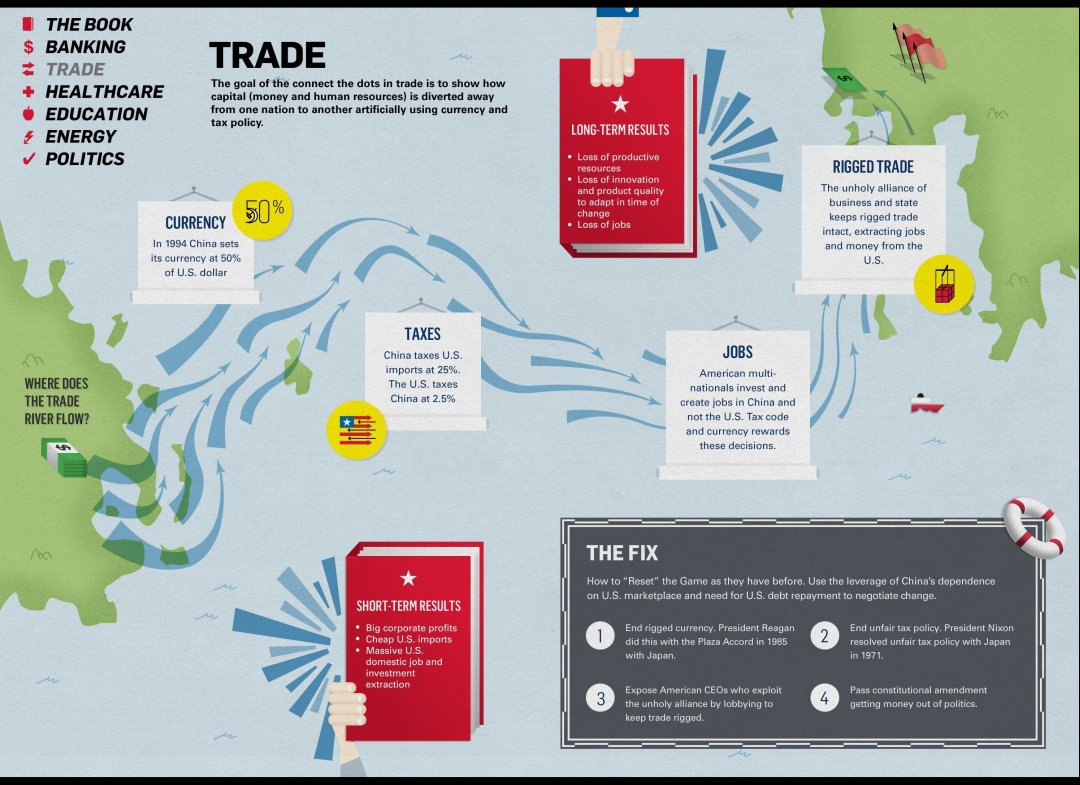
The Auction 2012 series explores the ways industries influence policymaking in five areas: banking, energy, health care, trade and education. Read Dylan Ratigan's blog post introducing the series and his blog post on trade.
Follow this diagram of trade's flow from Dylan Ratigan's book "Greedy Bastards":

Komen Board Member Refutes ‘Reversal’ Story

I just got off the phone with a Komen board member, and he confirmed that the announcement does not mean that Planned Parenthood is guaranteed future grants — a demand he said would be “unfair” to impose on Komen. He also said the job of the group’s controversial director, Nancy Brinker, is safe, as far as the board is concerned.
As some were quick to point out, the statement put out by Komen doesn’t really clarify whether Planned Parenthood will actually continue to get money from the group. The original rationale for barring Planned Parenthood was that it was under investigation (a witch-hunt probe undertaken by GOP Rep Cliff Stearns). Komen said today that the group would “amend the criteria to make clear that disqualifying investigations must be criminal and conclusive in nature and not political.”
Does that mean Planned Parenthood will get Komen grants in the future?
I asked Komen board member John Raffaelli to respond to those who are now saying that the announcement doesn’t necessarily constitute a reversal until Planned Parenthood actually sees more funding. He insisted it would be unfair to expect the group to commit to future grants.
“It would be highly unfair to ask us to commit to any organization that doesn’t go through a grant process that shows that the money we raise is used to carry out our mission,” Raffaelli told me. “We’re a humaniatrian organization. We have a mission. Tell me you can help carry out our mission and we will sit down at the table.”

Gadhafi’s Hollywood ending

I found this article it is from Sept of 2011.  I am blogging it because I found it interesting. It is a story about how our government is the studio producing and directing, and the news media are the scriptwriters, who want freedom to write, but in the end go along with the studio.  And the article goes right down the line showing how this was done with each of the Arab Spring up risings. And it started with the Reagan Presidency, in the 80's.   I love the picture below taken in 1990. 
TUESDAY, SEP 6, 2011 8:01 AM EASTERN STANDARD TIME

How the government and media transformed the Libyan leader's image from repentant bad boy to evil tyrant

Moammar Gadhafi, Hosni Mubarak
FILE - In this August 1990 file photo, during an emergency Arab League summit, Libyan leader Moammar Gadhafi, left, is driven by Egyptian President Hosni Mubarak, in Tahrir Square in Cairo. As rebels swarmed into Tripoli, Libya, late Sunday, Aug. 21, 2011, and Gadhafi's son and one-time heir apparent Seif al-Islam was arrested, Gadhafi's rule was all but over, even though some loyalists continued to resist. (AP Photo/Farouk Ibrahim, File) (Credit: AP)
Poor Moammar Gadhafi. Libya’s longtime leader, dubbed “the Mad Dog of the Middle East” by President Ronald Reagan over his support for terrorism, came in from the cold after Sept. 11 by collaborating with the CIA in the fight against al-Qaida and offering American firms access to his oil fields. Look what he got for his good behavior: the enmity of his people and uninvited strangers visiting his seaside villa.
Gadhafi had warmed American hearts in 2004 by normalizing relations with George W. Bush’s administration and falling hard for Condoleezza Rice. The colonel was still an SOB, but now he was our SOB.