Pages

Saturday, July 9, 2011

Why is the Obama Team Embracing Hooverism?


Chris Hayes had Gene Sperling, Director of the National Economic Council for President Obama, on while guest-hosting the Last Word with Lawrence O’Donnell last night.  Hayes played the clip that Krugman recently highlighted, where Obama said that the government’s budget is like a family’s budget that has to tighten in hard times and emphasized deficit reduction as a means to get confidence going to kick up the recovery, and asked Sperling to explain.  Hayes also brought up the historical-low interest rates on Treasuries as a counter-argument to these points.
You’ll be happy to know that Sperling brought up that the government is, in fact, kind of like a family, that trillions on corporate balance sheets are a little bit because of a lack of confidence, especially on the deficit, and, my favorite, this, in response to Hayes bringing up the interest rate as the most sophisticated pricing instrument we have on government debt:
“well I think there’s a lot of factors that go into the interest rates right now.  But there’s certain things you know that are just sound….any country anywhere that has its debt increasing as a percentage of its income creates doubts about its sustainability.  That’s gotta discourage some people from feeling as good as the long-term investments…”
Wow.  It is quite funny to watch Hayes’ jaw drop with a sense of horror when he realizes what he’s hearing from one of the key current architects of the Democratic economic platform:


I’m pretty up-to-date on the conservative arguments for expansionary austerity, from data to assumptions to talking points, and what Sperling is saying is more or less indistinguishable from the latest round of right-winger talking points.
It also appears, God bless ‘em, that the administration is going to start rotating structural unemployment talking points in their discussion of the economy as well.  So, what gives? Why has the administration gone this route? This is different than the idea that they don’t want to be associated with the stimulus or further efforts at stimulus – this is running into the exact opposite arguments.
Krugman thinks it’s because the Very Serious People embrace this and Obama is wired to think that VSP know what the right course of action is. That sort of restates the question, which is why do VSP and Obama’s immediate economic team embrace this argument? I can think of a few guesses.
The 1980s
Richard Koo is an expert on the Japanese recession who calls for continued aggressive fiscal stimulus in the United States. In his recent book, The Holy Grail of Macroeconomics, he makes an early point to explain how he though there were serious structural problems in the late 1970s and early 1980s, and supported the “reforms” necessary to break it. Reading it, it is clear that he thinks making this point establishes his ability to call out a demand recession, because he is equally unapologetic in calling out a supply recession. He made this chart that explains what he saw in Japan versus the Reagan U.S., and also concludes that we look like the Japan scenario:
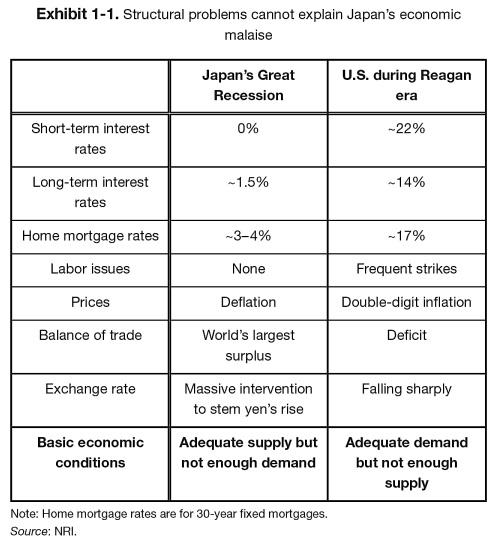
If you are someone who idolizes Reagan, or thinks the early 1980s gave us the answers that are everywhere and anywhere applicable (a phenomenon that now goes beyond tax cuts for everything), or sees severe debt-deflation and a minimum wage side-by-side and thinks the minimum wage is, far and away, the more ghastly thing you are seeing, if you are someone who never got over the 1980s or understood that there’s an alternative, it doesn’t surprise me that you would be find this logic convincing.
The 1990s
Felix Salmon noted the following about ideology and job creation when the whole stimulus as “sugar” debate happened:
Geithner cut his teeth in a world of bond vigilantes, an era when James Carville said that he would like to be reincarnated as the bond market, because then he could intimidate everybody. And after that, Geithner dealt with a series of international sovereign-debt crises where countries found themselves hammered by enormous bond spreads.
The people in the senior economic policy shop are primarily Wall Street people, who view the world in a much different frame that those looking at demand-side, deflationary consumer pressures. Similarly they are people who think that a solid Wall Street will be the driver of the economy, an argument we’ve seen going back to at least PPIP.
Also the 1990s is when neoliberals really took over the macroeconomic arguments (see this Galbraith argument).  Liberals abandoned demand-side arguments in order to try and win over a role for the government in the supply-side arguments – the liberal government can bring job training, relocation loans, tax credits, etc. to help with employment, leaving the demand side arguments to disappear.
Meritocracy, Rentiers
The most stable, and the least easily shifted, element in our contemporary economy has been hitherto, and may prove to be in future, the minimum rate of interest acceptable to the generality of wealth-owners. If a tolerable level of employment requires a rate of interest much below the average rates which ruled in the nineteenth century, it is most doubtful whether it can be achieved merely by manipulating the quantity of money.
Certainly our housing policy is being run on the idea that homeowners should eat as much of the costs as they can potentially bear, even if it means keeping the economy depressed for years longer than it needs to be.  Stimulus, a short-round of inflation and bad-debt writedowns all would help the economy, but all hurt rentiers.  Right now Wall Street has a great deal milking the remains of the housing bubble’s bad debts.
When these are the smartest, most meritocratic guys in the room, it is perfectly designed for acceptance from Very Serious People, especially creations of the meritocracy like Obama.
These are all idle speculations. Your thoughts?

Not a Normal Party


THURSDAY, JULY 7, 2011

Nate Silver says that the GOP reluctance to compromise is driven byvoter alignments. John Sides has a good post up responding, in which he points to the strong conservativism of GOP activists and politicians as the driving force.

I tend to agree with John, but with a major caveat: I think that only looking at ideology misses a significant piece of the puzzle here. Yes, Republican politicians and activists are very conservative. But they are also, and perhaps more importantly, highly partisan. That's why they can flip positions overnight when the situation calls for it; their positions are informed by the partisan context as much, if not more than, some sort of principles.

But neither of those things is sufficient to explain a party that in many cases appears to do things that undermine its own goals. After all, no matter how conservative Republicans may be, it's still the case that in any situation there's a best (that is, most conservative) deal that can be made, and whether it's partisanship or ideology driving them, they should be trying to make that deal. I'm convinced that the problem is that on top of everything else, the money to be made from conservative extremism introduces perverse incentives that color everything that the GOP does. That, and not ideology or simple partisan polarization, is what I think may be actually scary about politics as it has been practiced for the last several years.  Everything about Madisonian politics is based on an assumption that ambition will drive politicians and everyone else in the system to aspire to winning elections. If there are serious incentives to be in the minority, it's not clear that the system will work.

(And I've said it before, so I don't know that I'll write a post about it, but that's part of my answer to Matt Yglesias's argument against the US Constitutional system and in favor of parliamentary government. If the problem with the current system is perverse incentives created by a consumer market exploited by conservative rejectionists, then I'm not sure why parliamentary systems would be the cure. Beyond that, as usual, I'd just point out that the US doesn't have a "presidential" system -- it has a system of separated institutions sharing powers).

Are Republican Voters to Blame for GOP Intransigence on the Budget?


by JOHN SIDES on JULY 7, 2011 · 
Nate Silver answers this question in the affirmative:
The Republican Party is dependent, to an extent unprecedented in recent political history, on a single ideological group. That group, of course, is conservatives.
He shows that, among voters who voted for a Republican House candidate, the percentage who were conservative increased from 58% in 2008 to 67% in 2010.  He suggests that this reflects an “enthusiasm gap” in turnout—conservative Republicans were more likely to vote than other Republicans—and that this helps explain why Republican leaders are reluctant to compromise with Obama.
I’m not completely sold on the enthusiasm gap as an explanation for 2010.  Just based on the number of seats they had to defend, the state of the economy, and Obama’s approval rating, they were forecast to lose 56 seats, according to Gary Jacobson.   Moreover, the preferences of so many demographic groups shifted against the Democrats (see slides 9 and 10) that I don’t think it’s just about, or even primarily about, turnout.  See also my earlier post.
But here’s a more important caveat: Republican members of Congress are more conservative than Republican voters.  In fact, representatives from both parties are more ideologically extreme than voters in their parties.  That’s the conclusion of a recently published paper by Joseph Bafumi and Michael Herron (gated; ungated).   In their study of the 109th and 110th Congresses, they use a large national survey that asked voters their positions on key roll call votes taken in Congress.  Thus, Bafumi and Herron can measure the ideologies of voters and members on the same scale.  Once they do so, representatives emerge as far more extreme.
You might think that, even if a Republican representative is more extreme than a Republican voter, he or she might not be more conservative than a conservative Republican voter, who are the focus on Silver’s post.  Bafumi and Herron shed some light on this as well by focusing on a more ideologically extreme group of voters: people who donate money to candidates.  But even most donors are still not as ideologically extreme as the candidates.  For example, only 13% of Republican donors were more conservative than their representatives in the 109th and 110th Congresses.  To be sure, donors are ideologically closer to representatives than are non-donors, but representatives are still more extreme.
Of course, it is true that the 112th Congress is not the 110th Congress.  But I doubt that, in the past 4 years, Republican voters became so much more conservative that they actually matched Republican representatives.  Indeed, all available evidence suggests that the parties in Congress are polarizing much more quickly than the partisans in the public.  It is true that there are fewer liberal or moderate Republicans and conservative Democrats in the public than there once were—you can explore some data here—but the public doesn’t look anything like Congress.   In part, this reflects the lack of ideological fidelity within the parties.  To wit: Silver’s results suggest a shift in the fraction of people who identify as conservative, but even conservatives don’t want to cut most kinds of government spending.
In general, I don’t think we get very far attributing the Republicans’ reluctance to compromise on the budget to what their constituents want.  It likely stems much more from the opinions of interest groups and activists, which have become ideologically polarized (pdf) and which play acrucial role in selecting candidates.  Or it stems simply from the ideologies of members themselves.  People underestimate how much the behavior of politicians is sincere.

Former U.S. Comptroller General: Who's Going to Get Paid?


July 07, 2011 5:22 PM

ABC News’ Sherisse Pham (@sherisse) reports:
Treasury Secretary Tim Geithner said that missing the August 2 deadline to raise the debt ceiling would result in catastrophic economic and market consequences.
But Republican leaders are doubtful such Armageddon-like consequences will come to light. On ABC’s Top Line, GOP lawmakers have repeatedly dismissed the deadline, saying they are “not afraid” of it, as Rep. Allen West, R-Fl., put it. Or in the words of Rep. Jim Jordan, R-Ohio, “it’s not like the world ends on August 2nd.” 

In a literal sense, Jordan is right, it is unlikely the world will cease to exist if Republican and Democratic lawmakers fail to come to an agreement. But what exactly will happen -- we’re talking dollars and cents here -- if Congress fails to pass a budget amendment in time for that early August deadline? 

The answer: a $4 billion-a-day gap in revenues coming in and expenditures going out, according to former U.S. Comptroller General, David Walker. And that includes weekends.
 
Indeed, the United States is already in the hole when you run the revenue-minus-expenditures equation.
“Our revenues are so low this year, and our mandatory spending is so high, we're $2 billion bucks a week short of being able to pay mandatory spending,” said Walker, a shortfall that comes after eliminating all discretionary spending. Walker is also the founder and CEO of the Comeback America Initiative.
“National defense, homeland security, education, transportation, state department, congress, the White House  - you could eliminate all of that. We're still 2 billion a week short.”

But back to what would happen post August-2nd. The United States Constitution protects bond holders, said Walker, so interest trade payments on those bonds must be paid. And then there’s the pay penalties of interest for all government employees laid off in the event of a government shutdown. Historically the president and congress retroactively paid people once the crisis passed. But such a move could affect interest rates. 

“For every one percent increase of interest rates - 100 basis points - it’s $150 billion bucks a year,” said Walker. “That's real money.”
Decisions on debt and the debt ceiling should ultimately come from the executive branch of government, said Walker, because Congress is incapable of handling them. 

“Congress is totally dysfunctional right now. You cannot run a country by committee. Congress is a committee. There's nobody in charge of the committee. They can't even control their own caucuses right now,” said Walker. 

Walker is reportedly looking to address that dysfunctional himself; he is reportedly leaning toward running for the open Connecticut Senate seat in 2012, according to the Washington Post.  

Like Geithner and several economists have warned, Walker says it is a bad idea to flirt with the deadline, and wait until the last minute to broker a deal. There is no precedence for failing to raise the debt ceiling, but Walker pointed to a similar debt scenario in the 1970s, when the U.S. did not pay $100-$200 million worth of its payments on time during the oil crisis. The late payment pushed interest rates up 60 basis points, or 0.601 per cent, said Walker.  

“Sixty basis points on our debt is about $90 billion a year. And what do you get for that 90 billion bucks? Nothing.”

This time around, should the US be late on its payments again, it would likely affect the stock market as well as interest rates. The government, says Walker, needs to get a deal in place before that deadline.

“Look, we're the largest economy on Earth, the world's sole super power, 60 percent plus of global reserve currency, we cannot afford to take a risk.”

Recent Posts

Does the current impasse over the debt ceiling augur a constitutional collapse?


Founding Falter

 | 


Founding Falter
James Madison
As the endless debt-ceiling debate drags on, the conventional take has become Washington Post writer Robert Samuelson’s: a pox on both the parties. More interestingly, over the weekend, David Brooks, albeit in the most polite way, joined with progressives to note that Republicans are acting insane and are largely responsible for the current gridlock in Washington.
Still, crazy and feckless politicians have always been around. It’s worth considering the possibility that the debt-ceiling fiasco reflects not an upsurge in insanity but long-simmering problems with the basic structure of American political institutions.
Americans love to heap praise on the Founders, especially in early July. But it is precisely because they were visionaries that they had little in the way of experience to guide them in thinking about how political institutions would evolve. In the intervening 200-plus years since the founders were around, scholars have learned a lot about constitutional systems.
In his classic 1990 article, “The Perils of Presidentialism,” [PDF], Princeton’s Juan Linz observed that “in a presidential system, the legislators, especially when they represent cohesive, disciplined parties that offer clear ideological and political alternatives, can also claim democratic legitimacy.” In other words, both an elected president and an elected House speaker can plausibly claim--and plausibly feel entitled to claim--that their agenda reflects the true desires of the people and deserves to carry the day.
Thus, both the president and the congress may believe they have a mandate from the public to enact their agenda. This is supposed to lead to a compromise, but the experience of a majority of presidential systems has been for the conflict of priorities to lead to a breakdown of the constitutional order. Linz observes that “the only presidential democracy with a long history of constitutional continuity is the United States.” Research from Jose Antonio Chebuib in 1999 notes that parliamentary regimes survive 73 years on average, to just 21 for presidential systems in which at some point, clashes between presidents and legislatures led either to a military coup or else presidential abrogation of congress.
If you’re an American, of course, that’s no minor exception. But Linz’s brief remarks on why American constitutionalism has survived in tact thus far should give us pause.
“To explain how American political institutions and practices have achieved this result would exceed the scope of this essay,” Linz wrote, “but it is worth noting that the uniquely diffuse character of American political parties--which, ironically, exasperates many American political scientists and leads them to call for responsible, ideologically disciplined parties--has something to do with it.”
That, of course, was over 20 years ago. In the intervening time, America’s political parties have become progressively more disciplined and ideologically coherent. What’s more, the Republican Party has evolved further in this direction than the Democratic Party, so it’s no coincidence that the GOP’s majority in a single chamber of Congress is provoking crisis in a way that the 110th Congress of 2007–2008 didn’t.
That doesn’t, of course, mean that the United States is heading for a coup d’état. In an insightful 2001 law review article (PDF), Yale law professor Bruce Ackerman argued that “it is possible, of course, to avoid the Linzian nightmare without redeeming the Madisonian hope.” He sketched a scenario of a crisis in governance, in which “the House will harass the executive, and the president will engage in unilateral action whenever he can get away with it.”
Presidents break legislative impasses by “solving” pressing problems with unilateral decrees that often go well beyond their formal constitutional authority; rather than protesting, representatives are relieved that they can evade political responsibility for making hard decisions; subsequent presidents use these precedents to expand their decree power further; the emerging practice may even be codified by later constitutional amendments. Increasingly, the house is reduced to a forum for demagogic posturing, while the president makes the tough decisions unilaterally without considering the interests and ideologies represented by the leading political parties in congress.
This is probably the best way to understand the Obama administration’s otherwise odd theory that the ongoing war in Libya doesn’t constitute “hostilities.” It’s also the best explanation of the amazing surge of interest in the previously obscure argument that Section 4 of the 14th Amendment makes the statutory debt ceiling unconstitutional. Ultimately, if House Republicans prefer default to reaching a compromise with the Obama administration, the country as a whole will find that it prefers a novel constitutional theory—one that lets the president take the reigns when Congress gets out of hand—to defaulting on the national debt.
This would be a good deal better than a coup. But it certainly looks like a step down the road toward lawlessness and breakdown. What’s more, though many liberals have criticized Obama’s assertions of executive authority in certain specific contexts, the preponderance of left-wing criticism of the president has been about his failure to act as a sufficiently zealous partisan and fully wield the powers of office. Representative Luis Gutierrez and other immigration-reform advocates urged Obama to unilaterally halt deportations of students who would be legalized by the DREAM Act if it passed. Environmentalists urge Obama to aggressively deploy the Environmental Protection Agency to halt carbon-dioxide emissions. Gay-rights advocates laud the decision to stop fighting for the Defense of Marriage Act in court. This all makes sense, just as it makes sense for people to be urging serious consideration of the constitutional objections to the debt ceiling. But add it all together, and you’ve got the somewhat frightening spectacle of a president consistently and forcefully doing end arounds to evade Congress. When the political system stops working, that becomes the only path available to activists. But at some point, the underlying crisis in governance itself deserves to become the center of attention.

Thursday, July 7, 2011

Floppy fists of justice


  -  


Madison, Wisconsin's tradition of protest continues. This time, citizens have constructed a 25-foot tall inflatable balloon of Supreme Court Justice David Prosser, using what the Milwaukee Journal-Sentinel describes as $10 worth of drop cloths and duct tape.
They are protesting over allegations made by fellow Justice Ann Walsh Bradley, who says Justice Prosser attacked her and put her in a chokehold. Authorities are investigating.
UPDATE: Here are the apparent protesters, building it in their yard.