Pages

Friday, June 11, 2010

Arlington National Cemetery scandal leads to shake-up

by Steve Handelsman, NBC Newschannel


ARLINGTON, Va. - It's a square mile of hallowed ground across the Potomac from Washington.
Arlington National Cemetery is the resting place of more than 320,000  Americans, many of them war heroes.
Now a Pentagon investigation has uncovered troubling problems with the plots and record keeping.
Unmarked gravesites, improperly marked graves and improper handling of cremated remains were all found.
At least 211 mistakes have been documented so far.
Two are in Section 60, an area reserved for those lost in Iraq and Afghanistan.
Salon.com revealed the scandal, detailing how in 2008 Air Force Master Sgt. Marion Grabe's cremated remains were mistakenly buried on top of other remains.
Salon reporter Mark Benjamin found the pattern of bad record keeping and improperly disturbed graves.
"Arlington officials went to bury a service member in what was supposed to be an empty grave.  And guess what?  There was already somebody there," he explained.  "They didn't know who it was, and they covered it up with grass and they walked away."
Arlington's superintendent John Metzler has been reprimanded and will step down.
His deputy was fired.
Secretary of the Army John McHugh apologized on Capitol Hill Thursday and vowed to make immediate corrections.
A new team will take over to fix the mess. 
They might have to X-ray gravesites and even dig up coffins to get a perfect roll call of Arlington's heroes.


200 graves misidentified at Arlington Cemetery

Probe found some graves where the bodies were misidentified
By Jim Miklaszewski
NBC News
updated 7:46 p.m. ET, Thurs., June 10, 2010

Video

  Offenses at Arlington lead to change of command
June 10: Two administrators at Arlington National Cemetery have lost their jobs following accusations that mistakes and poor management violated the nation's most sacred oath to its fallen. NBC's Jim Miklaszewski reports.
Nightly News
WASHINGTON - A number of scandals at Arlington National Cemetery, including one in which a service member's body was buried on top of another, cost the top two administrators their jobs, Pentagon officials said Thursday.
Army Secretary John McHugh announced that Arlington National's superintendent, John Metzler, would be relieved of his duties and that his deputy, Thurman Higginbotham, would be placed on immediate administrative leave, pending further investigation.
McHugh told a Pentagon press conference that the investigation found 211 graves where there were problems of misidentification or improper record keeping. There also are claims that Higginbotham had illegally hacked into the computer files of a former Arlington employee.
Over the past couple of years, officials said, some of the 300,000 graves at Arlington were improperly marked and in some cases bodies were buried in the wrong graves.
In 2008, an Air Force master sergeant was buried on top of a staff sergeant already in the grave, but the error wasn't discovered until the widow of the first service member buried there complained to authorities that someone else's headstone had been placed on her husband's grave. 
Metzler and Higginbotham have come under heavy criticism for not creating a computer database of gravesites. Records of the hundreds of thousands buried at Arlington National are still kept in paper files.
"We found nothing that was intentional, criminal intent or intended sloppiness that caused this. ... But of all the things in the world, we see this as a zero defect operation," Whitcomb told reporters Thursday.
The Army said it plans a more thorough investigation of the questioned grave sites under the new management.
Kaitlin Horst, Arlington National's spokesperson, said all scheduled funerals at the cemetery would still be held. Family members with questions are urged to call the cemetery at 703-607-8000.
The Army is investigating whether Higginbotham made false statements to service investigators. Higginbotham, who ran the day-to-day operations at the cemetery, has been accused by former employees of creating a hostile work environment and breaking into their e-mail systems.
Higginbotham is on administrative leave, pending further review.
According to a defense official familiar with the case, who discussed the details on condition of anonymity, Higginbotham won't face criminal charges because of a lack of evidence. But, the official said, the Army will ensure he never works at the cemetery again.
While Metzler announced in May that he intends to retire on July 2, Department of Defense and Army officials say he is being forced to step down with a letter of reprimand that blames him for failing to rein in Higginbotham's mistakes.
Taking their place will be Kathryn Condon, a former civilian head of Army Materiel Command who as executive director will in charge of fixing any burial errors. Patrick Hallinan, a director with the Veterans Affairs Department, is temporarily being assigned as the cemetery's superintendent.
McHugh also announced the creation of an independent advisory commission that will be led by former senators and Army veterans Max Cleland and Bob Dole. 
Metzler, 62, has worked for the government for 42 years. He is the son of John C. Metzler Sr., who preceded him as cemetery superintendent.
In a Marine Corps Times story on Thursday, Metzler responded to the charges against him. "Nobody here is doing anything malicious," he said. "Sure, mistakes get made . . . Does anyone run a perfect organization?"

Focus on Boom June 10

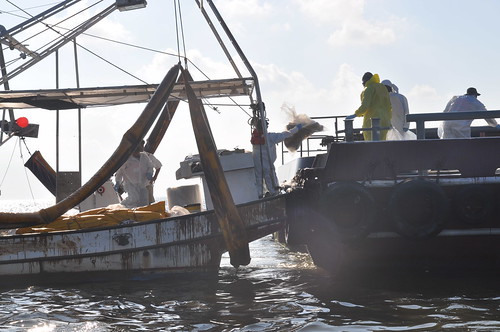
JEFFERSON PARISH, La. — An oil skimmer, a participant in the Vessels of Opportunity Program, offloads bags of oiled sorbent boom onto a larger vessel in Barataria Bay, Grand Isle, June 10, 2010. Skimming vessels, many of which are converted fishing and shrimping boats, provide one type of weapon used to combat the oil mid-ocean and help minimize the shore impact. U.S. Coast Guard photo by Petty Officer 3rd Class Caleb Critchfield.


GRAND ISLE, La. – Two boats, both participants in the Vessels of Opportunity Program, back up stern to stern allowing the oil skimmer to offload bags of oiled sorbent boom collected by the ship in Barataria Bay, Grand Isle June 10, 2010. Skimming vessels, many converted fishing and shrimping boats, provide one type of critical tool used to combat the oil mid-ocean and help minimize shore impact. U.S. Coast Guard photo by Petty Officer 3rd Class Caleb Critchfield.


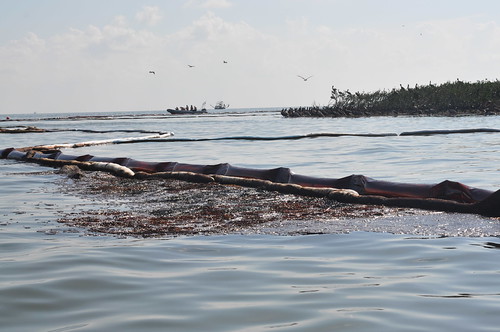
JEFFERSON PARISH, La. — Containment boom and sorbent boom block a patch of oil from reaching an island populated by brown and white pelicans and many other species of birds in Barataria Bay, Grand Isle, June 10, 2010. Containment boom is used to block or contain oil slicks and sorbent boom is selectively permeable so that it absorbs oil and not water. Boom is a defensive measure used to help prevent the oil from invading beaches and environmentally sensitive areas. U.S. Coast Guard photo by Petty Officer 3rd Class Caleb Critchfield.

Controlled Burn June 9


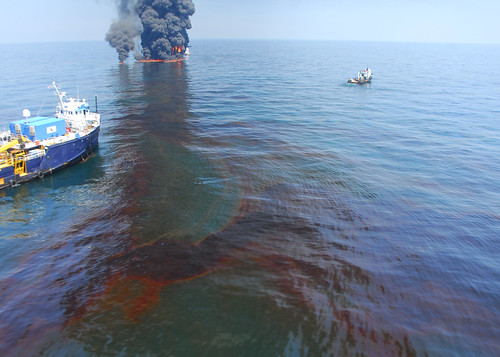
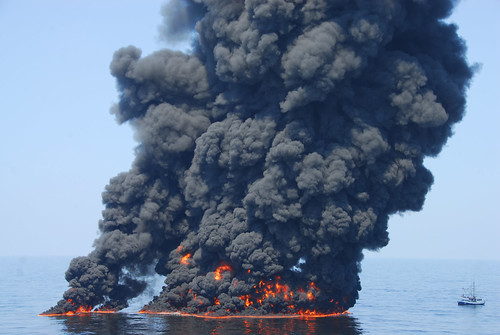
OFF THE LOUISIANA COAST---The Premiere Explorer of Venice, La. stands by near a controlled burn of spilled oil from in the Deepwater Horizon/BP oil spill in the Gulf of Mexico June 9. Coast Guard Photo by Petty Officer First Class John Masson.

Lawmakers welcome Main Street lobbies

Credit unions had more influence on financial regulation than Wall Street.

Lawmakers aren't afraid to admit that they consulted at least one bank lobby during the financial regulation bill.
Credit unions, the nation's smallest financial institutions, organized an effective grassroots campaign during the debate to ensure that they would not have to suffer for Wall Street's mistakes.
As the House and Senate started to reconcile their versions of financial regulation Thursday, the Washington Post   reported on the lobby:
Credit union members have submitted 375,000 e-mails, letters and phone calls over the past two weeks, and about a thousand credit union executives are swarming Capitol Hill this week.
Wall Street may have more money to lobby, but the article states that lawmakers preferred to listen to this smaller group:
Again and again, big banks have been outpaced by small-town interests, proving that even when it comes to overhauling financial regulation, politics really is local.
Community bankers, auto dealers and other Main Street businesses have won exemptions from proposed new regulations by repeating a mantra not available to big Wall Street firms: We didn't cause the crisis.
Lawmakers were more sensitive to these groups' concerns because they have a presence, and represent votes, in every congressional district.
Credit unions aren't done lobbying yet on financial regulation. They continued to meet with lawmakers Thursday over an amendment to limit the fees merchants charge when consumers swipe their credit and debit cards.
The small banks say they will lose out if Congress tries to curb the profits generated by those fees.
-- Ambreen Ali, Congress.org

A chance encounter on the Gulf Coast with a BP engineer

I’d pulled over to the side of Highway 1 in Grand Isle, La., to film one of the many angry signs local residents have put up across this island. “Cannot fish or swim” this one read. “How the hell are we supposed to feed our kids now?”

Photo: William Brangham
A vehicle pulled in behind mine and a man stepped out to snap a picture of the same sign.
I gestured at it and said something about how if I lived here, I’d likely feel the same.
“Yeah, me too.” he said. “But I’m on the other side of this one.”
“What do you mean?” I asked.
“I’m a drilling engineer for BP.”
BP has barred its employees from talking to people like me without authorization. I explained who I was, but asked if he’d be willing to talk on background about life inside the company in the middle of this crisis. He was reticent at first, but soon seemed eager to vent.
He described dozens of rank-and-file BP workers like him who were “just sick to death” about what was happening.  He said they were desperate to get the leak under control and were working round-the-clock shifts to get it fixed.
“I’m not complaining,” he said. “it’s our job to fix our own mess.” His real anger seemed directed at the managers who he said had single-handedly ruined a company, and a place, he clearly cared a great deal about. He seemed distressed about the damage that was being wrought along the Gulf Coast: “Many of us come here for vacation. Some of the guys live here themselves … It’s just horrible.” He just shook his head when I asked about the way the company had handled the aftermath of the spill. He gestured at the big yellow sign on the side of the road. “We deserve that.”
I asked about recent allegations that BP routinely skirted safety rules, and while he said he’d heard the accusations, he said he’d not witnessed those things himself.
He also said that BP’s move in recent years into alternative fuels (part of its official makeover from “British Petroleum” to “Beyond Petroleum”) wasn’t all corporate spin.  Sure, he said, the research was probably based more on money than on environmental concerns, but “a lot of folks in the company took that mandate really seriously. We wanted to be out ahead of the competition. We wanted to be the ones to find new energy sources.”Clapping his hand on the hood of his gas-guzzler, he said: “These can’t be the future.”
By the end of our conversation he seemed dejected. “This [the oil spill] is all anyone’s gonna remember us for.”
As he was leaving, I asked if I could get his number in case I had questions down the road. “I can’t.” he said.  “My name in your notebook is not a good thing for me.”

In 2008, BP Touted New Tech To Measure Oil Flow

| Fri Jun. 11, 2010 3:00 AM PDT

For seven weeks, BP has insisted that measuring exactly how much oil is gushing into the Gulf of Mexico is a daunting—perhaps impossible—task. The depth of the well, and the volume of natural gas emitting from it, has made the flow rate "very, very difficult to estimate," BP has said, while its chief operating officer has emphasized the "huge amount of uncertainty" surrounding the question. But back in 2008, the company was singing a very different tune. In an in-house magazine, BP bragged about sophisticated technology it had developed to measure precisely the flow of oil and gas through pipelines.
The August 2008 issue of Frontiers, BP's technology and innovation magazine, includes a lengthy feature, titled "Listening to the Flow." The article boasts of the company's "expertise [in] flow measurement." Determining how much oil and gas is flowing out of a pipeline is "tricky to do," the article says. It explains that BP had developed a technology called sonar-based flow metering, in which the flow of hydrocarbons is measured using sonar sensors placed inside a pipe. This technology is "proving its worth in the company’s operations around the world," the article says, noting that BP "has pioneered the introduction of a new and very useful tool into the wider oil industry."
According to the article, BP tested its technology in 2004 on a wet gas pipeline in Alaska and had already introduced around 45 sonar meters to oil fields. The company's research and development program manager told the magazine that BP planned to use the devices on underwater wells, too.
Scientists from Woods Hole Oceanographic Institution have also developed acoustic technology. BP initially invited them to the site of the spill in early May, one scientist told a House panel last month, but then rescinded the invite. The Woods Hole team is now working on estimates as part of the government flow rate team.
In the early weeks of the catastrophe, BP said 1,000 barrels of oil were leaking from the well each day. Then, the oil giant went along with a later government estimate of 5,000 barrels per day. That, too, proved to be understating the matter. The government's latest assessment is 20,000 to 40,000 barrels per day, but the upper range could be as high as 50,000 barrels per day. Meanwhile, BP says it's siphoning up to 15,000 barrels of oil daily. Given that oil is still pouring into the ocean, this only serves to verify that the spill is far worse than BP—and the government—originally let on. BP's earliest estimates would have us believe that a total of around 2.2 million gallons of oil had entered Gulf waters. According to the new, upper-end calculation from the flow rate team, that total could be as high as 109.2 million gallons.
There's a reason the oil giant is being so cagey about the spill's true size. The amount that the company will eventually have to fork out in civil penalties will be determined by how much oil they've dumped into the Gulf. On Thursday, Rep. Ed Markey (D-Mass.) called on BP to grant independent scientists direct access to the spill site in order to figure out the flow rate.
Of course, if BP's technology is as ground-breaking as that 2008 magazine article would have us believe, the oil giant should be perfectly capable of undertaking this complex calculation itself. Where's that cutting-edge research now?
Image from Frontiers, August 2008. Image from Frontiers, August 2008.

South Carolina needs help


I'm really beginning to think that Kathleen Parker is the last best thing to come out of South Carolina. We've seen the ugliness that enveloped Republican gubernatorial candidate Nikki Haley. The boisterousness of Rep. Joe "You Lie!" Wilson (R). And the literal wanderlust of Gov. Mark Sanford (R).
Now, from literally out of nowhere, comes Alvin M. Greene, the Democratic nominee for Senate. He barely campaigned. Aside from his campaign filing fee, Greene spent next to nothing. He was slapped with a felony obscenity charge from last November for allegedly showing porn on his computer to a fellow college student and then asking to go back to her room. Greene, who grabbed 60 percent of the vote, is so unlikely a candidate that House Majority Whip James E. Clyburn (D-S.C.) thinks he's a stooge for the GOP. The state's Democratic Party chair is urging Greene to withdraw from the race. He refuses.
I'm the Democratic Party nominee...The people have spoken. The people of South Carolina have spoken. The people of South Carolina have spoken. We have to be pro-South Carolina. The people of South Carolina have spoken. We have to be pro-South Carolina.
The people of South Carolina have spoken all right -- and it's gibberish.

Business group sees body blow to 'card-check' in Lincoln win

By Michael O'Brien - 06/09/10 06:40 AM ET
A key business group saw a body blow for "card-check" legislation on Tuesday night in Arkansas.

The Workforce Fairness Institute (WFI), a group opposed to the Employee Free Choice Act (EFCA), a piece of union-organizing legislation favored by organized labor, seized on incumbent Sen. Blanche Lincoln's victory over the state's lieutenant governor in a closely contested Democratic primary.

"A massive investment on the part of union bosses, which they will not be able to duplicate in other races, resulted in a loss for Big Labor’s poster-child candidate, producing a general election where both nominees will oppose [EFCA]," WFI Director Katie Packer said in a statement.

Lincoln eked out a 52-48 percent victory over Arkansas Lt. Gov. Bill Halter (D) last night after labor groups had spent around $10 million to unseat the centrist senator, who had angered unions over her opposition to the card-check bill, as well as the public option in healthcare reform.

The move pitted labor, usually a Democratic constituency, against the party establishment, which had backed Lincoln as the better general-election candidate against challenger John Boozman, a Republican congressman in the state.

WFI pointed out that Halter had refused to answer questions on EFCA throughout the race, despite his heavy union backing. While there is a sizable labor movement in the state, it is also the headquarters to companies like Wal-Mart, which has fought back against unionizing its employees.

Halter's ambiguity on the issue, along with Lincoln's win, helped signal the death knell for card-check, WFI argued.

"Blanche Lincoln’s victory, coupled with Big Labor’s failure to get its candidate to endorse their top legislative priority even after spending millions of dollars, speaks volumes to how far [EFCA] has fallen in the last year and serves as an unambiguous victory for those who oppose forced unionization," Packer said.

Svanberg CEO of BP

Letter to CEO of BP from Obama Administration

President Obama will participate in a portion of the meeting.

Republicans 'You Cut' Eric Cantor


EricCantor May 10, 2010Republican Whip Eric Cantor introduces YouCut, a first-of-its kind initiative designed to change the culture of spending in Washington to a culture of saving.

Learn more at: http://www.republicanwhip.house.gov/y...
Subscribe to "EricCantor" for the latest YouTube videos
Follow on Twitter: http://www.twitter.com/gopwhip


  EricCantor May 20, 2010YouCut: The First Week's Vote. Learn more at: http://republicanwhip.house...


EricCantor May 28, 2010YouCut: The Second Week's Vote


EricCantor June 09, 2010YouCut: The Third Week's Vote

Congress people announcing the winning you cut winner


EricCantor May 18, 2010 — Congressman Tom Price Announces The First YouCut Winning Item


EricCantor May 25, 2010 — Congresswoman Michele Bachmann Announces The Second YouCut Winning Item


EricCantor June 09, 2010 — Garrett and Hensarling Announce This Week's Winning YouCut Proposal

Gibbs:

 No complaints about Obama 'kick ass' line

By Jordan Fabian - 06/09/10 05:19 PM ET

White House press secretary Robert Gibbs said Wednesday that he has heard no complaints about President Barack Obama's comment that he is trying to figure out "whose ass to kick" for the BP oil spill.
CNBC anchor Becky Quick called the comment unpresidential on Tuesday, a claim that was echoed by Sen. James Inhofe (R-Okla.) on Wednesday.
"No, I’ve not heard any regrets about the language," Gibbs said.
In an interview with NBC's "Today" show on Tuesday Obama said "[I] don't sit around just talking to experts because this is a college seminar — we talk to these folks because they potentially have the best answers, so I know whose ass to kick."
He was responding to Matt Lauer's request to respond to those who say he should stop talking to experts and start "kicking butt."