Pages

Tuesday, June 8, 2010

PRIMARY NIGHT IN AMERICA

Blanche Lincoln Defeats Bill Halter In Arkansas .. Nikki Haley, Gresham Barrett Headed To Runoff In S.C. .. Nevada Gov. Ousted In GOP Primary .. Elections Test Anti-Incumbent Sentiment .. LIVE Tweets

'Birther Queen' Orly Taitz Goes Mainstream


California Republicans Worry About 'Birther Queen'
Candidacy, Orly Taitz Goes Mainstream


Birther queen Orly Taitz's claim to fame might not have seemed like an ideal launching pad for a Republican campaign for California Secretary of State, but now her momentum has the GOP quaking in their boots.

Taitz is facing a rather weak primary challenge from former Jacksonville Jaguar Damon Dunn on Tuesday, and Republican officials are worried that the controversial conspiracy theorist could go all the way.

As Politico reported Monday, the GOP would see a Taitz victory as a lost opportunity:

"It'd be a disaster for the Republican party," says James Lacy, a conservative GOP operative in the state. "Can you imagine if [gubernatorial candidate] Meg Whitman and [candidate for Lt. Gov.] Abel Maldonado -- both of whom might have a chance to win in November -- had to run with Orly Taitz as secretary of state, who would make her cockamamie issues about Obama's birth certificate problems at the forefront of her activities?"


"There is no Republican candidate for statewide office that would be willing to have her campaign with them," says Adam Probolsky, a spokesman for the Orange County Republican Party.

But while the GOP continues to bemoan the relatively powerful campaign that the birther queen has launched from the fringe, Taitz may be taking steps -- however small -- toward the mainstream.

Talking Points Memo reports Tuesday that Taitz, who is originally from Israel, attended the Republican Jewish Coalition "annual summer bash" on Sunday as a "special guest."

Other high-profile Republicans at the event included former Bush adviser Karl Rove, former Minnesota Senator Norm Coleman, and California Senate candidates Chuck DeVore and Carly Fiorina, and Minnesota Rep. Michele Bachmann.

UPDATE:

The Washington Post's Dave Weigel draws up a blueprint for an Orly Taitz victory:

Republican voters, brought out in sizable numbers by the contested primaries for governor and U.S. senator, fill out the rest of their ballot with progressively less information about their candidates. They know Taitz's name from... somewhere. And she's listed first on the ballot, thanks to the state's randomized ranking system. (Some of these voters, of course, will know and avidly support her.) She's identified on the ballot as an attorney, while Dunn is a real estate agent. They check off her name, and she wins.


Orly Taitz, Head Of Birther Movement,To Run For CA Secretary Of State

Orly Taitz, Orange County based dentist/lawyer and leader of the of
the birther movement, is planning to run for California Secretary of
State. The SF Gate reports:

Orange County
Registrar of Voters Neal Kelley said Wednesday that Orly Taitz, a leader
of the so-called birther movement, has qualified as a candidate.

She plans to challenge fellow Republican Damon Dunn, a former NFL
player living in Irvine, for her party's nomination.
Taitz made a name for herself last summer at the height of the "let's all forge up some birth certificates" craze.

Ethics Office Investigates C Street Residence


June 9, 2010
By Paul Singer
Roll Call Staff


The Office of Congressional Ethics is apparently investigating whether Members of Congress sharing a residence run by a religious organization have received an improper gift in the form of below-market rent in the building. Sen. Tom Coburn (R-Okla.), who lives in the residence known as the “C Street house,” told Roll Call on Tuesday that he has not been contacted by ethics investigators seeking information about the residence but added, “I know some House Members have been asked for it. This is not the ethics committee. It’s the other one,” Coburn said, referring to the OCE, which was created by the House in 2007 to vet complaints and refer cases to the ethics committee.
The C Street Southeast house is owned by a Christian organization known as the Fellowship, or the Family, which runs the annual National Prayer Breakfast. A handful of Members of Congress have lived there over the past several years, and there also are regular prayer meetings there for Members who do not live in the house.
The residence became the focus of attention last summer when Sen. John Ensign (R-Nev.) acknowledged having an affair with the wife of his chief of staff and said his housemates at C Street attempted to intervene to end the affair.
Shortly thereafter, South Carolina Gov. Mark Sanford (R), in a rambling press conference about his own extramarital affair, mentioned that he had gone to C Street for counseling.
The watchdog group Citizens for Responsibility and Ethics in Washington filed complaints in April with the OCE and the Senate Ethics Committee, arguing that the Members’ living arrangements at C Street appeared to be an improper gift.
The CREW complaint cited news articles indicating that Members paid $950 a month to live at the C Street residence and argued that is far below market value for a living situation that more closely resembles a hotel than a private apartment. Citing news reports, CREW said the residents at C Street received maid and laundry service and occupied furnished rooms.
CREW asked the OCE to investigate Reps. Mike Doyle (D-Pa.), Heath Shuler (D-N.C.), Bart Stupak (D-Mich.), Zach Wamp (R-Tenn.) and Jerry Moran (R-Kan.). The group asked the Senate Ethics Committee to investigate Coburn, Ensign and Sens. Sam Brownback (R-Kan.) and Jim DeMint (R-S.C.), all of whom had been reported to live at the C Street house at various times since 2003.
Coburn said the allegations are nonsense and he had not been contacted by the Senate Ethics Committee. Ensign is under a separate investigation into allegations that he helped his aide start a lobbying business as a kind of payoff for the aide’s silence about the affair.
It is not clear how far the OCE has gone in investigating the matter on the House side. A spokesman for Doyle said he was not aware of any contact from the OCE, and a spokeswoman for Stupak said the same. Inquiries to the offices of Wamp, Moran and Shuler were not returned.
Moran, who is running to replace Brownback in the Senate, has recently downplayed the amenities at C Street.
At an April campaign event with Coburn in Wichita, Kan., Moran was asked about the CREW complaint. He described the C Street house as a place where Members gather for Bible study, and he said, “It became a residence of mine several years ago. I rent a room there with other colleagues and moved my bed in and share a bathroom with other folks.”
Moran added, “I’ve never even showered at C Street.”
Moran has said he believes the complaint is groundless, and he said at the Wichita event: “I do believe that there are those people that want to make certain that one’s religious faith is not something that is mingled with their public service. ... My public service is clearly related to my beliefs as a Christian.”
Ethics lawyer C. Simon Davidson, who is a contributing writer for Roll Call, said “the fundamental issue is, ‘Did they receive a gift?’ In order to determine whether they received a gift, you would need to determine whether they received disproportionately more than what they paid for.” In short, did the Members pay a fair price for their lodging?
But Davidson pointed out, “The difficulty is that it is not clear that there is really a fair market value for this type of thing. It is such an unusual living arrangement,” more akin to a rooming house than a normal hotel or apartment building.
When the OCE opens an investigation, the office may review a matter for up to three months. After that, the OCE must refer to the House Committee on Standards of Official Conduct a recommendation for further review or dismissal.
But if the OCE abandons an investigation after the first 30 days of an inquiry, it is not required to issue a report to the ethics panel, and the probe is not released to the public.

Conlin Wins in Iowa—Is Grassley Vulnerable?

Mother
 Jones


One poll shows the GOP vet barely fending off the ex-US atty's challenge.
Roxanne Conlin, a former Iowa Attorney General, won the Democrats' Senate nomination there Tuesday night and will face incumbent Republican Chuck Grassley in the fall. Logic holds that Grassley should be vulnerable. Iowa has been trending blue, and is perfectly capable of sending Democrats to Washington—Tom Harkin, the Dem half of the state's senate pair, is pretty liberal and a big supporter of organized labor. Grassley has definitely been feeling some pressure from his state's increasingly blue hue—he flirted with negotiating on health care reform, for example. Most important, Conlin's a serious candidate with the ability to raise real money. The Democratic National Committee is certainly excited about her chances. DNC chair Tim Kaine released this statement Tuesday night:
As we look toward November, the contrast for Iowa voters could not be more clear. Voters will choose between Roxanne Conlin, a Democrat who will fight for middle-class Americans, or Republican Chuck Grassley, a senator who has repeatedly put special interests and the insurance companies ahead of the people of Iowa. At every turn Senator Grassley and his Republican colleagues in Congress have opposed President Obama—from the Recovery Act, to the Affordable Care Act, to relief for out of work Americans. Senator Grassley had the opportunity to do right by the American people by standing with the President on health reform, but decided instead to stand with insurance companies. We know where Chuck Grassley stands, and it is not with the people of Iowa. This November Iowans will have the opportunity to elect Roxanne Conlin, a candidate who will work hard every day for the people of Iowa.
I'm not sure Grassley is as vulnerable as Kaine hopes. Sure, one poll had Conlin within 10 points of Grassley earlier this year. But that result hasn't been replicated since. We can tell one thing from the statement, though: in Iowa, at least, the Dems are perfectly confident about running on their record. If this turns out to be an anti-incumbent, rather than simply an anti-Dem, year, look for Conlin to at least give Grassley a scare.

Reining in the Debt Machine

Mother
 Jones


The conference committee on financial reform gets down to business this week, and one of the subjects on the table is Susan Collins's provision to increase capital requirements for banks. Wall Street is dead set against this, of course, but Pat Garofalo dismisses their objections: [1]
Throughout the financial reform debate, the banks have claimed that every proposed regulation would hinder credit and decrease the availability of loans. The same threat, used over and over, begins to ring a bit hollow.
I sort of wonder about the advisability of this approach. Because let's face it: the banks are right. Other things equal, anything that raises capital requirements or reduces leverage does limit the size of a bank's asset base. That's the whole point. And since the vast bulk of most bank assets consists of loans in one form or another, higher capital requirements will indeed lead to them reducing the availability of loans.
Now, it's possible that the effect will be less than Wall Street says. Maybe banks will shift their portfolios in ways that keeps credit to the real economy flowing. Maybe other parts of the financial industry will take up some of the slack. Maybe. But the housing bubble of the aughts was really a credit bubble, and one of the whole points of financial reform is to put rules in place that rein in the kind of unsustainable increases in debt we saw over the past decade. It might or might not work (the financial industry is pretty good at figuring out ways around prudential regulation, and global capital flow imbalances are going to continue driving debt upward unless we get them under control), but putting a modest damper on loan availability is a feature of financial reform, not a bug.
Whether it's wise to say this very loudly I'm not sure of. But I'm not sure it's wise to deny it too loudly either.

The Strange Musings of Lindsey Graham

Mother
 Jones


Is the Climate Bill Going to Pass?

Mother
 Jones


Grand Isle Bird Rescue June 4


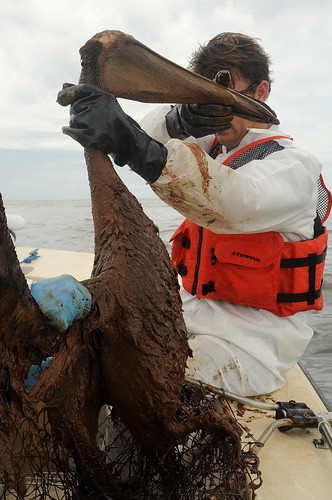
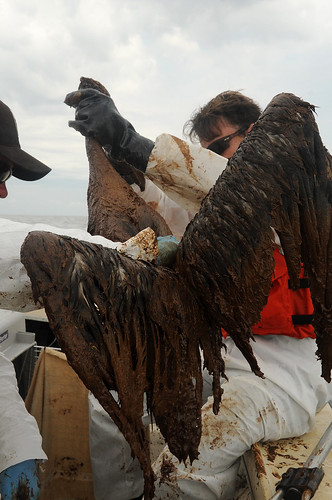
JEFFERSON PARISH, La. – Jeff Phillips, Environmental Contaminants Coordinator for the U.S. Fish and Wildlife Service, rescues a Brown Pelican from the Barataria Bay in Grand Isle, La., June 4, 2010. State and federal wildlife services pulled approximately 60 Brown Pelicans, in the last two days, covered in oil from the Barataria Bay area. U.S. Coast Guard photo by Petty Officer 3rd Class Ann Marie Gorden.

Deepwater Horizon Oil Spill Responders to Hold Plaquemines Parish Community Expos

HOUMA, La. – Representatives from BP, the U.S. Coast Guard, U.S. Fish and Wildlife, the Environmental Protection Agency and other state and partner agencies responding to the Deepwater Horizon BP oil spill, will host two open house Expos Tuesday and Thursday in Plaquemines Parish at 6 p.m. CDT. 
The open house expos will offer Plaquemines residents the opportunity to engage one-on-one with experts about the techniques, strategies and materials being used in the spill response.
“We want to keep the local communities informed with the most accurate and timely information we have,” said Coast Guard Capt. Roger Leferriere, Coast Guard unified commander at the Incident Command Post in Houma, La. “We want to communicate with the public and provide them with first-hand information on the topics that concern them most.”
The expos will feature experts and representatives from responding agencies who will answer questions and provide visual information on the various tools, equipment and strategies that are being used in the response, including booms, burns, sand berms, skimming and dispersants. Agencies will be available to address concerns about environmental quality, wildlife, safety and resources available to residents. Information will also be available on the Vessels of Opportunity (VOO) Program, Supplemental Nutrition Assistance Program (SNAP) and volunteer and employment efforts. 
Claims representatives will be available for any questions or concerns residents might have on the claims process.
Plaquemines Parish (West)
Tuesday, June 8, 2010, 6 p.m. CDT -- Belle Chasse Auditorium, 8398 Highway 23, Belle Chasse, LA 70037
Plaquemines Parish (East)
Thursday, June 10, 2010, 6 p.m. CDT  -- Phoenix High School, 13073 Highway 15, Braithwaite, LA 70040

BP Announces First Payment on Barrier Islands Project for State of Louisiana

HOUSTON -- As part of the previously announced commitment to fund the entire $360 million cost of six berms in the Louisiana barrier islands project, BP today announced that it will make an immediate payment of $60 million to the State of Louisiana. In a letter to Louisiana Governor Bobby Jindal and as previously announced, BP detailed its plans to make payments in stages based on the project’s completion milestones.  
The initial $60 million payment is intended to permit the State to begin work on the project immediately. BP will then make five additional $60 million payments when the Coastal Protection and Restoration Authority of Louisiana, which is chaired by Garret Graves, certifies that the project has satisfied 20%, 40%, 60%, 80% and then 100% completion milestones. The entire $360 million will be funded by the completion of the project. Under the arrangement announced today, BP plans to make payments directly to the State of Louisiana rather than establishing an escrow fund for this project. 
“We are committed to doing everything we can to protect the coastline and reduce the impact of the oil and gas spill in the Gulf of Mexico. We understand that the United States Coast Guard and the State of Louisiana want this project to proceed with urgency, so we want to ensure that funding is immediately available to begin construction of the berms,” said Bob Dudley, Managing Director.  
BP already has provided $170 million to Louisiana, Alabama, Mississippi, and Florida to help with those state’s response costs and to help promote their tourism industries. The company also has paid approximately $51 million in compensation to people and companies affected by the spill.

The Ongoing Administration-Wide Response to the Deepwater BP Oil Spill


The Ongoing Administration-Wide Response to the Deepwater BP Oil Spill
Prepared by the Joint Information Center
UPDATED June 7, 2010 7 PM

* For a full timeline of the Administration-wide response, visit the White House Blog.
PAST 24 HOURS
President Meets with Cabinet Members and Other Top Officials at White House
President Obama met with members of his cabinet and other top U.S. government officials involved in the ongoing administration-wide response to the BP oil spill in the Cabinet Room at the White House.
Following the meeting, the President again reiterated the federal government’s commitment to ensuring that BP fulfills every claim obligation. “We are going to insist that money flows quickly—in a timely basis—so that you don’t have a shrimp processor or a fisherman who’s going out of business before BP finally makes up its mind as to whether or not it’s going to pay out,” the President said. “That’s going to be one of our top priorities, because we know that no matter how successful we are over the next few weeks in some of the containment efforts, the damages are going to be there.” A transcript is available here.
Admiral Allen and Press Secretary Gibbs Provide Operational Update
National Incident Commander Admiral Thad Allen and White House Press Secretary Robert Gibbs provided a briefing to inform the American public and answer questions on the progress of the administration-wide response to the BP oil spill from the White House press briefing room. A transcript is available here.
Admiral Allen included a slide in his briefing that presents a three-dimensional view of the response and the four different areas of operations: in the subsea area near the well; on the surface above the well; within 50 miles of the coast; and on the shoreline. “We’re no longer dealing with a large, monolithic spill,” Allen said. “We’re dealing with an aggregation of hundreds or thousands of patches of oil that are going a lot of different directions.  And we’ve had to adapt and we need to adapt to be able to meet that threat.” 
BP Continues to Capture Some Oil and Gas Using Containment Device
BP continues to capture some oil and burn some gas at the surface using its containment dome technique, which is being executed under the federal government’s direction. After cutting off a portion of the riser, BP placed a containment device over it in order to capture oil at its source.
EPA Continues to Monitor Air, Water and Sediment Quality in the Gulf Coast
According to the most recent data, the Environmental Protection Agency has found that air quality levels for ozone and particulates are normal on the Gulf coastline for this time of year. Likewise, water and sediment samples along the Gulf Coast did not reveal elevated levels of chemicals usually found in oil.  
EPA has observed odor-causing pollutants associated with petroleum products in the air along the coastline at low levels. Some of these chemicals may cause short-lived effects like headache, eye, nose and throat irritation, or nausea. People may be able to smell some of these chemicals at levels well below those that would cause short-term health problems. Anyone experiencing these and other symptoms should call the Medical Support Line at 1-888-623-0287.
Fishing Restrictions Decrease by One Percent; 68 Percent Remains Open
Today, NOAA opened 430 square miles of previously closed fishing area off the Florida panhandle – the northern boundary now ends at the Florida federal-state water line on the east side of Choctawhatchee Bay. This area was initially closed on June 5 as a precaution because oil was projected to be within the area over the next 48 hours. However, the review of satellite imagery, radar and aerial data indicated that oil had not moved into the area.
The closed area now represents 78,264 square miles, which is approximately 32 percent of Gulf of Mexico federal waters—the closed area does not apply to any state waters. This leaves approximately 68 percent of Gulf federal waters available for fishing. Closing fishing in these areas is a precautionary measure to ensure that seafood from the Gulf will remain safe for consumers. Details can be found at http://sero.nmfs.noaa.gov/.
Administration Continues to Oversee BP’s Claims Process
The administration will continue to hold the responsible parties accountable for repairing the damage, and repaying Americans who’ve suffered a financial loss as a result of the BP oil spill. BP reports that 38,052 claims have been opened, from which more than $48.6 million have been disbursed. No claims have been denied to date. There are 514 claims adjusters on the ground. To file a claim, visit www.bp.com/claims or call BP’s helpline at 1-800-440-0858. Those who have already pursued the BP claims process and are not satisfied with BP’s resolution can call the Coast Guard at (800) 280-7118.
SBA Economic Injury Assistance Loans Approved for Louisiana
SBA has approved 43 economic injury assistance loans to date, totaling $1,8 million for small businesses in Louisiana impacted by the BP oil spill. Additionally, the agency has granted deferments on 301 existing SBA disaster loans in the Gulf Coast region, totaling $1,253,800 per month in payments. For information on assistance loans for affected businesses, visit the SBA’s Web site at www.sba.gov/services/disasterassistance, call 800-659-2955;  800-877-8339 for the hearing impaired), or email disastercustomerservice@sba.gov.
Successful Controlled Burn
Favorable weather conditions allowed responders to conduct a successful controlled burn operation. As part of a coordinated response that combines tactics deployed above water, below water, offshore, and close to coastal areas, controlled burns efficiently remove oil from the open water in an effort to protect shoreline and wildlife.  
By the Numbers to Date:
  • The administration has authorized 17,500 National Guard troops from Gulf Coast states to participate in the response to the BP oil spill.
  • More than 22,000 personnel are currently responding to protect the shoreline and wildlife and cleanup vital coastlines.
  • More than 3,100 vessels are responding on site, including skimmers, tugs, barges, and recovery vessels to assist in containment and cleanup efforts—in addition to dozens of aircraft, remotely operated vehicles, and multiple mobile offshore drilling units.
  • Approximately 2.19 million feet of containment boom and 2.46 million feet of sorbent boom have been deployed to contain the spill—and approximately 702,000 feet of containment boom and 2.5 million feet of sorbent boom are available.
  • Approximately 15.5 million gallons of an oil-water mix have been recovered.
  • Approximately 1.09 million gallons of total dispersant have been deployed—779,000 on the surface and 317,000 subsea. More than 469,000 gallons are available.
  • More than 125 controlled burns have been conducted, efficiently removing a total of more than 3.2 million gallons of oil from the open water in an effort to protect shoreline and wildlife.
  • 17 staging areas are in place and ready to protect sensitive shorelines.
Resources:
  • To contact the Deepwater Horizon Joint Information Center, call (985) 902-5231.
  • To volunteer, or to report oiled shoreline, call (866) 448-5816. Volunteer opportunities can also be found here.
  • To submit your vessel as a vessel of opportunity skimming system, or to submit alternative response technology, services, or products, call (281) 366-5511.
  • To report oiled wildlife, call (866) 557-1401. Messages will be checked hourly.
  • For information about validated environmental air and water sampling results, visit www.epa.gov/bpspill.
  • To file a claim with BP, visit www.bp.com/claims or call BP’s helpline at (800) 440-0858. A BP fact sheet with additional information is available here. Those who have already pursued the BP claims process and are not satisfied with BP’s resolution, can call the Coast Guard at (800) 280-7118.  More information about what types of damages are eligible for compensation under the Oil Pollution Act as well as guidance on procedures to seek that compensation can be found here.
  • In addition, www.disasterassistance.gov has been enhanced to provide a one-stop shop for information on how to file a claim with BP and access additional assistance—available in English and Spanish. 
For information about the response effort, visit www.deepwaterhorizonresponse.com.

National Oceanic and Atmospheric Administration Deploys Additional High Powered Research Aircraft to Gulf to Help Monitor Air Quality

WASHINGTON -- A second National Oceanic and Atmospheric Administration WP-3D Orion aircraft was deployed to the Gulf today to build on current air quality monitoring efforts near the BP Deepwater Horizon Oil Spill.  The NOAA plane conducted two flights over and around the spill site to detect pollutants and their reaction products released into the atmosphere by the oil, as well as the pollutants and smoke from controlled burns.  The flights will enable researchers to better understand the spill’s atmospheric effects.
As part of the federal government's ongoing response to the BP spill, the Environmental Protection Agency (EPA) continues its extensive air quality monitoring along the Gulf Coast.  In this case, NOAA and EPA are working collaboratively to take advantage of NOAA’s highly specialized atmospheric research capabilities, which can detect concentrations of compounds in the atmosphere with greater sensitivity than standard operational monitoring flights. The P-3 is currently involved in a major climate and air quality study in California, called Calnex, which is why it is already properly outfitted for this emergency gulf mission.  Another NOAA P-3 is also in the Gulf and has done multiple flights to help monitor the location of the loop current. 
“We’re taking every step we can to ensure the health and safety of Gulf Coast residents and oil spill responders,” said EPA Administrator Lisa P. Jackson.  “The data we gather through this next step in our partnership with NOAA will enhance efforts to monitor the air we breathe and better prepare us to address the long-term impacts of the BP oil spill.”
"Ensuring the health and safety of Gulf Coast families is a priority for NOAA,” said Jane Lubchenco, under secretary of commerce for oceans and atmosphere and NOAA administrator.  "We want to make certain that the air is safe for coastal residents as well as workers on the water.  We are pleased to partner with EPA in this effort and to provide state-of-the-science air quality instruments in our flying laboratory aboard the P-3 aircraft."
Both NOAA Administrator Jane Lubchenco and EPA Administrator Lisa P. Jackson were in the Gulf region last week overseeing the ongoing federal response operations.
Operated by NOAA’s Office of Marine and Aviation Operations, the NOAA WP-3 Orion “hurricane hunter” plane is currently configured as a high-tech flying chemistry laboratory that can collect and provide near real-time air-quality data to scientists on the aircraft and on the ground.  Scientists onboard will also collect air samples that will be sent to the laboratory to be analyzed for additional compounds. 
Much of the sampling will be conducted below 1,000 feet, in what is called the marine boundary layer, where scientists expect most of the pollutants to be trapped.  They will collect data from as close to the sea surface as allowed by safe aircraft operation, with plans to go as low as 200 feet, to monitor for pollutants near the surface and up to 1,000 feet or more to track how the pollutants move through the air. The many measurements gathered from the flights will enable scientists to distinguish emissions associated with the leaking oil well from other sources, such as ships and aircraft operating in the area.
Both NOAA and EPA will combine their measurements with model simulations to provide a broader overall picture of air quality impacts from the BP Deepwater Horizon oil spill. 
NOAA’s mission is to understand and predict changes in the Earth's environment, from the depths of the ocean to the surface of the sun, and to conserve and manage our coastal and marine resources.