Pages

Monday, March 29, 2010

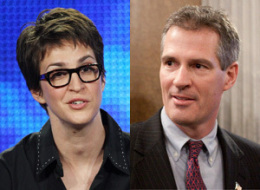
Rachel Maddow's Boston Globe Ad: I'm Not Running Against Scott Brown, He Won't Come On My Show

Huffington Post   |  Danny Shea First Posted: 03-26-10 09:34 AM   |   Updated: 03-26-10 09:43 AM
MSNBC took out a full-page ad in Friday's Boston Globe for a letter from Rachel Maddow to her fellow Massachusetts citizens.
The ad was a response to Sen. Scott Brown's claims — in an effort to raise money — that Maddow is planning a run against him in 2012.
"Hi, I'm Rachel Maddow. I host a TV show on MSNBC. I also live in Western Massachusetts, in the beautiful hilltowns of Hampshire County," the ad begins.
"I'm not running against Scott Brown," Maddow said. "I never said I was running against Scott Brown. The Massachusetts Democratic Party never asked me to run against Scott Brown. It's just not true. Honestly. I swear. No, really."
Maddow hit Brown for trashing one of his constituents.
"Do you remember when Mitt Romney ran for President after being our Governor and he went around the country insulting Massachusetts, talking about what an awful state we are?" she wrote. "To have our new Senator raising money around the country by saying how terrible one of his Massachusetts constituents is, kind of feels the same way to me.
Maddow wrote that "it's standard now for conservatives to invent scary fake threats to run against," citing death panels and the birther movement. "Senator Scott Brown's only been in DC seven weeks, but he already seems to be fitting right in with how conservatives operate there."
Maddow said she didn't run the ad because she's running against Brown, "but because he's the Senator for all of us, and maybe this will make him think twice the next time he wants to smear one of his constituents to raise money out-of-state."
The ad concludes with a reminder that Brown has refused to appear on Maddow's show.
"My show airs at 9PM Eastern in Massachusetts on MSNBC," she wrote. "So far, Scott Brown refuses to come on. Maybe he'll change his mind -- I hope he does.
See the ad below:
Maddow Senate Run 'Completely Made Up,' Despite Scott Brown Fundraising Pitch (VIDEO)


Rachel Maddow isn't planning to challenge Scott Brown for his senate seat in Massachusetts. Whether that's good or bad for Brown will be decided by the pundits -- and donors.

Brown sent a fundraising email on Tuesday, obtained by the Daily Beast, asking donors for help with a political season that "never ends." The message begins:

It's only been a couple of months since I've been in office, and before I've even settled into my new job, the political machine in Massachusetts is looking for someone to run against me. And you're not going to believe who they are supposedly trying to recruit--liberal MSNBC anchor Rachel Maddow.

Rachel lives in western Massachusetts, and recently it was reported that the chairman of the state Democratic Party had apparently tried to reach out to her in an attempt to coax her into a race against me.

Later that evening, Maddow chuckled throughout a denial of Brown's suggestion that she's being recruited to run. "It's completely made up by [Brown]," she told Bill Wolff. Normally the executive producer of The Rachel Maddow Show, Wolff took the host's chair as Maddow recused herself "for the first and probably last time."

The bewildered Maddow found herself in two unexpected positions: a guest on her own show and a fundraising catalyst. "The fear of Rachel Maddow is what he's raising money on in Massachusetts," she observed before joking, "Massachusets donors, open your wallets! Maddow's coming!"

The rumors may have originated with a Facebook page started by a friend of Maddow, as well as a vague Tweet sent by Massachusetts Democratic Party Chairman John Walsh. The MSNBC host suggested that the page was a joke ("there's a Facebook page for a lot of things") and pointed out that Walsh's tweet about the campaign made no reference to her.

"Why didn't they just call and ask me if it was true before sending out the fundraising letter?" she wondered.

Scott Brown Is Not Letting This Rachel Maddow Electoral Fantasy Go

First Posted: 03-25-10 01:58 PM   |   Updated: 03-25-10 02:37 PM


This past Tuesday, Senator Scott Brown (R-Mass.) made news after he sent around a strange fundraising email, which suggested that the "chairman of the state Democratic Party had apparently tried to reach out to" MSNBC host Rachel Maddow, and "coax" her into a run for the Senate seat he currently occupies.
This was alarming news to Maddow, who has no plans to run for anything and has not, in any event, even been approached to consider such a move. And so, she took to the airwaves to issue some Shermanesque denials.
WATCH:


But Scott Brown, he is not letting this go! Yesterday, he appeared on a WAAF radio show and was asked about this whole matter. Brown said, "With all due respect, I'm going to continue to fight and do my job and work hard to do just that. And, er, bring her on. I don't care."
WATCH:

To which Maddow replied: "Bring her on? Bring what on? I'm not running against you!" Indeed, the only thing that has been unleashed upon Scott Brown is the spectral image of the Rachel Maddow that lives in the wild weirds of his apparently overactive imagination. It's like Rachel Maddow is the Tyler Durden to Scott Brown's Edward Norton. So if one day soon, you espy Scott Brown beating the crap out of himself in some parking garage, you'll know what's going on.

How Lehman's Hidden Inner Circle Brought the Bank Down

Vicky Ward

Posted: March 28, 2010 09:19 PM

 Senator Spencer Bacchus, the top Republican on the House Financial Services Committee is quite right to write to Lehman bankruptcy examiner Anton J. Valukas and ask to review communications between the Federal Reserve and the Securities and Exchange Commission about Lehman Brothers Holdings Inc, in preparation for an April 20 hearing into the Valukas report. He wants to know what exactly the SEC found out while it was inside Lehman -- or more importantly what it missed.In his letter to Valukas. Bacchus wrote that Lehman "used accounting gimmicks to hide its debt and mask its insolvency...More disturbing, the examiner's report also describes what appear to be significant failings on the part of officials" at the SEC and the Federal Reserve Bank of New York.

The SEC and FED, after all, were inside Lehman Brothers for the last six months of its life. How did they miss all this?
Sen. Chris Dodd, the Senate banking chair has asked former Lehman chief Dick Fuld to return to testify exactly how Lehman misled so many people. (Fuld's lawyer has said Fuld had never heard of Repo 105, the accounting tool by which Lehman moved $50 billion of its balance sheets...)
Perhaps some explanation may lie in an email I received today from one of Lehman's most senior employees -- someone who worked there for 17 years. He wrote to me off the record so I am not at liberty to disclose his identity, but he was very senior and widely respected.
He is not the only Lehmanite to have responded to my new book, The Devil's Casino (Wiley). Many have thanked me for exposing a culture led (and ruined) by a tiny leadership that was egregious, isolated and mendacious. Without exception, Lehman readers have told me I got it absolutely right -- and -- in particular they have agreed with today's New York Post's article which noted that the book maintains that Lehman's president Joe Gregory was actually the chief villain at the firm, responsible for much of the over-risky leverage, and not so much Dick Fuld. (Incidentally all the e-mailers and callers have agreed that their wives loathed being "married to Lehman" as the book points out in one chapter.)
What my e-mailer of today however points out is something that both Rep. Bacchus and Sen. Dodd may find useful as they follow up on Valukas's report.
He wrote, "like many former colleagues, I'm astonished at how much we didn't know about the workings of the inner circle."
Note the last three words. "The Inner Circle." This was not the whole Lehman's executive committee. This was Fuld, Gregory, perhaps in reverse order, and then Gregory's pet of the month, at one point Erin Callan, at another Mark Walsh. But it was a tiny unit, cut off from the rest of Lehman.
He follows up.
  • Dick's hardly the gorilla. He's funny, passionate, caring, competitive, and serious about the business. In a way, he almost cared too much about Lehman and its employees.
  • Unfortunately, Joe G's characterization highly-accurate.
  • The commercial real estate book alone did not sink Lehman. Enormous and wrong prop bets on European interest rates in mid-2008 (FID chief Andy Morton moved on) and Alt-A MBS in NY also hurt.
  • As detailed in Examiner's Report ...real estate exposure went against recommendation of firm's own research department beginning in 2005. Why? The "growth engine" had to be fed. And internal politics.
  • Realize that space did not allow a full consideration of so many other terrific contributors and positive firm attributes. For example, No. 1 U.S. bond house for nearly a quarter century thanks to so many terrific capital market soldiers (sales, trading, research, syndicate) trying to do the right thing for their clients. And starting in 1973, Lehman ran world's largest debt index franchise that helped bolster its international reputation....
  • In the end, Paulson correct. Too many people in same seats for too long. Lehman would have been still standing if Mike Gelband had not been fired in 2007 for telling the truth and if the Lehman's most competent executive, Bart McDade, had been elevated to president before 2008.
So, here we have Lehman:
"An inner circle" at the top cut off from the rest. It fires people for telling the truth, and fails to promote the most competent executive until too late.... This culture didn't spring up in its last few months...it festered for years. Whatever the SEC and FED missed in the bank's final six months, the cabal at the top was already set in its ways and adept at hiding what it was really doing from not just the SEC, Fed and market -- but its own senior management. That really is a horrifying culture, and one I am delighted to have exposed.
Vicky Ward is the author of The Devil's Casino: Friendship, Betrayal and the High-Stakes Games Played Inside Lehman Brothers

Pawlenty: Don’t follow Mass. lead
Sunday, March 28, 2010 

Kevin LandriganKevin Landrigan

Minnesota Gov. Tim Pawlenty, a potential Republican presidential contender in 2012, said universal health care in Massachusetts is no model the nation should follow.
“The plan is dramatically propped up by federal money,” he said. “Take that away and there would be dire economic consequences.
“Looking at the Massachusetts experience, it would not be one I would want for the country to follow any further.’’
Now that Congress passed the health care reform law, the Massachusetts health experience could become even more a critical bellwether for Mitt Romney’s second run for president, in 2012.
During an interview with The Sunday Telegraph, Pawlenty didn’t mention Romney by name, but he relayed how Massachusetts state Treasurer Tim Cahill warned that a national version of the Massachusets law could bankrupt the country in four years.
Cahill is running as an independent for governor.
Romney will return to the state April 8 for a book tour that will include a visit to the Institute of Politics at St. Anselm College in Manchester.
Pawlenty lamented there were plenty of what he called “bipartisan areas of agreement’’ on health care far short of the national reform, including a new payment system, built-in incentives for healthy outcome, offering insurance across state lines and tort reform. He asked his state attorney general to join the 13 states suing the Obama administration over the law.
“We now have the federal government reaching so far inside our society, dictating whether human behavior is good or not,” Pawlenty said. “That is a quantum leap, and it should be alarming to people.”
Most historians now conclude former President Bill Clinton moved to the political center and ensured his solid re-election after his failure to achieve national health care.
Now that Obama has it, Pawlenty said there are all indications Obama will continue to play to his liberal base.
“He’s given no indication at all of moving to the center at all,” Pawlenty said. “You’ve got big government, big business and big unions taking care of each other, all to the detriment of the average person.”
Gambling on the ‘V word’
It’s all on you, Governor.
Maybe this is what he wanted all along, but the ever cautious, three-term Democrat now sits in the driver’s seat when it comes to dealing with the massive state budget deficit.
Getting to this destination, however, proved to be a very bumpy ride. Gov. John Lynch now has some Democratic leaders in both legislative branches privately unhappy with him.
Senate supporters of expanded gambling were miffed to watch Lynch come out and oppose a slot machine and casino-style legalization bill minutes after they had gotten it through the Senate. They liken it to Lynch’s vow in the spring of 2009 to veto a gas tax that came moments after the House of Representatives had approved a three-year, 15 cent hike.
House budget conferees objected, gaming was disengaged and that’s when lawmakers turned to the LLC tax, campground tax and others – and you well know the ugly details from there.
Then there are House budget writers who thought Lynch’s Hamlet act about gambling waiting until after the fact moved the Senate to reject a small package of cuts while they had unanimously endorsed cuts seven times larger.
“We were left holding a bad bag, and senators got to preen for the camera and for those who rely on Human Service spending that we felt had to be part of the cuts,’’ one House leader said. “If the governor had used the ‘V (veto) word’ about gambling, that bill never gets out of the Senate and we could be getting down to business.’’
Keep in mind, this wasn’t as easy a task as it appeared on the surface. You may recall Democratic Sen. Lou D’Allesandro couldn’t get a stand-alone gaming bill through the Senate last year and had to attach it to the two-year state budget.
At one point Wednesday, Lynch told one senator he believed the issue would deadlock 12-12. Later in the afternoon and prior to the Senate vote, Lynch told another source it would pass 13-11.
The 14-10 Senate passage is hardly a groundswell, but it wouldn’t have happened without the backing of Keene Democrat Molly Kelly and Senate Republican Leader Peter Bragdon, of Milford. Those were the pivotal votes for gambling advocates to turn, and they did.
Taxing projections
How big will the budget deficit be?
Well, the $140 million estimate Lynch offered six week ago assumes we fall $65 million short in revenue.
Through February, we were $50 million short of the forecast.
With less than a week left in this pivotal month, the news isn’t great, but it could have been much worse. All taxes and fees through Thursday were $20 million shy of the $594 million estimate.
March is a quarterly month for business taxes, and those are $10 million short with a few days left.
The final numbers will be better than that, as liquor revenues were short close to $2 million, but they always get a boost from the final weekend. The same is true from state lottery sales, which were more than $2 million below the target.
The tax on interest and dividends was $1.5 million below the plan, but April is the big month when all the annual returns are due, including 2009 dividends to LLC owners and members.
What should we add to the $140 million shortfall, along with the inevitably smaller base of revenue?
Let’s start with repeal of the LLC, which now is inevitable; that’s more than $15 million less, whether it was really ever going to raise that or not.
The campground tax looks like a goner, too, and that’s $4.5 million, even though forecasts admit it’s likely to only raise half that.
Some state department heads are expressing some doubt that they can meet the targets for returned money to the treasury or lapse amounts. The state is counting on $25 million a year from that source.’
Don’t look for Lynch to go this high, but some seasoned budget watchers peg the real hole at closer to $200 million, with an even gloomier $225 million deficit from others.
Playing with numbers
All eyes are on the 2011 deficit, but some close to Lynch have a more immediate concern.
That’s the shape of the state budget this June 30, weeks after he’ll make it official and file for a historic fourth term in office.
State law doesn’t require the first of the two-year budget cycle to be in balance, and some years it hasn’t been.
But with Democratic fortunes at great risk this fall, the last thing Lynch wants is to run again with red ink stains on his fingers. Legislative budget assistant Jeff Pattison pegged the 2010 deficit at $86 million.
With so little time left, how much can Lynch do to alter that picture? The answer is quite a bit.
Lynch is expected to present to the Legislative Fiscal Committee on April 12 an executive order that would offer cuts throughout most state agencies.
How to get the rest?
Well, there’s one way that’s under serious study, and it would involve the federal stimulus money known as state stabilization grants.
The current state budget divvied $160 million of that in half, $80 million in each year to support adequacy aid grants to school districts.
The research has been done, and the state could back load some of the $80 million slated for 2011 into 2010. It doesn’t change the size of the ultimate deficit, but merely would make next year’s hole bigger and could wipe out this year’s shortfall.
Rolling the dice
Gambling supporters have to make some fast decisions on the fly.
Are they willing to accept significant changes to their blueprint (SB 489) to give it a fighting chance of clearing the House?
If six locations for slots and table games are too much, would they scale that back in half? If so, which part of the state be left without a project when the music stops?
That’s easy. The top three destinations in this bill, in order, are Rockingham Park in Salem – No. 1 by a mile – Hudson and Seabrook, with The Lodge at Belmont competitive in this battle for the bronze medal.
But the Belmont folks most want historical racing or betting on randomly selected races that have already occurred.
Don’t look for advocates to be sending out bodies to pass this bill, however. When they do, one of two North Country sites will be the first to go, perhaps followed by Belmont.
Forget what the calendar requires; the move to schedule the gaming bill before the House Local and Regulated Revenues Committee this Tuesday is a sign the leadership in both parties is giving no help to this cause.
House Finance Committee Chairwoman Marjorie Smith, D-Durham, has long opposed expanded gambling, and she said she most objects to the fact the big winners in all of this would be out-of-state casino developers and not New Hampshire businesses.
“I would certainly hope the profits would be for New Hampshire companies and would stay in New Hampshire,” Smith said. “That’s not the case in this bill.”
She waxed nostalgic about the proposal several years ago of then-Senate President Ted Gatsas to have this become a state-controlled gaming operation that would mean not having to give half of the gross revenue to the operators, but a smaller percentage.
That’s a non-starter with D’Allesandro; Millennium Gaming, which holds a racino option at Rockingham Park; and the owners of Green Meadow Golf Club in Hudson, who have their own destination resort.
“The state would keep the money and would maintain control,” Smith said. “If the answer is yes to this, there are a lot of questions that really need to be answered.”
No sellouts
Let’s dispense with the latest rumor making the rounds Friday that the developers of the Hudson project would sell their franchise on the property to Millennium Gaming, which holds the option on Rockingham Park.
“I laughed out loud when I heard that one,’’ said former Senate Majority Leader Robert Clegg, of Hudson, now a lobbyist for the Green Meadow project.
The deep-pockets developer behind the Friel family, which owns Green Meadow, has never been identified, but Clegg confirmed it’s a national company with casino and other business.
“They have both union and nonunion locations,” Clegg said, “and I’m most impressed with how the principals relate to everyone working there down to the people taking out the trash.
“Our partners have no intention of selling to anyone, and they are convinced this is a market that will be very successful.’’
Bowing out
Is any New Hampshire Republican really surprised to see former U.S. Sen. Bob Smith bail out of another campaign late Thursday, this one for the U.S. Senate in Florida.
There wasn’t enough oxygen or campaign cash for Smith to compete in this race, in which House Speaker Marco Rubio has become the potential giant-slayer, leading in the polls for a closed Republican primary against Gov. Charles Crisp.
“Together we have tried to change the top-down paradigm from what is excessively dependent on sound-bite ads, and vulgarly over-funded by special interest money, to a grass roots-driven process,’’ Smith wrote in a letter to supporters.
“I have always recognized, however, that my campaign would need some degree of major funding to succeed. Unfortunately, funding has not materialized and we have reached the point where we can go no further without it. Sadly, therefore, I must now announce that I am ending my campaign.’’
The Florida GOP battle has become a rerun of the 2008 presidential primary in some minor ways. Crisp has the backing of Sen. John McCain, the 2008 GOP presidential nominee, while many in Rubio’s corner worked for former Massachusetts Gov. Romney’s White House effort.
In closing, Smith did not endorse anyone, but urged supporters to put all remaining Senate candidates through the paces.
“Therefore, as I end this campaign, I urge you to continue to ask the tough questions,’’ Smith said. “Demand detailed positions and Constitutional solutions from not only the U.S. Senate candidates, but from all of them, and do not accept squishy, sound-bite platitudes from the party playbook.’’
Virtual premium
Why would Office of Information Technology Director Rick Bailey, of Bow, take an $8,000 pay cut to become the new director of Motor Vehicles?
Well, for starters, this is an agency Lynch has placed a big premium on making more virtual. Current Director Virginia Beecher carried out Lynch’s first desire, which is to allow motorists to get their car and truck driver licenses online. But IT officials dispatched to Beecher’s agency told Bailey there are many other projects that could be achieved in the next few years.
Some wonder if this is a sign that Lynch and others might be ready to pull the switcheroo and break up the OIT and divvy back those staffs to agencies.
Former Gov. Craig Benson made OIT his brainchild, and many credit it under Bailey’s management for finally making it possible to quantify what computer expenses cost.
The Executive Council got a tour of the new $20 million computer system at the Department of Revenue Administration, which will be able to crank out IT reports on right-of-way owners for the Department of Transportation, potential new business property for the Division of Economic Development, and marketing and visitor trends for the Office of Travel and Tourism.
Lynch had looked at breaking up IT before and concluded it could be too cumbersome and counterproductive.
Some see Bailey’s departure as a signal that at the very least, OIT’s influence throughout state government won’t be what it once was.
Bailey goes out of the legislative firing line to DMV, an agency that relies on no money from state taxes and fees and operates well under the radar of rough-and-tumble scrutiny. This will also allow Lynch to deploy Bailey to work on special projects, such as the New Hampshire First computer system.
Bailey faces a public hearing on April 7, along with Paul Leather, who for several months has been rumored to become the next deputy commissioner for the Education Department, replacing retiring Mary Heath, of Manchester.
Kevin Landrigan can be reached at 321-7040 or klandrigan@nashuatelegraph.com.

President Obama's Vist to the Troops in Afghanistan

President Barack Obama waves to U.S. troops at Bagram Air Field in Afghanistan, March 28, 2010. (Official White House Photo by Pete Souza)


U.S. troops listen to President Barack Obama as he speaks at Bagram Air Field in Afghanistan , March 28, 2010. (Official White House Photo by Pete Souza)

President Barack Obama greets U.S. troops at Bagram Air Field in Afghanistan, March 28, 2010. (Official White House Photo by Pete Souza)

President Barack Obama greets U.S. troops at a mess hall at Bagram Air Field in Afghanistan, March 28, 2010. (Official White House Photo by Pete Souza)

President Barack Obama greets U.S. troops at a mess hall at Bagram Air Field in Afghanistan, March 28, 2010. (Official White House Photo by Pete Souza)

President Hamid Karzai chats with President Barack Obama during the start of the dinner at the Presidential Palace in Kabul, Afghanistan, March 28, 2010. (Official White House Photo by Pete Souza)

President Barack Obama meets with U.S. Ambassador Karl Eikenberry, left, and Gen. Stanley McChrystal at Bagram Air Field in Afghanistan, March 28, 2010. (Official White House Photo by Pete Souza)

Crist and Rubio Spar Over Spending in Debate


MIAMI — Gov. Charlie Crist and Marco Rubio faced off Sunday in the first debate of the race to become Florida’s next senator, and each unleashed a line of attack based on dollars and cents.
The question posed to the state’s Republican voters was which is worse: Mr. Rubio’s use of campaign contributions for personal expenses when he served in the Florida Legislature, including as speaker of the House? Or Mr. Crist’s support of the federal stimulus package?
“Speaker Rubio views public service as a way to enhance his personal enrichment,” said Mr. Crist, who spoke first, and attacked first, during the 40-minute debate on “Fox News Sunday.”
The governor went on to criticize Mr. Rubio’s use of campaign money for personal expenses, including $134 for a haircut, as well as his billing of what some said appeared to be personal flights to either the Republican Party or the state.
Mr. Rubio said that he had proved all the questioned expenses were legitimate or had repaid them. Then he tried to broaden the scope.
“You just don’t get it,” Mr. Rubio said. “This campaign is not about you, and it’s not about me. It’s about the people watching this program, that are watching their country being fundamentally redefined by this administration and this Congress.”
He added: “This election is about trust. Who do you trust to go to Washington and stand up to Barack Obama?”
Republican voters must decide which of the men will represent their party in the general election this fall. And in the candidates’ first face-to-face meeting, there was less bile than there has been in their campaign e-mail messages, perhaps because they were sitting just a foot apart.
Nevertheless, there were surprises.
Mr. Rubio, 38, said that, if elected, he would consider raising the age for Social Security benefit payouts and slowing the cost-of-living increases for recipients in his generation when they reach retirement age.
Mr. Crist, 53, said repeatedly and almost unequivocally that although he was behind in the polls by double digits, he would stay in the Republican column and not run as an independent.
“That’s right,” he said when asked about the persistent rumors that he would leave the party. “I’m running as a Republican.”
On policy, Mr. Crist emphasized his record of pragmatism. He defended his support for the $787 billion federal stimulus package — saying it had created or saved 87,000 jobs — and said that bringing assistance to Florida was more important than “rattling the cage and saying you’re going to do great things and stand on principle or politics above the people.”
He looked most frustrated, frowning noticeably and complaining, when the Fox News moderator, Chris Wallace, cut him off from talking about his mixed record on taxes. Mr. Rubio, the son of Cuban immigrants, looked most flummoxed on the issue of immigration, when Mr. Wallace said he had taken a tougher line as a Senate candidate than as speaker of the Florida House.
On the federal health care overhaul, more differences emerged.
Mr. Crist said he supported the new law’s ban on canceled coverage for pre-existing conditions. But after emphasizing his own efforts in Florida, he had little to say when Mr. Wallace pointed out that the state’s program for the uninsured had largely failed, with only 5,000 people signing up for coverage.
Mr. Rubio was more direct. He said the overhaul should be rejected for one reason: “We can’t afford it.”

Sunday, March 28, 2010

President Obama's speech to the troops

Visit msnbc.com for breaking news, world news, and news about the economy

Threats against Lawmakers Continue

 March 26 Chris Matthews and Rep. Debbie Wasserman-Shultz discusses to what extent the GOP's rhetoric  may have started the violent outburst toward members of Congress.


Seeking Boost McCain Campaigns with Sara Palin

Palin and McCain what a pair.  It has been sixteen months since they have appeared together on stage.  Palin said several things that were very interesting
'Don;t let the BS that the main stream media twist things around about the so called incidents with the "other party" we of the Tea Party do not condone the violence, nor do we  participate.  We believe in using our :Vote" to change things in Washington, we here are all part of the Tea Party(and she was including John McCain in that we).  I bet McCain did not know before that part of the speech that he was in the Tea Party.
She called the reported rock throwing, cut gas line and the racist slurs, name calling supposedly done by members of the Tea Party a bunch of "BUNK' In Other words the Democrats are lies, the FBI are lies, the Phone calls that we have heard never happened, it is all part of the twisted main stream media and the Democrats.  Worst of all the so called Republicans and their so called speeches to say they do not condone what has been happening, are half heart non apologetic words.  They have not come out in force to condone and say it with conviction.  They have basically said it wass all made up.  They are pathetic as a party for the People, they believe ib Hell No. 


In surprise visit to war zone, Obama prods Afghans

 AFP – US President Barack Obama (L) speaks with Afghan President Hamid Karzai during a meeting at the Presidential …

 By JENNIFER LOVEN, AP White House Correspondent Jennifer Loven, Ap White House Correspondent 36 mins ago

KABUL – President Barack Obama has told American forces during his surprise visit to Afghanistan that U.S. lives would be at risk if the Taliban retake control of the country.
Obama says difficult days lie ahead in the 8-year-old war and he says there will be setbacks. But he says the U.S. doesn't quit and will prevail.
The president spoke to about 2,500 U.S. forces at Bagram Air Field after talks earlier Sunday in Kabul with Afghan leaders.
Obama told President Hamid Karzai and his Cabinet that they need to make more progress in fighting corruption and improving their government.
THIS IS A BREAKING NEWS UPDATE. Check back soon for further information. AP's earlier story is below.
KABUL (AP) — In a surprise visit, President Barack Obama pressed Afghan leaders on Sunday to do more to rein in rampant corruption and improve their government as he got a firsthand look at the 8-year-old war he inherited and dramatically escalated.
During meetings with President Hamid Karzai and his Cabinet, Obama told them he was pleased with progress made since his last discussion with Karzai, by secure videoconference on March 15. Obama also invited Karzai to visit Washington on May 12.
He praised recent steps in the military campaign against insurgents. But in discussions that lasted about 30 minutes at the presidential palace, Obama stressed that Afghans need to see conditions on the ground get better.
"Progress will continue to be made ... but we also want to make progress on the civilian front," Obama said, referring to anti-corruption efforts, good governance and adherence to the rule of law. "All of these things end up resulting in an Afghanistan that is more prosperous and more secure," he said after a brief meeting with Karzai.
The trip, its secrecy forced by security concerns, was an extraordinary capstone to a momentous week in Obama's presidency. He achieved the most ambitious domestic policy initiative in decades with a historic health care overhaul and scored first major foreign policy achievement with a significant new arms control treaty with Russia.
Karzai promised that his country "would move forward into the future" to eventually take over its own security, and he thanked Obama for the American intervention in his country.
He told Obama he has begun to establish more credible national institutions on corruption and made clear he intends to make ministerial appointments more representative of the multiple ethnic and geographic regions of the country, according to a U.S. account of the meeting.
Obama's trip was intended to emphasize U.S. demands that Karzai deal with corruption and cut the flow of money from poppy production and drug trafficking that is sustaining the insurgency. The U.S. also wants Karzai to create an effective, credible judicial system and to halt cronyism and rewards for warlords in government hiring. Both of Karzai's vice presidents are former warlords whose forces allegedly killed thousands of people in the civil war of the 1990s that paved the way for the rise of the Taliban.
The White House insisted that Karzai's Cabinet participate in most of the meetings with Obama. The Cabinet includes a number of ministers favored by the U.S., including the heads of finance, interior and defense, whom the Obama administration wants to empower as a way of reducing the influence of presidential cronies. Some talented Afghan administrators have complained that Karzai marginalized them in an attempt to solidify his powers.
The Afghan government has tried to tackle corruption in the past with little success but Karzai pledged after fraud-marred August elections to rein in graft by making officials declare their assets and giving the country's anti-corruption watchdog more power to go after those accused of misusing their office. This month he gave more powers to an anti-corruption body — the High Office of Oversight and Anti-Corruption — including the authority to refer cases to court and act as prosecutor.
The non-governmental organization Transparency International last year ranked Afghanistan 176th out of 180 countries in its annual poll that assesses the degree to which corruption is perceived to exist among public officials and politicians. The only countries ranked lower were Haiti, Iraq, Myanmar and Somalia.
Obama landed in Afghanistan for a stay of just a few hours, all in darkness, after an overnight flight from Washington. He flew by helicopter from Bagram Air Field to the capital for his second stop in a war zone as commander in chief, coming about a year after a similarly secretive trip to Iraq. He arrived in Kabul just two days after a threatening new audio message from al-Qaida leader Osama bin Laden, believed to be hiding along the ungoverned border between Afghanistan and Pakistan.
The White House made no advance announcement of the visit, which officials said had been long desired by the president but delayed by weather and other logistical obstacles. Initially, the White House said Karzai had been informed of Obama's impending visit just an hour before his arrival. But Obama's press secretary, Robert Gibbs, said later that the Afghan government was told about the trip on Thursday.
Obama had gone Friday afternoon to the presidential retreat at Camp David, Md., from which unnoticed departures are easier because of its secluded mountain location. The small contingent of White House aides and media allowed on the trip were sworn to secrecy.
It was Obama's second visit to Afghanistan; the first was in 2008 when, as a presidential candidate and U.S. senator, he joined an official congressional delegation.
After his talks with Afghan leaders, Obama was to speak with American troops.
In December, Obama ordered 30,000 additional forces into the fight against the Taliban, which lost control of the country when the U.S. invaded in 2001. Those new U.S. troops are still arriving and most are expected to be in place by summer, for a full force of roughly 100,000 U.S. troops. There were about 34,000 when Obama took office.
At least 945 members of the U.S. military had died in Afghanistan, Pakistan and Uzbekistan as a result of the U.S. invasion of Afghanistan in late 2001, according to an Associated Press count. The number of U.S. troops killed in Afghanistan has roughly doubled in the first three months of 2010 compared to the same period last year as Washington has added tens of thousands of additional soldiers to reverse the Taliban's momentum.
The war is unpopular with a majority of Americans, especially progressives in the base of Obama's Democratic Party. This was reflected in Obama's new Afghanistan strategy. He combined the large buildup — his second to the Afghanistan force in less than a year as president — with a call to start bringing troops home in July 2011, just a year after the full contingent is in place.

Obama announces 15 recess appointments, scolds GOP

 Contentious appointments


WASHINGTON – Fed up with waiting, President Barack Obama announced Saturday he would bypass a vacationing Senate and name 15 people to key administration jobs, wielding for the first time the blunt political tool known as the recess appointment.
The move immediately deepened the divide between the Democratic president and Republicans in the Senate following a long, bruising fight over health care. Obama revealed his decision by blistering Republicans, accusing them of holding up nominees for months solely to try to score a political advantage on him.
"I simply cannot allow partisan politics to stand in the way of the basic functioning of government," Obama said in a statement.
The 15 appointees to boards and agencies include the contentious choice of union lawyer Craig Becker to the National Labor Relations Board. Republicans had blocked his nomination on grounds he would bring a radical pro-union agenda to the job, and they called on Obama not to appoint Becker over the recess.
Obama went ahead anyway, while also choosing a second member for the labor board so that four of its five slots will be filled. The board, which referees labor-management disputes, has had a majority of its seats vacant for more than two years, slowing its work and raising questions about the legality of its rulings.
Overall, Obama's appointments will take place throughout the week, allowing people to make the transition to their new jobs, White House spokeswoman Jen Psaki said. The news of Becker's appointment drew the bulk of the ire from Republicans.
"Once again the administration showed that it had little respect for the time honored constitutional roles and procedures of Congress," said Republican Sen. John McCain of Arizona, Obama's foe in the 2008 presidential election. "This is clear payback by the administration to organized labor."
Both Republican and Democratic presidents have made recess appointments, which circumvents the Senate's authority to confirm nominees, when they could not overcome delays. President George W. Bush made more than 170 such appointments in his two-term presidency. President Bill Clinton made nearly 140.
Obama had been on record as warning of recess appointments if the Senate didn't act. He followed through at the end of a week in which his political standing was significantly bolstered by the party-line passage of a historic health care bill, a student loan overhaul and a hard-fought nuclear arms treaty with Russia.
The White House dropped the news in a press release on a quiet Saturday, with Obama at Camp David and lawmakers home in their districts.
The recess appointments mean the 15 people could serve in their jobs through the end of 2011, when the next Senate finishes its term. A recess appointment ends at the completion of the next Senate session or when a person is nominated and confirmed to the job, whichever comes first.
Obama filled two posts at the Treasury Department: Jeffrey Goldstein as under secretary for domestic finance and Michael Mundaca as assistant secretary for tax policy. He singled them out: "At a time of economic emergency, two top appointees to the Department of Treasury have been held up for nearly six months."
On Becker, Republicans have held up his confirmation for months, saying they fear he would circumvent Congress to make labor laws more union-friendly.
Democrats had failed to overcome Republican delaying tactics on Becker's nomination, and all 41 GOP senators wrote to Obama on Thursday urging him not to appoint Becker over the break — to no avail. Becker is a top lawyer at the Service Employees International Union and the AFL-CIO.
Labor unions were especially keen on getting Becker installed on the board that is responsible for certifying union elections and addressing unfair labor practices. Under a Democratic majority, the labor board could decide cases or make new rules that would make it easier for unions to organize workers. The board could allow speeded-up union elections that give employers less time to counter organizing drives.
The other pro-union lawyer Obama named to the board, Mark Pearce, has not faced opposition from Republicans.
The White House says its appointees have been awaiting a vote for an average of seven months.
Obama named three people to the Equal Opportunity Employment Commission, which has also been operating without a quorum.
The Senate's top Democrat, Harry Reid, welcomed Obama's move. "Regrettably, Senate Republicans have dedicated themselves to a failed strategy to cripple President Obama's economic initiatives by stalling key administration nominees at every turn," said Reid, the majority leader from Nevada.
Obama and Democratic leaders say he faces more obstruction, in terms of the number of pending nominees and the length of their delay in getting a vote, than Bush did. The hyper-partisan atmosphere in Washington began long before Obama's presidency but remains as entrenched as ever, if not worse, during his term.
Already in a struggle with the U.S. Chamber of Commerce over a financial overhaul, Obama now has another one over Becker. "The business community should be on red alert for radical changes that could significantly impair the ability of America's job creators to compete," the chamber said in a statement.
In February, Democrats fell far short of the 60 votes they needed to push through Becker's nomination. Two Democrats joined Republicans to halt Becker.
Senate Minority Leader Mitch McConnell said Saturday that Obama's move is "another episode of choosing a partisan path despite bipartisan opposition."