Pages

Monday, March 8, 2010

Reconciliation! What you do not knoiw

1. Reconciliation! 2. ??? 3. Profit!


I'm a little surprised that some people are still pushing a "reconciliation only" strategy on health care, particularly when passing the Senate bill with a "sidecar" of fixes through reconciliation would quite clearly be the dominant strategy. But just suppose that the only two options are "reconciliation only" and to pass the Senate's bill as is.

Let's take another look at that Kaiser poll I cited earlier today and look at the popular elements of the health care bill -- those which poll at a net favorability of +10 or better. Which could be implemented through a "reconciliation only" strategy? It's hard to say for sure, but here is a reasonable guess given the constraints imposed by the process:


You could probably -- not certainly -- get a public option through reconciliation, and the public option is popular, polling at a net +22. However, there are are least five provisions which are more popular than the public option that you almost certainly couldn't get through reconciliation only, including the insurance exchange, guaranteed issue, allowing children to stay on their parents' plans though age 25, guarantees on the acturial value of private insurance policies, and limitations on age rating. Nor could reconciliation ban gender rating or or eliminate lifetime coverage limits, which also poll well.

"Reconciliation only" might be better than the status quo. But it's almost certainly worse than the Senate's bill, as is. And it's categorically worse than the Senate's bill with a reconciliation sidecar. But why take half a loaf when you can get a quarter?

p.s. For those who don't catch the reference in the headline, the background is here.


GOP Strategy to Defeat Health Care

The Plum Line   Greg Sargent's blog

GOP Strategy: Bleed Reconciliation Fix To Death With Byrd Rule


Senior Senate GOP leadership aides have settled on a new strategy that, they hope, will stall or kill the Dem health reform push: They are going to use the arcane “Byrd rule” to try to bleed the reconciliation fix to death and ensure that it never passes.
Senior GOP aides have been studying the rule book in recent days, and they think they have a game plan. Here’s how they hope it will work.
At risk of oversimplification, the Byrd rule is designed to ensure that reconciliation is used to only make budgetary fixes, not policy ones, to existing legislation. Presuming the House passes the Senate bill, the House will then pass a reconciliation fix to the bill, after which the Senate will then try to pass that fix, too.
At this point Senate GOPers will repeatedly invoke the Byrd rule to ask the parliamentarian to strip individual provisions (ones fixing this or that in the original bill) out of the fix, on the grounds that they are policy fixes. If individual provisions are stripped, it would change the Senate’s version of the overall fix.
That would force the House to vote on it again and again, stalling the process further.
“The bottom line is that it is incredibly difficult to craft a reconciliation bill on health care that isn’t subject to multiple Byrd rule violations,” says one senior Senate GOP aide, who was granted anonymity to preview their strategy. “House Dems are likely to be voting on a reconciliation bill multiple times.”
There’s a larger game plan here. By making it clear they will do their best to tie reconciliation in procedural knots, Republicans are hoping to frighten House Dems into believing reconciliation is doomed. If House Dems are persuaded that the fix later will fail, they will be less likely to pass the original Senate bill in the first place, perhaps killing it.
So that’s the GOP game plan. This stuff is enormously complex, and I’m hoping to get more from experts on how likely it is to succeed. Will keep you posted.
These are two of the comments posted for the article above.

No matter what your political persuasion is, I think we can all agree on the following points:
1. Our deficit is too high
2. Government is inherently corrupt
3. Governments tend to spend and cannot stop spending
4. Government health care reform is not sustainable, i.e. Medicare
5. Some government oversight is needed for the good of society
6. When you have more government, you have less private involvement in anything
To summarize, you cannot live with government and you cannot live without government. The question is how much of government do you want? How much government involvement do you want in healthcare?
Like almost all cost benefit ratios, it is a good rule of thumb to have less of the inefficient factor in the equation. My personal preferrence would be a 80/20 rule. 80% private sector and 20% government. This would be a good rule to measure healthcare reform. If applied to the current reform measure in Congress, we all know that it fails to muster simply on the cost estimates alone, which I think is way too low.
If you want to opinionate on moral grounds, I can give a good point too.


Scott C and QB think they can NEVER be wrong.
They just don’t think it is possible.
They think that everything they say is correct. Not just some things. EVERYTHING.
Even if the facts disagree with them, they think that it’s YOU who is wrong, not them. You can show them links, show them quotations, show them data, doesn’t matter.
In fact, they think that it’s not only YOU who is wrong, but that you don’t have any grasp on reality and that you have no capability for rational thought.
That’s my takeaway from Scott C and QB after months of argument. They think they are always right on every single issue and you are always wrong regardless of your argument and regardless of the facts.
Ya know WHY they act this way?
Because THEY DON’T CARE ABOUT BEING LIARS.
THEY DON’T CARE ABOUT AMERICA.
THEY DON’T CARE ABOUT THE DEBT OR THE DEFICIT.
THEY DON’T EVEN CARE ABOUT THEIR OWN IDEOLOGY.
THEY DON’T CARE ABOUT ANYTHING BUT THEMSELVES, POLITICAL POWER AND MONEY.
AND THEY DON’T CARE WHO KNOWS THIS.


Tally Sheet: Where House Dems Stand On How To Move Health Care Reform Forward
House Majority Leader Steny Hoyer, D-Md., House Education Chairman George Miller, D-Calif., House Speaker Nancy Pelosi, D-Calif., House Transportation Chairman James L. Oberstar, D-Minn., and House Appropriations Chairman David R. Obey, D-Wis., during a news conference.


As the post-Scott Brown phase of the health care debate unfolds, TPMDC is keeping score of where House members stand on the various proposals to move reform forward. Using reader emails as a starting point and confirming them with outside press accounts and our own reporting from Capitol Hill, we're keeping up with Democratic Representatives as they sort out how -- and if -- the reform process gets back on track after the loss of the Democratic supermajority in the House.
The choices facing Representatives break down like this so far: A member can choose to vote for the Senate bill as it exists today, vote for the Senate bill with the promise that the Senate will use reconciliation to make immediate changes to it, split up both bills into smaller single-reform bills and hope there's bipartisan support for them, scrap both bills and start over, or walk away from the process entirely.
Most of these options are new, and members are still making sense of them. Below is our confirmed list of where Representatives stand right now -- check back often for updates as we receive them.

Pass the Senate bill: (1)
Abercrombie, Neil (HI)

Pass the Senate bill with separate amending bill: (12)
Capps, Lois (CA), Clyburn, James (SC), Dingell, John (MI), Frank, Barney (MA), Grayson, Alan (FL), Holt, Rush (NJ), Hoyer, Steny (MD), Kennedy, Patrick (RI), Pelosi, Nancy (CA), Sestak, Joe (PA), Van Hollen, Chris (MD), Watson, Diane (CA)

Pass a bunch of small bills: (9)
Arcuri, Michael (NY), Blumenauer, Earl (OR), Delahunt, Bill (MA), Grijalva, Raul (AZ), McDermott, Jim (WA), Pascrell, Bill (NJ), Tanner, John (TN), Woolsey, Lynn (CA), Yarmuth, John (KY)

Start over: (2)
Weiner, Anthony (NY), McCarthy, Carolyn (NY)

Noncommittal: (28)
Andrews, Robert E. (NJ), Becerra, Xavier (CA), Bishop, Tim (NY), Brady, Robert (PA), Capuano, Mike (MA), Cooper, Jim (TN), Davis, Susan (CA), DeGette, Diana (CO), DeLauro, Rosa (CT), Ellison, Keith (MN), Garamendi, John (CA), Hill, Baron (IN), Hodes, Paul (NH), Kind, Ron (WI), Lee, Barbara (CA), Lujan, Ben (NM) Maloney, Carolyn (NY), McDermott, Jim, (WA), Moran, Jim (VA), Neal, Richard (MA), Pallone, Frank (NJ), Pomeroy, Earl (ND), Rush, Bobby (IL), Schakowsky, Jan (IL), Speier, Jackie (CA), Stark, Pete (CA), Walz, Tim (MN), Waters, Maxine (CA)

Unknown:
Everyone else.

Thursday, March 4, 2010

Organizing for America

Today in USA Today:"You Fight, We'll Fight" Ad
By Erica Sagrans - Mar 2nd, 2010 at 2:06 pm EST
Today, OFA is running an ad in USA Today to highlight the nearly 9 million -- and counting -- hours pledged by supporters to volunteer for candidates and elected officials who fight for health insurance reform.

OFA supporters have repeatedly smashed the goals set for the "You Fight, We'll Fight" volunteer hours pledge bank, showing that they're ready to knock on doors, make phone calls, and do everything they can to fight for candidates working hard for reform this election season.

You can sign up to pledge your hours here.

Here's today's ad:

Organizing America        Web site

The White House Blog

President Obama Follows Up on Thursday's Bipartisan Meeting on Health Reform

Last Thursday the President hosted a unique, open conversation with leaders from both parties in Congress to hear everyone's ideas about how to finally put American families and small businesses in control of their health care.
The President brought a proposal to the table, which included many Republican ideas that have been incorporated over the past year, and asked Republicans to bring their proposals as well.
The meeting, which lasted most of the day, provided a forum for enlightening discussion and ideas which the President has been considering seriously in the days since.  Today the President wrote to Democratic and Republican Leadership to relay his reflections on the meeting along with even more Republican ideas he believes are worth exploring further as part of the final health reform package that he signs:
March 2, 2010     
Dear Speaker Pelosi, Senator Reid, Senator McConnell, and Representative Boehner:
Thank you again for the time, energy, and preparation you invested in last Thursday’s bipartisan meeting on health insurance reform. I have always believed that our legislative process works best when both sides can discuss our differences and common goals openly and honestly, and I’m very pleased that our meeting at Blair House offered the American people and their elected representatives a rare opportunity to explore different health reform proposals in extraordinary depth.
The meeting was a good opportunity to move past the usual rhetoric and sound-bites that have come to characterize this debate and identify areas on which we agree and disagree. And one point on which everyone expressed agreement was that the cost of health care is a large and growing problem that, left untended, threatens families, businesses and the solvency of our government itself.
I also left convinced that the Republican and Democratic approaches to health care have more in common than most people think.
For example, we agree on the need to reform our insurance markets. We agree on the idea of allowing small businesses and individuals who lack insurance to join together to increase their purchasing power so they can enjoy greater choices and lower prices. And we agree on the dire need to wring out waste, fraud and abuse and get control of skyrocketing health care costs.
But there were also important areas of disagreement. There was a fundamental disagreement about what role the oversight of the health insurance industry should play in reform. I believe we must insist on some common-sense rules of the road to hold insurance companies accountable for the decisions they make to raise premiums and deny coverage. I don’t believe we can afford to leave life-and-death decisions about health care for America’s families to the discretion of insurance company executives alone.
No matter how we move forward, there are at least four policy priorities identified by Republican Members at the meeting that I am exploring. I said throughout this process that I’d continue to draw on the best ideas from both parties, and I’m open to these proposals in that spirit:

  1. Although the proposal I released last week included a comprehensive set of initiatives to combat fraud, waste, and abuse, Senator Coburn had an interesting suggestion that we engage medical professionals to conduct random undercover investigations of health care providers that receive reimbursements from Medicare, Medicaid, and other Federal programs.
  2. My proposal also included a provision from the Senate health reform bill that authorizes funding to states for demonstrations of alternatives to resolving medical malpractice disputes, including health courts. Last Thursday, we discussed the provision in the bills cosponsored by Senators Coburn and Burr and Representatives Ryan and Nunes (S. 1099) that provides a similar program of grants to states for demonstration projects. Senator Enzi offered a similar proposal in a health insurance reform bill he sponsored in the last Congress. As we discussed, my Administration is already moving forward in funding demonstration projects through the Department of Health and Human Services, and Secretary Sebelius will be awarding $23 million for these grants in the near future. However, in order to advance our shared interest in incentivizing states to explore what works in this arena, I am open to including an appropriation of $50 million in my proposal for additional grants. Currently there is only an authorization, which does not guarantee that the grants will be funded.
  3. At the meeting, Senator Grassley raised a concern, shared by many Democrats, that Medicaid reimbursements to doctors are inadequate in many states, and that if Medicaid is expanded to cover more people, we should consider increasing doctor reimbursement. I’m open to exploring ways to address this issue in a fiscally responsible manner. 
  4. Senator Barrasso raised a suggestion that we expand Health Savings Accounts (HSAs). I know many Republicans believe that HSAs, when used in conjunction with high-deductible health plans, are a good vehicle to encourage more cost-consciousness in consumers’ use of health care services. I believe that high-deductible health plans could be offered in the exchange under my proposal, and I’m open to including language to ensure that is clear. This could help to encourage more people to take advantage of HSAs.
There are provisions that were added to the legislation that shouldn’t have been. That’s why my proposal does not include the Medicare Advantage provision, mentioned by Senator McCain at the meeting, which provided transitional extra benefits for Florida and other states. My proposal eliminates those payments, gradually reducing Medicare Advantage payments across the country relative to fee-for service Medicare in an equitable fashion (page 8). My proposal rewards high-quality and high-performing plans.
In addition, my proposal eliminates the Nebraska FMAP provision, replacing it with additional federal financing to all states for the expansion of Medicaid.
Admittedly, there are areas on which Republicans and Democrats don’t agree. While we all believe that reform must be built around our existing private health insurance system, I believe that we must hold the insurance industry to clear rules, so they can’t arbitrarily raise rates or reduce or eliminate coverage. That must be a part of any serious reform to make it work for the many Americans who have insurance coverage today, as well as those who don’t.
I also believe that piecemeal reform is not the best way to effectively reduce premiums, end the exclusion of people with pre-existing conditions or offer Americans the security of knowing that they will never lose coverage, even if they lose or change jobs.
My ideas have been informed by discussions with Republicans and Democrats, doctors and nurses, health care experts, and everyday Americans – not just last Thursday, but over the course of a yearlong dialogue. Both parties agree that the health care status quo is unsustainable. And both should agree that it’s just not an option to walk away from the millions of American families and business owners counting on reform.
After decades of trying, we’re closer than we’ve ever been to making health insurance reform a reality. I look forward to working with you to complete what would be a truly historic achievement.
Sincerely,

Wednesday, March 3, 2010

FunnyorDie.com Presidential Reunion

I saw this on Keith Olbermann this evening it was so funny I laughed so hard.  Jim Carey as Ronald Reagan was hysterical.  Watch you will love it......


Barack Obama gets a surprise visit in the night from ex-Presidents Bush Sr., Bush Jr., Clinton, Ford, Reagan and Carter to get a few pointers about the Consumer Financial Protection Agency and why it's so important.


Presidential Reunion Behind the Scenes

The White House Blog

Moving Forward to Put the American People Ahead of Insurance Companies


Today the President made it exceedingly clear that he intends to move forward on reform to put Americans in control of their health care, and explained once again why:
Democrats and Republicans agree that this is a serious problem for America.  And we agree that if we do nothing -– if we throw up our hands and walk away -– it’s a problem that will only grow worse.  Nobody disputes that.  More Americans will lose their family's health insurance if they switch jobs or lose their job.  More small businesses will be forced to choose between health care and hiring.  More insurance companies will deny people coverage who have preexisting conditions, or they'll drop people's coverage when they get sick and need it most.  And the rising cost of Medicare and Medicaid will sink our government deeper and deeper and deeper into debt.  On all of this we agree.
So the question is, what do we do about it?
The answer to that question, of course, has been at least a year in the making – countless hearings, meetings, and conversations have brought the best ideas from both sides to the surface, and the President’s proposal includes a broad array of Republican suggestions in addition to Democratic ones.

President Barack Obama speaks about health care reform in the East Room of the White House, March 3, 2010. (Official White House Photo by Chuck Kennedy) 


However, the President also confronted the fact that there is a fundamental disagreement on how to deal with some core elements of the problem. Explaining that just as he has rejected one extreme of the spectrum that calls for an actual government takeover of health care, so too does he disagree with the other side:
On the other end of the spectrum, there are those, and this includes most Republicans in Congress, who believe the answer is to loosen regulations on the insurance industry -- whether it's state consumer protections or minimum standards for the kind of insurance they can sell.  The argument is, is that that will somehow lower costs.  I disagree with that approach.  I'm concerned that this would only give the insurance industry even freer rein to raise premiums and deny care.
So I don't believe we should give government bureaucrats or insurance company bureaucrats more control over health care in America.  I believe it's time to give the American people more control over their health care and their health insurance.  I don't believe we can afford to leave life-and-death decisions about health care to the discretion of insurance company executives alone.  I believe that doctors and nurses and physician assistants like the ones in this room should be free to decide what's best for their patients.  (Applause.)
The President spoke at length about the merits of his proposal, from ending insurance company abuses, to the fact that it is paid for will reduce the deficit (concepts largely abandoned in recent years), to the fact that 30 million people will be covered and millions of middle class families will be able to afford the peace of mind of quality insurance for the first time.
He also called for an up or down vote in the next few weeks just as has been given to many health care bills before and to the Bush tax cuts, pledging that “from now until then, I will do everything in my power to make the case for reform.”
He closed with an explanation of what is motivating him:
So at stake right now is not just our ability to solve this problem, but our ability to solve any problem. The American people want to know if it's still possible for Washington to look out for their interests and their future. They are waiting for us to act. They are waiting for us to lead. And as long as I hold this office, I intend to provide that leadership. I do not know how this plays politically, but I know it's right. (Applause.) And so I ask Congress to finish its work, and I look forward to signing this reform into law.

Monday, March 1, 2010

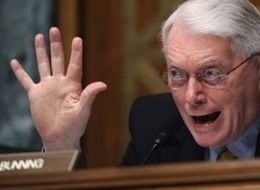
Bunning Objects To Extending Unemployment Insurance AGAIN (VIDEO)

HuffingtonPost

First Posted: 03- 1-10 02:13 PM | Updated: 03- 1-10 03:21 Pm


Sen. Jim Bunning continues to object to extending unemployment benefits. On Monday, the Kentucky Republican once again prevented a vote on a bill that would extend eligibility for enhanced unemployment benefits and subsidized health insurance for laid-off workers by 30 days.
Senate Majority Leader Harry Reid (D-Nev.) asked for unanimous consent to move forward with the bill. If Congress fails to pass an extension, the National Employment Law Project estimates that 1.2 million people will lose their benefits in March.
"Six times last week, Democrats asked to extend their unemployment benefits for a short time while they work on a longer extension," Reid said. "Six times, Republicans said no. They didn't just say no to us, that is members of the Senate. They said no to their families in their own states and all our states count on us to act when we need action. They count on us to respond in the event of an emergency. This is an emergency. The Republicans in the Senate are standing between these families and the help they need while these benefits expire and expired."
Make it seven. After Reid spoke, Bunning raised his objection and blamed the Democrats for failing to extend benefits with an earlier bill that Reid scrapped. He repeated his insistence that the Senate not add an additional $10 billion to the deficit.
"Just a brief explanation of why we are where we're at with this extension bill, the brief extension of 30 days," said Bunning. "There was an agreement between the majority leader of the Finance Committee and the minority leader in the Finance Committee, Sens. Baucus and Grassley, on a three-month extension of these very same provisions. There were more provisions in the bill also. It cost a little more than the the $10 billion that is asked for because it was a three-month extension. Senator Reid pulled that bill from the floor of the U.S. Senate. He did it. The leader of the Democrats pulled that bill from the floor. I support extending unemployment benefits, COBRA benefits, flood insurance, highway bill fix, doc fix, small business loans, distant network television for satellite viewers. If we can't find $10 billion to pay for something that we all support, we will never pay for anything on the floor of this U.S. Senate."
The bill under consideration provides a stop-gap 30 day extension for several other expiring laws, including funding for highway projects that employed 2,000 people until Monday, improved Medicare reimbursement rates (known as "doc fix"), flood insurance, and licensing that allows satellite TV providers to carry local channels in rural areas where they are unavailable with an antenna. Reid said nearly 1.5 million people in rural access would lose access to their local channels today. (DirecTV did not immediately respond to a request for comment.)
Even if Senate Democrats get around Bunning and pass an extension this week, some recipients of unemployment benefits could miss a check. Before last week, workforce agencies in some states were already sending out letters notifying recipients that they would be ineligible for any of the federally-funded "tiers" of additional benefits provided by the stimulus bill. Eligibility for those benefits ended on Feb. 28; the bill under consideration would push the deadline back to April 5.


Bunning showed some anger when ABC News tried to ask him about his objection on Monday. "Excuse me, this is a Senate-only elevator," he said. "Excuse me!"

It apparently didn't happen on camera, but Bunning also reportedly gave an ABC News producer the middle finger.


AP
Senate gridlock triggers cut to doctors

By RICARDO ALONSO-ZALDIVAR (AP) – 3 hours agoWASHINGTON — Political gridlock in the Senate triggered a 21 percent cut in Medicare fees to doctors Monday, as the American Medical Association warned of a "meltdown" for seniors and the Obama administration scrambled to contain the damage.
Funding to temporarily stave off the cuts was part of a bill passed last week by the House. But the Senate failed to act on the one-month fix because Republican Sen. Jim Bunning of Kentucky objected that the $10 billion measure would add to the deficit.
Republican leaders have since pledged to help pass the temporary legislation. The administration, meanwhile, is ordering Medicare billing contractors not to pay any claims from doctors for the first 10 business days of March, hoping the Senate will move swiftly and physicians can be reimbursed in full. Medicare usually pays electronic claims in 14 days.
But Dr. James Rohack, president of the AMA, said the instability is damaging the popular health insurance program for seniors — and is a harbinger of bigger problems, if Congress fails to act this year on a health care overhaul.
The Medicare cuts are the consequence of a 1990s deficit reduction measure that Congress has routinely waived over the years. But every time the cuts are postponed, they only get bigger in percentage terms, making a permanent fix more costly and difficult.
Rohack says the doctor cuts are a prime example of why postponing action won't work when it comes to high medical costs and millions of uninsured.
"From the AMA's standpoint, if Congress does nothing, things are not going to get better by themselves," Rohack said in a recent interview. "They are only going to get worse, and it's only going to become more of a crisis management situation."
Coincidentally, the Medicare cuts come as the doctors' group opens a major issue advocacy conference in Washington this week. Health and Human Services Sec. Kathleen Sebelius is scheduled to address the AMA on Tuesday.


Newsweek
Congress Cuts Medicare Payouts; Medicare Says 'Oh, No You Don't' 
Posted Monday, March 01, 2010 12:10 PM
Mary Carmichael
Let's say an order comes down from the CEO of your company ordering that your salary be drastically cut. You tell your boss you'll have to quit because you can't survive on your meager new paycheck. Your boss says he thinks the pay cut is an atrocity and vows to fight it, but he has done nothing by the time your last full-size check gets written. You're starting to pack up your family photos when suddenly, a miracle: a guy from payroll swoops into your boss's office. "Sir," he says, "don't you want to reconsider this?" Your boss looks thoughtful. "Yeah," he says, "give me 10 more days."
That's essentially what happened in Washington over the weekend regarding the 21.2 percent Medicare pay cut for doctors. Instead of delaying the cut (as it's done every year since 2001, and as the House did late last week), the Senate failed to do anything about it and adjourned for the weekend early. That means the cut technically went into effect today.
But the Centers for Medicare and Medicaid Services, playing the part of the guy from payroll, has stepped in. It's refusing to process any of its biweekly payments to doctors over the next 10 days. That gives the Senate more time to act before the pay cut actually starts hitting doctors' wallets. Maybe it'll use these 10 days to repeal the cut and convince the House to do likewise, making a lot of doctors happy. More likely, it'll just use this brief, artificial reprieve to buy itself even more time.

Why won't Congress just make up its mind about the pay cut, already? "They all say they understand how flawed the formula [that calls for the cut] is," says Lori Heim, president of the American Academy of Family Physicians. But back to our analogy: Even if your boss wants your paycheck to stay the same, the corporate brass may need to cut costs overall. Likewise, even if you think the Medicare pay cut is a horrid idea, it would at least technically do something about the amount the government spends on health care. If the cut goes through, that's $210 billion the government doesn't have to pay out.
That's not fair to doctors, because it effectively pins the blame (and the punishment) for rising health care costs on them. You can certainly argue that doctors who prescribe too much care—whether out of fear of lawsuits or a desire to line their pockets—are responsible for a lot of the increase in health-care costs, as Atul Gawande brilliantly did last year. But not all doctors overprescribe. Yet the Medicare cuts would punish all docs, except those who already refuse to see Medicare patients—and these aren't necessarily the physicians that health-care reform ought to be rewarding.
This week, I have an article in the magazine about increasing the country's ranks of primary-care doctors. Like the flawed pay-cut formula, this is an example of something that everyone claims to agree on. Heim told me that "support for primary care seems to be bipartisan. Congress gets it. The public gets it."
That may be true, but reforming primary care is going to take money. (Yes, better primary care might eventually prevent chronic illness and keep health-care costs down, but first we'll need to provide scholarships to med students, train up more nurses, change the payment system so primary-care docs make more, and so on.) And even Heim balks at the issue of increasing the amount we spend annually on health care. "If we don't address the cost issue now," she says, "we're still going to end up with very expensive medical costs that we can't afford."
That, in a nutshell, is the whole problem with health-care reform, isn't it? The Medicare pay cut may be a small part of the debate, but it turns out to be a microcosm. Everyone agrees that we should fix it; nobody wants to spend a lot of money to make that happen.

Pelosi and the Tea Party 'Share Views'

February 28, 2010 8:15 AM


House Speaker Nancy Pelosi says she has much in common with the Tea Party.   The speaker now says she shares views with movement she dismissed last summer as being “Astroturf” --  her suggestion that the grassroots of the Tea Party were a creation of the Republican Party. 
In a “This Week” interview with ABC’s Elizabeth Vargas, Pelosi said, “We share some of the views of the Tea Partiers in terms of the role of special interest in Washington, D.C., as -- it just has to stop.  And that's why I've fought the special interest, whether it's on energy, whether it's on health insurance, whether it's on pharmaceuticals and the rest.”

Pelosi held to her skepticism about what is behind the movement.  “Some of it is orchestrated from the Republican headquarters,” Pelosi said.  She also added that, “Some of it is hijacking the good intentions of lots of people who share some of our concerns that we have about the role of special interests.”

Watch video HERE:

Read full exchange HERE:

VARGAS: Let's talk a bit about the coming elections in November.  You had recently-- and the Tea Party movement, do you think it will be a force to be reckoned with?  You had said last summer that it was a faux grassroots movement.  You called it the Astroturf movement.

PELOSI: In some respects it is. Uh-huh.

VARGAS: Is the Tea Party movement a force?

PELOSI: No – No what I said at the time is, that they were -- the Republican Party directs a lot of what the Tea Party does, but not everybody in the Tea Party takes direction from the Republican Party.  And so there was a lot of, shall we say, Astroturf, as opposed to grassroots.

But, you know, we share some of the views of the Tea Partiers in terms of the role of special interest in Washington, D.C., as -- it just has to stop.  And that's why I've fought the special interest, whether it's on energy, whether it's on health insurance, whether it's on pharmaceuticals and the rest.

VARGAS: So, common ground with many people in the Tea Party movement.

PELOSI: Well, no, there are some.  There are some because they, again, some of it is orchestrated from the Republican headquarters.  Some of it is hijacking the good intentions of lots of people who share some of our concerns that we have about the role of special interests and many Tea Partiers, not that I speak for them, share the view, whether it's -- and Democrats, Republicans and Independents share the view that the recent Supreme Court decision, which greatly empowers the special interests, is something that they oppose.

Leave of Absence

I will be gone for about a week.  I have two other blogs that I have not worked on since staring this one. If something comes up that I feel important I will blog it. I have a biblical blog I need to pay attention to .  Thank you for your understanding.  I will be back in a week maybe a little longer.
Blurple60

Political Irony Humor and Hypocrisy from the World of Politics

Reforming Health Care Reform

The media has been concentrating on the more lurid and confrontational aspects of the debate over health care reform; for example, the protestors at town halls, including the recent case of a man who had his finger bitten off during a fight (which was itself ironic, since he was against health care reform, but having his finger reattached was paid for by Medicare).
But the reality is that most of the town halls have happened without incident, and even at the ones where there are disruptions, the people being disruptive are a small minority. It turns out that in the area of health care reform, most Americans agree on more things than they disagree on.
Don’t believe me? Watch this video of new Senator Al Franken at the State Fair in Minnesota, confronted by some people who say they are against health care reform. Franken manages to have a civil, intelligent, and substantive discussion about health care in the US, and how we can reform it.


Naturally, this won’t get any attention from the mainstream media.

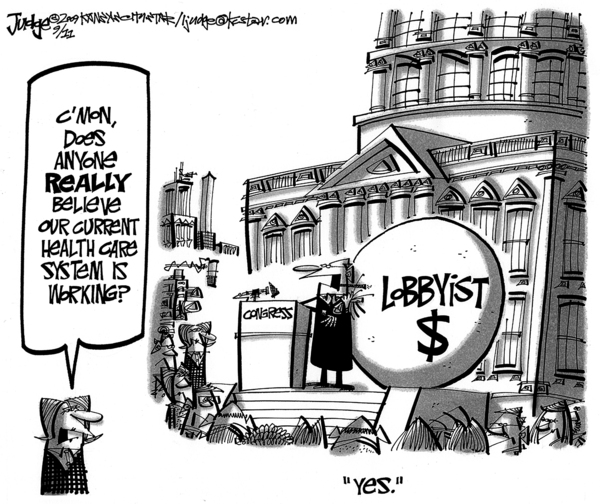
Cute CArtoon

Does Anyone Believe Our Current Health Care System is Working?


Direct student loans: A better way to invest in education


By Arne Duncan
Friday, February 26, 2010 


For too long, bankers have gotten a free ride from the U.S. Department of Education.

Under current law, taxpayers provide as much as $9 billion each year to subsidize guaranteed student loans issued by banks. The banks earn profits on the interest; if students default, taxpayers take the loss, not the banks. In other words, working Americans pay while bankers get rich.

Meanwhile, educators, engineers and computer scientists -- the backbone of the new economy -- face crushing debt from six-figure college tuitions. A study of national postsecondary student aid found that in 2008, two-thirds of college seniors graduated with debt averaging more than $23,000. That number will rise as public and private college tuition costs escalate.


The banks have had plenty of help with government bailouts and other subsidies while working families and students are increasingly squeezed. President Obama wants to eliminate the subsidy for banks and use that money to help poor and middle-class students and adults attend college.


The president also wants to strengthen community colleges, give grants to states that improve college completion rates and boost early-learning programs. He wants to lower maximum monthly payments for student loans from the current 15 percent of income to 10 percent to make college debt more manageable.

Not surprisingly, the banks are working hard to block our common-sense proposal. Sallie Mae, the largest player in the student lending business, has spent millions of dollars to lobby Congress and run ads in several states, claiming that our proposal will cost jobs and inhibit service. These claims must be challenged.

The president's plan actually creates jobs and draws on free-market principles by selecting private companies through a competitive process to service student loans issued directly by the Education Department. These private companies, including Sallie Mae, compete for our business and are evaluated on the quality of their customer service and their default rates.

Loan servicing is a growing industry as more and more Americans pursue college degrees. Under our contract, the high-performing companies will get more business over time while poor-performing companies will get less. The market will play, and students and taxpayers will win.

It's no wonder that the banking industry is pushing back hard to protect its taxpayer subsidy. Over the years, this giveaway has generated billions in profits for banks and hundreds of millions of dollars in compensation for bank executives.

The banking industry's claims that it wants to protect American jobs are also suspect. The fact is, Sallie Mae sent thousands of American loan servicing jobs overseas in 2007 to further increase profits, and it agreed to bring them back last year only to compete for our loan-servicing business.

The Education Department has issued more than $187 billion in student loans since the Direct Loan Program was created in 1993. The number of universities participating in the program has more than doubled, to 2,300, in just the past three years. There is no justification to continue wasteful subsidies to banks. It is time to complete the shift to direct lending.


The president's proposal, which has passed the House and awaits Senate consideration, represents the ideal hybrid of public investment and market-based management. Through direct lending, we get a bigger bang for taxpayer bucks while using competition and private-sector expertise to improve customer service.
The writer is the U.S. secretary of education.